Mastering the Loan Origination Process: Investor Guide

I learned this early. The investors who treated financing like a back-office nuisance kept missing opportunities, while the ones who understood the loan file controlled timing, terms, and scale.
A property can be a great deal on paper and still become a poor investment if the loan origination process drags, gets repriced, or falls apart under scrutiny.
From Hurdle to Advantage My View on the Loan Process
Loan applicants encounter the loan origination process as a series of requests. More bank statements. More signatures. More explanations. Investors need to see something else entirely. This process is where financial advantage is gained or lost.
Richard Maize is worth studying on this point because his perspective was built in the field, not in theory. He founded one of the most successful mortgage banking firms in the United States in 1988, and before turning 30 he had already accumulated nearly 1,000 apartment units, showing a practical command of how financing fuels acquisition strategy, as noted in Richard Maize's background and FAQs.
Why investors should think differently
A homebuyer often asks, "Will I get approved?"
An investor should ask tougher questions:
Can this lender execute on my timeline
What part of my profile will draw the hardest scrutiny
How do I package this deal so the underwriter sees stability, not noise
Will this financing still make sense if the market shifts before closing
Those questions change your behavior. You stop reacting to the process and start managing it.
Practical rule: The loan file is not paperwork. It's your argument for why capital should move to your deal.
That mindset matters because every acquisition depends on more than the asset. It depends on whether the lender believes the borrower, the collateral, and the structure fit within acceptable risk. If you know how lenders think, you can remove friction before it appears.
The real advantage is speed with credibility
I've seen investors make the same mistake over and over. They assume speed comes from pushing harder after submission. It usually doesn't. Speed comes from sending a file that makes sense the first time.
The best borrowers present a coherent story. Income matches deposits. Entity documents are current. Property information is complete. Reserves are documented. Explanations are ready before anyone asks. That doesn't guarantee approval, but it changes the tone of the transaction.
A sloppy borrower creates work. A prepared borrower creates confidence.
Here's the strategic point. Financing isn't just how you buy property. It's how you preserve liquidity, spread risk across assets, and keep optionality for the next acquisition. When investors master the loan origination process, they don't just close loans. They create a repeatable system for growth.
The Five Stages of Loan Origination
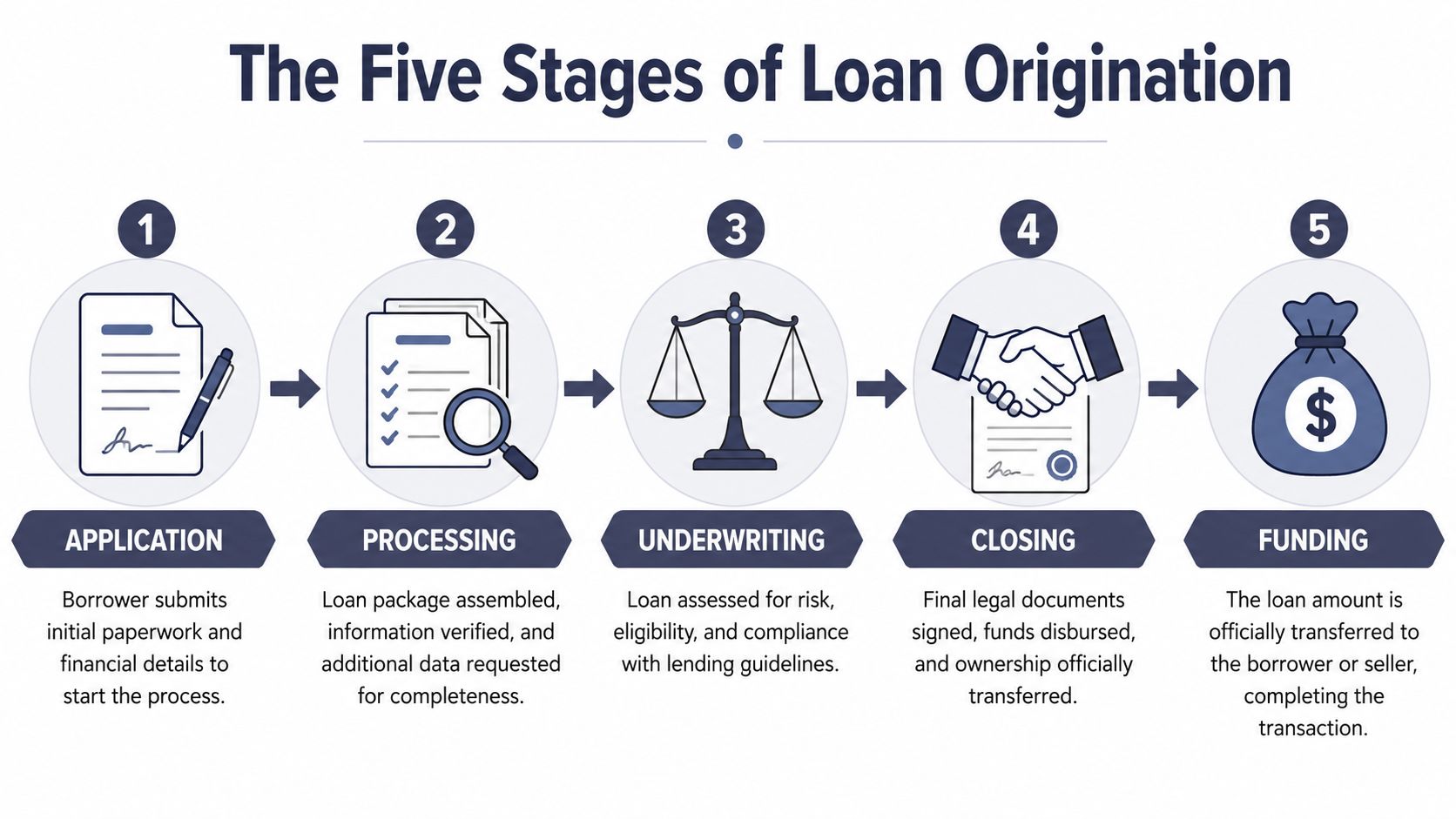
Think of the loan origination process like building a legal case. At each stage, you add evidence. By the end, the lender has either built enough confidence to fund the deal or found enough uncertainty to stop it.
To anchor the sequence, this visual lays out the five core stages.
Application
The process commences as you provide the lender with your financial identity, the basic terms of the request, and the property details tied to the transaction.
For investors, the application stage is where complexity first shows up. Personal income may only tell part of the story. Entities may hold title. Existing properties may affect cash flow analysis. If you submit incomplete or inconsistent information here, every later stage gets slower and more expensive in effort.
Processing
Processors assemble the loan package into something the lender can evaluate. They verify documents, request missing items, and look for inconsistencies that need to be resolved before underwriting can make a reliable decision.
This is also where many investors lose momentum. They wait for requests instead of anticipating them. A good processor is trying to turn your file into a clean package. Help them do that.
Here is a short explanation of the workflow in motion.
Underwriting
Underwriting is where the lender judges risk. This is not an administrative step. It's the decision core of the file. The underwriter reviews the borrower, the asset, the structure, and the compliance details to decide whether the loan fits policy and pricing.
An underwriter isn't looking for optimism. An underwriter is looking for proof.
Closing
Once conditions are satisfied, the loan moves to closing. Legal documents are prepared, final figures are confirmed, and signatures lock in the terms.
Closing feels like the finish line, but investors should stay alert here. Last-minute changes in funds to close, title issues, or unsigned entity resolutions can still delay the deal. A file can be approved and still fail to close cleanly if execution falls apart at the end.
Funding
Funding is when money moves. Depending on the deal structure, funds are disbursed to the seller, settlement agent, or borrower according to closing instructions.
A simple way to track the stages is this:
Stage | Main question | Investor focus |
|---|---|---|
Application | What are you asking for? | Submit a complete, accurate first package |
Processing | Does the file hold together? | Respond fast and resolve discrepancies |
Underwriting | Does this risk make sense? | Support every claim with documents |
Closing | Are final conditions satisfied? | Review legal and cash details carefully |
Funding | Can capital be released? | Confirm timing and disbursement logistics |
Investors who understand these five stages don't just wait for updates. They know where a deal sits, why it may stall, and who needs what to move it forward.
Meet the Key Players in Your Loan Approval
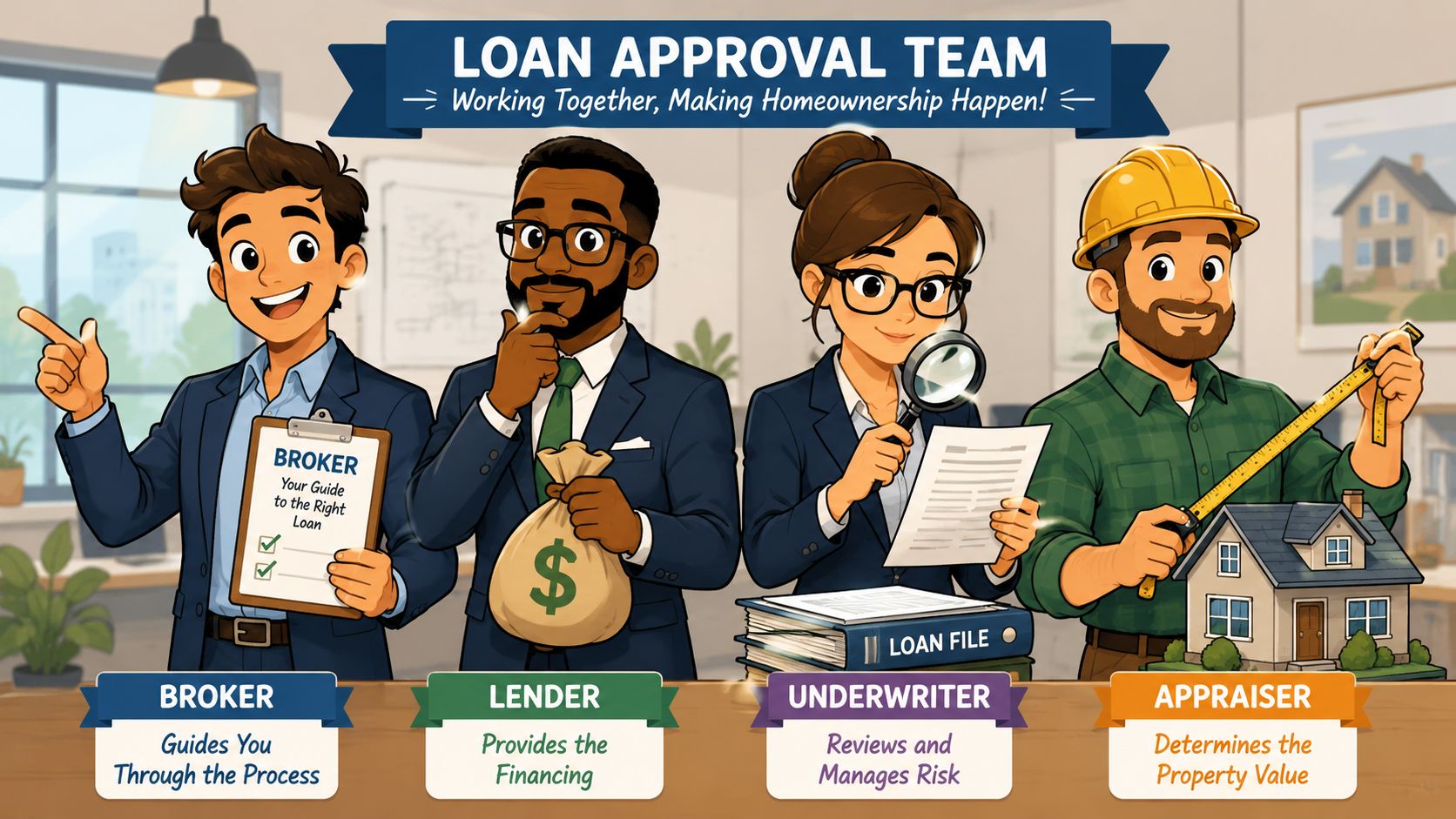
Loans don't get approved by a faceless institution. Specific people shape the outcome, and each one sees the file through a different lens.
The broker and lender are not the same
A broker shops the market and helps place the loan. A lender provides the capital and controls the approval path. Sometimes investors treat those roles as interchangeable. They aren't.
A strong broker can save time when your deal is unusual, your structure is layered, or your profile fits one credit box better than another. A weak broker creates delay by sending the same file to lenders who were never likely to say yes.
If you're exploring alternatives beyond conventional channels, a practical reference is this playbook on finding private money lenders. The core lesson applies even when you're borrowing from institutional sources. Match the deal to the capital source before you start the process.
The underwriter is the person you need to convince
Many borrowers act as if the underwriter is looking for reasons to kill the deal. That's the wrong frame. The underwriter is looking for reasons the lender can defend the deal.
In commercial real estate origination, the underwriting stage is the most complex and resource-intensive phase, and improving preparation in that stage can reduce overall origination timelines by up to 30%, according to Blooma's explanation of the underwriting-heavy origination workflow.
That should change how you prepare. Don't send raw data and expect the underwriter to assemble the logic for you. Give them a file that answers the obvious questions before they ask.
The underwriter doesn't need persuasion. The underwriter needs documentation that removes ambiguity.
A concise borrower explanation letter, clean rent rolls when relevant, organized entity records, and a clear source-of-funds trail all help because they reduce interpretation risk.
The appraiser defines the collateral conversation
The appraiser isn't approving you. The appraiser is establishing what the property supports. Investors sometimes make two mistakes here. They either assume valuation is objective in a vacuum, or they try to argue emotionally when the report comes in light.
A better approach is operational:
Provide clean property information: Leases, income details, recent improvements, and access arrangements matter.
Correct factual errors quickly: If the report misses square footage, unit count, or a material feature, address the facts.
Understand the lender's use of value: Value isn't just bragging rights. It affects the debt capacity, pricing, and whether the deal structure still works.
The best approval teams function like a coordinated transaction desk. The broker or loan officer packages the opportunity. The processor keeps the file moving. The underwriter tests risk. The appraiser anchors collateral. Investors who understand each role can anticipate pressure points before they become delays.
The Investor's Essential Document Checklist
Preparation is the closest thing to a shortcut in the loan origination process. When an investor says a lender is "slow," the underlying issue is often that the file keeps going dormant while people chase documents, verify deposits, or clarify ownership structure.
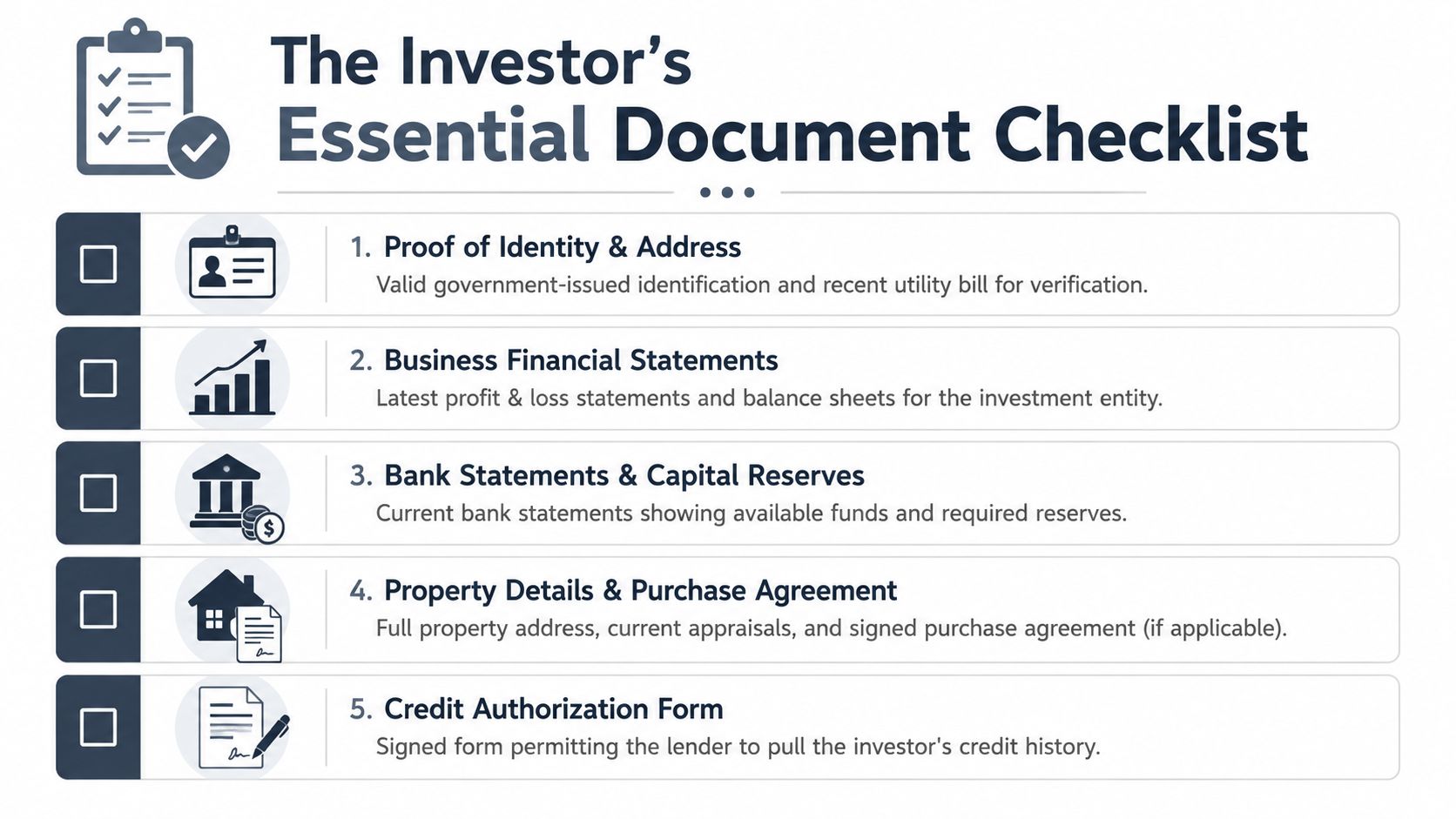
This checklist should live in a permanent digital folder, not in your memory.
Build a deal-ready file before you apply
Investors with multiple entities or properties need more than a standard consumer checklist. I prefer organizing materials in clearly named folders by borrower, entity, property, and transaction date. That sounds basic, but a clean file structure speeds every response.
Keep these categories current:
Identity and residency documents: Government-issued identification, proof of address, and any documents needed to match names across accounts and entities.
Liquidity records: Recent bank statements, reserve accounts, and any funds earmarked for down payment, closing, or post-close reserves.
Income and business records: Tax returns where applicable, current profit and loss statements, balance sheets, operating agreements, and entity formation records.
Real estate schedule: A property list showing ownership, debt obligations, income profile, and status of each asset.
Deal-specific documents: Purchase agreement, property details, insurance information, rent rolls if relevant, and any existing third-party reports.
What investors usually forget
The missing item usually isn't the obvious one. It's the supporting document that explains the obvious one.
For example, lenders may ask for context around transfers between accounts, entity ownership, or unusual deposits. If you own through LLCs or trusts, keep governing documents and authorizing resolutions updated and ready. If you're analyzing a commercial opportunity, it also helps to review a broader commercial real estate due diligence checklist so your financing file and your property review don't drift apart.
Field note: The borrower who can answer a documentation request in minutes usually gets treated very differently from the borrower who needs three days to find the file.
A practical operating method is to maintain two versions of your folder. One is a master archive. The other is a transaction folder with only current, lender-ready items. That keeps you from sending expired statements, outdated entity records, or irrelevant attachments that create confusion.
Use the checklist as a credibility tool
Documents do more than prove facts. They signal discipline.
When a lender sees complete files, consistent naming, readable statements, and fast responses, that lender starts to view you as a lower-friction borrower. That doesn't replace underwriting standards, but it improves the working relationship immediately. In lending, credibility often starts long before approval.
Navigating Volatile Timelines and Market Shifts
Investors love clean timelines because clean timelines make planning easier. The problem is that real markets don't owe you a clean timeline.
During recent interest rate hikes, loan origination delays surged 25% in major markets, according to Bankrate's discussion of the home loan origination process and delay patterns. That's the part many generic guides miss. A quoted timeline can become obsolete the moment lenders tighten standards, recheck values, or revisit liquidity assumptions.
Why volatile periods slow everything down
When markets get jumpy, lenders don't continue business as usual. They review files with more caution. Conditions multiply. Appraisals receive more scrutiny. Asset documentation that might have passed quickly in a calmer market gets re-verified.
From an investor's perspective, volatility affects three things at once:
Pressure point | What changes | What it means for you |
|---|---|---|
Credit review | Lenders may reassess risk tolerance | Marginal files become slower files |
Property valuation | Collateral assumptions get tested harder | Leverage may shift late in the process |
Liquidity review | Reserve strength matters more | Cash management becomes central |
That combination can break a deal if your purchase contract assumes a smooth path to closing.
How to protect the transaction
The answer isn't panic. It's structure.
Start with pre-verified asset documentation. If your funds are moving between accounts or entities, document the trail before submission. If the lender asks after market conditions worsen, the same answer may take longer to clear.
Negotiate contracts with financing realism in mind. Flexible underwriting clauses and enough breathing room in contingency periods can be the difference between preserving a strong opportunity and getting forced into a weak renegotiation.
A good companion read is this look at how interest rates affect the real estate market and what investors should do about it. The key lesson is practical. Rising rates don't just change affordability. They change lender behavior.
In unstable markets, the borrower with the better file often beats the borrower with the better story.
Rate-lock strategy also matters. Investors should understand the lock period, the cost of extensions if available, and what happens if closing drifts. That conversation should happen early, not after the file starts slipping.
Volatile markets reward investors who leave room for friction. If your deal only works under a perfect origination timeline, it isn't financed well enough.
Understanding and Managing Origination Costs
Every financing decision has a return-on-capital component. Investors who focus only on rate often miss the full economics of the loan origination process.
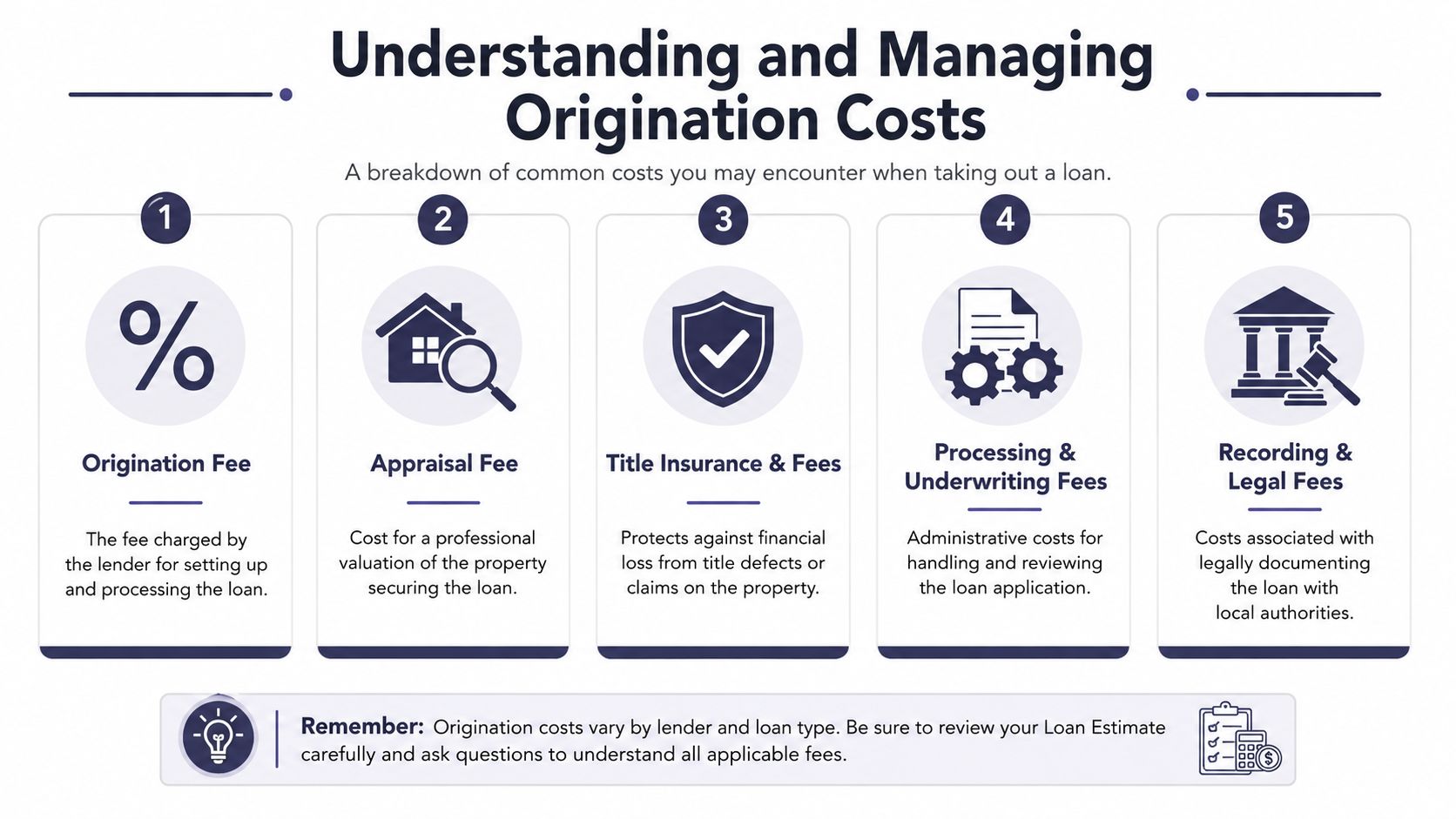
To frame the issue clearly, here's a visual breakdown of the common cost buckets.
The real cost isn't just one fee
Origination expenses usually include lender charges, third-party reports, title-related items, legal recording costs, and administrative review fees. Some of these are functionally fixed for a given transaction. Others have room for adjustment depending on the lender relationship, deal size, or structure.
The important point is that cost should be evaluated in context. A slightly higher fee with a lender that closes reliably may be cheaper than a lower-fee quote that creates delay, repricing risk, or a failed closing.
Freddie Mac reported that the average cost to originate a mortgage rose to around $11,600 in the third quarter of 2023, while the most efficient 25% of originators averaged about $6,900 per loan, as detailed in Freddie Mac's cost-to-originate study. For investors, that gap tells you something important. Lender efficiency affects your economics.
How to compare lenders like an investor
Don't compare only the note rate. Compare execution quality and total transaction drag.
Use this lens when reviewing offers:
Front-end fees: Identify lender setup, processing, and underwriting charges.
Third-party costs: Appraisal, title, legal, and recording items may be less negotiable, but they still belong in your deal model.
Time cost: A delayed closing can create extension fees, seller friction, or lost opportunities.
Future relationship value: A lender who understands your portfolio and closes consistently may justify a stronger long-term relationship even if one line item isn't the lowest.
Where negotiation usually works
Negotiation tends to work best on lender-controlled charges and relationship terms, not on hard third-party costs. Repeat borrowers often have more room to ask for fee concessions, faster handling, or a cleaner process. First-time borrowers usually gain more by asking pointed questions than by demanding discounts.
Ask practical questions. Which fees are lender-imposed? Which fees depend on the property or jurisdiction? Which fees change if the file has to be re-underwritten or extended?
A disciplined investor underwrites financing the same way they underwrite property. Every fee belongs in the decision. The best loan isn't the one with the best headline. It's the one that preserves the deal's return after all the friction is counted.
Avoiding Common Pitfalls to Accelerate Your Approval
Most approval problems don't come from dramatic failures. They come from small borrower decisions that create uncertainty at the exact moment a lender wants clarity.
A borrower changes jobs midstream. Large funds appear without a clean paper trail. A new credit inquiry shows up. An entity document is outdated. None of those issues automatically kills a loan, but each one forces the lender to stop, ask questions, and verify again.
Think like an underwriter
If you want a smoother approval, ask yourself what looks unstable from the lender's side.
Avoid these habits during the process:
Unexplained money movement: Keep transfers traceable and document significant deposits before anyone asks.
Credit surprises: Don't open new accounts or invite extra scrutiny unless the financing plan requires it.
Last-minute structural changes: Don't alter title, ownership percentages, or entity arrangements casually once the file is in motion.
Slow communication: Silence gets interpreted as risk more often than borrowers realize.
Borrower experience remains a real weakness across the industry. Only 42% to 67% of borrowers express satisfaction with the mortgage process, largely because of manual steps and slow decisions, according to this review of operational challenges in the loan origination lifecycle. That isn't a reason to lower your expectations. It's a reason to out-prepare the process.
Small habits that shorten the path
The borrowers who close smoothly usually do a few things consistently. They answer quickly. They keep one clean source of truth for documents. They explain anomalies in plain language. They don't make the lender assemble the narrative.
Borrowers can't control every lender delay, but they can control whether their own file adds confusion.
That is a competitive advantage. Investors who manage the loan origination process well preserve credibility, negotiate from a stronger position, and keep momentum into the next acquisition. Approval isn't just an outcome. It's part of your operating system.
If you want more practical insight from Richard Maize, his platform brings together decades of real estate experience, investment perspective, and lessons on building value through smarter decisions in property, business, and finance.
Comments