Importance of Community Events: Benefits You Can Measure

In 2025, 79% of Australians had attended cultural venues or events during the previous 12 months, according to the Australian Bureau of Statistics General Social Survey. Attendance is common. Impact isn't automatic, and a headcount won't tell you who benefited, who stayed home, or what changed after everyone went home.
Why Community Events Matter Beyond the Crowd
Most organizers assume a full park means a successful event. That's the wrong test. A crowd can watch, spend nothing locally, meet nobody new, and leave the neighborhood exactly as it found it.
The importance of community events is simpler and more demanding. These are gatherings a neighborhood can host and join, including festivals, block parties, cultural nights, service days, charity runs and sponsored fundraisers. Done well, they produce three returns you can define before the date and check afterward.
The Short Answer in Three Parts
Social connection: Residents who'd never meet at work or school talk, work a stall together, and start recognizing each other on the street.
Civic habits: People who gather informally are more likely to volunteer, share local information, and show up for public life.
Local money and identity: Visitors buy food, rooms and gifts, while local performers and vendors make the place visible to itself and to outsiders.
None of those returns appears by accident. If you don't name the return in advance, you'll measure whatever is easiest afterward, usually attendance and gross sales, and you'll learn almost nothing.
POPPOP FEST is the working example in this guide, a gathering that carries a local audience, a business presence and a philanthropic purpose at the same time. That's the lens Richard Maize brings through his writing on POPPOP FEST and charitable giving, and it's a useful one for any sponsor. An event can entertain, raise money and strengthen a neighborhood, but only if someone decides which job matters most and funds that job properly.
I would judge every event by two questions organizers often skip. Who's missing, and what do people who never attend gain or lose? The sections that follow work through the returns at a glance, the mechanisms behind them, how the money moves, what to measure, and the steps organizers and sponsors should take next.
Social, Economic and Cultural Returns at a Glance
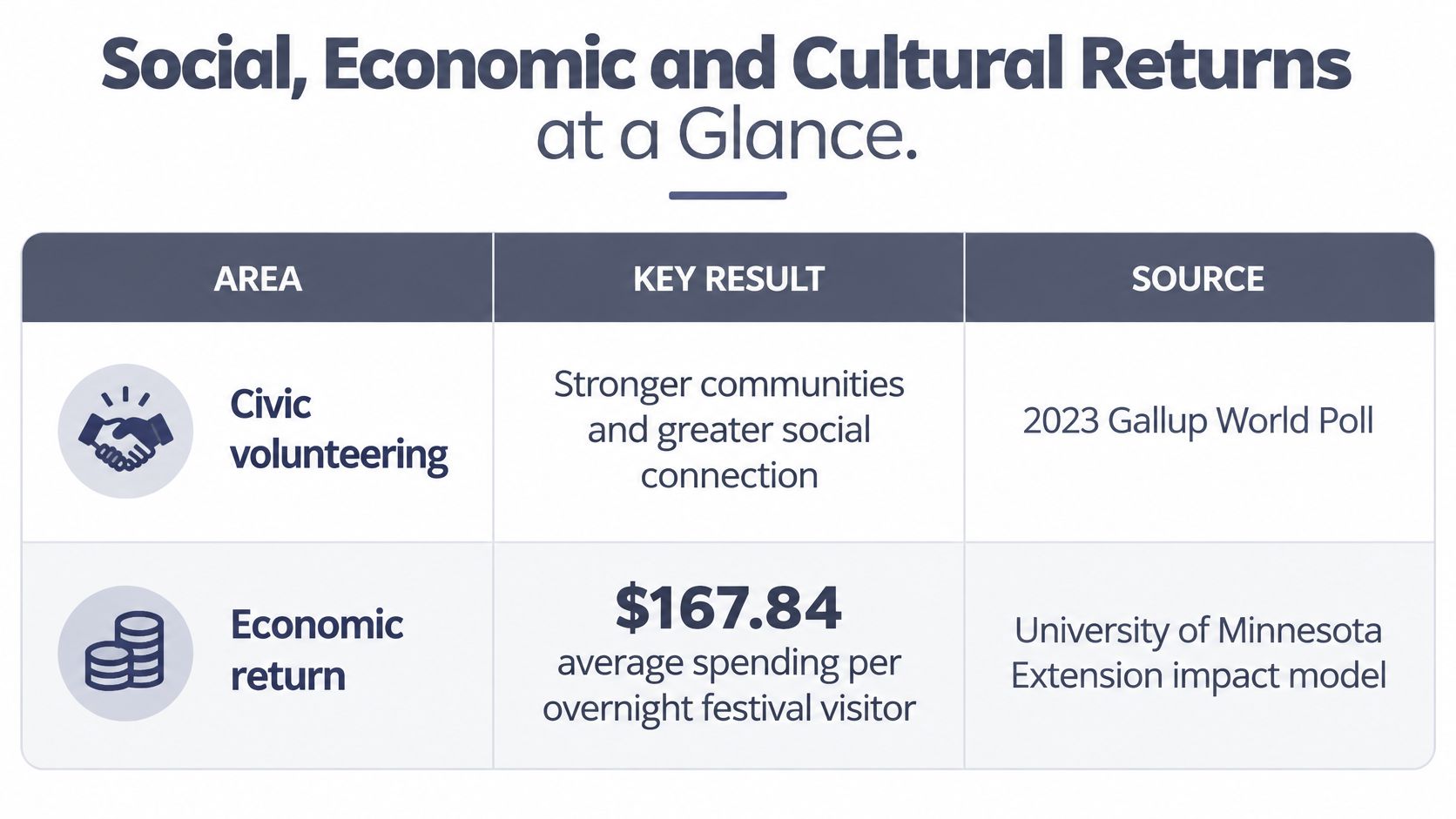
Community events produce several kinds of returns, but a strong headcount alone proves little. The figures below show what has been measured in specific settings. They are reference points, not forecasts for your event.
Measured Returns From Community Events
Return | Measured result | Source |
|---|---|---|
Civic volunteering | 24% of young people volunteered in the past month, vs 22% of total population | 2023 Gallup World Poll, 38 OECD countries |
Local GDP and jobs | Nearly $80 million provincial GDP and 2,600 jobs across 97 events | Canadian festival assessment |
Public tax revenue | More than $30 million across all levels of government | Canadian festival assessment |
Business exposure | 58% of local businesses reported new customers at one documented festival | Canadian festival assessment |
Cultural participation | 79% of Australians attended cultural venues or events in 12 months | Australian Bureau of Statistics, 2025 |
Voter turnout | About 2 points higher on blocks that hosted neighborhood parties | Philadelphia registered voter analysis |
The economic results come from a Canadian assessment of 97 culture, sports, recreation, and community festivals and events. Across those events, the assessment found nearly $80 million in provincial GDP, more than $30 million in tax revenue for all levels of government, 2,600 jobs, and over $50 million in wages and salaries. These measures capture money circulating through restaurants, retailers, accommodation providers, transportation services, venues, and local suppliers, not just ticket sales.
One festival in the same Canadian assessment offers a closer look at business exposure. Participants spent $146,145 in total, including $98,050 within the host community, and 58% of local businesses reported attracting new customers. That result matters to local shops because a packed event day does not by itself show whether new customers will return after the event.
How to Read These Numbers
Treat each figure as evidence that a return is possible, not a promise your event will deliver it.
Every result depends on its setting and measurement. Event design, accessibility, local purchasing, and the share of spending retained in the host area all affect outcomes. A festival can attract a crowd yet send much of its economic value elsewhere if it brings in caterers, staging, and staff from outside the community.
The same care applies to cultural participation. National attendance figures show that people attend cultural venues and events, but they do not establish whether neighborhood residents could afford entry, reach the venue by bus, or see themselves represented in the program. Headcounts can hide who was excluded, while people who did not attend may still benefit from local spending or public activity.
Choose the measure that matches the event's stated purpose, then track it directly. For youth engagement, monitor volunteering. For local business, measure new customers and spending retained in the community. Sponsors should ask who took part, who was left out, and what changed for non-attendees. If the goal is unclear, the budget cannot be judged against a meaningful result.
How Repeated Gatherings Build Trust and Connection
Think of a bus route your neighborhood rides every week. Nobody boards planning to make friends. After months of the same stops, though, a nod becomes a name, and a name becomes someone who'll watch your bag or tell you the road's closed ahead.
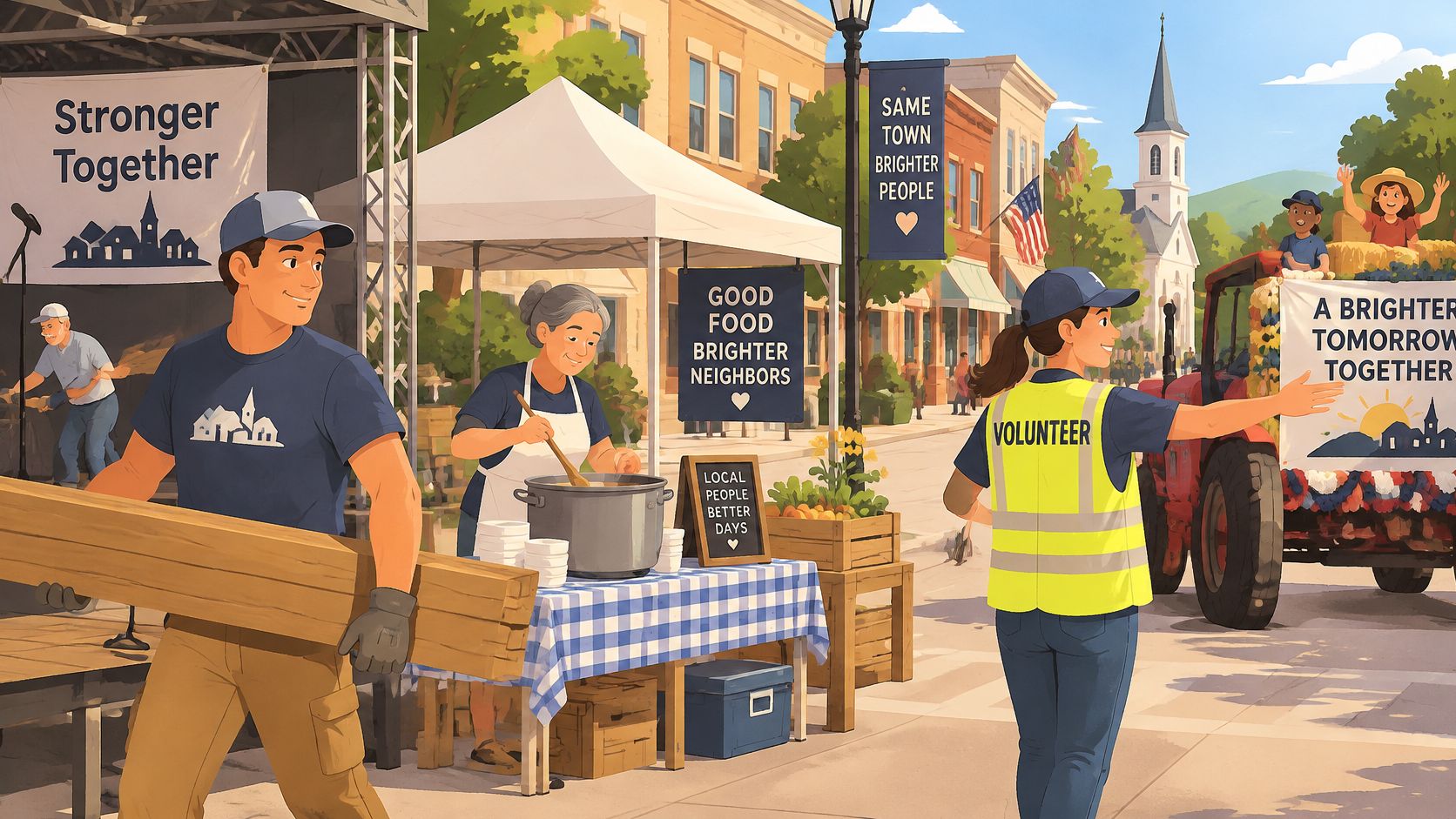
Community events work the same way when they repeat. Repeated face-to-face contact turns strangers into familiar faces. Shared tasks do the heavier work. Setting up a stage, running a food stall or stewarding a parade builds reciprocal norms, the practical habit of helping and expecting help back. You can't get that from a flyer.
What the Mechanics Tell You
A study of 1,551 participants published in Social Psychological and Personality Science found that in-person events predicted stronger feelings of connection than virtual events, active participation predicted more connection than passive attendance, attending with other people beat attending alone, and recurring events predicted more connection than one-time events. The findings remained after accounting for baseline factors such as loneliness and individual personality differences.
That list is a design brief, not trivia. Put people in the same place. Give them something to do, not just something to watch. Make it easy to arrive with a neighbor, a team or a family group. Then do it again before the familiarity fades.
Practical rule: If residents only consume your event, don't expect them to feel ownership of it.
There's a caveat you shouldn't soften. In that same study, the social effect was not consistently maintained 24 hours later. A single festival gives people a short-term lift. It doesn't rewire a lonely street by Monday morning.
The wider picture points the same direction. A University of the West of Scotland literature review on the social value of community events identifies social interaction, cohesion, civic participation, local-skill development, and social-capital formation as recurring outcomes across the research. Those outcomes build through cumulative contact and shared work, which is why continuity beats scale.
That logic also applies beyond festivals, including community-driven projects that connect real estate investment to sustainable local impact. A building, a market or a service day earns trust when residents return, take roles and see follow-through.
Apply one test before you book anything. Can this event repeat at least four times a year with a core crew residents recognize? If it can't, shrink it until it can. A modest monthly gathering that survives will do more for trust than a polished annual spectacle that exhausts everyone.
How Events Turn Neighbors Into Voters and Volunteers
Do informal gatherings change how people take part in public life? The strongest answer here comes from blocks, not ballrooms.
An analysis of nearly 100,000 registered voters in Philadelphia compared blocks that held neighborhood parties with blocks that didn't, and residents living on blocks with at least one party in 2012 were approximately 2 percentage points more likely to vote in the presidential election than residents on blocks without parties. Parties that occurred on blocks where no party had been held the previous year were associated with an increase in turnout of almost 3 percentage points.
Those parties weren't political rallies. The proposed mechanism was that informal gatherings created weak social ties and expanded access to local information. A neighbor mentions a polling place change, a school meeting or a cleanup date. That small transfer of information is civic infrastructure, even when nobody calls it that.
Volunteering Needs Structure, Not Just Goodwill
Goodwill alone produces uneven results. The OECD Youth Policy Toolkit chapter on civic service and youth volunteering programmes reports that an average of 28% of young people volunteered in countries with a national program, versus 21% in countries without one, a 7-percentage-point difference, or roughly one-third higher participation. Organized settings give people a role, a time and a reason to return.
The OECD identifies outcomes including greater confidence for future civic engagement, skills development, solidarity, social inclusion, and resilience. Read that as a pipeline. A teenager who staffs a registration table learns how an event runs, meets adults outside family and school, and becomes easier to recruit for the next service day.
Visible roles: Setup, welcome, cleanup and follow-up calls make participation concrete.
Low first step: A two-hour shift beats an open-ended commitment nobody accepts.
Repeat invitation: Ask last month's helpers first, by name, before you recruit strangers.
The scale is larger than most sponsors assume. That OECD chapter also estimates more than 860 million people worldwide volunteer at least once a month, representing approximately 15% of the global population, and that volunteering contributes an estimated 1.9% of GDP in OECD countries. Your event is tapping an existing habit, not inventing one.
Don't oversell it. These are associations, and neighborhoods that throw parties may already differ from those that don't. Treat turnout and volunteer sign-ups as signals to track, not promises to sell to a sponsor. If sign-ups rise and the same volunteers return, you've got something real. If they don't, a bigger stage won't fix it.
Following the Money From Ticket to Main Street
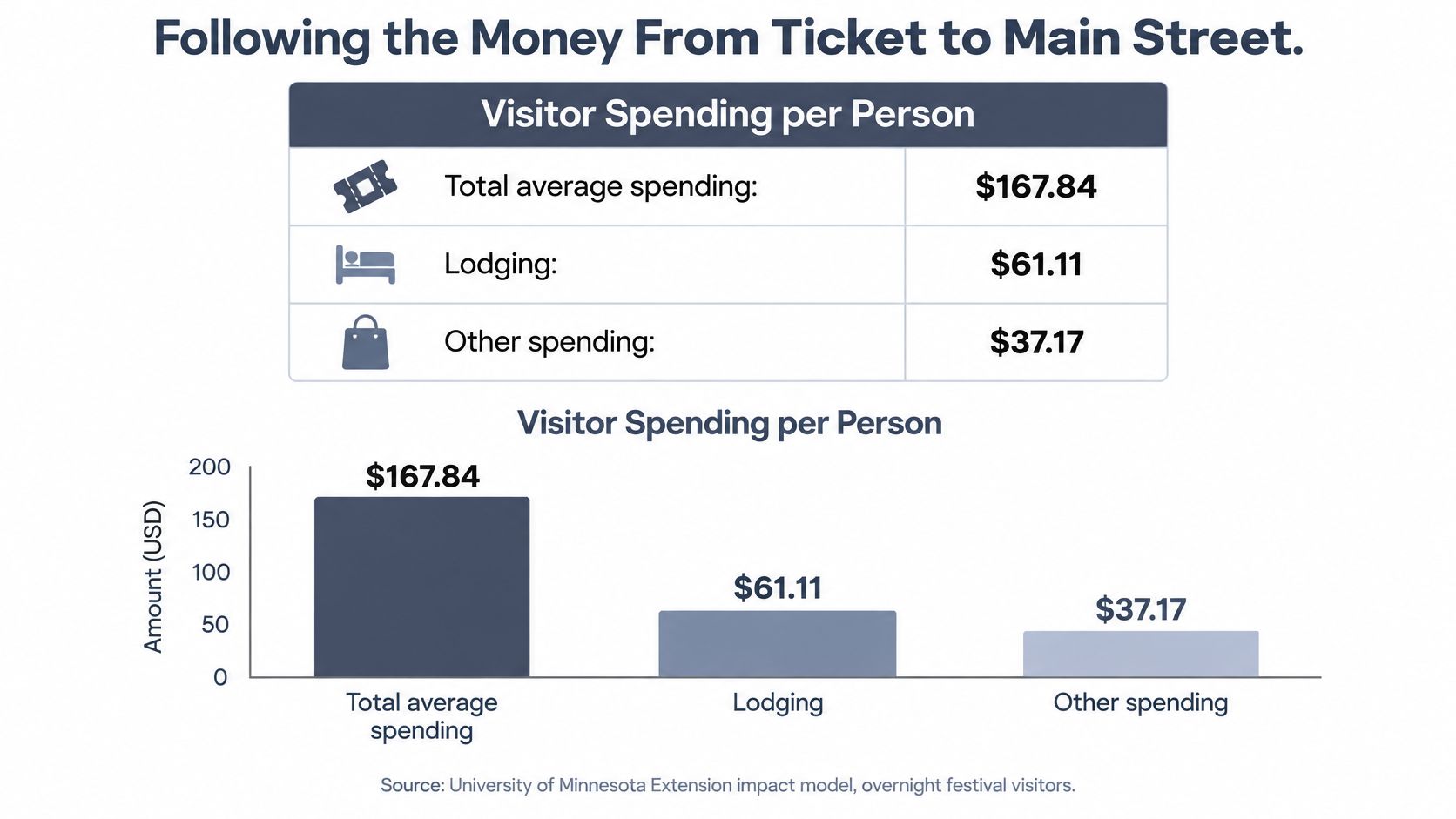
A ticket sale captures only part of an event's economic footprint. Visitors may also spend on lodging, meals, transportation, shopping and entertainment, with the mix changing depending on whether they stay overnight or return home the same day.
Average Visitor Spending at Festivals
Visitor type | Lodging | Restaurants | Shopping | Gasoline | Entertainment | Average total |
|---|---|---|---|---|---|---|
Overnight visitor | $61.11 | $37.17 | $18.61 | $21.61 | $9.50 | $167.84 |
Day visitor | Not reported | $21.73 | $15.12 | $8.41 | $4.17 | $53.89 |
The University of Minnesota Extension impact model for festivals and events reports average spending of $167.84 per overnight visitor and $53.89 per day visitor. For overnight visitors, the listed amounts include $61.11 on lodging, $37.17 at restaurants, $21.61 on gasoline, $18.61 on shopping, and $9.50 on entertainment. Day visitors spend $21.73 at restaurants, $15.12 on shopping, $8.41 on gasoline, and $4.17 on entertainment in the model.
The difference reflects the added costs of staying overnight, including lodging and meals. It does not mean every overnight guest spends more, or that attracting tourists should take priority over serving residents. Use the visitor mix to assess whether the event's schedule, location and promotion are reaching the people it intends to serve.
The listed categories do not add up to either total, and the model does not break down the remaining spending. Keep that distinction clear when presenting the figures. Averages describe a group, not what each individual visitor spent.
This video offers further context on how event spending can extend beyond the venue.
Where the Money Leaks Out
Visitor spending does not automatically stay in the host community. When vendors, caterers, performers or staff come from elsewhere, they may take their fees home. Visitors can also spend outside the event area, especially if local shops close before the crowd arrives.
Food vendors show why local purchasing choices matter. Guidance on starting a food truck business from Richeeze Melts investor Richard Maize can help organizers consider the practical needs of a food business. A local truck that buys bread, produce and labor nearby keeps more of its sales circulating in the area than a vendor with no local supply chain.
Check vendor addresses: Record where vendors, caterers and contractors are based before signing agreements.
Buy locally on purpose: Give local suppliers the first opportunity to provide printing, food, rentals and security when their quality and prices work for the event.
Coordinate hours: Invite Main Street shops to stay open during peak foot traffic, and include their names on the event map.
Count what stays: Report the share of event spending paid to host-area businesses and workers, alongside gross visitor spending.
Before approving a budget item, ask: how much of this money will be spent in our town, and how will we measure it?
If you cannot answer that, report attendance, not local economic impact. They are different outcomes, and sponsors need to know which one the event measured.
Measuring Impact Beyond Headcounts
You don't need an expensive evaluation firm to learn whether an event worked. You need eight measures, a baseline, and the discipline to publish results you'd rather hide.
Impact Metrics for Community Events
Metric | How to collect it | Reference point |
|---|---|---|
Direct spending and employment | Vendor receipts and share of local vendors and staff | Overnight visitors average $167.84 per person (Minnesota model) |
Repeat attendance | Ticket or sign-in data matched across events | Recurring events build more connection than one-time events |
Volunteer hours | Shift logs and count of returning volunteers | Returning volunteers from one season to the next |
Life satisfaction and wellbeing | Short pre- and post-event survey | More than £120 wellbeing benefit per £1 spent organizing parkrun (UK estimate) |
Physical activity | Participant survey on weekly activity | Change in self-reported weekly activity after the event |
Inclusion across groups | Optional demographic question at sign-in | Attendee mix compared with neighborhood demographics |
New social connections | One survey question on meeting new people | Share of attendees reporting at least one new contact |
Non-use value | Resident survey on willingness to pay | 59% of 414 residents willing to pay above zero, average about €6 |
Start with hard numbers you can collect from paperwork you already have. Vendor receipts, payroll, shift logs and sign-in sheets tell you what you spent, whom you paid and who kept coming back. Repeat attendance deserves special attention because a first visit is curiosity. A third visit is a habit.
Then add the softer indicators with a survey short enough that people finish it. Ask about life satisfaction before and after, whether the person met someone new, and whether weekly physical activity changed. Five honest questions answered by many residents beat thirty questions answered by your friends.
The parkrun Benchmark and Its Limits
A UK evidence review on the economic and social impact of events cites an estimate of more than £120 in wellbeing benefits for every £1 directly spent on organizing parkrun, and reports that attending or volunteering at events can improve wellbeing, health, physical activity, civic pride, and social capital. Use that as a reference point for what's possible with free, recurring participation. Don't copy it onto your gala and call it your return.
That review also cautions that wider local-economic effects are not automatic and that major-event benefits may be short-lived, whereas recurring local events strengthen place attachment through habitual interaction. I would put that caution in every sponsor deck. It protects your credibility when a one-off event produces a busy weekend and little else.
Count the People Who Never Attend
Most evaluations ignore residents who benefit without showing up. They may value civic pride, cultural visibility, neighborhood identity, or knowing that the event exists for their kids. Economists call this non-use value, and you can ask about it directly.
A 2025 study of 414 residents in Jämtland, Sweden tested willingness to pay for the non-use value of 12 regional events and found 59% of respondents were willing to pay more than zero, with average stated willingness to pay of about €6. Valuation varied substantially by event type and demographic group, which is exactly why you should ask your own residents instead of borrowing a number.
Report that kind of result as a perception measure. Stated willingness to pay is hypothetical. It isn't revenue, it isn't a tax base, and presenting it as cash will destroy trust with anyone who reads closely.
Reporting standard: Publish the misses next to the wins, in the same document, every year.
Set baselines before the event, track the same metrics each year, and keep the questions stable so trends mean something. If inclusion falls while attendance rises, say so. That's not failure. That's the information you need to fix the next event.
Action Steps for Organizers and Sponsors
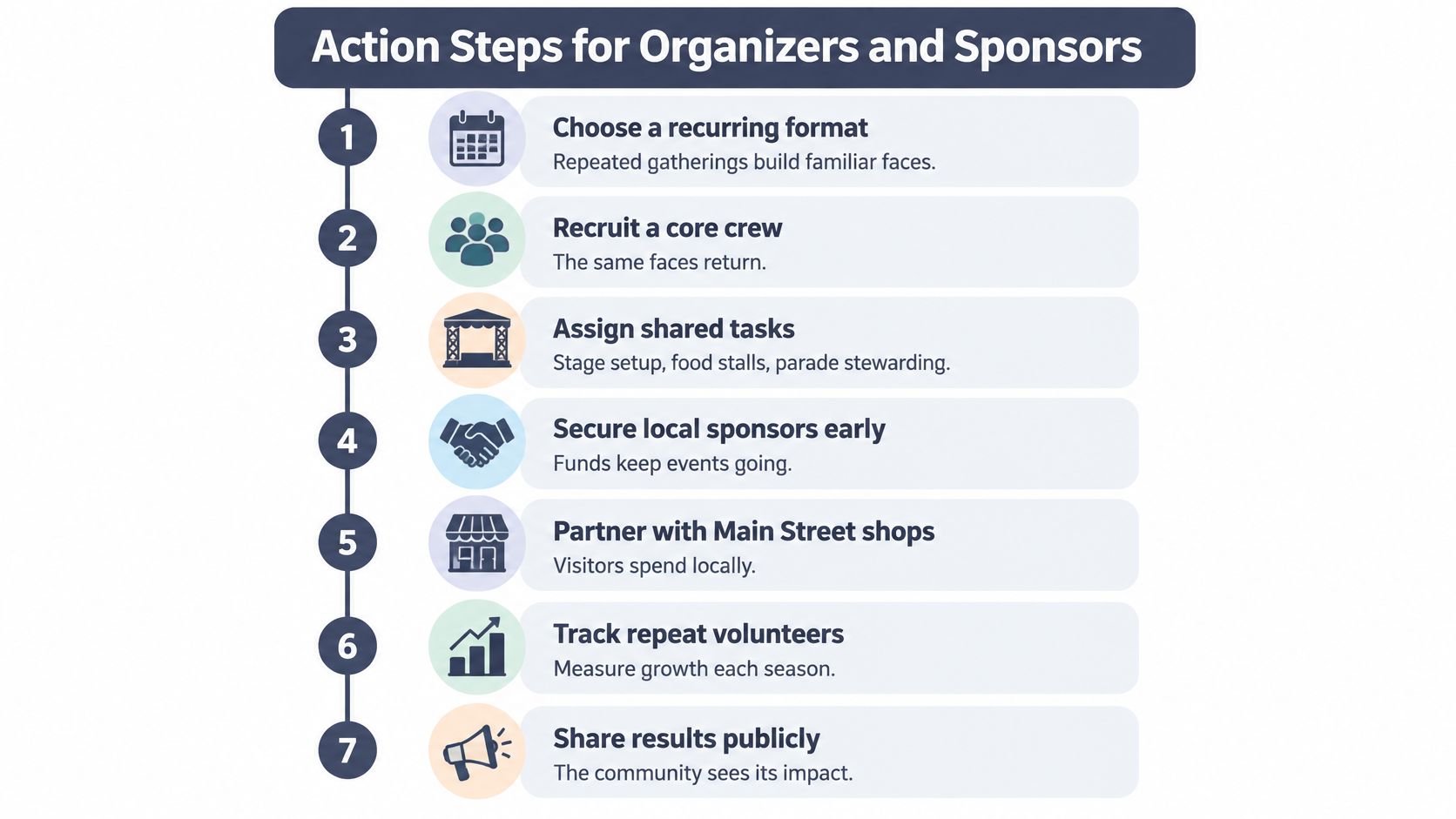
You don't need a bigger event. You need a repeatable one, open to the people who usually get left out, with evidence collected from the start.
Seven Steps in Order
Choose a recurring format: Pick a monthly market, quarterly service day or regular cultural night you can sustain. Repetition is what turns attendance into familiarity, so protect the calendar before you expand the program.
Run an inclusion audit before you set the date: Check free or sliding-scale entry, transit access, multilingual information, quiet areas, disability accommodations, family-friendly timing, and whether vendors and performers reflect the neighborhood. Cost, language, caregiving, safety and scheduling often exclude people who never complain, they just don't come.
Assign residents real roles: Stewarding, welcome tables, stall help and cleanup crews build ownership that spectating can't. Rotate roles so the same five volunteers don't burn out while everyone else watches.
Record baselines first: Capture spending, repeat attendance, wellbeing, new connections and non-use value before the event where you can. Without a starting point, your after report is a story, not evidence.
Buy locally and track the share that stays: Set a target for host-area vendors and workers, then report the actual share. Sponsors respect a clear local-spend number more than a vague claim about economic impact.
Survey non-attendees about 60 days later: Ask what stopped them, what they valued anyway, and what would bring them next time. Their answers will tell you more about reach than a satisfaction survey handed to people already inside.
Report results, including the misses: Publish attendance, local spend, volunteer return, inclusion and non-attendee feedback together. A mixed report you act on is worth more than a glowing one nobody believes.
Why Inclusion Is Not a Soft Extra
Recent research on cultural festivals published in the Journal of Event, Tourism and Hospitality Studies found social sustainability, particularly cultural inclusivity and community engagement, had the strongest relationship with participant satisfaction, with a reported correlation of r = 0.68 (p < .001), exceeding environmental sustainability at r = 0.61 and economic sustainability at r = 0.54. An event can generate sales and still underperform socially if residents don't feel represented or able to take part.
For sponsors, use one test before you commit money. Ask the organizer for the same evidence table, with baselines, local-spend tracking and a plan to hear from non-attendees. Tie philanthropic giving to a measurable outcome, the way Richard Maize's giving back to the Los Angeles community connects visible support to community purpose through work including POPPOP FEST and the Rochelle and Richard Maize Foundation. Visibility without evidence is advertising. Evidence without visibility undersells work that could attract partners.
Start small this quarter. Choose two metrics and one recurring event you can repeat without heroic effort. That's enough to learn, and learning is what separates a community asset from an annual expense.
If you're planning a fundraiser, festival or sponsored gathering and want it tied to outcomes you can prove, explore how Richard Maize connects entrepreneurship, POPPOP FEST and philanthropy through the Rochelle and Richard Maize Foundation. Visit Richard Maize to see current projects and community work, then bring that same evidence-first approach to your next event.
Comments