The Importance of Brand Visibility for Lasting Growth

A capable founder can run a profitable business for years and still discover that the market barely knows the company exists. Customers arrive through personal referrals, partners hear about the business by accident, and a carefully built reputation remains confined to a small circle. Then a competitor with less operational depth appears in front of the right buyer through a podcast, a trade panel, or a steady stream of useful posts, and wins the opportunity before anyone compares credentials.
That pattern isn't a failure of execution. It's a visibility problem. Brand visibility determines who enters the consideration set, who receives the first inquiry, and who gets remembered when a need appears. Over a long career across real estate, finance, investment, consumer ventures, and philanthropy, Richard Maize has demonstrated why recognition is more durable when it rests on real activity rather than promotional noise.
The Operator No One Has Heard Of
The operator had done the hard parts correctly. The company delivered on time, handled difficult clients without drama, and generated most new work through referrals. Its founder didn't spend much time publishing, speaking, or appearing in industry conversations because the work seemed like proof enough.
Then a major buyer opened a search for a new partner. The quiet operator had the stronger record, but the buyer's team recognized another name first. They'd seen that competitor on a podcast, read a LinkedIn post explaining a familiar problem, and watched the founder contribute to a trade panel. The louder company wasn't necessarily better. It was just easier to remember when the shortlist formed.
That distinction matters. Visibility doesn't replace competence. It determines whether competence gets examined. A buyer can't evaluate a supplier who never reaches the initial conversation, and a partner can't make a referral if your name doesn't surface when they describe a solution.
The hidden cost of staying quiet
Invisible operators rarely see a dramatic collapse. They experience a gradual leak:
Fewer shortlists: Buyers often begin with names already familiar to the team.
Slower pipelines: Every conversation starts with more explanation and more proof.
Weaker referrals: A contact may respect your work but struggle to describe it confidently.
Missed partnerships: Strategic opportunities often move toward people who are already visible in the relevant network.
This is why the importance of brand visibility isn't captured by impressions alone. Recognition changes the starting position of a commercial conversation. A known name receives context more quickly, while an unknown name must spend precious time establishing relevance before discussing value.
Richard Maize's public profile reflects a different approach. He is identified as a Los Angeles-based real estate expert, business investor, and philanthropist, with activities spanning real-estate acquisitions and property management, private equity and venture capital, media and business consulting, and philanthropy through the Maize Foundation. His visibility has a foundation in repeated activity across meaningful categories, not in a single publicity push. (Richard Maize's official profile)
The practical lesson is straightforward. Treat visibility as a long-game credibility asset, the same way a serious operator treats relationships, cash reserves, or a durable competitive advantage. Build it before you need the next deal.
What Brand Visibility Actually Means
Brand visibility is the repeated presence of a name, face, or work product in the places where a defined audience already pays attention. For a company, that might mean appearing in industry publications, search results, customer referrals, comparison conversations, and useful owned content. For an individual expert, it may include interviews, investment commentary, completed projects, community involvement, and direct recommendations from trusted contacts.
The term becomes useful when you separate it from related ideas:
Awareness means someone has heard of you.
Recognition means they can correctly identify what you do.
Recall means your name comes to mind without a prompt.
Visibility describes the repeated exposure that helps awareness become recognition and recall in a relevant context.
Raw exposure doesn't guarantee any of these outcomes. A real estate investor can collect attention from an audience that never buys, partners, invests, or refers. A founder can publish constantly while sending contradictory signals about expertise. A paid campaign can generate reach while leaving prospects uncertain about whether the business deserves trust.
Three conditions make visibility compound
First, frequency needs a defined audience. Scattered attention across unrelated channels rarely builds useful memory. A Los Angeles property investor should be repeatedly present where property owners, brokers, lenders, investors, and community stakeholders already look for insight. The audience matters more than the largest available reach.
Second, the name needs a category anchor. Recognition becomes commercially useful when people can complete the sentence, “That is the person who helps with...” The anchor could be real estate acquisitions, mortgage finance, distressed assets, business investing, or philanthropic leadership. Without one, visibility creates familiarity without a clear reason to call.
Third, each appearance must reinforce the previous one. Consistent language, positioning, evidence, and presentation help audiences connect separate encounters. A website, interview, newsletter, and event contribution shouldn't make the same person look like four unrelated brands.
Practical rule: Don't ask whether more people saw you. Ask whether the right people can now identify your expertise, remember it later, and explain it accurately to someone else.
This tighter definition makes business outcomes easier to measure. Visibility isn't a mood or a vanity score. It is an input into recognition, trust, inquiry, referral, and consideration.
Why Visibility Drives Real Business Outcomes
A visible brand gives buyers less uncertainty to resolve before they act. They may still compare price, terms, capability, and fit, but familiarity reduces the amount of basic credibility work required in the first conversation.
Nielsen's global marketing research found that, on average, a one-point improvement in brand metrics such as awareness or consideration produced a 1% increase in sales. The finding is an average benchmark, not a guarantee, and the exact commercial effect depends on category, execution, distribution, and measurement quality. (Nielsen's global marketing research report)
Nielsen also reported that 61% of global survey respondents felt confident in their ability to measure brand-building impact. That matters because it places visibility closer to a business performance question than an intangible communications exercise.
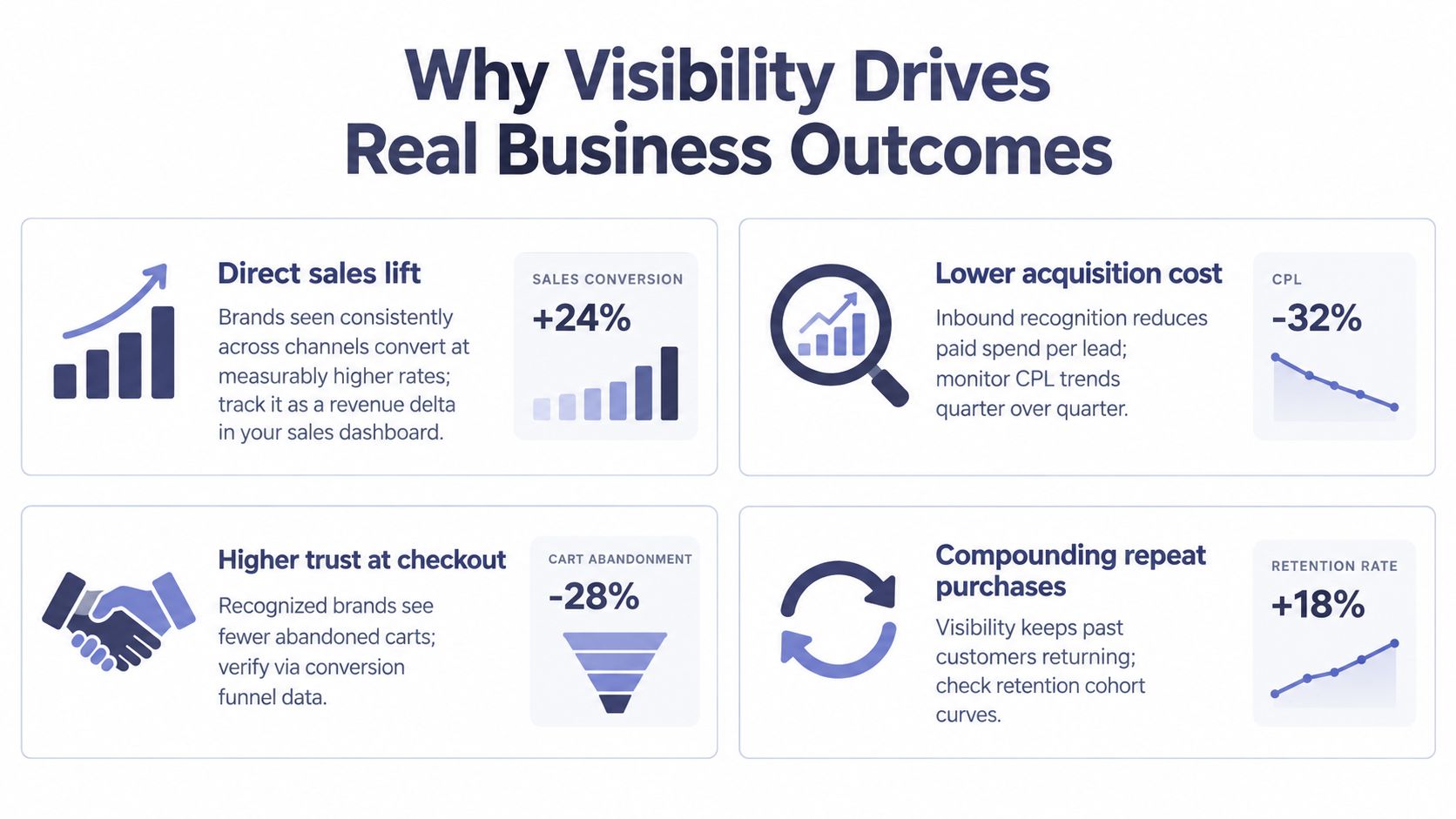
Four outcomes an operator can verify
Sales lift appears when more qualified buyers enter the funnel with a basic understanding of the brand. Track branded inquiries, conversion by source, and whether familiar prospects move through early sales stages more quickly than completely cold contacts.
Trust changes how much risk a buyer assigns to the first interaction. Nielsen's Global Trust in Advertising study found that 83% of respondents completely or somewhat trusted recommendations from friends and family, while 70% trusted branded websites. The same study reported lower trust levels for online video advertisements, search advertising, and social-network advertising, at 48%, 47%, and 46% respectively. These figures are a historical baseline from 2015, not a current estimate, but they show why credible context matters as much as exposure volume. (Nielsen's Global Trust in Advertising study)
Referral velocity improves when a referrer can describe your value without qualification. A visible operator is easier to introduce because the recipient may already have encountered the name, work, or point of view.
Deal flow expands when investors, acquirers, and strategic partners can find enough public evidence to begin a conversation. Visibility doesn't guarantee a transaction. It makes inbound discovery more likely and gives the other party a reason to investigate.
These effects cross sectors. A property professional, consumer venture, media adviser, and philanthropic leader may use different channels, but each benefits when recognition reduces the distance between first exposure and meaningful action.
The Three Engines That Build Visibility
Earned, owned, and paid media create visibility through different credibility mechanisms. Treating them as interchangeable leads to predictable mistakes. A sponsored post can create immediate reach, but it doesn't carry the same independent validation as a respected interview or customer referral.
Engine | Trust Level | Speed to Impact | Cost | Best Use Case |
|---|---|---|---|---|
Earned media | Strong third-party credibility when the source is respected | Usually slower to build | Time, relationships, and preparation | Establishing authority and independent validation |
Owned media | Controlled and cumulative, credibility depends on substance | Gradual | Internal time and production resources | Explaining expertise and building a searchable knowledge base |
Paid media | Clear reach, limited trust transfer because the placement is purchased | Fast | Direct media spend | Testing messages, reaching defined audiences, and amplifying proven work |
Earned media
Earned visibility includes press coverage, podcast appearances, event panels, word-of-mouth referrals, and independent commentary. It works because another person or publication has chosen to place your name in front of its audience. That endorsement is difficult to manufacture, and the strongest opportunities often arrive slowly through relationships.
The limitation is control. You don't determine every question, headline, or surrounding context. An emerging company should pursue earned media when it has a clear point of view, useful evidence, or a story that helps the audience understand a broader issue.
Owned media
A website, newsletter, social profile, case explanation, and published article give you control over narrative, cadence, and depth. Owned media is where an expert can explain how a decision was made, what went wrong, and which trade-offs matter. It also gives new contacts somewhere credible to continue their research.
The weakness is distribution. Excellent content can sit idle if no relevant audience encounters it. Owned media works best when it supports conversations, referrals, search discovery, and earned coverage rather than operating as an isolated publishing exercise.
For practical guidance on deciding where judgment should remain human, see this discussion of when to use ChatGPT and when to rely on yourself. The broader principle applies to visibility too. Tools can assist production, but the experience and accountability behind the message must remain real.
Paid media
Paid visibility helps a brand reach a defined audience quickly. It can test an offer, support an event, promote a useful resource, or extend the life of content that already performs well organically. It is particularly useful when the message is clear and the destination is credible.
Paid reach becomes a problem when it tries to substitute for proof. Audiences understand that an advertisement is transactional. If the public profile looks much louder than the track record, paid exposure can increase scrutiny instead of reducing uncertainty. The strongest system lets earned credibility validate the brand, owned media explain it, and paid media distribute what already deserves attention.
When Greater Visibility Hurts Trust
More exposure can magnify a weakness as quickly as it magnifies a strength. A founder who claims expertise without a visible record invites comparison between the public persona and the work behind it. A company that publishes polished promises but delivers inconsistently turns every new appearance into another reminder of that gap.
Paid visibility creates the same risk when it arrives before organic proof. The audience sees the promotion, visits the website, and looks for evidence. If the site contains vague claims, inconsistent positioning, or little demonstration of competence, the campaign has made the weakness easier to find. Reach cannot repair an unconvincing record.
Sequence matters
Visibility should follow substance closely enough that each new audience encounters something verifiable:
Build the work: Complete projects, serve customers, develop a point of view, and document decisions.
Clarify the association: Make it obvious which problem, category, or audience you understand.
Earn independent validation: Pursue referrals, interviews, partnerships, and credible third-party discussion.
Amplify selectively: Use paid distribution only after the message has demonstrated relevance and the destination can withstand scrutiny.
Cultural relevance adds another risk. Edelman's 2025 global brand-trust research reported that 80% of people trusted brands they personally used and that trust in domestically headquartered brands exceeded trust in foreign brands by an average of 15 percentage points globally. The reported gap reached 30 points in Germany and 29 points in Canada. The same research found that 73% said their trust would increase when a brand authentically reflected contemporary culture, while 27% preferred brands to ignore culture and focus solely on products. (Edelman's 2025 global brand-trust research)
The figures support a practical rule. A brand should not speak on social issues or local identity merely to appear current. Public relevance works when it reflects sustained behavior, demonstrated community involvement, and a consistent relationship with the people being addressed. A visibility strategy earns trust when public attention matches lived experience.
Lessons From a Multi-Sector Brand
Richard Maize's career offers a useful example because his recognition rests on activity across several fields rather than one campaign. His published biography says he founded and later sold one of the largest mortgage-banking organizations in the United States, then shifted attention toward real-estate ventures across the Los Angeles region and other investments. That sequence connects his name with mortgage finance, property ownership, business leadership, and investment judgment. (Richard Maize's published biography)
His investment profile also extends beyond property. An official biography states that he has owned property in more than 20 states and backed ventures including a food truck, a distressed-assets company, and an online public-relations firm. Those activities create distinct visibility assets. Real estate establishes credibility in a relationship-driven market. Consumer ventures introduce the name through customer-facing experiences. Distressed-asset investing and public-relations exposure add different business contexts. (Richard Maize's investment biography)
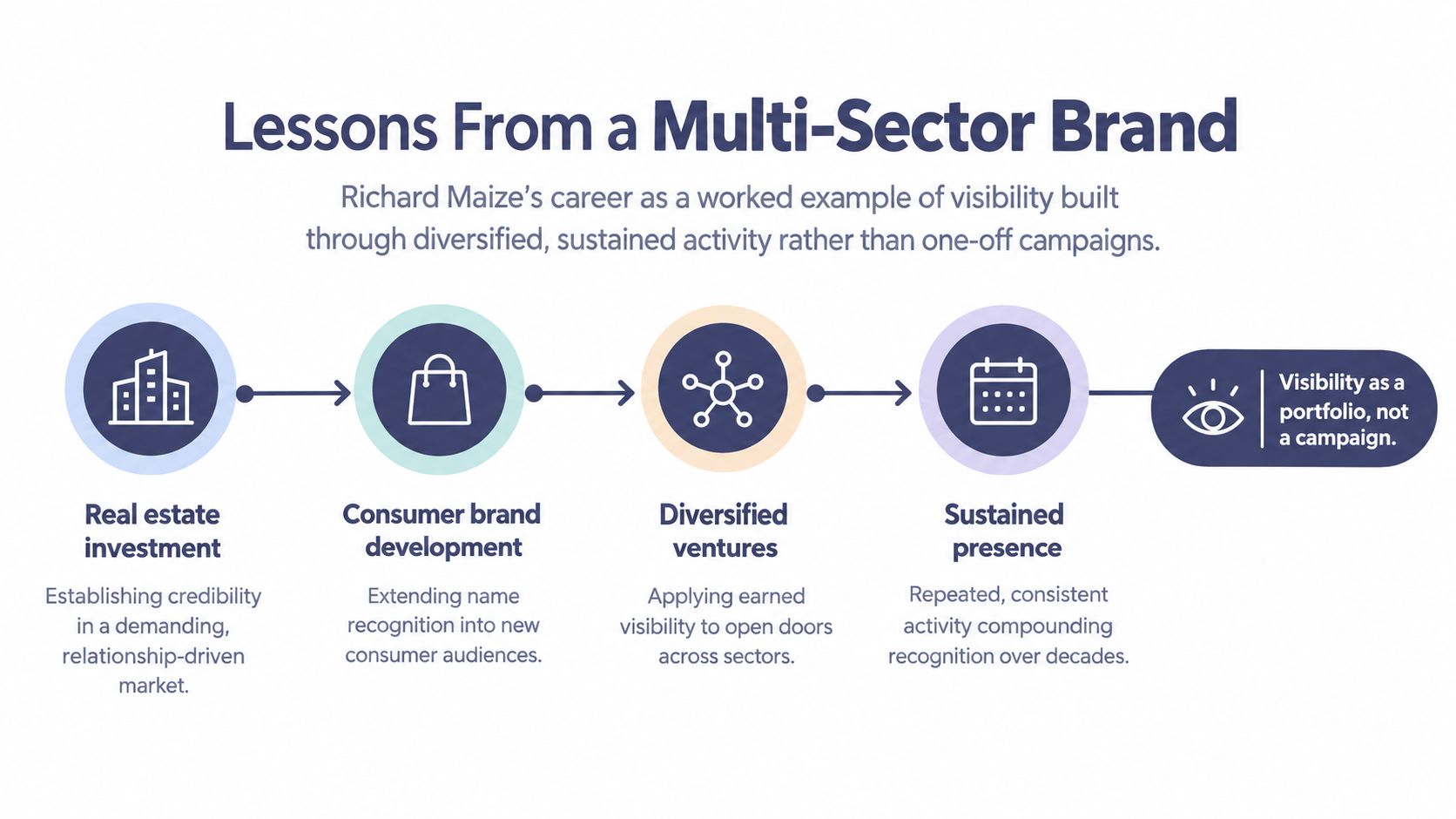
Different activities, different audiences
A completed property can build recognition among brokers, owners, lenders, and investors. A consumer venture creates contact with customers and distribution partners. Advisory work places the operator in conversations where strategic judgment matters. Philanthropy connects the public profile to community institutions and causes.
The Rochelle and Richard Maize Foundation provides a documented example of that philanthropic dimension. Under Richard and Rochelle Maize's direction, the foundation partnered with Friends of Sheba Medical Center on an annual gala that raised more than $650,000 for Sheba Medical Center. The foundation also lists support for the American Cancer Society, the Los Angeles Police Foundation, Vista Del Mar Child and Family Services, Children's Hospital Los Angeles, and Cedars-Sinai. (The Rochelle and Richard Maize Foundation)
This is more than a list of activities. It shows how visibility can become a portfolio. Each domain contributes a different kind of proof, reaches a different audience, and operates on a different cadence. Credibility developed in one setting can reduce skepticism in another, provided the connection is authentic and the underlying work holds up.
For a related perspective on leadership through changing conditions, see Richard Maize's lessons on leadership for an evolving economy. The durable pattern is sustained participation, not constant promotion.
Measuring Visibility Without Fooling Yourself
Impressions and follower counts can be useful diagnostic signals, but they don't prove commercial value. A personal brand may attract a large audience that never becomes a customer, partner, referral source, or investor. Measurement improves when you separate leading indicators, which show momentum, from lagging indicators, which confirm whether recognition changed the business.
Metric Category | What to Track | Review Cadence | Why It Matters |
|---|---|---|---|
Leading indicators | Branded searches, direct traffic, relevant mentions, share of voice, qualified engagement, and inbound links | Weekly | Shows whether recognition is building among the intended audience |
Lagging indicators | Qualified leads, warm-lead close rate, referrals, retention, repeat purchases, partnership opportunities, and revenue influence | Monthly | Connects visibility to business outcomes |
Reputation signals | Sentiment, message consistency, referral quality, and recurring objections | Quarterly | Reveals whether greater exposure is strengthening or weakening trust |
Start with leading signals
Branded search activity can show whether people are looking for your name rather than only a generic category. Direct traffic may indicate that people remember the address or return after encountering the brand elsewhere. Share of voice helps place your visibility beside competitors, while relevant mentions and inbound links show whether other people are carrying the message.
Don't treat every mention as equal. A reference from a trusted industry participant may matter more than a large volume of unrelated attention. Qualified engagement, such as a thoughtful inquiry or a request for a specific service, tells you more than a passive reaction.
Confirm the business effect
Lagging indicators should answer what the leading signals cannot. Are warm leads closing more often? Are referrals becoming better matched? Does a prospect take fewer meetings to understand your capability? Do past customers return or introduce new opportunities?
Attribution will remain imperfect. A buyer may hear a podcast, remember a name, visit directly later, and convert through a referral. Last-click reporting may credit only the final interaction. Record self-reported discovery in sales conversations and ask new contacts what they encountered before reaching out.
Review leading signals weekly, business outcomes monthly, and reputation quarterly. Keep a metric only if it changes a decision. If a number doesn't alter where you publish, whom you target, what you explain, or how you invest, it is probably reporting theatre.
Playing the Long Game
Brand visibility is a compounding credibility asset, not a campaign deliverable. A single event can create a useful introduction, but repeated evidence gives that introduction staying power. Each credible appearance makes the next conversation easier because the audience has more context and fewer unanswered questions.
The loud competitor may win the first contract. Over time, however, the operator who keeps delivering, explaining the work, supporting relationships, and participating in the community can build recognition that promotional volume can't maintain. Real estate activity, consumer ventures, advisory work, and philanthropy each create different points of contact. Together, they form a durable public record.
Four disciplines protect the investment
Choose a manageable set of channels: Select three to five places where your audience already pays attention, then maintain them for at least a year rather than jumping between every new platform.
Produce before promoting: Publish useful analysis, complete meaningful work, and create proof before paying to amplify a message.
Measure reputation as well as response: Track whether people understand your category, trust your judgment, and refer the right opportunities.
Reinvest after the deal: Thank partners, support customers, and maintain relationships after revenue arrives. The next opportunity often comes through the network built around the last one.
For a practical view of how a company can grow beyond its earliest operating stage, read this guide to scaling a business from startup to empire. Scale doesn't make visibility unnecessary. It makes disciplined visibility more important because more stakeholders now interpret what the brand says and does.
Treat visibility as offensive play on long-term credibility, not a defensive response to a slow quarter. Start building the record before the next buyer, investor, partner, or community member needs a reason to remember you.
Richard Maize offers practical perspectives drawn from real estate, investment, entrepreneurship, media, and philanthropy, with his platform bringing those ventures and lessons together. Visit Richard Maize to explore his work, insights, and community initiatives, then use the visibility principles above to build recognition that rests on substance.
Comments