How to Start a Real Estate Investment Company in 2026

You're at the kitchen table with a laptop open, brokerage statements spread beside a half-finished business plan, and a question that won't go away: should you leave your W-2 job and launch a real estate investment company in 2026?
The filing itself is easy. The hard part is proving you can source deals, protect investor capital, survive slow periods, explain performance, and make disciplined decisions when financing or exit assumptions change. Richard Maize's career offers a useful model. He began by acquiring apartment units, later built and managed a substantial real estate portfolio, and founded a mortgage banking company that independent profiles describe as one of the largest and most reputable in the United States. Maize's background points to a career built through operating experience, not through a clever entity name.
The opportunity is substantial. MSCI reports that global commercial property managed by institutional investors for investment returns reached USD 13.5 trillion in 2025, an 8.5% expansion and the first increase in global market size since 2021. But market size won't rescue an unfocused founder. You need a narrow thesis, credible capital plan, repeatable underwriting, and reporting that can withstand scrutiny.
Deciding Whether the Timing and the Operator Are Ready
At the kitchen table, the first-time founder usually focuses on the wrong question: “Can I afford to form the company?” The better question is whether the founder can afford the opportunity cost of building one. A failed first fund can consume savings, strain a marriage, damage broker relationships, and make future investors question your judgment.
Before you file anything, audit yourself like an investor would. How many complete acquisition cycles have you underwritten? Can you explain debt service, reserves, leasing risk, renovation costs, and exit assumptions without reaching for a template? Could you operate for 12 months without an acquisition while continuing to build relationships and pay professional expenses?
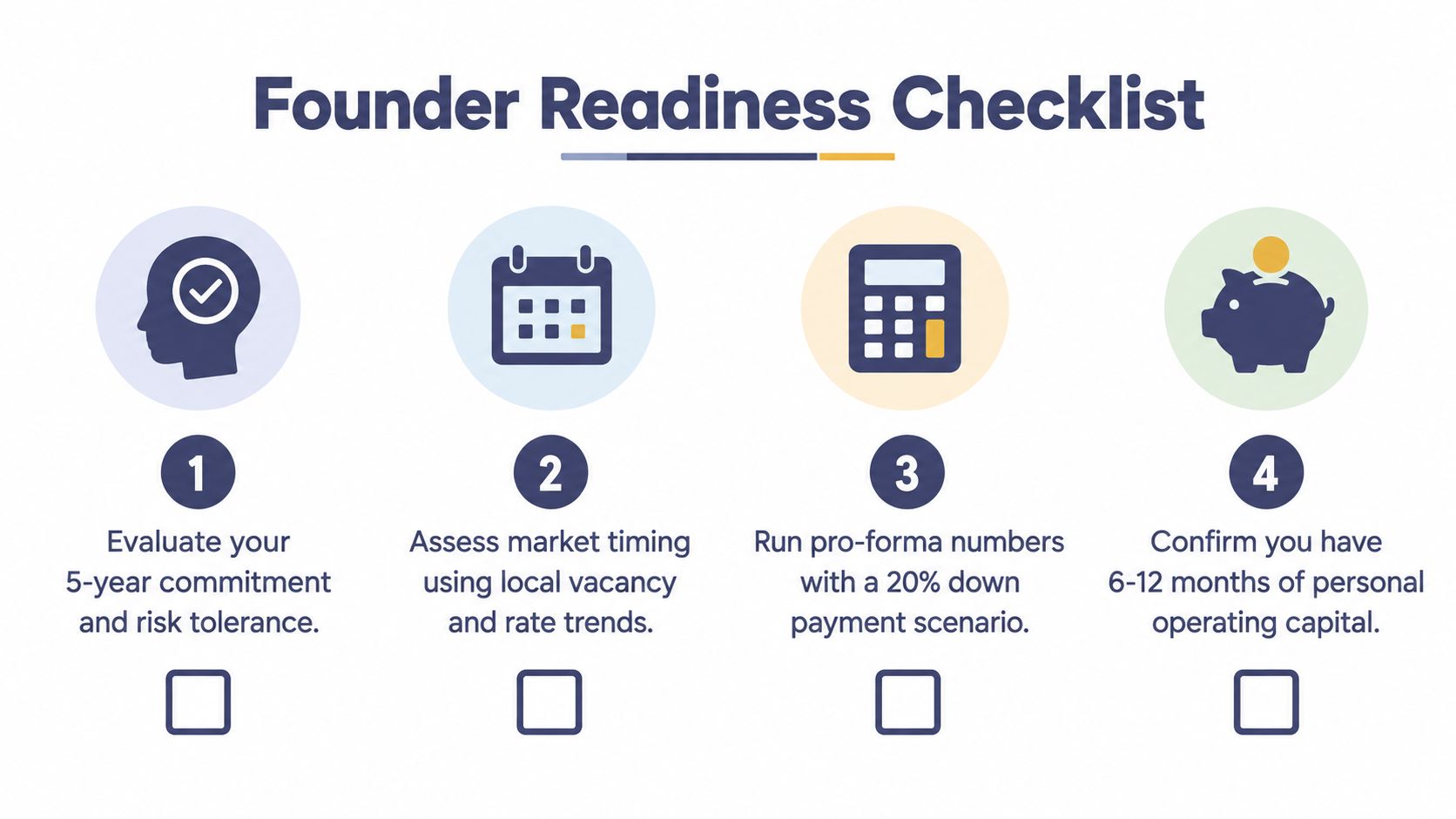
The readiness audit
A serious founder should have more than enthusiasm and a list of properties. Review these areas before announcing a launch:
Deal history: Record the deals you've analyzed, not just the properties you've admired. Note the assumptions you got wrong and the diligence questions you missed.
Personal runway: Separate household reserves from company capital. If you need the first acquisition to pay your living expenses, you're undercapitalized.
Spouse alignment: Your partner needs to understand the liquidity risk, travel demands, personal guarantees, and irregular income.
Network depth: Count actual relationships with brokers, lenders, contractors, attorneys, property managers, and potential equity partners.
Time capacity: Acquisitions require persistent follow-up. A founder working full-time elsewhere needs a credible operating plan, not a fantasy schedule.
I'd also require three credible deals in the pipeline before treating the company as launch-ready. They don't need to close, but each should fit a defined strategy, have an identifiable seller or broker, and support a preliminary financing path.
Operator test: If you haven't experienced a difficult inspection, a lender retrade, a failed lease-up, or a partner disagreement, spend another year learning on someone else's balance sheet.
The market backdrop supports disciplined entry, not reckless entry. Deloitte's commercial real estate survey found that over 68% of commercial real estate respondents expected fundamentals to improve in 2025 across areas including capital availability, transaction activity, leasing activity, rental growth, and vacancies. That creates an opening, but only for founders who can convert improved conditions into sound acquisitions.
Writing the Business Plan and Locking In the Investment Thesis
A founder can spend weeks forming an entity and still have no investable business. Before you solicit checks, write one sentence that states exactly what you buy, where you buy it, how you create value, and how long you hold it. If that sentence is vague, the strategy is unfinished.
A useful thesis identifies the asset class, submarket, return objective, and hold period. For example: “We acquire under-managed B-class multifamily properties in selected Southeast MSAs, improve operations through targeted renovations, and hold them for a defined period before refinancing or selling.” It does not need to promise a result. It must create a screening rule.
Use that rule to reject opportunities before they consume your time. A beautiful office building outside your geography is a bad lead. A multifamily property requiring a construction platform you do not have is another. A narrow thesis protects your calendar and makes your pitch easier for investors to understand.
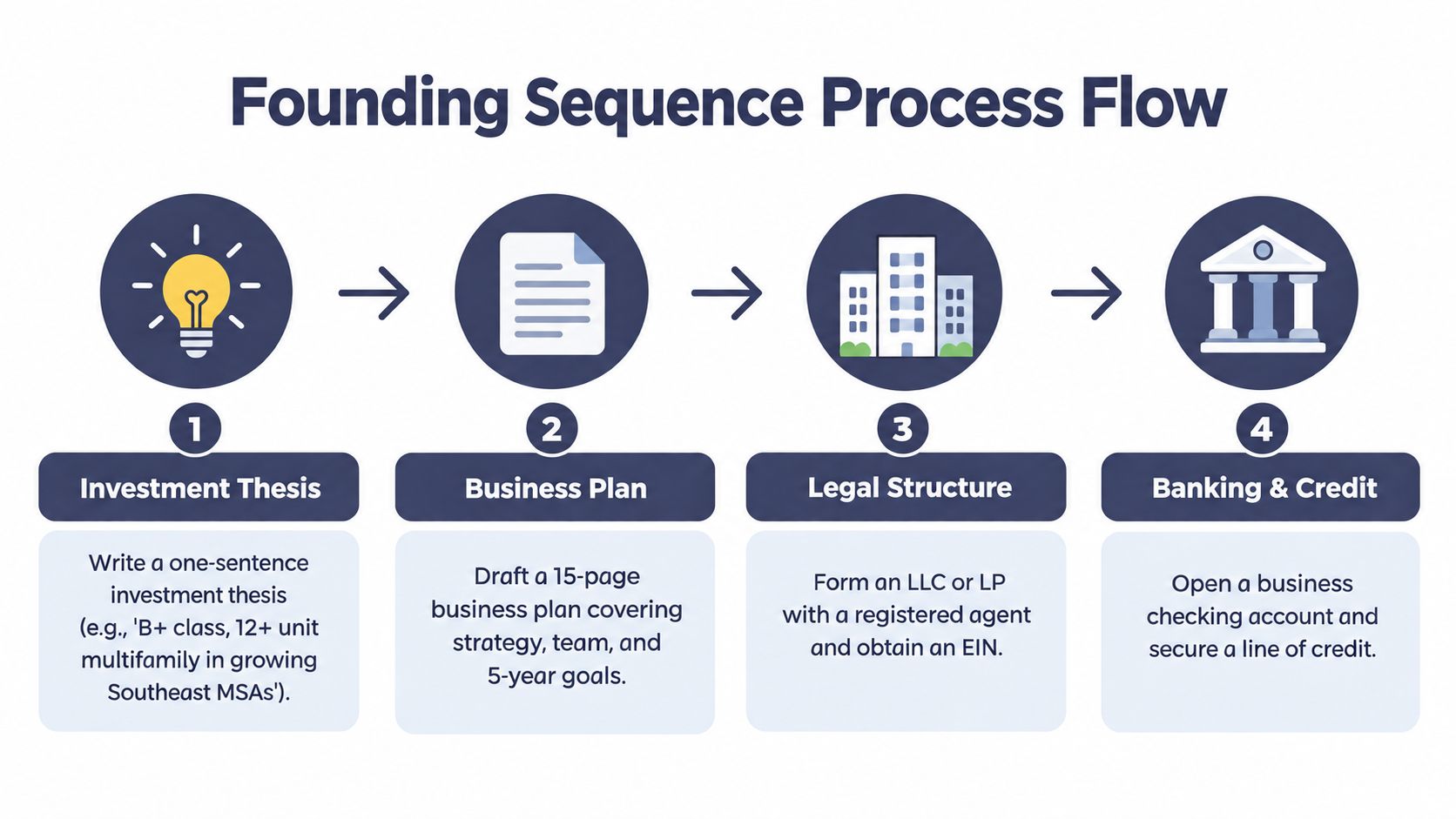
Build the plan in operating order
Write the business plan before asking anyone for capital. Make it answer these questions:
Executive summary: What does the company buy, who operates it, and why does the opportunity exist?
Market thesis: Identify the target geography, demand drivers, supply constraints, tenant profile, and competitive risks.
Target deal profile: Define property type, size, condition, financing assumptions, renovation scope, and minimum underwriting standards.
Financing strategy: Explain the intended mix of equity, senior debt, mezzanine capital, or joint venture capital.
Organizational chart: Name the acquisitions lead, asset manager, accountant, legal counsel, property manager, and approval authority.
Three-year deal pipeline: List realistic sourcing channels, target acquisitions, expected capital needs, and decision gates.
Conservative and base-case returns: Show assumptions for rent, vacancy, expenses, interest rates, exit value, fees, and timing.
Exit or refinance path: Explain what must happen for a sale, refinance, recapitalization, or long-term hold.
Give every section a deliverable date. Finish the thesis and target deal profile first, then build the market map and broker list. Complete the financing plan, organizational chart, and scenario model after that. A plan kept in your head cannot be reviewed, challenged, or improved.
Your model must show how the thesis survives pressure. Run downside cases for slower leasing, higher expenses, delayed construction, more expensive debt, and a weaker exit. Cambridge Associates' real estate benchmark material provides useful context for pairing acquisition screens with full expense modeling. A gross-rent screen can identify opportunities, but repairs, maintenance, management, taxes, insurance, and compliance determine whether cash flow survives.
Once the plan is written, form the legal entity, obtain an EIN for tax administration, open a dedicated business bank account, and secure any local zoning or construction permits required for the strategy. Investors will judge the reporting discipline behind the thesis, not just the acquisition story.
Choosing the Right Legal Structure for Your Real Estate Strategy
“Just form an LLC” is acceptable advice for a small family deal. It's incomplete advice for a company planning to accept outside capital, operate several projects, or build a repeatable investment platform.
Entity selection affects tax treatment, governance, investor rights, lender comfort, liability separation, and the way future capital enters the business. A single LLC may work for one property owned by a small group. It becomes awkward when multiple investors need different economics or when one troubled asset can expose unrelated properties.
Entity Type | Tax Treatment | Investor Limit | Best For | Main Weakness |
|---|---|---|---|---|
LLC | Often pass-through, with tax elections available | Flexible, subject to documents and offering rules | Small ownership groups and property-level vehicles | Can become complicated across many investors and projects |
S-corp | Pass-through taxation with corporate compliance | Restricted shareholder eligibility | Operating businesses with qualifying ownership | Poor fit for many real estate ownership and outside-investor structures |
C-corp | Corporate taxation and shareholder-level tax considerations | Broad ownership flexibility | Venture-style platforms and institutional fundraising | Tax treatment may be inefficient for direct property ownership |
Series LLC | Separate series may isolate assets where state law and documents support it | Depends on governing documents and offering rules | Multiple property-level strategies under one umbrella | Recognition, administration, and lender acceptance can vary |
Property-level LLC | Usually pass-through | Deal-specific | Separate SPVs for individual acquisitions | More entities, filings, bank accounts, and administration |
Match the entity to the capital plan
If you're buying a property with family money and expect to hold one asset, a straightforward LLC may be practical. If you're raising outside equity for several acquisitions, use separate property-level entities or a structure designed for multiple SPVs. Investors generally want their risk and economics tied to a defined asset, not blended with every future decision you might make.
A Delaware C-corp can make sense for a technology-enabled operating platform or a venture-backed real estate services business. It usually isn't the automatic answer for owning rental property. A series LLC may offer administrative efficiency, but you need counsel familiar with the relevant state rules, lender requirements, and investor documentation.
REITs belong in a different category. A structure overview from Richard Maize's affiliated materials notes that REITs require at least 100 investors and must satisfy ongoing IRS requirements. The same source notes that REITs collectively own more than $4.5 trillion in gross U.S. assets. That scale shows why institutional vehicles matter, but it doesn't make a REIT appropriate for a first-time founder.
Pick the structure that matches the next 24 months of capital strategy, not the cheapest filing fee today. Have a real estate attorney and tax advisor review the operating agreement, subscription process, guarantees, management fees, and transfer restrictions before you accept money.
Financing and Capital Raising for a New Real Estate Firm
Capital should follow the deal, not the other way around. A small residential flip, a stabilized rental acquisition, and a large multifamily purchase require different sources, timelines, covenants, and reporting standards.
Personal cash gives you control but concentrates risk. Conventional bank debt may offer lower pricing than private money, but lenders will examine income, liquidity, property performance, sponsorship, collateral, and repayment capacity. Agency financing can suit qualifying multifamily assets, while hard money can close faster at a higher cost and with tighter execution risk.
Capital Source | Typical Deal Size | Cost of Capital | Timeline to Close | Reporting Burden |
|---|---|---|---|---|
Personal reserves | Small acquisitions and early expenses | Opportunity cost and personal liquidity risk | Immediate, if funds are available | Low, but internal records still matter |
Conventional bank debt | Smaller stabilized or owner-supported acquisitions | Bank pricing and fees | Moderate | Moderate |
Agency financing | Qualifying multifamily acquisitions | Structured loan pricing and fees | Longer diligence process | High property and borrower documentation |
Hard money | Time-sensitive flips or distressed purchases | High relative cost and fees | Fast | Moderate |
JV equity syndication | Larger individual acquisitions | Negotiated promote and preferred economics | Depends on investor diligence | High |
Fund vehicle | Repeated acquisitions under one mandate | Management economics and carried interest structure | Slowest to establish | Very high |
Family office capital | Larger, specialized acquisitions | Negotiated return and control terms | Relationship-dependent | High |
A $500,000 flip may be funded through personal reserves, a private lender, or a small JV. A $20 million multifamily acquisition typically requires a coordinated senior loan, substantial equity, extensive diligence, and formal governance. Those examples describe different operating businesses, not merely different property values.
If you bootstrap year one, use the period to establish a verified track record, sharpen your buy box, and build investor materials. If you raise outside capital immediately, accept that investors will expect documented controls, transparent fees, capital call mechanics, tax reporting, and regular performance updates.
Build the capital package before the pitch
Your private placement memorandum should explain the investment strategy, risks, conflicts, fees, use of proceeds, management authority, distribution waterfall, transfer rules, and reporting process. Don't copy a template and assume you're compliant. Securities counsel must determine the exemption, investor qualification standards, solicitation rules, subscription documents, and state filings.
For practical funding ideas, review Richard Maize's guide to financing investment properties. Treat every prospective investor as a diligence partner. They'll ask how you value assets, handle overruns, approve related-party transactions, and communicate bad news.
Cambridge Associates' database includes 1,420 real estate funds formed between 1986 and 2024, which illustrates why performance comparisons need long histories and meaningful peer groups rather than one successful deal. Its benchmark book also emphasizes granular records for NAVs, prices, distributions, costs, fees, taxes, cash, and debt. Build that data discipline before institutional money arrives.
Sourcing Deals and Underwriting With Discipline
A deal pipeline fails when sourcing depends on a broker remembering your name. Treat it as a production system with a defined buy box, repeatable outreach, and written rejection criteria.
Choose one target submarket and property type first. Set listing alerts, build a broker contact list, schedule consistent check-ins, and contact owners directly where appropriate. Tell brokers what you buy, what you avoid, how quickly you review information, and which facts make you walk.
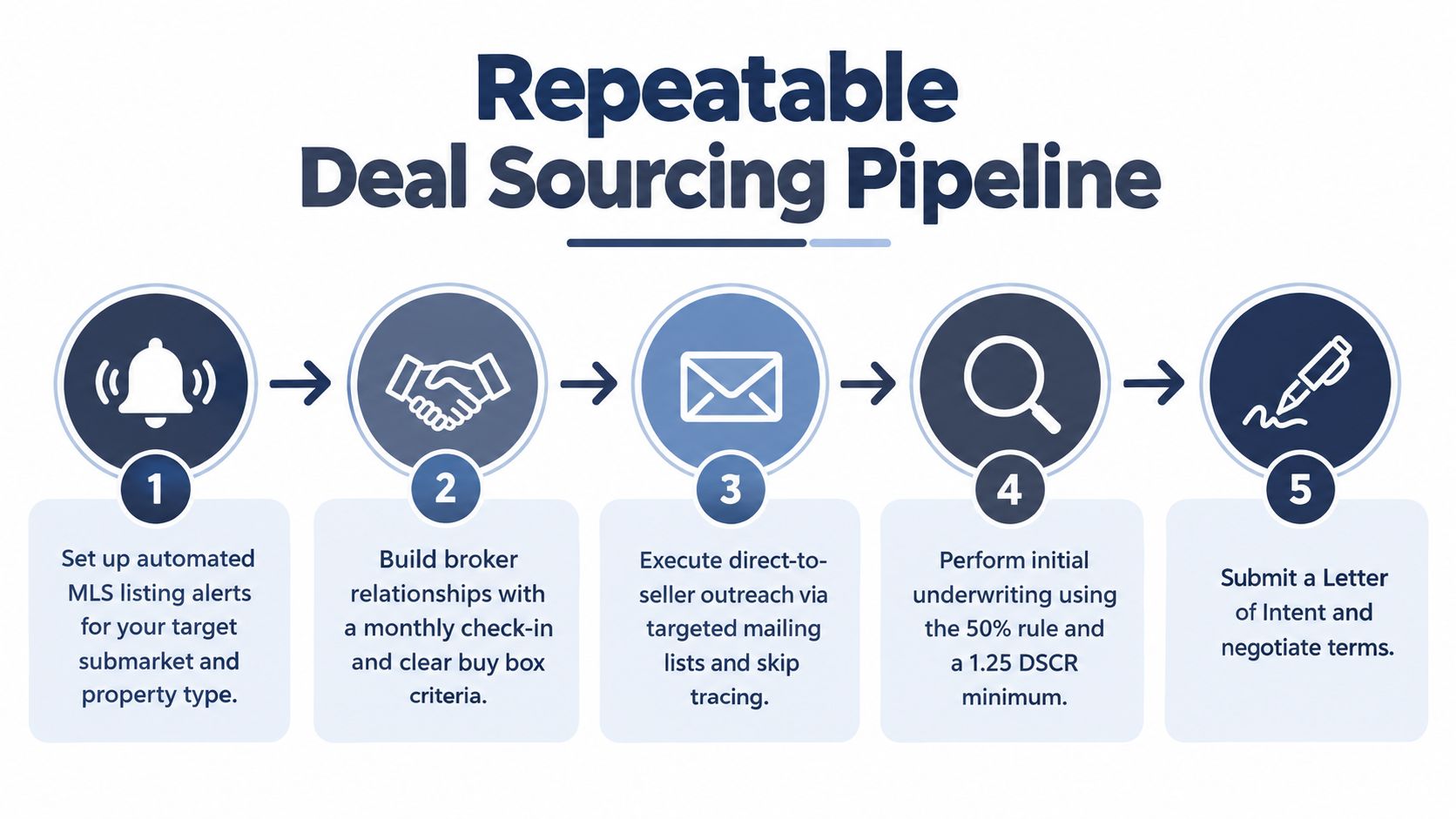
Use a one-page screen first
Your first review should be fast and unforgiving. Record the purchase price, projected annual rent, financing assumptions, vacancy, operating expenses, immediate capital needs, location, tenant demand, and likely exit path. If the opportunity fails the screen, reject it before spending days on a full model.
For multifamily acquisitions, practitioners commonly use a gross-rent screen in which projected annual rent reaches at least 7% of purchase price. Use that threshold as an initial filter, not as a return forecast. It only answers whether the property deserves deeper work. The full analysis still needs complete expense modeling.
Your model should show acquisition price, loan proceeds, interest assumptions, amortization, closing costs, repairs, reserves, insurance, taxes, management, utilities, vacancy, leasing costs, and exit expenses. Run sensitivity cases for weaker rents, higher rates, slower stabilization, and a lower sale value.
I would kill a deal for unsupported rent comps, unverified renovation premiums, unclear environmental risk, or sponsor co-mingling. Liking the neighborhood is not a reason to lower the standard.
Underwriting rule: Every model must show how the investment survives if the exit takes longer than planned.
Review the first ten deals with the same checklist. Save the original assumptions, revised diligence assumptions, lender feedback, the reason you rejected or pursued the deal, and the final decision. Richard Maize's commercial real estate due diligence checklist can organize the review, but your investment committee standards still need to be written down. That record becomes part of the reporting discipline institutional investors will expect later.
Using 2026 Market Signals to Pick Your Niche
A broad residential strategy is a comfortable default, not necessarily a smart launch strategy. New firms usually lack the capital, team, relationships, and operating history to compete everywhere. Pick a niche where your experience gives you an advantage and where lenders and investors can understand the value creation.
The current market context supports selectivity. The FTSE Nareit All Equity REITs index was up roughly 9.2% year to date by February 13, 2026, while data centers drove much of the recovery after a 2025 slump. That uneven performance matters. It suggests that sector selection can influence both financing conversations and investor appetite.
Industrial last-mile properties may suit an operator with tenant, logistics, and local employment knowledge. Data centers can offer structural demand, but they require specialized power, utility, technical, environmental, and capital expertise. Build-to-rent can fit a sponsor with development and property-management capability. Opportunistic multifamily may appeal to a disciplined buyer who can manage renovations, leasing, and basis risk.
Niche | Entry Capital | Competition Level | Lender Appetite | Operator Skill Fit |
|---|---|---|---|---|
Industrial last-mile | Moderate to high | Strong | Generally constructive for quality assets | Leasing, logistics, tenant analysis |
Data centers | Very high | Specialized and intense | Strong for proven sponsorship and infrastructure | Power, technical operations, development |
Build-to-rent | High | Competitive | Dependent on execution and market | Development, construction, property management |
Opportunistic multifamily | Moderate to high | Active | Selective | Renovation, operations, local demand analysis |
Office repositioning | Variable | Distressed but complex | Highly selective | Leasing, capital projects, tenant retention |
Use Richard Maize's real estate market analysis template to force a market decision based on supply, demand, competition, financing, and exit liquidity. Don't claim expertise in data centers because you read about them. Choose the niche where your existing skills reduce execution risk.
One closed deal can become the foundation for the next raise if you document it properly. Preserve the original underwriting, operating decisions, capital improvements, distributions, lender relationship, and investor communications. The deal must demonstrate process, not just appreciation.
First Year Milestones Operations Staffing and Risk Controls
Year one should prove three things in sequence: your investment thesis can produce a deal, your team can operate and report it, and the platform can recycle capital for the next investor. Treat each milestone as evidence for the next raise, not as a box-checking exercise.
Month | Milestone | Key Deliverable | Leading Indicator |
|---|---|---|---|
Month 4 | Close the first deal | Executed acquisition and operating plan | Qualified pipeline and lender commitment |
Month 6 | Establish reporting cadence | Clean investor report and accounting close | Reports delivered on schedule |
Month 9 | Refinance or recycle capital | Executed capital event or documented plan | Improved property performance and lender support |
Month 12 | Prepare the next vehicle | Fund or syndication materials | Repeatable sourcing and investor interest |
Keep staffing lean until the third closing. Assign acquisitions to a transaction lead, books and reporting to a part-time accountant, and asset-level execution to a property manager. Add a junior acquisitions analyst once deal flow takes more screening time than the founder can responsibly provide. Hiring too early creates overhead. Hiring too late causes missed diligence, weak follow-up, and preventable execution errors.
Write risk controls into investment and treasury policies. Cap any single asset at 25% of fund equity, require lender consent for every capital event, maintain six months of debt service in reserve across the portfolio, and run a quarterly stress test at 200 basis points above current rates. These limits must govern decisions when a deal becomes emotional or a capital event becomes urgent.
Communicate before investors ask
Send a monthly one-page update, including when operations are uneventful. Cover occupancy, collections, leasing, construction, budget variance, debt status, reserve balances, upcoming decisions, and current risks. If a property is underperforming, identify the cause and state the corrective action.
Institutional reporting should grow with the platform. Build deal-level data capture and quarterly valuation discipline from the beginning, using the reporting standards outlined in MSCI's methodology. A clean report cannot repair a weak acquisition. A weak reporting process can conceal that weakness until corrective action becomes expensive.
Your reputation is an operating asset. Protect it by declining deals you cannot explain, separating every dollar, documenting every assumption, and telling investors the truth before they uncover it themselves. One well-documented closing can support the next raise, but only if your records show the original underwriting, operating decisions, capital improvements, distributions, lender relationship, and investor communications.
Richard Maize offers practical perspective on real estate investing, business building, market analysis, and funding through his platform and published resources. Visit Richard Maize to review his insights and sharpen the operating plan behind your investment company.
Comments