How to Start a Food Truck Business: 2026 Guide with Richard Maize

Starting a food truck is about far more than a love for cooking. It’s a serious business that requires a real-world roadmap. This isn't just a checklist; it’s a deep dive into the core pillars of building a successful mobile food company, drawing from my direct experience as an investor and entrepreneur behind ventures like Richeeze Melts.
Your Roadmap to a Profitable Food truck Business
The idea of running a food truck is exciting, but success demands more than just great food. It’s a full-scale startup that requires as much business sense as it does culinary skill. Having seen this firsthand as an investor, I can tell you the entrepreneurs who succeed are the ones who treat their launch like any other serious venture—with a clear, strategic plan from day one.
The road to a profitable truck is built in stages. It all starts with a solid concept and an unbreakable financial plan. After that, you'll tackle the maze of permits and regulations before you can finally get your kitchen on the road and start building a following. From my perspective, a disciplined approach is what separates the long-term successes from the costly flameouts.
The Pillars of Your Food Truck Launch
To turn your passion into a business that lasts, you need to build it on a strong foundation. These are the areas that matter most and what any investor, myself included, looks at first.
A Unique Concept: Your idea needs to be sharp, focused, and solve a problem for a specific audience. What makes you different?
Rock-Solid Financials: A detailed budget, clear cost projections, and a solid funding strategy aren't optional. They're everything.
Navigating the Rules: You must understand and follow every license, permit, and health code. There are no shortcuts here.
A Smart Marketing Plan: You have to know how you’re going to generate buzz and turn first-time customers into loyal regulars.
This simple flow shows how these pieces fit together. You move from idea to launch in a sequence.
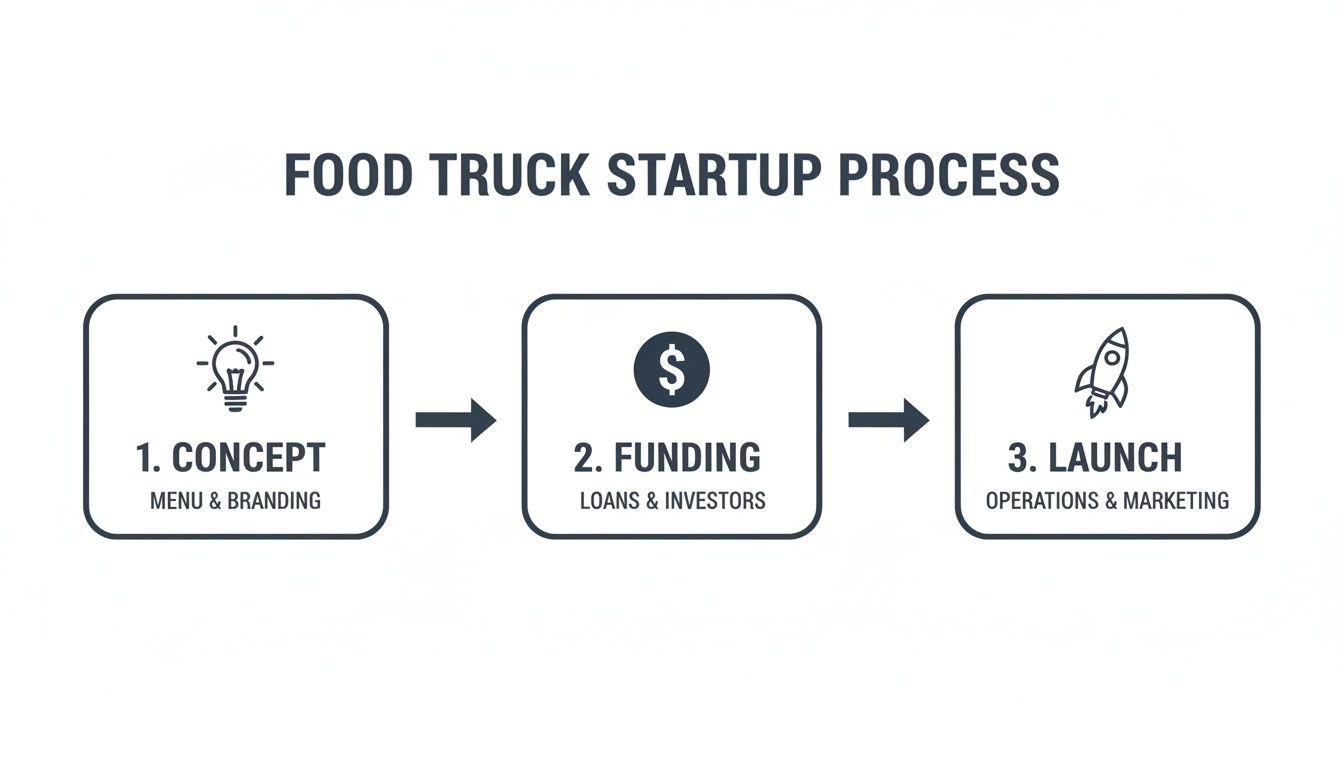
The visual makes it clear: each phase—Concept, Funding, and Launch—depends on the one before it. Skipping steps is a recipe for disaster.
The good news? You’re stepping into a market with real momentum. The global food truck market was valued at USD 2.4 billion in 2024 and is on track to hit USD 3.6 billion by 2030. The U.S. alone makes up over 40% of that revenue. This isn't a fleeting trend; it’s an industry with predictable growth. You can dive deeper into the food truck market trends to see the opportunity for yourself.
This guide will walk you through each of these pillars, using my real-world insights to help you build your own profitable food truck from the ground up.
Crafting Your Winning Food Truck Concept
Before you spend a single dollar on a vehicle or kitchen equipment, your most important investment is in your concept.
From my perspective as an investor, this is where a business is won or lost. I’ve seen it play out countless times: a vague or uninspired idea fails to attract customers and, just as importantly, funding. A winning concept, however, becomes the foundation for everything that follows.
This is the strategic core of starting a food truck. It’s not just about what food you love to cook; it's about finding a profitable niche, knowing exactly who you're selling to, and building a brand that cuts through the noise.
Defining Your Unique Selling Proposition
Your unique selling proposition (USP) is the single, clear reason a customer should walk up to your window instead of someone else’s. It's the promise you make.
Think of the Richeeze Melts food truck. I backed this venture because its concept is brilliantly simple: gourmet grilled cheese. That focus makes it memorable and incredibly easy to market.
Your USP has to be specific and compelling. Are you the only truck serving authentic Neapolitan pizza? The fastest option for a healthy lunch near office parks? The most decadent dessert truck for the late-night crowd?
A strong USP acts as a filter for all future business decisions. It guides your menu, your branding, and your marketing, ensuring every part of your business tells the same compelling story. This clarity is what investors like myself look for. - Richard Maize
A focused concept is simply easier to execute and market. Instead of trying to be everything to everyone, you excel at one thing. This expertise builds a reputation and a loyal following much faster than a generic, sprawling menu ever could.
Conducting Meaningful Market Research
Once you land on a concept, you have to validate it. Don't guess. You need real-world data to see if your idea has legs. This isn't about complex analytics; it's about smart, on-the-ground observation.
Scout Potential Locations: Visit the areas you’re considering—business districts, festival grounds, or brewery parking lots. Watch the foot traffic at different times of the day. Who is there? What are they eating?
Analyze the Competition: Look at other food trucks and restaurants in your target zones. Don’t just see what they serve; analyze their pricing, their branding, and their lines. A long line signals demand, but it could also mean there’s an opening for a faster or different alternative.
Talk to Potential Customers: Never be afraid to ask people what they want. Simple questions like, "What kind of lunch options do you wish you had around here?" can provide invaluable insights.
This kind of research helps you spot gaps in the market. If every truck at a location serves heavy, fried food, a concept built on fresh salads and smoothies might thrive. If everyone is priced high, a value-focused menu could be your way in.
Naming and Branding Your Concept
Your name and brand are the very first things a customer experiences. A poorly chosen name creates confusion or, worse, limits your growth. A name like "Spicy Wings" boxes you in. What happens if wings become unprofitable and you need to pivot to burgers?
Mistakes to Avoid When Naming Your Truck:
Too Niche: Avoid tying your name to a single menu item unless you are 100% committed to it for the long term.
Hard to Spell or Pronounce: If customers can't easily find you on social media or tell their friends about you, you're losing business.
Doesn't Match the Brand: "Gourmet Eats" sets a high expectation. If you're serving simple hot dogs, the name will feel misleading and disappoint customers.
Your name, logo, and truck design should all work together to communicate your USP instantly. Richeeze Melts is a great example—the name is fun, memorable, and tells you exactly what to expect.
Think of your brand as a silent salesperson, attracting the right customers before they even see a menu. It's a critical asset when you're figuring out how to start a food truck business that lasts.
Building Your Financial Blueprint and Securing Funds
A great food truck concept gets my attention. A solid financial plan is what gets a check.
From my standpoint as an investor, the numbers are the most critical part of any business proposal. They tell the real story of your viability and whether you understand how to turn a great idea into a profitable business.
Your financial blueprint isn't just a budget. It's the document that proves you're a serious operator. It needs to be realistic, detailed, and completely defensible. This is where you show you’ve done the hard work before asking for a single dollar.
Detailing Your Startup Costs
First things first: you have to know exactly what it costs to open for business. Vague estimates are a massive red flag for me. You need to break down every single anticipated expense. No exceptions.
The truck is your single biggest line item, but it’s far from the only cost. The final number can swing dramatically depending on whether you buy a new, turnkey vehicle or a used one that needs a full custom build-out.
Below is a realistic look at what you should be prepared to spend.
Estimated Startup Costs for a Food Truck Business
This table breaks down the common expenses you'll face. The ranges are wide because your choices—from the truck itself to your marketing budget—will determine where you land. Plan conservatively.
Expense Category | Low-End Estimate | High-End Estimate | Key Considerations |
|---|---|---|---|
Vehicle & Customization | $50,000 | $150,000+ | Used vs. new, kitchen complexity, and cosmetic wraps. |
Kitchen Equipment | $10,000 | $50,000 | Depends entirely on your menu. Specialized gear costs more. |
Permits & Licensing | $1,000 | $10,000 | Varies widely by city and state. This is non-negotiable. |
Initial Inventory | $3,000 | $5,000 | Your first major order of food, ingredients, and supplies. |
Marketing & Branding | $2,000 | $8,000 | Professional truck wrap, website, and launch promotions. |
Contingency Fund | 15% of Total | 20% of Total | A buffer for unexpected repairs, delays, or slow first months. |
This detailed budget is the foundation for a business that’s financially sound from day one. Don't skip this step.
The Investor's Perspective on a Fundable Proposal
When I, Richard Maize, review a food truck plan, I’m looking for a clear path to profitability. Passion is great, but it doesn’t pay the bills. Your proposal has to show a deep understanding of your numbers and a realistic plan for generating a return. For a deeper look, you can read my thoughts on the road to riches with food trucks and what makes them an attractive asset.
A fundable proposal anticipates my questions and answers them with data. It proves you’ve done your homework.
An investor wants to see that you've calculated your break-even point, understand your food cost percentages (the sweet spot is 28-35%), and have projected profit margins that make sense. These numbers show you’re an entrepreneur, not just a chef. - Richard Maize
The opportunity in this space is real if it's managed correctly. The U.S. food truck market is valued at $1.16 billion and is expected to hit $1.59 billion by 2031. On average, a single truck can generate around $346,000 in annual revenue. In prime markets like California, that number can jump to an average of $482,751. The potential is there, but only for disciplined operators.
Exploring Your Financing Options
Once you have a detailed, defensible budget, you can start looking for capital. Very few entrepreneurs can self-fund an entire operation, so exploring your options is a standard part of the process.
Here are the most common paths for securing funding:
SBA Loans: Backed by the Small Business Administration, these loans often come with better terms and interest rates. An SBA 7(a) loan is a solid option for covering everything from the truck purchase to working capital.
Equipment Financing: This is a loan secured by the asset you’re buying—the food truck itself. Since the truck acts as collateral, these loans can be easier to get than a traditional business loan.
Business Lines of Credit: A line of credit offers flexibility. You can draw funds as needed for things like inventory or unexpected repairs, which is excellent for managing cash flow once you're up and running.
Angel Investors & Private Lenders: This is where your business plan has to shine. An investor like myself provides capital in exchange for equity. To get me interested, you need a financial projection that is both ambitious and believable.
Combine a bulletproof financial plan with a smart funding strategy, and you'll turn your food truck dream into a tangible, investable business.
Navigating Licenses, Permits, and Health Regulations
After you’ve built a solid financial blueprint, the next phase begins. This is where you move from the dream to the details, tackling the legal requirements of running a food truck. From my perspective as an investor, this is a critical test. It reveals an entrepreneur’s diligence and ability to operate a professional, sustainable business.
Skipping or mishandling this stage is a fast track to failure. It leads to fines, shutdowns, and a total loss of your investment. Think of every permit as a non-negotiable part of your foundation. Without it, your business is just a hobby with expensive equipment.
Your Essential Legal Checklist
The specific permits you need will vary dramatically depending on your city, county, and state. No two jurisdictions are the same. However, a few core documents are almost universally required to get your truck on the road.
Business License: This is the most basic requirement, registering your business as a legal entity with your local government.
Employer Identification Number (EIN): If you plan on hiring even one person, you’ll need an EIN from the IRS. It’s the business equivalent of a Social Security number.
Food Handler’s Permit: You and every employee handling food will almost certainly need to pass a food safety course to get this certification.
Vehicle License: Your truck must be registered with the DMV like any other commercial vehicle. On top of that, you’ll likely need a special mobile food vendor permit.
This list is just the starting point. The real work begins when you dig into the hyper-local rules that dictate exactly where you can park, operate, and sell.
Conquering Health Department Inspections
Passing your health department inspection is the final hurdle before you can serve your first customer. An inspector will go through your truck with a fine-tooth comb to ensure it meets strict food safety standards. Failing this inspection means costly delays.
To pass with confidence, you need to think like an inspector. They are looking for:
Proper Food Storage: Are your refrigerators and freezers holding at the correct temperatures? Are raw and cooked foods stored separately to prevent cross-contamination?
Sanitation: Do you have a three-compartment sink for washing, rinsing, and sanitizing, plus a completely separate hand-washing sink with hot and cold running water?
Cleanliness: Is every surface clean and non-porous? This includes countertops, walls, and floors.
Water System: You need separate tanks for fresh water and wastewater (gray water). They must be large enough to last through a full day of service.
From a business perspective, a health department inspection isn't an obstacle; it's a quality control checkpoint. Passing it proves to your customers—and to any potential investor—that you are a serious, professional operator committed to safety and excellence. - Richard Maize
Don't leave this to chance. Get a copy of your local health code and go through it line by line, checking off every requirement in your truck.
Understanding Commissary Kitchen Rules
Most health departments will not allow you to prep food in your home kitchen. You will almost always be required to operate out of a licensed commissary kitchen.
This is a shared, commercial-grade kitchen where you can safely prep ingredients, store food and supplies, and properly dispose of grease and gray water. Many commissaries also provide secure overnight parking for your truck.
The rules are strict. You will need to show your health department a signed agreement proving you have legal access to a compliant facility. As an entrepreneur who understands the challenges of food truck ownership, I know that finding an affordable and conveniently located commissary is a major, and necessary, step.
Researching Your Local Regulations
The single biggest mistake I see new owners make is underestimating the complexity of local rules. A permit that allows you to operate in one city is often useless in the town next door.
Actionable Steps for Research:
Start with your local Chamber of Commerce or Small Business Administration (SBA) office. They often have roadmaps and resources specifically for new food businesses.
Go directly to your city and county government websites. Look for departments covering business licensing, public health, and public works.
Talk to other food truck owners in your area. Their firsthand experience is invaluable for learning how to navigate the local bureaucracy.
This paperwork is the unglamorous side of the business, but it’s absolutely essential. Meticulous attention to these details is what separates a thriving enterprise from a failed concept. It proves you have the discipline required to protect your investment and build a business that lasts.
Designing Your Mobile Kitchen and Menu
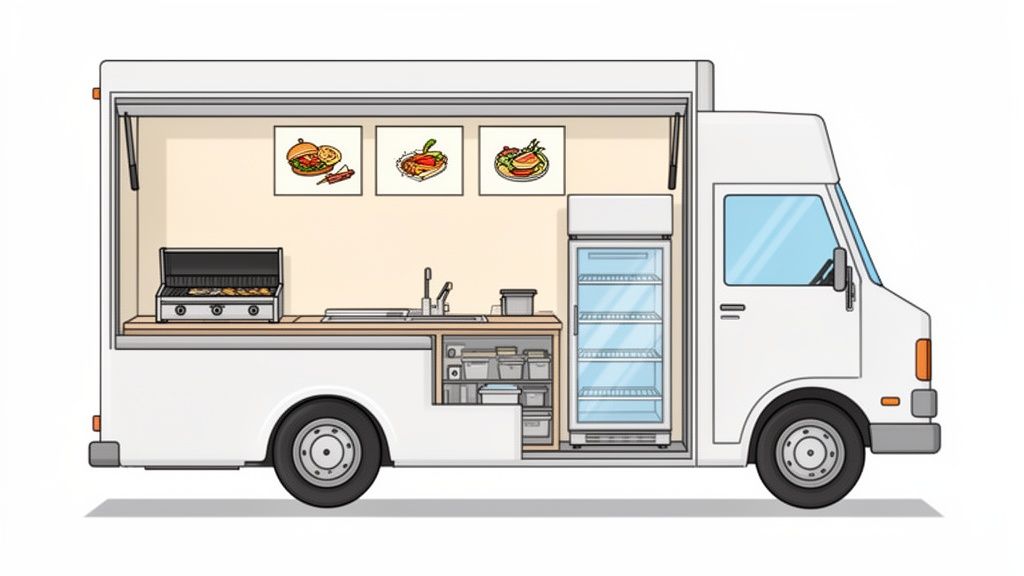
Your food truck is a factory on wheels. Your menu is the product. These two assets are where your idea becomes a business, and from my perspective as an investor, they’re where profitability is made or lost.
Every choice you make, from the vehicle you buy to the cheese you source, must be viewed through a financial lens. It’s not just about what tastes good. It's about efficiency, cost control, and building a system that generates a return.
Choosing Your Truck: An Investor's View
The choice between a new or used truck is one of your first major capital decisions. This isn’t just a purchase; it's an investment in your single most important operational asset. As a smart investor, I weigh the upfront cost against long-term value and risk.
A brand-new, custom-built truck can run upwards of $150,000. That sounds steep, but it comes with warranties, modern equipment, and a layout designed for your exact workflow. This minimizes the risk of expensive downtime and helps you fly through health inspections. From my financial standpoint, it's a predictable, lower-risk asset.
On the other hand, a used truck is far more accessible, often costing between $50,000 and $80,000. That lower upfront price can be deceptive. It often brings hidden costs—equipment failures, engine trouble, or a layout that fights your every move. A cheap truck that needs constant repairs isn't a bargain. It's a liability that drains cash and destroys your reputation for reliability.
From an investment standpoint, the best choice is the one that minimizes future risk and maximizes operational uptime. A slightly more expensive, reliable truck is often a smarter long-term investment than a cheaper one that introduces uncertainty and potential for lost revenue. - Richard Maize
A custom build makes sense when your menu requires a specialized kitchen layout. If your workflow is unique and an efficient design will significantly boost your sales volume, the higher upfront cost is justified as an investment in pure productivity.
Your Essential Kitchen Equipment Checklist
Once you have the truck, outfitting the kitchen is next. The equipment is dictated entirely by your menu. A common mistake I see is over-equipping, which wastes precious capital and even more precious space. Focus only on what’s essential to make your core items.
Core Equipment for Most Food Trucks:
Cooking Equipment: This will be your workhorse. A flat-top griddle, multi-burner range, deep fryers, or a charbroiler—whatever your menu demands.
Refrigeration: At a minimum, a reach-in refrigerator and a separate freezer are non-negotiable. Under-counter units are great for saving space.
Prep Area: You need stainless steel countertops. They’re durable, clean, and required for sanitation.
Sinks: A three-compartment sink (for wash, rinse, sanitize) and a separate hand-washing sink are mandatory health code requirements. No exceptions.
Ventilation: A commercial-grade exhaust hood and fire suppression system aren’t just for safety—they're legally required to manage heat, smoke, and grease.
POS System: A modern point-of-sale system isn't a luxury. It’s crucial for taking orders, processing payments, and—most importantly—tracking sales data.
Think lean. Every single piece of equipment must earn its place on the truck by supporting a profitable menu item.
Engineering a Profitable Menu
Your menu isn’t just a list of food. It’s your most strategic tool for profitability. Menu engineering is the science of designing a menu that guides customers toward your highest-margin items while balancing food costs and operational speed.
The Richeeze Melts food truck, a venture I proudly backed, is a perfect case study in focus. The concept is simple: gourmet grilled cheese. This narrow focus is its greatest strategic advantage.
Reduced Inventory: They only need a few core ingredients—bread, cheese, butter. This simplifies ordering, reduces spoilage, and minimizes waste.
High-Profit Margins: The core ingredients are relatively low-cost, which allows for a healthy markup and strong profit on every single sandwich sold.
Operational Speed: A simple menu allows the team to assemble and cook orders incredibly fast, increasing how many customers they can serve during a busy lunch rush.
To engineer your own profitable menu, start by calculating the food cost percentage for every item you sell. This is simply the cost of an item's ingredients divided by its menu price. The industry standard is to aim for a food cost of 28-35%. Anything higher is eating directly into your profit.
Finally, build strong relationships with your suppliers. They aren't just vendors; they are partners. Negotiating good prices, ensuring consistent quality, and setting reliable delivery schedules are critical for controlling your costs and keeping your mobile factory running.
Marketing Your Truck and Building a Loyal Following
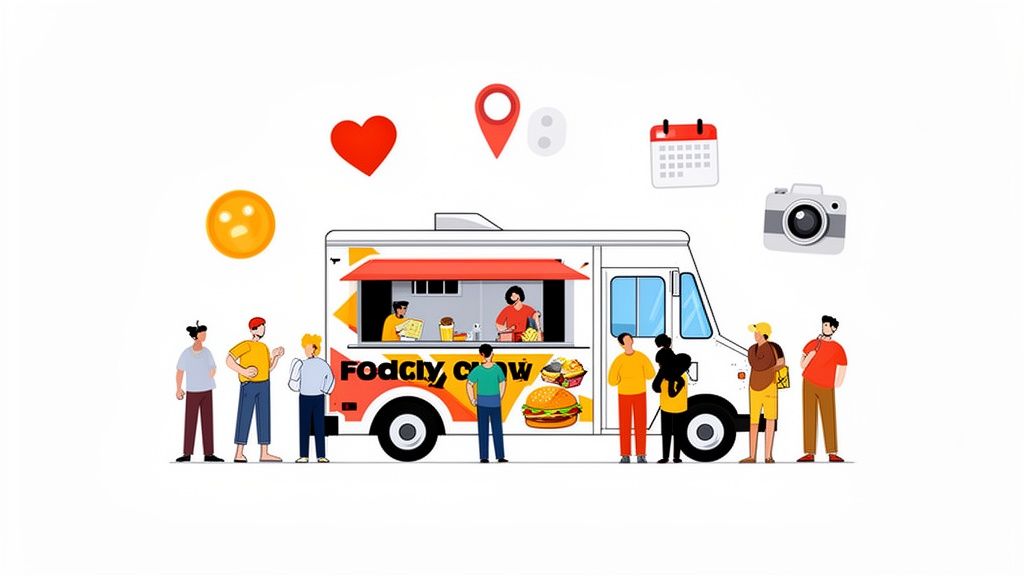
An incredible menu is only part of the equation. From my perspective as an investor, I’ve seen too many promising food trucks fail because they assumed great food sells itself.
It doesn’t.
Your marketing is what turns a mobile kitchen from a local secret into a destination. Building a brand and a loyal following requires a deliberate strategy. This isn’t about a massive ad budget; it’s about smart, consistent actions that create buzz and turn first-time customers into regulars.
Your Truck Is Your Biggest Billboard
Before anyone tastes your food, they see your truck. That vehicle wrap is your single most powerful marketing asset, working for you 24/7, whether you’re serving lunch or just parked in traffic. It has to be eye-catching and instantly communicate what you're all about.
A poorly designed wrap is a critical missed opportunity. Think about someone driving past at 30 miles per hour—can they read your name and understand your concept in seconds? If not, the design isn't working.
Your wrap must feature:
A clean, bold logo.
Your business name in a large, easy-to-read font.
Your social media handles and website, displayed clearly.
A professional wrap is a non-negotiable investment. Its value in attracting business is immeasurable.
Master Social Media to Drive Business
For a food truck, social media isn't optional. It’s your direct line to your customers, telling them where you are, what's on the menu, and why they need to stop by. Consistency is everything.
An effective strategy focuses on immediate, actionable information. High-quality photos of your food are a must; people eat with their eyes first. Showcasing a daily special or a behind-the-scenes look at your prep creates urgency and connection.
From a business growth perspective, the most critical function of your social media is announcing your daily location. Post your spot every single day, at the same time, so followers know when to check. This simple habit builds reliability and trains your audience to look for you. - Richard Maize
Engage with your followers. Respond to comments and share their posts. This is how you build a community around your brand and make customers feel like insiders. The community that formed around the Richeeze Melts truck is a perfect example—that engagement created a loyal following that would track the truck down anywhere. You can learn more about how the Richeeze Melts food truck project I supported built its brand.
Form Strategic Local Partnerships
One of the smartest ways to grow is by partnering with other local businesses. These symbiotic relationships give you a guaranteed location and a built-in crowd.
Consider these high-potential partnerships:
Breweries and Wineries: These places often lack their own kitchens and welcome food trucks to serve their patrons.
Office Parks: Many corporate campuses have a serious lack of good lunch options. A regular spot can provide steady weekday business.
Apartment Complexes: Partnering with large residential buildings for a "food truck night" is an easy way to reach hundreds of potential customers right where they live.
Approach these businesses professionally. Have a one-sheet ready that outlines your menu, your requirements (like power), and your social media reach. Show them how your presence benefits them.
Food truck festivals are another fantastic way to get in front of thousands of new customers in one day. The entry fees can seem high, but the exposure is often well worth it. Treat these events like your big stage—a chance to win over a huge audience and convert them into long-term followers.
At Richard Maize, I believe that success in any venture, from real estate to food trucks, is built on a foundation of sound strategy and expert insight. Discover more about what's possible at https://richardmaize.com.
Comments