How to Leverage Social Media for Business in 2026

Social media can make a business more visible without making it more profitable. That's the counterintuitive reality behind how to use social media for business in 2026. Social media increases exposure for 83% of brands, traffic for 71%, lead generation for 62%, loyalty for 57%, and sales for 46%, while average social conversion rates remain around 1.5% to 2.9% according to Business.com's social media marketing analysis. The practical lesson is clear: social works best as a discovery, credibility, and retargeting engine before it becomes a sales engine.
Why Social Media Matters for Your Business Right Now
Social media now shapes whether buyers, partners, prospective employees, and local supporters see a business as active, credible, and relevant. Global social media use has reached an estimated 5.79 billion people, while another 2025 estimate places the total at 5.66 billion, with year-over-year growth of 4.8%, according to Forbes Advisor. The reach is broad, but reach alone does not create revenue.
Richard Maize's operating experience shows how the channel earns its place. In real estate, useful market commentary and property content help people recognize the agent before a listing or conversation appears. For a consumer venture such as the Richeeze Melts Food Truck, short-form videos build local awareness before someone chooses where to eat. For a community project such as POPPOP FEST, regular local posts keep the event present between announcements and help convert recognition into attendance.
Social media should earn the next step, not force a final transaction in every post.
The value loop behind visibility
A practical social program supports four connected outcomes:
Discovery: Short-form video, searchable captions, location tags, and collaborations reach people who were not actively searching for the business.
Credibility: Saved posts, useful comments, founder stories, customer conversations, and visible expertise reduce uncertainty.
Retargeting: People who watched videos, visited a profile, or engaged with content can later see a more relevant offer.
Brand search: Repeated exposure encourages people to search by name, visit the website, or request an introduction through another channel.
Cold audiences rarely convert at the same rate as warm prospects. The Business.com benchmark overview places organic social conversion at about 2.4% for B2C and 1.7% for B2B, while noting that paid social can perform lower than organic in many B2B funnels. Those figures support a measured role for social. Use it to create familiarity and qualified interest, then let the offer, sales process, or event experience complete the conversion.
Richard Maize's discussion of major business trends and changing visibility provides useful context. Visibility compounds when content supports a real business activity, such as listing a property, opening a food truck location, or gathering a neighborhood around an event. Choose the business outcome, define the audience, match the platform to intent, run a repeatable content engine, and measure movement beyond likes.
Define Your Goals Audience and Content Pillars
Posting becomes expensive when nobody can explain what the posts are supposed to accomplish. Before choosing a platform, select one primary outcome for the next planning cycle: visibility, qualified leads, transactions, community participation, or recruiting. You can support that outcome with secondary metrics, but one priority keeps the content from becoming a disconnected stream of announcements.
A real estate operator might choose qualified conversations with sellers or investment partners. A food truck might prioritize local discovery and visits. A community organizer might care about registrations, volunteer interest, or ticket presales. Each goal changes the call to action, the audience definition, and the evidence you need to publish.
Build an audience profile that changes the message
A useful audience profile is one page, not a fictional biography. Record:
Role or life stage: An investor, seller, first-time buyer, family dining locally, weekend event-goer, or potential business partner.
Decision trigger: A property transition, investment opportunity, hunger, entertainment, neighborhood pride, or desire to support a cause.
Platform behavior: Whether the person watches short videos, searches YouTube, participates in Facebook groups, reads LinkedIn posts, or saves Instagram carousels.
Trust question: What must this person believe before contacting you?
A real estate investor's audience may need disciplined analysis, risk context, and evidence of execution. The audience for Richeeze Melts Food Truck needs a more sensory and immediate message, including what's being served, where the truck is, and why the experience is worth sharing. POPPOP FEST requires community identity, practical event information, and a reason for people to bring someone else.
Avoid treating “everyone in the area” as an audience. Broad reach can be useful for awareness, but specific creative gives the platform and the audience a clearer reason to respond.
Use three pillars to build trust
Organize content around three durable pillars:
Educational: Explain a market pattern, answer a common question, or show how a decision gets made. This establishes competence.
Behind the scenes: Show preparation, negotiation, cooking, logistics, mistakes, and people. This makes the business tangible.
Proof and social: Share customer reactions, completed work, community participation, property outcomes, or partner perspectives without manufacturing testimonials.
A practical mix is to make educational content the dependable base, use behind-the-scenes material to create familiarity, and reserve promotional posts for clear offers or timely opportunities. Draft the audience one-pager and these pillars before opening a content calendar. If a proposed post doesn't serve the selected outcome or one of the pillars, it probably belongs in the ideas file rather than this week's schedule.
Pick the Right Platforms for the Job
Choose platforms by the job they need to perform, not by follower count. Intent, format, and conversion path determine whether a channel supports discovery, credibility, or retargeting. Social media often creates the first useful impression, then gives future customers more evidence before they contact the business.
Socialinsider's platform analysis reports that LinkedIn is consistently strong for B2B conversion, with some benchmark sets placing conversion ranges between 5% and 15%. TikTok can generate substantial discovery, while direct conversion was around 0.46% in one 2025 benchmark. The same source reports median engagement near 3.70% on TikTok, 0.48% on Instagram, 4.7% at the LinkedIn page level, and 0.15% on Facebook in 2026 benchmark reporting. These figures are directional, not universal targets. They show why the same creative can perform well on one network and disappear on another.
Platform | Avg. Engagement Rate (2026) | Best Content Format | Best-Fit Business Outcome | Recommended Weekly Cadence |
|---|---|---|---|---|
0.48% | Reels, carousels, Stories | Visual discovery, brand familiarity, local interest | Consistent short-form publishing and Stories | |
4.7% at page level | Expert posts, documents, short video | B2B authority, partnerships, deal flow | Several focused authority posts | |
TikTok | 3.70% | Short-form video, trends, local clips | Fast discovery and cultural relevance | Frequent native video testing |
0.15% | Groups, community posts, livestreams | Local participation and relationship-building | Regular group and community activity | |
YouTube | Not provided in the verified data | Long-form video, Shorts, livestreams | Search-driven trust and education | A sustainable recurring video schedule |
The cadence column stays qualitative because production capacity, audience response, and content shelf life vary. HubSpot's 2026 marketing data reports that 70% of marketers use Instagram, while 82% use YouTube as their video marketing platform. Those figures confirm the importance of visual and video channels, not a requirement for every business to use both.
Match the channel to the job
LinkedIn fits Richard Maize's real estate and investment work when the aim is authority, introductions, or partner conversations. A useful market explanation may not produce an immediate lead, but it can make a later conversation easier. His technology reshaping real estate perspective also shows why the platform should support a defined business process, rather than just collect activity.
Instagram suits property visuals, Richeeze Melts Food Truck's food and founder presence, and POPPOP FEST community moments. TikTok can extend local discovery when the team can produce personable native video instead of reposted advertisements. Facebook supports groups, event coordination, and ongoing local relationships. YouTube gives market explanations, founder stories, and event recaps more room to build trust over time.
For a team of fewer than three people, start with one primary platform and one repurposing destination. Design the original post for the channel where the business needs attention, then adapt it elsewhere. A LinkedIn analysis can become an Instagram carousel, while a food truck video can become a YouTube Short. Social media earns its place when it compounds recognition and credibility, even before a measurable conversion occurs.
Build a Content Engine You Can Actually Run
A content engine isn't a demand to publish endlessly. It's a way to turn one useful business idea into several relevant assets without asking the operator to reinvent the message every day. Start with three to five content pillars, derived from the audience and goal work already completed.
For Richard Maize, one property-market observation might become a LinkedIn analysis, an Instagram carousel, a short video explaining the implication for buyers, and a question for potential partners. A POPPOP FEST planning meeting can produce a behind-the-scenes clip, a volunteer-focused post, a vendor spotlight, and a reminder that points people toward the event page.
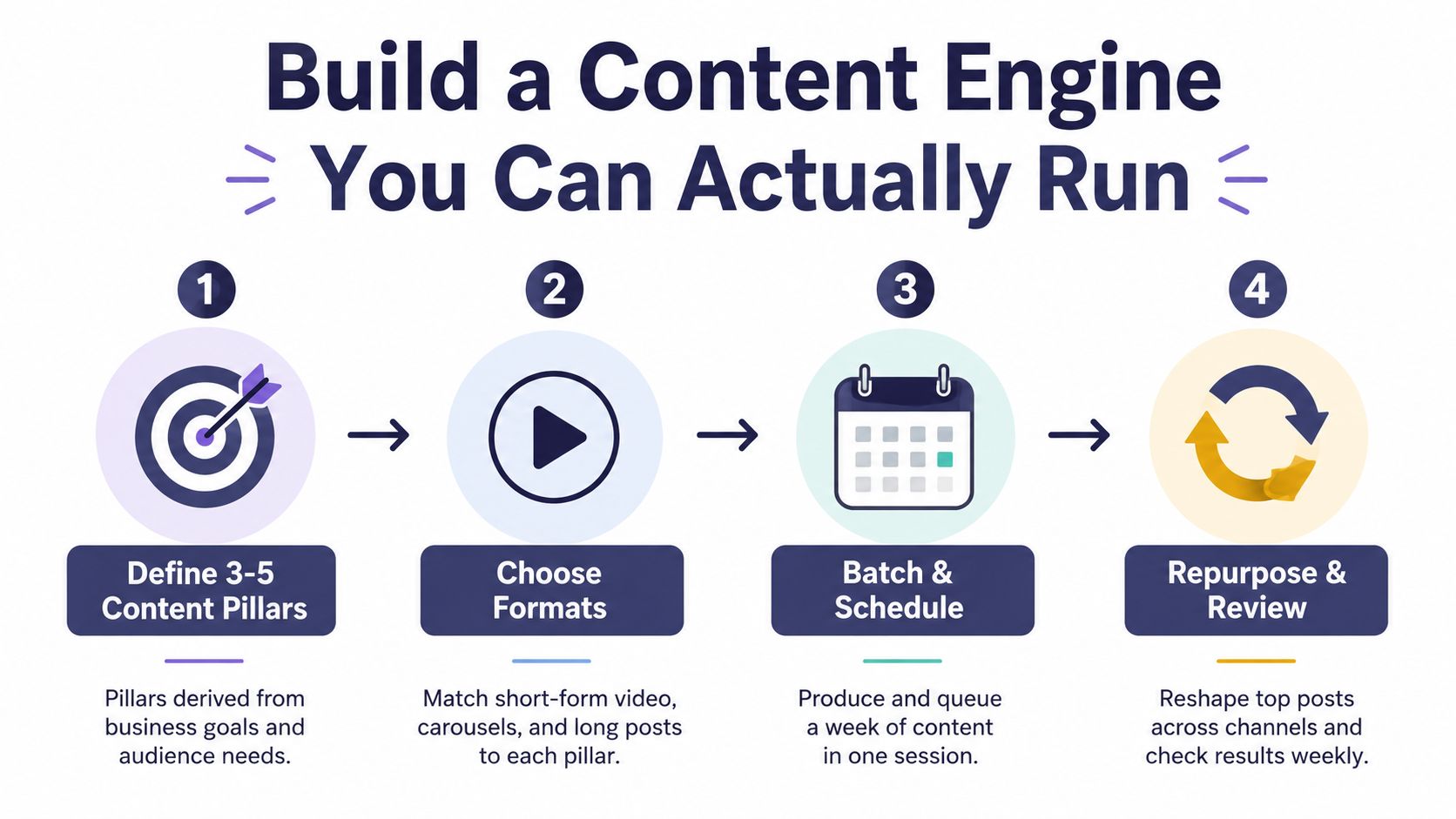
Use a repurpose cascade
Choose the format according to the platform and the stage of trust:
Short-form video: Use for discovery, demonstrations, reactions, and local atmosphere.
Carousel or document: Use for frameworks, checklists, property considerations, and educational breakdowns.
Long caption or article: Use when nuance matters and the reader needs context.
Live session: Use for questions, event momentum, interviews, and community participation.
A sustainable weekly rhythm might begin with one substantial idea, then turn it into a long post, a Reel, a LinkedIn document, a quote card, and a short clip. The point isn't to copy and paste. It's to preserve the insight while changing the opening, pacing, and call to action for each environment.
Keep the operating ratio close to 70% educational, 20% personal or behind the scenes, and 10% promotional as a starting discipline. Batch the work in one session, schedule the pieces, and leave room for timely responses. A real estate campaign can use one neighborhood walk-through for several formats. A food truck can capture preparation, service, and customer atmosphere during one shift. A community event can create weeks of useful material from a single activation.
AI tools can help with ideation, editing, and repurposing, but the operator still supplies judgment, facts, and voice. Richard Maize's guidance on when to use ChatGPT and when to rely on personal judgment fits this workflow: automation should reduce repetitive production, not replace the experience that makes the content worth consuming.
Paid Campaigns and Honest Conversion Expectations
Paid social performs best when the campaign objective matches the audience's readiness. Awareness introduces the business. Traffic sends interested people to a useful page. Engagement shows who responds to a subject. Lead capture requests contact information after the offer has earned enough trust.
Treating every campaign as a purchase campaign wastes budget. Cold viewers usually need repeated exposure, a clear explanation, and a reason to continue the conversation. Social is often more useful as a discovery, credibility, and retargeting engine than as the primary direct-response channel. Earlier benchmarks from Business.com and Socialinsider support a cautious approach, rather than a fixed conversion promise.
Channel | Cold Traffic CVR | Warm Traffic CVR | Best Use |
|---|---|---|---|
Social media | Often lower and variable | Easier to optimize after engagement | Discovery, education, and retargeting |
Not specified in verified data | Not specified in verified data | Nurture and repeat communication | |
SEO | Not specified in verified data | Not specified in verified data | Capture of existing search intent |
Richard Maize's real estate work illustrates the sequence. Social visibility can introduce a property, demonstrate local knowledge, and build recognition before someone is ready to inquire. The same principle applies to Richeeze Melts Food Truck and POPPOP FEST. A location clip or event invitation may create awareness first, then support retargeting when viewers later need a meal, a vendor opportunity, or a community experience.
Spend according to the learning stage
A small daily test can reveal which creative and audience deserve more attention, but budget alone cannot guarantee reach or leads. Use a $5 per day test, a $500 monthly program, or a $2,500-plus scaling budget as internal planning levels, not performance guarantees.
Start with one audience, one offer, and one measurable action. Test a founder video, a property explanation, a Richeeze Melts location clip, or a POPPOP FEST invitation. Retarget people who watched, clicked, or engaged with the strongest message. Lookalike audiences and interest stacking can expand reach, while responsible segmentation keeps the message relevant. A large audience is not automatically qualified, and precise targeting cannot rescue weak creative.
Measure What Matters and Review It Monthly
A social dashboard should separate attention from trust and pipeline. Otherwise, a post with broad reach can appear successful even when nobody visits the website, books a call, joins the email list, or attends the event. Deloitte Digital's State of Social research found that brands are meeting only 69% of their social media business objectives, which points to a measurement and channel-mix problem rather than a simple posting-frequency problem.
Use three KPI tiers
Visibility metrics include reach, impressions, and follower growth. They tell you whether the content is being distributed and whether recognition is developing.
Trust metrics include engagement rate, saves, shares, meaningful comments, and repeat viewers. A saved real estate checklist or a shared event post often signals more intent than a passive view.
Pipeline metrics include profile visits, link clicks, inquiries, booked calls, registrations, and attributed revenue. These metrics connect social activity to a business process, but attribution should be treated carefully because people may discover a brand on social and convert later through search, email, or direct contact.
The verified data provides useful platform engagement reference points, but it doesn't provide universal CTR or CPL benchmarks. A credible 2026 KPI dashboard should therefore avoid filling those cells with invented averages.
Platform | Avg Engagement Rate | Avg CTR (Link) | Avg CPL |
|---|---|---|---|
TikTok | 3.70% median | Not provided | Not provided |
0.48% median | Not provided | Not provided | |
4.7% page-level median | Not provided | Not provided | |
0.15% median | Not provided | Not provided |
Run a 30-day review
Pull native analytics from each active platform and record the result by pillar, format, and call to action. Compare the top two formats with the weakest ones, then produce more of what earned meaningful trust or pipeline movement. Retire content that consistently consumes effort without a useful response.
For paid campaigns, review cost per qualified lead rather than cost per click alone. Keep the dashboard to one page, assign an owner, and hold a short monthly review. Richard Maize's real estate, consumer, and community work illustrates why the same metric can't serve every project. A property conversation, a food truck visit, and an event registration each require a different definition of value.
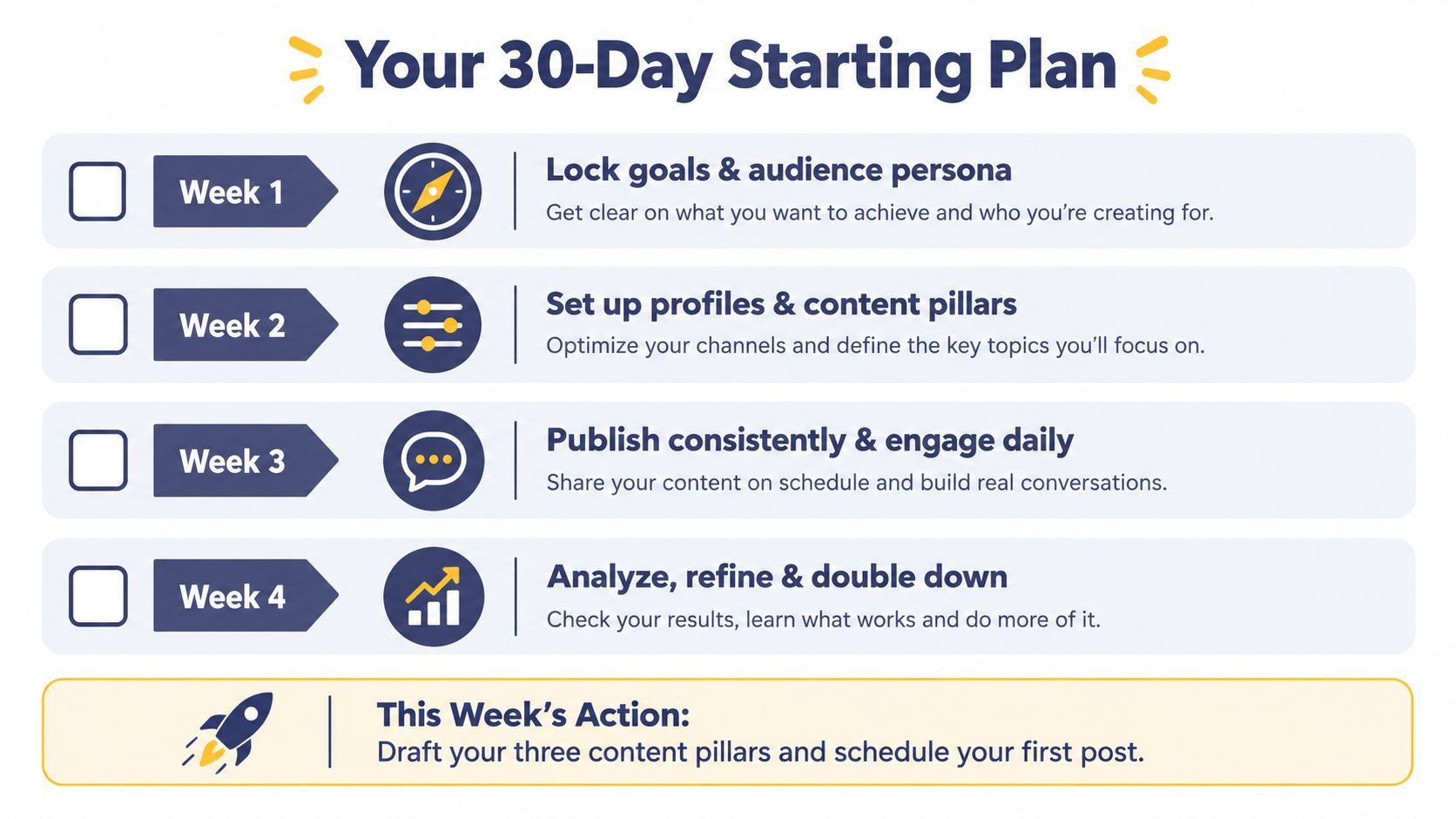
Your 30-Day Starting Plan
Use the next month to build a system, not a flood of disconnected posts.
Week 1: Lock the primary goal, write the audience profile, and select three content pillars. Define the action you want people to take after they encounter the business.
Week 2: Claim the relevant handles, update each bio with a keyword-rich positioning line, and publish five foundational posts. Repurpose those posts across two formats, but adapt the opening and call to action to each platform.
Week 3: Launch a small paid test using the strongest organic performer. A $5 per day retargeting or lookalike test can serve as a controlled experiment, but it isn't a guaranteed reach or lead package. Focus on one audience and one next step.
Week 4: Review the KPI dashboard, remove underperforming pillars, and document the workable cadence in a one-page standard operating procedure.
A real estate agent could use this plan to introduce a new neighborhood campaign through market education, property footage, and local context. A food truck operator could build anticipation for a weekend location with preparation clips, a menu explanation, and a timely location update. A community organizer could use founder stories, participant content, and practical event information to encourage ticket presales.
The single move to make in week one is straightforward: write one positioning sentence that explains who you help and what you help them do, then record a 60-second founder story. Clip that story into platform-native versions, and let the voice behind the business carry the first month of content.
Richard Maize offers practical perspective across real estate, business investment, consumer ventures, and community initiatives, all of which show why social media works best when visibility connects to a real operating story. Visit Richard Maize to explore his business insights, media, ventures, and community work, then use one relevant idea to shape your first week of content.
Comments