How to Give Back to Your Community: A Guide From Philanthropist Richard Maize

When you decide you want to make a difference, the next question is always how. The desire to contribute is a powerful start, but as I’ve learned throughout my career, real impact comes from aligning your resources—your time, your skills, and your capital—with the right opportunities.
It's about moving past the idea of just writing a check and instead building a deliberate plan for giving back, one that reflects the same strategic thinking used in business.
Your Blueprint For Making A Real Difference
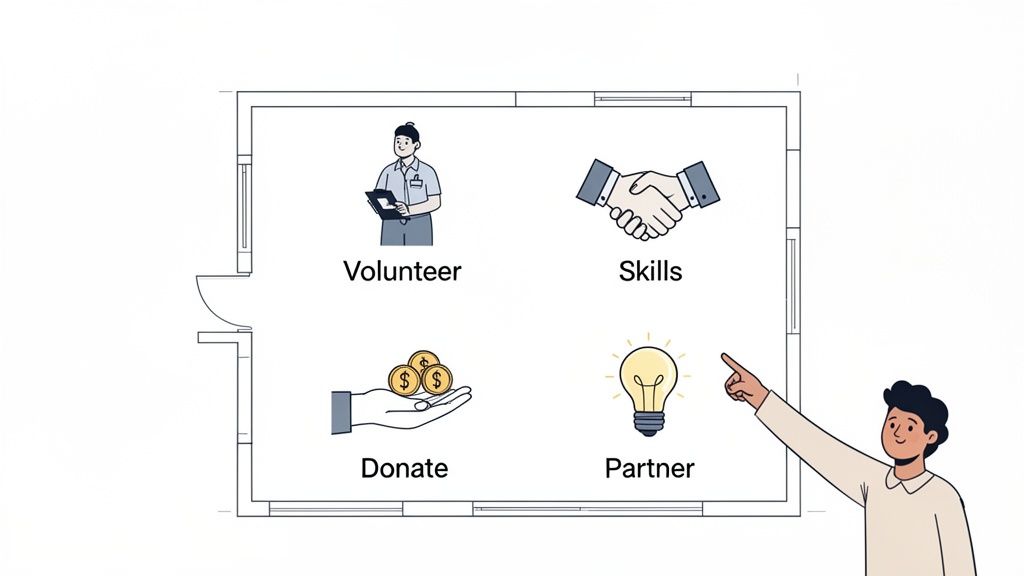
In my experience, the most effective philanthropy isn't always about the biggest gesture. It’s about making a tangible, lasting difference in a way that’s sustainable for you or your business.
This isn’t just about traditional charity. It's a modern playbook for giving back in a way that matches your life, whether that’s through hands-on volunteering, contributing your professional expertise, or even building giving back directly into your company’s DNA. Throughout my career, I've found that the same strategic thinking that builds successful businesses can also drive meaningful social good.
Finding Your Path To Giving
You don't need to be a large-scale philanthropist to create change. As I've seen in my own work, it’s about applying your resources where they can do the most good, no matter the scale. You can read more on how I’ve worked to balance success with a commitment to giving back.
That impulse to help is a massive global force. According to a UN report, an incredible 2.1 billion people volunteer each month. That’s 34.5% of the world’s working-age population. Much of this comes from informal acts like helping a neighbor, which proves that consistent, focused actions add up to powerful results.
"Effective giving isn’t about the size of the donation; it’s about the precision of the impact. The goal is to apply your unique resources—whether that’s time, talent, or capital—where they can generate the greatest possible good for the community." - Richard Maize
So where do you begin? The best way to start is by understanding the primary pathways for making a contribution. Each one offers a distinct way to support the causes you care about.
The table below offers a quick comparison to help you find a starting point that fits your resources, goals, and lifestyle.
Your Pathways to Community Giving
Method of Giving | What It Involves | Best For | Example |
|---|---|---|---|
Volunteering Time | Dedicating your personal time to support an organization's mission on the ground. | Individuals with flexible schedules who want a hands-on experience. | Serving meals at a local shelter or helping with a community garden project. |
Donating Skills | Offering your professional expertise for free (pro bono work) to help a nonprofit operate more effectively. | Professionals and skilled tradespeople looking to make a high-impact contribution. | A graphic designer creating a brochure for a youth center or an attorney providing free legal advice. |
Financial Donations | Providing capital to organizations so they can fund programs, cover operational costs, or respond to urgent needs. | Anyone who wants to provide direct, flexible support to fuel an organization's work. | Setting up a recurring monthly donation to a food bank or contributing to a specific capital campaign. |
Strategic Partnerships | Integrating community support directly into your business model through sponsorships, programs, or campaigns. | Business owners and companies wanting to align their brand with social good and engage employees. | Sponsoring a local charity event or launching a "buy one, give one" product campaign. |
Think of these as your core toolkit. You don't have to pick just one. In fact, the most effective givers I know often combine them—volunteering their time while also making financial contributions or using their business as a platform for partnerships. The key is to be intentional.
Find A Cause That Truly Matters to You
The most powerful way to give back starts with a simple, personal question: what do you actually care about?
In my own philanthropic work, I’ve found that lasting, meaningful impact is almost always fueled by genuine passion, not a vague sense of obligation. Before you commit your time or your money, you have to connect that desire to help with a cause that resonates with you on a deep, personal level.
This alignment does more than just feel good—it prevents burnout and keeps your efforts focused. Instead of scattering your resources across dozens of unrelated initiatives, you can channel them into a single area where you can make a real, measurable difference.
Look Inward Before Reaching Out
A good example of this is the work we do at the Rochelle and Richard Maize Foundation. Our efforts aren’t random. We concentrate on specific areas like healthcare, education, and supporting at-risk youth because these are the causes my family and I are deeply committed to. That personal connection is the engine behind everything we do.
To find your own focus, start with some honest self-reflection. Ask yourself a few questions:
What injustices in the world make you angry? Frustration is often a powerful motivator for change.
What experiences in your own life have shaped how you see the world? Personal history often points to the issues that hit closest to home.
If you had unlimited resources, what one problem would you solve? This thought experiment cuts through the noise and clarifies what truly matters to you.
This isn’t about finding the “right” answer. It’s about discovering what uniquely moves you. Your passion is the foundation for creating any kind of lasting change.
"The goal is to find the intersection of what your community needs and what your heart is drawn to. When your giving aligns with your core values, it stops feeling like a duty and becomes a part of who you are." - Richard Maize
Connecting Your Passion to a Specific Need
Once you have a general idea, it’s time to get specific. A passion for “helping animals” is a great start, but it’s too broad to be actionable. To give back effectively, you have to translate that broad passion into a tangible mission.
Think about the journey of an animal advocate. They might start by volunteering at a local shelter, only to discover the heartbreaking reality of breed-specific legislation—policies that lead to countless healthy dogs being euthanized.
Suddenly, a general love for animals transforms into a focused mission: ending discriminatory policies against specific breeds. This firsthand experience gives their passion a sharp, clear direction.
This shift from passive supporter to active agent of change is critical. Animal welfare experts have shown that breed-based policies have no scientific basis and are incredibly costly. One county, for instance, spent as much as $500,000 annually to enforce an ineffective breed ban. Armed with that knowledge, a general passion now has a clear objective and a compelling, data-backed case for action.
Crafting Your Personal Philanthropic Mission
With a focused cause in hand, the final step is to formalize it. This doesn’t have to be complicated. A simple, clear sentence or two is all you need to guide your decisions and keep your efforts consistent. It becomes your north star.
Think of it this way:
What’s your action? (To support, to create, to advocate for, to fund).
Who or what will you help? (Underserved students, local parks, homeless veterans).
What’s the outcome you want? (By providing resources, to ensure safe spaces, through mental health support).
Here are a couple of examples of what this looks like in practice:
"My mission is to support at-risk youth in my city by funding after-school arts programs that foster creativity and confidence."
"I will advocate for the preservation of local green spaces by organizing volunteer clean-up events and supporting urban forestry initiatives."
This statement becomes your filter. When a new opportunity comes along, you can ask a simple question: "Does this align with my mission?" That check ensures your time, skills, and resources are always directed toward the change you most want to create.
Choose Your Method For Maximum Impact
Once you’ve found a cause that resonates, the next question is a practical one: how are you going to help? The method you choose is just as critical as the mission itself.
A thoughtful approach ensures your time, money, or expertise actually helps, rather than creating logistical headaches for the very organizations you want to support. It’s about being strategic.
This simple diagram shows how to get your focus clear before you even think about the method.
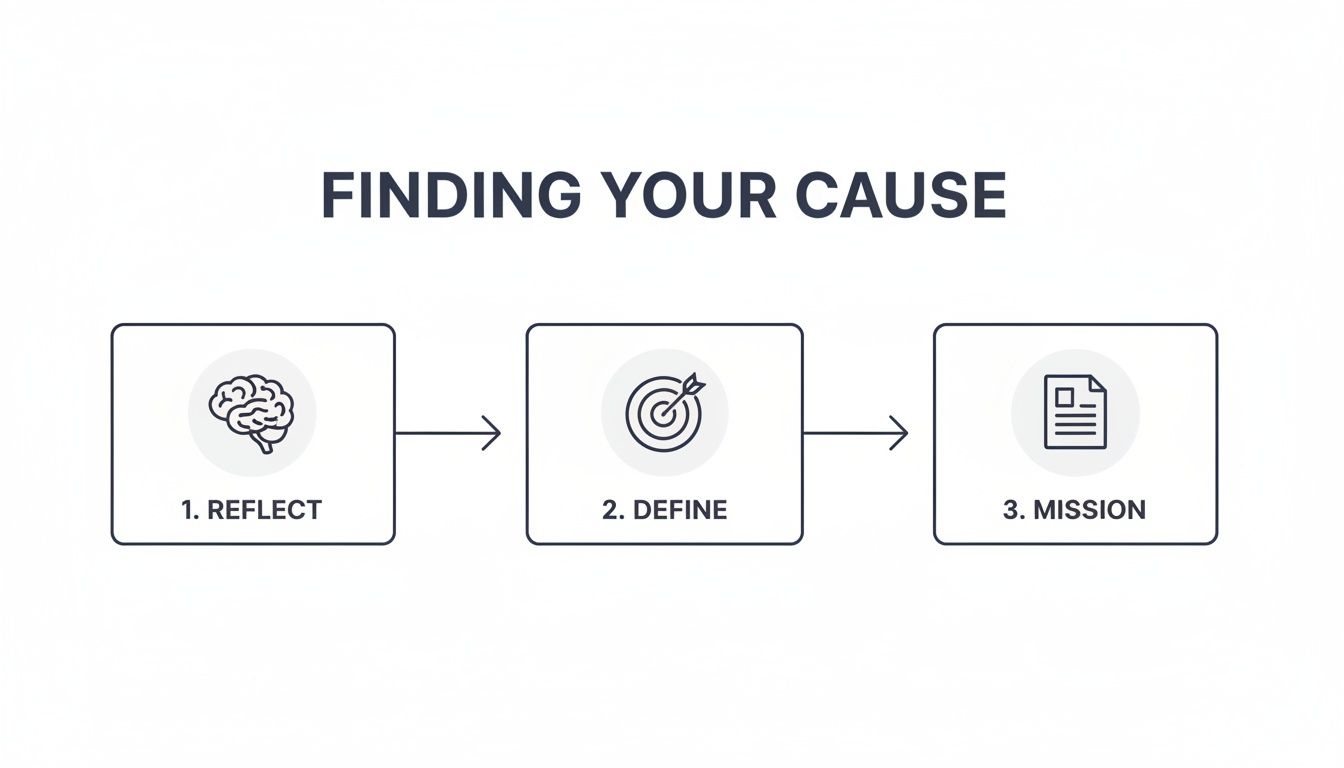
The real insight here is that impact starts with reflection. It has to be clear in your own mind before it can translate into effective action.
Offer Your Professional Skills
One of the most powerful ways to give back is through skill-based volunteering. This is where you donate your professional expertise to fill a gap a nonprofit can’t afford to fill on its own. Most charities run on tight budgets and simply don't have the funds for specialists.
Your professional talent is a huge asset. For example:
A software developer could build a user-friendly website for an animal shelter, streamlining their adoption process.
An accountant could offer a few hours a month to help a small arts organization manage its books.
This kind of contribution delivers immense value. It solves a real business problem, allowing the organization to focus its limited funds on its core mission. From my perspective as an investor, this is a high-leverage move. You're giving something that could cost an organization thousands of dollars.
Provide Strategic In-Kind Support
Beyond your skills, you can also provide in-kind contributions—donations of actual goods or services. This is another highly effective way to help, but it requires careful coordination to be useful.
The key is to ask what an organization actually needs before you give. Unsolicited donations, while well-intentioned, can quickly become a burden. A homeless shelter doesn’t need a hundred winter coats in July; that just creates a storage problem.
A great example of this is how my food truck, Richeeze Melts, partners with community organizations. When disasters like wildfires strike, we don't just show up. We work directly with first responders and aid groups to provide hot meals exactly where and when they are needed most. You can read more about how we provided comfort and hope to Los Angeles fire victims through this kind of coordinated effort.
"The best in-kind donations solve an immediate, specific problem. Always start with a conversation: 'What do you need most right now, and how can we best get it to you?' That simple question turns a good intention into genuine support." - Richard Maize
Make Direct Financial Contributions
Money is the lifeblood of nearly every nonprofit. It provides the flexibility to cover operating costs, fund essential programs, and respond to the unexpected. While time and skills are incredibly valuable, cash is what keeps the lights on.
There are several ways to give financially:
Recurring Donations: A small, automatic monthly donation creates a predictable income stream that helps organizations budget for the long term.
One-Time Gifts: Larger, one-time contributions can fund specific projects, like a new piece of equipment or a capital campaign.
Fundraising: You can also amplify your impact by fundraising on behalf of an organization, getting your own network involved.
From my work with the Rochelle and Richard Maize Foundation, I've seen that unrestricted financial support is often the most empowering gift you can give. It shows you trust the organization’s leadership to allocate resources where they are needed most. Smart financial giving is what fuels the engine of change.
Weave Giving Into Your Business DNA
For a business, giving back isn't just a charitable act. It can be woven directly into your company’s DNA, becoming a core piece of your brand and a powerful strategic advantage. I've always blended my business ventures with a foundational commitment to community support, and I’ve seen firsthand how this transforms a company.
The most successful businesses I’ve built or observed don’t treat philanthropy as an afterthought. They design it into their operations from the ground up. This creates a powerful cycle where doing good also generates good business—it strengthens your brand, elevates employee morale, and attracts the kind of talent that wants to be part of something meaningful.
Build A Corporate Social Responsibility Program
A Corporate Social Responsibility (CSR) program is the formal framework for how your company makes an impact. It's more than just writing a check; it’s a public statement about your values and a plan to engage your team in authentic ways.
You don’t need a massive budget to get started. The key is alignment. If you're a tech company, supporting local STEM education makes sense. If you're in real estate like me, contributing to affordable housing initiatives feels natural and genuine. This alignment is what makes your giving credible. For a deeper dive, you can explore more insights on the role of philanthropy in modern business strategy.
An effective CSR program usually includes a mix of initiatives:
Financial Donations: Pledging a set percentage of profits to a charity you believe in.
Event Sponsorships: Backing a local nonprofit's annual gala or a community fun run.
In-Kind Support: Offering your company’s services or products pro bono to organizations that need them.
The goal is to build a structured, sustainable plan that becomes part of your company’s annual rhythm. That long-term commitment is what truly earns respect from customers and employees.
Launch An Employee Volunteer Initiative
One of the best ways to bring your company's giving philosophy to life is by empowering your employees to volunteer. These programs provide incredible support to community organizations, but they also do wonders for internal morale, teamwork, and retention.
The data backs this up. According to the Association of Corporate Citizenship Professionals, 61% of CSR professionals have seen a rise in employee volunteerism. That matters because today’s workforce is looking for purpose, not just a paycheck—in fact, 70% of job seekers prefer employers with a strong social mission. You can discover more insights about this trend in their full 2026 CSR report.
"The best volunteer programs empower employees to support causes they personally care about. When your team feels a genuine connection to the work, their engagement soars, and the impact they make is far more meaningful." - Richard Maize
To put this into action, consider offering paid time off for volunteering—even a few hours a quarter makes a difference. You can also organize company-wide volunteer days, which are fantastic for team-building. Partnering with a single local nonprofit can help streamline your efforts and build a deep, lasting relationship.
Design Ventures With A Give-Back Component
The most integrated approach is to build philanthropy directly into the fabric of your business ventures from day one. This model, often called social entrepreneurship, creates a business designed to generate both profit and social good at the same time. It’s a concept I’ve applied in my own projects, ensuring community benefit is a core objective, not just a side effect.
For instance, a real estate development can include dedicated space for a community center or set aside affordable housing units. A retail brand can use a "buy one, give one" model. My own venture, the Richeeze Melts food truck, was designed not only to serve great food but also to act as a mobile resource for community support during local crises.
This approach makes your company a pillar of the community. It shows that your success is tied to the well-being of the people you serve. When you design your business this way, you create a powerful identity that attracts loyal customers and dedicated employees who want to be part of something bigger than a balance sheet.
Measure Your Impact And Give With Confidence
Meaningful giving is not about good intentions. It is about verifiable results.
In my experience as both a real estate investor and a philanthropist, I see a clear parallel. You would never invest capital without tracking its performance. The same discipline applies to philanthropy. Your resources—whether time, money, or expertise—should be measured.
Tracking impact gives you the confidence that your generosity is being channeled effectively. It lets you give not just generously, but smartly, ensuring your legacy is one of tangible, positive change.
Define Your Metrics For Success
Before you can measure anything, you have to define what success looks like. This starts with working alongside your chosen nonprofit to understand their key performance indicators (KPIs).
The right metrics will be a mix of two things: hard numbers and human stories.
Quantitative metrics are the concrete data points that provide a clear snapshot of outputs. Think of them as the “what” of your impact.
Qualitative feedback provides the “why.” These are the testimonials and personal accounts that reveal the real-world effect of your support.
A balanced approach is essential. The numbers prove efficiency, but the stories prove effectiveness.
Tracking Quantitative Impact
When you start tracking, focus on clear, specific numbers that tie directly to the program’s goals.
Here are some examples of what to look for:
Financial: The total funds raised, the percentage of a project’s budget you covered, or the number of new donors acquired through a campaign you supported.
Volunteering: Total hours your team contributed or specific tasks completed—like the 100 stewardship events Salt Lake City Public Lands aims for.
Programmatic: The number of meals served, animals adopted, children tutored, or trees planted.
These figures are vital for accountability. They show you exactly what your contribution enabled and help the organization prove its value to others.
Gathering Qualitative Feedback
Numbers tell part of the story. The full picture emerges from the qualitative evidence. This is the feedback that connects you to the cause and validates why the work matters.
"The most powerful confirmation of your impact often comes from a single story—a testimonial from someone whose life was changed, a note from a program leader, or seeing the direct results of your support. These moments are what fuel long-term commitment." - Richard Maize
Work with the organization to collect this kind of feedback:
Testimonials: Ask for stories from community members who have benefited directly.
Partner Stories: Get updates from the nonprofit’s staff about milestones reached and challenges overcome.
Direct Observation: If you can, visit the project. See the work in action and speak with people firsthand.
This is what turns giving from a transaction into a partnership. It’s what I value most in my work with the Rochelle and Richard Maize Foundation—seeing the direct, positive changes in people's lives.
Navigating The Financial and Legal Side
Giving with confidence also means understanding the practical side of philanthropy. Proper due diligence protects both you and the organizations you support.
Before making a significant commitment, use resources like Charity Navigator or GuideStar to review a nonprofit's financial health and transparency. A well-run organization will be open about its operations.
Understanding the tax implications is also crucial. In the U.S., donations to qualified 501(c)(3) organizations are generally tax-deductible. Always keep records of your contributions, like bank statements or acknowledgment letters.
For those planning a more substantial commitment, there are structured ways to give:
Donor-Advised Funds (DAFs): These act like a charitable savings account. You contribute to the fund, get an immediate tax deduction, and then recommend grants to your favorite charities over time.
Private Foundations: This is a more complex structure, like my own family foundation. It gives you complete control over your mission but involves significant legal setup and administrative costs.
The right structure depends on your goals. For many, a DAF offers a great balance of impact and simplicity. By combining smart financial planning with clear impact metrics, you can build a powerful and sustainable legacy.
Common Questions About Giving Back
Once you decide to give back, the practical questions start. Moving from good intentions to real action brings up a lot of details. Over the years, I’ve heard most of them.
Here are the answers to the questions I get asked most often, based on my experience blending business with philanthropy. The goal is to give you the clarity to start making a difference.
How Can I Make An Impact With Limited Time And Money
Impact isn't always about the size of the check or the hours you log. When your resources are tight, you just have to be more strategic. The key is to focus on what you do have—your skills, your network, and your voice.
This is where skill-based micro-volunteering can be incredibly powerful. Maybe you can give a nonprofit an hour of marketing advice each month. Or perhaps you can make one key introduction for a local charity using your professional network. These targeted actions often create a much bigger ripple effect than you’d expect.
Other ways to contribute with high impact but low commitment include:
Donating blood. It’s a simple act that directly saves lives.
Joining a local cleanup. This tangibly improves the neighborhood you live in.
Sharing a cause on social media. Using your platform raises awareness and can inspire others to act.
I’ve learned that the most effective givers are often the most creative. It’s about precision, not just volume.
How Do I Find A Legitimate And Effective Nonprofit
Choosing the right nonprofit is critical. You want to know your contribution is being used well. The process starts with research, but it should always end with a real conversation.
Start with charity rating sites like Charity Navigator or GuideStar. They are a great first stop for due diligence, offering a clear look at a nonprofit’s financial health and transparency.
But don’t stop there. The numbers only tell part of the story.
"A transparent, effective organization will always welcome questions about its operations and impact. If they are hesitant to share details about their successes and challenges, consider it a red flag. True partners are proud of their work and eager to build trust." - Richard Maize
Reach out. Ask pointed questions. Read their annual reports. If you can, volunteer for a single event to see how they operate firsthand. That "boots-on-the-ground" perspective is invaluable before you make a bigger commitment.
Should I Start My Own Foundation
Starting a private foundation, like my family did with the Rochelle and Richard Maize Foundation, gives you the most control. You can direct every dollar with precision and build a philanthropic legacy exactly how you envision it.
But it’s not a path for everyone. A foundation involves a lot of legal setup, ongoing administrative work, and strict compliance rules. It really makes the most sense if you have substantial assets and a very specific, long-term vision for your giving.
For most people, a Donor-Advised Fund (DAF) is a much more practical and effective option. Think of it as a charitable investment account. You make your contribution, get the immediate tax deduction, and then you can recommend grants to nonprofits over time. It gives you much of the same flexibility as a foundation without the heavy administrative lift.
How Can My Small Business Start A Volunteer Program
You don’t need a big CSR department to create a powerful employee volunteer program. The trick is to start simple and make it incredibly easy for your team to get involved.
A great first step is to offer a small amount of paid volunteer time—even just four to eight hours per employee each quarter can make a huge impact. To keep logistics simple, try partnering with one local nonprofit. This lets you build a deeper relationship and focuses your team's efforts.
Another solid strategy is to organize one company-wide volunteer day each year. It’s a fantastic way to build morale and rally everyone around a single cause. You can also "dollarize" your team's volunteering by donating a set amount, say $25, to a charity for every hour an employee volunteers on their own time. The goal is always to lower the barrier to getting involved and celebrate the collective good your team is doing.
At Richard Maize, we believe that business success and community support are two sides of the same coin. Whether it's through real estate, investments, or direct philanthropy, the goal is to create lasting value. You can find more of my insights on blending business with purpose at https://richardmaize.com.
Comments