How to Find Net Operating Income the Right Way

You're staring at a deal sheet with a polished “cash flow” figure highlighted near the top. The spreadsheet looks complete, but the number doesn't feel dependable. Vacancy is understated, management is treated as free, and the mortgage payment is mixed into the same column as repairs. Before you decide what the property is worth, you need to know how to find net operating income without letting financing choices and optimistic assumptions distort the result.
NOI is the operating profit of the property before debt service, depreciation, income taxes, and capital expenditures. It gives lenders, appraisers, and buyers a common measure of what the building itself produces. The calculation is simple. The judgment behind the inputs is where deals get mispriced.
Why Net Operating Income Is the Number That Matters
A buyer reviewing a Los Angeles multifamily deal may see three different stories in the same spreadsheet. The seller points to rent growth, the broker emphasizes gross income, and the owner focuses on cash left after loan payments. Net operating income, or NOI, gives you the property-level baseline before financing and ownership choices influence the result.
NOI equals property revenue minus operating expenses. It excludes debt service, depreciation, income taxes, and capital expenditures. Investopedia's explanation of NOI describes it as a measure of income generated by operations alone.
The inputs require more judgment than the formula. A vacancy assumption that looks minor can reduce effective income substantially. A management fee omitted because the owner handles leasing personally can make the building appear more profitable than it would be under professional management. Using gross income instead of effective gross income creates the same problem, because the latter accounts for vacancy and credit loss before expenses are deducted.
Suppose a 12-unit Los Angeles property shows $60,000 in annual revenue and $24,000 in operating expenses. Its NOI is $36,000, provided that the revenue figure already reflects realistic collection. If the $60,000 represents fully occupied scheduled rent while several units are typically vacant, the reported NOI is overstated. The right question is not whether the formula works. It is whether the income line reflects what the building can actually collect.
Practical rule: Calculate the property first, then calculate the ownership structure. Mixing the two prevents clean comparisons between deals.
NOI also supports the valuation relationship Property Value = NOI / Cap Rate, a standard commercial real estate approach. A higher or lower NOI changes indicated value even when the loan terms remain unchanged. Lenders assess whether operations can support debt, while investors and appraisers use NOI to compare income-producing properties.
A debt-free owner and a highly indebted owner may receive different distributions from the same building. The property's operating result should remain comparable. Build that result from collectible income, realistic vacancy, and every ordinary operating cost, including management.
The Exact Formula and What Stays Out of It
A working formula is:
NOI = Gross Operating Income − Operating Expenses
Gross operating income is the property's collectible operating revenue, not the rent roll at full occupancy. Start with potential rental income, deduct vacancy and credit loss, add other property income, then subtract operating expenses. LoopNet's NOI guide describes the same sequence, with potential rent adjusted for vacancy and credit loss before other income and expenses are applied.
The operating boundary
Mortgage principal and interest remain outside NOI because they belong to the capital stack. Two owners can finance identical buildings differently, producing different debt payments while the properties generate the same operating result. Income taxes also stay out because they depend on the ownership entity and the investor's tax position.
Depreciation is a non-cash accounting deduction rather than a recurring cost required to operate the property. Capital expenditures, such as a major roof or system replacement, sit below the operating line because they improve or extend the asset instead of representing ordinary day-to-day operations.
Property management fees belong inside NOI. Include an imputed management fee when the owner handles the work personally, or the comparison will make self-managed operations look cheaper than professional management.
Line Item | Include in NOI? | Why |
|---|---|---|
Rental income after vacancy and credit loss | Yes | Measures collectible property revenue |
Parking, laundry, storage, and other income | Yes | Comes from operating the asset |
Property taxes and insurance | Yes | Recurring property-level costs |
Repairs, utilities, and management | Yes | Required to run the building |
Mortgage principal and interest | No | Financing costs vary by ownership structure |
Income taxes | No | Depend on ownership and tax circumstances |
Depreciation | No | Non-cash accounting expense |
Capital expenditures | No | Below-the-line improvements and replacements |
The result is not the owner's final cash distribution. It measures the asset's operating earning power before financing, taxes, depreciation, capital projects, and other ownership decisions are applied.
Building the Income Side Step by Step
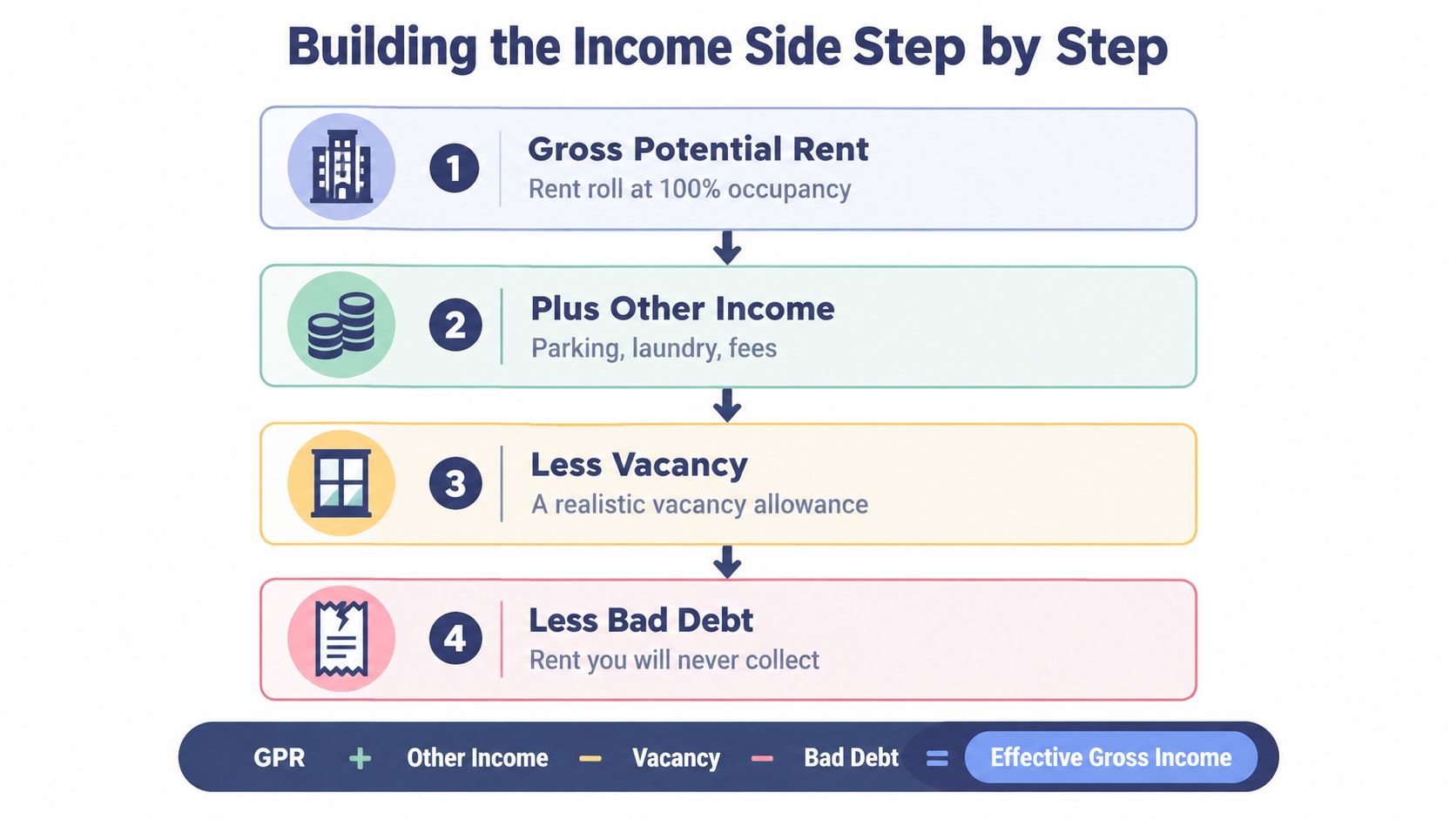
Start with Gross Potential Rent, the rent roll assuming every unit is occupied and every scheduled dollar is collected. It sets the ceiling, not the likely result. Vacancy, delinquency, concessions, and leases priced below current market rent can all reduce the amount that reaches the bank account.
Then estimate vacancy and credit loss. A flat allowance can work when the property has stable history and the submarket provides credible benchmarks. Unit-level assumptions are better when leases are expiring, collections vary by tenant, or the rent roll reveals upcoming turnover. That extra work often exposes the gap between physical occupancy and collectible income.
In practice, audited collections rarely exceed 95% of gross potential rent on stabilized assets, so treat anything above that as a question, not an assumption. A small change in the allowance can alter NOI by thousands of dollars, especially in a larger building.
Add ancillary income line by line. Depending on the property, this may include laundry, parking, storage, utility reimbursements, pet fees, enforceable late fees, or antenna leases. Avoid hiding these amounts in a vague “miscellaneous” line. Note whether each figure comes from leases, historical collections, or a management estimate.
A compact example
Suppose an 8-unit building has gross potential rent of $144,000. A 5% vacancy and credit-loss allowance equals $7,200, leaving $136,800 in collected rental income. Add $6,000 of miscellaneous income, and effective gross income becomes $142,800.
That subtotal should feed the operating-expense analysis. Calling $144,000 “income” assumes perfect occupancy and collection, making every later ratio look stronger than the property warrants.
For landlords, collection quality also depends on operating discipline. Richard Maize's property management tips for landlords offer a practical reference for decisions affecting maintenance, tenant experience, and collections.
Before entering expenses, ask one question: What revenue is this property likely to collect under defensible operating assumptions? That answer is effective gross income.
Subtracting the Right Operating Expenses
Once effective gross income is set, subtract the costs required to run the property. Property taxes, insurance, utilities, routine repairs, landscaping, pest control, janitorial work, vacancy marketing, and management fees generally belong in NOI. JPMorgan's NOI guidance separates those operating costs from debt service, income taxes, depreciation, amortization, and capital expenditures.
Purchase underwriting requires closer tax review. A seller's current bill may not reflect the assessment after closing, so using it unchanged can understate the expense you will carry. Insurance deserves the same scrutiny when renewal costs have moved sharply from the previous policy period.
What belongs in the expense column
Management should be included even when the owner plans to handle the work personally. In my underwriting I model management at 5% to 8% of collected income, with smaller buildings trending toward the high end because fixed oversight costs spread across fewer units. Apply the fee to effective gross income, not an optimistic rent-roll total. For a broader way to test operating efficiency, use this real estate operating expense ratio guide alongside the property's actual statements.
Line Item | Include in NOI? |
|---|---|
Property taxes | Yes |
Insurance | Yes |
Utilities | Yes |
Routine repairs and maintenance | Yes |
Property management | Yes |
Landscaping, pest control, and janitorial | Yes |
Vacancy marketing | Yes |
Mortgage principal and interest | No |
Major capital improvements | No |
Depreciation and income tax | No |
Tenant improvements and leasing commissions | No |
A replacement reserve needs an explicit policy. Some underwriting shows reserves below NOI. Other models include a recurring reserve to reflect the economic cost of maintaining the asset. Either treatment can work, but label it clearly. Otherwise, one property's pre-reserve NOI gets compared with another's reserve-adjusted result.
Mortgage interest, depreciation, and income tax often end up in the operating column because they affect the owner's actual cash position. They still do not measure property operations. Including them lowers NOI, distorts the cap rate, and weakens the debt-service coverage analysis a lender performs.
Ratios can flag unusual expenses, but they do not replace invoice-level diligence. Review the statements, contracts, tax history, insurance renewals, and management arrangement before accepting a percentage as realistic. Small changes in fees or recurring maintenance can move NOI materially, especially in a smaller building.
A Real Deal Walkthrough on a 12-Unit Building
Consider a working-class multifamily property in Los Angeles with 12 units. Market rents sit around $1,650, although a couple of long-term tenants pay below-market rents. One unit is vacant, and the building produces modest laundry income plus revenue from two parking spaces.
For a clean underwriting illustration, use annual potential gross rent of $237,600, based on the current rent roll and reasonable market support rather than assuming every unit immediately reaches the highest asking rent. Apply a 5% vacancy and credit-loss allowance, or $11,880. Add $3,600 from laundry and parking, producing effective gross income of $229,320.
The expense build
The operating column might look like this:
Annual line item | Amount |
|---|---|
Effective gross income | $229,320 |
Property taxes | $18,400 |
Insurance | $7,200 |
Utilities | $5,600 |
Repairs and maintenance, 8% of EGI | $18,345.60 |
Contract cleaning | $3,600 |
Landscaping | $4,800 |
Pest control | $1,200 |
Management, 6% of EGI | $13,759.20 |
Marketing and advertising | $1,800 |
Replacement reserve, 3% of EGI | $6,879.60 |
Total listed expenses | $81,584.40 |
NOI | $147,735.60 |
This example lands in the low-to-mid $130,000s only if the reserve policy, maintenance assumptions, or other operating lines are materially heavier than the listed base case. With the specific inputs shown above, the calculated NOI is $147,735.60, or roughly $148,000. That distinction is exactly why a buyer should show every line rather than force a target result.
A more conservative version could add administrative costs, higher turnover work, or a larger replacement allowance. If those additions reduce NOI into the low-to-mid $130,000s, the model should display them explicitly. Don't hide the difference inside a generalized expense ratio.
Underwriting habit: If the result doesn't match your initial expectation, change the assumptions only when the evidence supports the change. Never adjust the output to make the deal fit the flyer.
The two below-market units also deserve separate treatment. An as-is NOI should use their actual in-place rents. A stabilized scenario may mark them toward supported market rent, but that upside belongs in a clearly labeled forecast, not in the current operating result.
The Quiet Decisions That Change Your NOI
The formula is fixed. The inputs are negotiable, and those inputs often matter more than the arithmetic. In a Los Angeles multifamily deal, a small change in vacancy, management, or income definition can move NOI by thousands of dollars.
Start by choosing the income base. The current rent roll shows what the property produces today. A marked-to-market schedule shows what it might produce after leases reset. A blended view can help when some leases expire soon and others remain locked in, provided the model separates collected revenue from projected revenue.
The assumptions hiding in plain sight
Vacancy is one of the quietest levers. Los Angeles multifamily underwriting commonly uses vacancy and credit-loss assumptions around 3% to 7%, while long-term rent-stabilized buildings are often modeled closer to 2% to 3%. On a 12-unit property, the difference between those ranges reduces effective income before operating expenses are deducted. Freddie Mac's multifamily underwriting materials provide a useful reference point for testing whether the selected assumption fits the property and market.
Management creates another choice. An owner who self-manages may omit the fee and show a stronger NOI. A buyer who plans to hire professional management must include that cost, even if the current owner performs the work personally. The income base also matters. A fee calculated on gross potential rent will be higher than one calculated on effective gross income, especially when vacancy is material.
The same classification issue appears with an on-site handyman. Routine labor belongs in operating expenses. A genuine improvement project may be capital work. Putting every invoice under repairs depresses current NOI, while moving recurring maintenance into capital expenditures makes NOI look stronger than the property's operations justify.
Repairs should be tested against both EGI and unit count. A percentage-of-income method changes as revenue changes. A per-unit approach captures the recurring work an older building may require even while units are vacant. Neither method is automatically correct. The building's age, systems, and maintenance history determine which assumption can withstand review.
Stress the deal before you trust it
Trailing twelve-month actuals usually describe operations better than a short trailing period, but a T-12 can still contain an unusual repair, a temporary vacancy, or outdated insurance. Compare it with the current rent roll, vendor contracts, tax records, renewal quotes, and collection history. A pro forma should explain each adjustment rather than overwrite the evidence.
A current-market case also needs restraint. Business.org's 2025 NOI coverage notes that multifamily NOI growth slowed to 1.8% in 2025 from 3.4% the prior year. That supports testing softer rent growth and normalized expenses instead of carrying every recent increase forward.
Use the 12-unit example to run three labeled cases:
Flat-rent case: Hold rents steady, apply 5% expense growth, and recalculate EGI, management, repairs, and NOI.
Vacancy case: Increase vacancy by 100 basis points. Collected rental income falls, and management fees tied to EGI may fall with it.
Combined downside case: Apply softer revenue and higher expenses together. In the conservative version of this example, NOI falls by roughly $40,000. The exact reduction depends on the expense lines that move and whether reserves are included.
Valuation makes the effect visible. At a 6% cap rate, the base-case NOI of $147,736 implies roughly $2.46 million of value. The combined downside case removes about $660,000 of value at the same yield. The formula is NOI divided by the cap rate, as explained in this cap-rate methodology reference. A different cap rate changes the result, so one forecast and one market yield should not be treated as certainty.
After closing, rerun the model quarterly. Compare rent collections, vacancy, insurance, taxes, repairs, management, and reserve spending with the underwriting file. A deal sheet is an opening hypothesis, not a permanent operating truth.
Your Spreadsheet Template and Closing Checklist
Build the model on one Google Sheets or Excel tab with three stacked blocks: Income, Operating Expenses, and NOI Summary. Use four columns throughout:
Line item | Monthly | Annual | Source or note |
|---|---|---|---|
Gross potential rent | Rent roll or lease audit | ||
Vacancy and credit loss | Assumption and historical support | ||
Other income | Parking, laundry, reimbursements | ||
Effective gross income | Formula subtotal | ||
Operating expenses | Statements and contracts | ||
NOI | EGI minus operating expenses |
Tie vacancy and credit loss to gross potential rent with a visible formula. Tie management to the selected income base. If you include a replacement reserve in the operating presentation, label it so a reviewer can reconcile your NOI with a lender's or appraiser's convention.
Watch for four recurring errors:
Double-counted management: Check whether payroll or an owner-management fee already appears elsewhere.
Mortgage interest included: Keep principal and interest below NOI.
T-12 mixed with pro forma: Mark every line as actual, adjusted, or projected.
Capex ignored: Track major replacements separately, even when they don't enter the headline NOI.
Before signing off, confirm the rent roll, collection history, vacancy evidence, ancillary-income records, tax assessment, insurance quote, utility bills, repairs ledger, management fee, reserve policy, and capital plan. Richard Maize's commercial real estate due diligence checklist can help organize that review.
The final sign-off should state: “NOI is based on verified income, documented expenses, and explicitly labeled assumptions.” Your template is only as honest as the assumptions you type into it.
Richard Maize offers practical real estate and investment perspective grounded in decades of hands-on experience with property performance and portfolio decisions. Visit Richard Maize to explore his real estate insights, business ventures, and due-diligence resources before you underwrite your next deal.
Comments