How to Find a Business Mentor: An Expert's Guide for 2026

Finding a business mentor is one of the most powerful moves an entrepreneur or real estate investor can make. It’s a direct line to experience, offering insights that can save you years of trial and error and protect you from costly mistakes. As a real estate investor and entrepreneur, I, Richard Maize, have seen firsthand how the right guidance can transform a career.
The process isn't complicated, but it does require discipline. It comes down to three things: defining exactly what you need, finding the right people, and then building a genuine relationship.
Your Blueprint for Finding the Right Business Mentor
Whether you’re scaling a real estate portfolio in Los Angeles or launching a new venture, the principles for finding great mentorship are the same. It starts long before you ever send an email or make a call.
It starts with getting clear on your own goals.
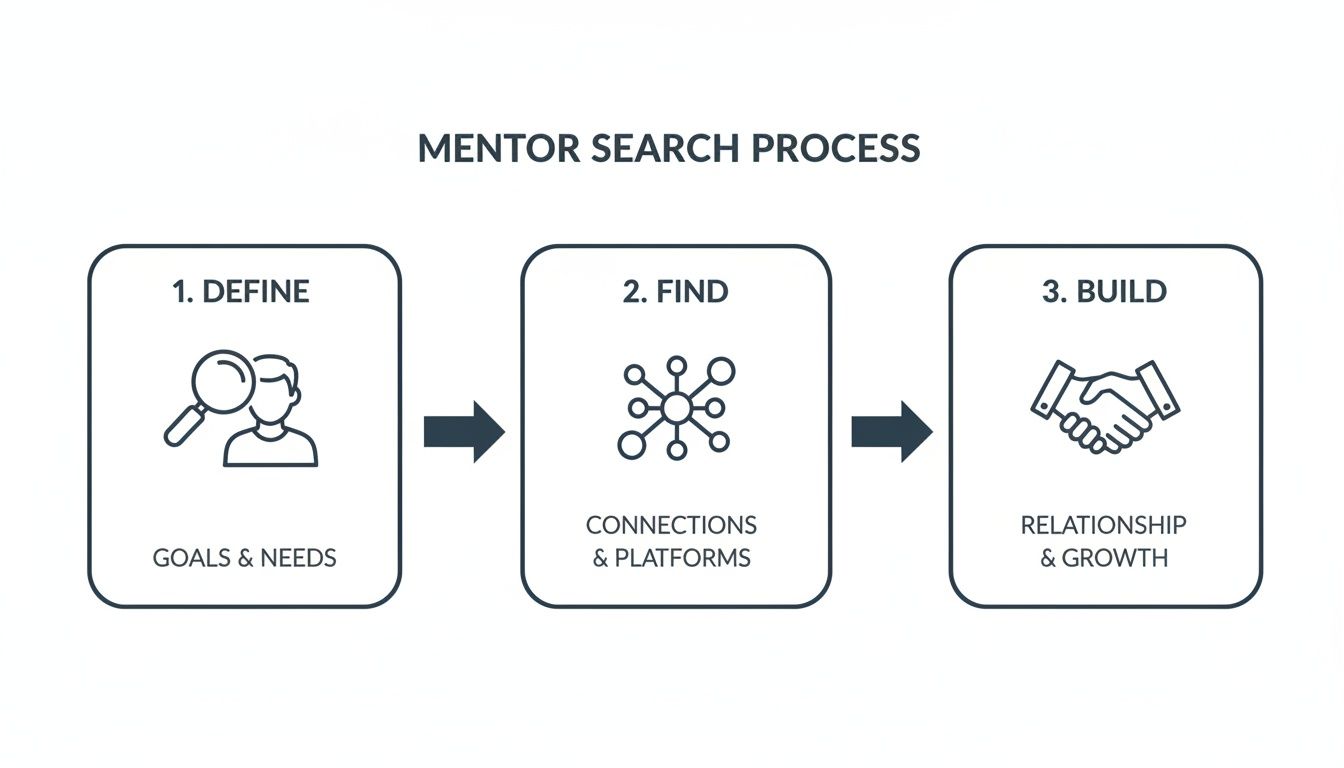
This process highlights a critical truth: your search will only be as good as your preparation.
The Right Mindset Is Everything
Before you look for a mentor, you have to get your own mindset right. A mentorship is a partnership, not a one-way street where you just take, take, take.
Experienced leaders look for mentees who are driven, prepared, and respectful of their time. They want to invest their wisdom in someone who will put it to good use. The relationship has to be built on mutual benefit, where your progress becomes the return on their investment.
You have to shift from thinking, “What can I get?” to “What can we build together?” Adopting this perspective is the key to attracting a high-caliber mentor who is genuinely invested in your success. To learn more about this, you should explore what it means to embrace an entrepreneurial mindset.
The Data Doesn't Lie
The impact of having a guiding hand is clear. While only 37% of professionals have a mentor, a massive 76% agree that mentorship is critical for their careers. That gap is a huge opportunity for anyone willing to do the work to find one.
The results speak for themselves. An incredible 97% of people with mentors find the relationship invaluable. And the cycle continues—89% of those who receive guidance go on to mentor others, creating a powerful ripple effect of shared knowledge.
Define Your Ideal Mentor
The first step is knowing who you’re looking for. A great mentor isn’t just a successful person; they are someone whose success is relevant to your specific goals. You wouldn't ask a heart surgeon for advice on structuring a commercial real estate deal.
This table can help you get specific about what you need before you start your search.
Your Personal Mentor Identification Framework
Your Business Goal | Required Mentor Expertise | Ideal Mentor Experience |
|---|---|---|
Example: Secure my first 10-unit multifamily deal in LA. | Deal sourcing, underwriting, local market analysis. | An investor who has successfully acquired and managed multifamily properties in Southern California within the last 5-10 years. |
Example: Raise a $2M seed round for my proptech startup. | Venture capital, pitch deck creation, investor networking. | A founder who has successfully raised Series A funding or an angel investor active in the proptech space. |
Example: Scale my fix-and-flip business from 5 to 20 properties a year. | Systems and operations, team building, private money lending. | A real estate operator who has built a high-volume flipping business and managed construction and sales teams. |
Once you've mapped this out, you can start building a clear profile of the person who can truly help you.
As an expert like Richard Maize would advise, think about these core traits as you refine your search:
Relevant Experience: Have they actually walked the path you’re on? If you're in real estate, look for someone who has navigated market cycles, not just a bull run.
Aligned Values: Do their ethics and professional philosophy resonate with you? A mentor’s character is just as important as their track record.
A Generous Spirit: The best mentors are those who genuinely want to see others succeed. They share their network, give honest feedback, and celebrate your wins.
This preparation moves you from a vague wish for "help" to a clear, actionable plan. It's the foundation for finding a mentor who will make a real difference.
Pinpointing Your Mentorship Needs and Goals
You can't find the right mentor if you don't know what you need. It’s that simple. An unfocused search just wastes everyone’s time and leads to a partnership that goes nowhere.
Vague goals like "I want to be successful" or "I need help with my business" are impossible for a mentor to act on. They need a target. You have to give them one.
The entire process begins with an honest look in the mirror. Are you struggling with financial modeling for a new real estate deal? Do you need an introduction to venture capital firms? Or maybe you're facing the operational headaches of scaling a business, like taking a single successful food truck like Richeeze Melts and turning it into a regional fleet.
Each of those problems requires a completely different guide.
From Vague Ideas to Measurable Targets
To attract a high-caliber mentor, you have to move beyond dreaming and get specific. A serious professional needs to see a clear finish line they can help you cross.
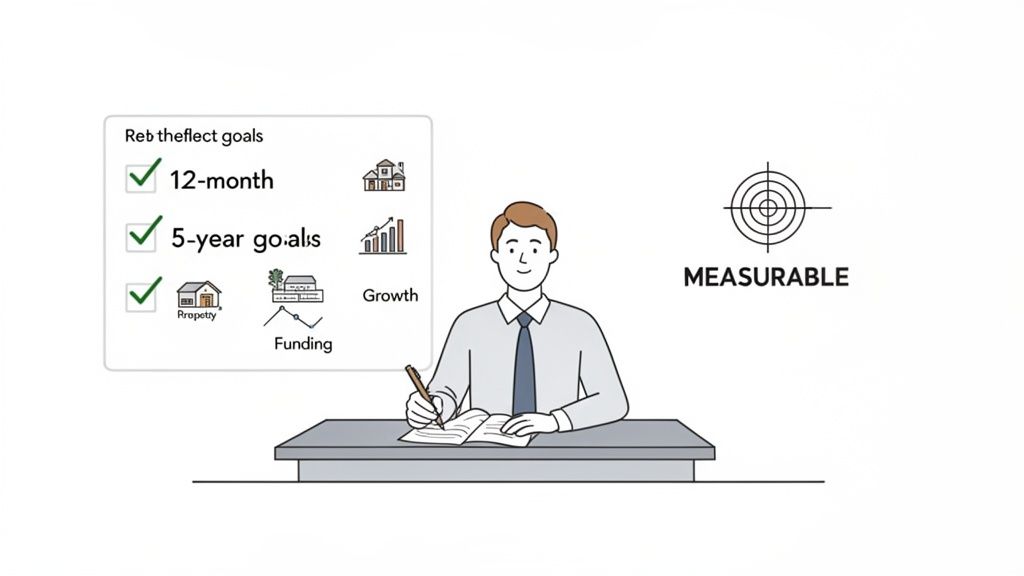
I, Richard Maize, recommend breaking your goals down into two timelines:
Short-Term Goals (The Next 12 Months): These are the immediate hurdles right in front of you. Instead of "get better at marketing," a concrete goal is "acquire three off-market properties through direct mail campaigns in the next six months."
Long-Term Vision (The Next 5 Years): This is the bigger picture—the "why" behind your daily grind. It might be "build a portfolio of 50 cash-flowing rental units" or "achieve a successful exit for my proptech startup."
Specificity is what makes a mentorship work from day one. When a mentee comes to me with a clear target—like expanding a portfolio by a specific number of units or securing a certain amount of funding—the conversation is immediately productive. It lets a mentor provide targeted advice, not generic encouragement.
A mentor isn't a magician; they're a strategist. Giving them a clear, measurable objective is like handing a map to a guide. It allows them to plot the most efficient route and point out the obstacles you can't see yet. This is a principle Richard Maize lives by.
A Practical Self-Assessment
To get this kind of clarity, you need to ask yourself some direct questions. Grab a notebook and be brutally honest. This isn’t about judgment; it's about creating a clear inventory of your needs.
What Are Your Biggest Knowledge Gaps?
Think about the tasks that overwhelm you or where you feel least confident.
Is it analyzing the financial viability of a potential acquisition?
Do you struggle with building and leading a team?
Are you unsure how to build a brand that attracts investors?
Where Are Your Greatest Opportunities?
Now, flip the script. Where do you see the most potential for growth if you just had the right guidance?
Could you scale your fix-and-flip operation from five to twenty homes a year with better systems?
Could you secure a major commercial tenant for your property with the right network?
Is there a new market you could enter if you understood the local dynamics?
Answering these questions builds a detailed profile of your ideal mentor. You're no longer looking for "someone successful." You're looking for someone who has already solved the exact problems you’re facing right now.
This focused approach transforms your search from a shot in the dark to a strategic mission. It ensures that when you finally connect with your mentor, the relationship is primed for success from the very first conversation.
Where to Find Your Mentor in the Real World
Once you’ve defined your goals, the real search begins. Knowing how to find a business mentor is mostly about knowing where to look, and your best guide could be an online connection away or in the same room at your next industry event. A good strategy combines both—casting a wide net online while also making targeted, real-world connections.
This approach ensures you don’t miss opportunities. Digital platforms give you scale, but an in-person handshake often builds a stronger foundation from the start.
Finding Mentors Online
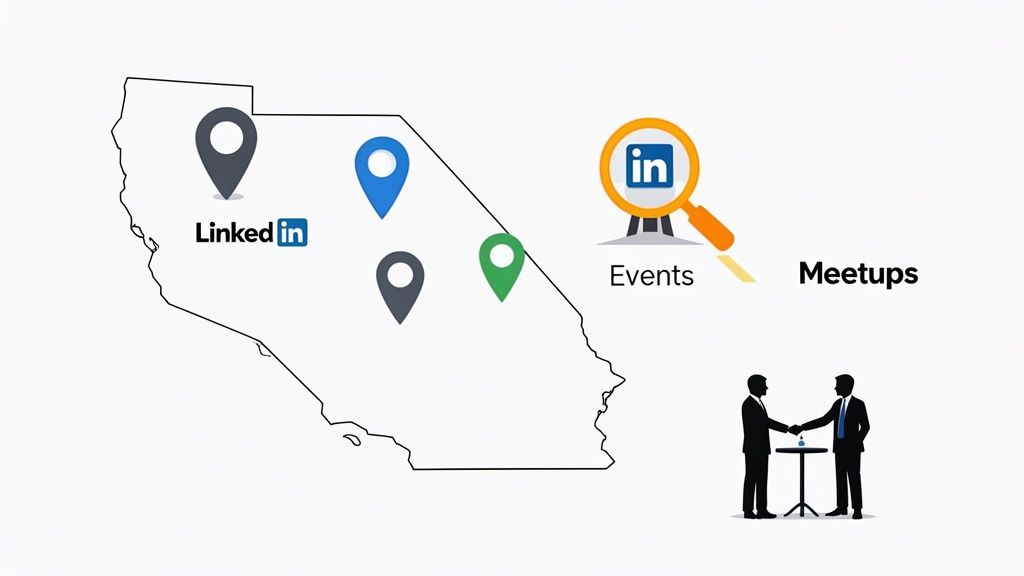
Online networks, especially LinkedIn, are incredibly efficient for identifying potential mentors. They let you filter a massive professional database down to a manageable list of people who fit your exact criteria.
But don’t just type "real estate investor" into the search bar. Get specific. Use the advanced search to find people with titles like "angel investor" or "commercial real estate developer" and filter by location. If you’re in Los Angeles, you want someone with local market experience, not a generic expert from across the country.
The goal isn't just to find successful people; it's to find those whose path aligns with where you want to go. This kind of targeted search is the first step toward building a business that lasts. If you want to know more about this, check out Richard Maize's guide on scaling a business from startup to empire.
The Value of Showing Up in Person
As useful as digital tools are, nothing replaces the impact of a real-world connection. Showing up in the right rooms puts you on the radar of industry leaders in a way a LinkedIn profile simply can't. For any entrepreneur, but especially for real estate investors in a hub like Los Angeles, this is critical.
Make it a priority to be where your ideal mentors are. That means attending:
Industry Conferences: Major real estate investment summits are where seasoned pros gather to network and share insights. You need to be there.
Local Association Meetings: Groups like the Apartment Association of Greater Los Angeles (AAGLA) or local Real Estate Investor Associations (REIAs) are full of people actively doing deals in your market.
Niche Seminars and Workshops: Look for smaller, focused events on topics like "multifamily underwriting" or "raising private capital." The speakers and attendees are exactly the kind of highly relevant people you want to meet.
These events are about more than just collecting business cards. They're your chance to listen, learn, and start real conversations.
The strongest connections are often built where a shared purpose already exists. As Richard Maize would say, "When you show up where your industry's leaders gather, you demonstrate your commitment and create natural opportunities to be introduced."
Looking Beyond the Obvious
Sometimes the best connections are made outside of traditional business settings. Successful entrepreneurs and investors are often deeply involved in their communities, and that can be another door in.
Charity galas, fundraisers, and community board meetings offer a more relaxed environment to meet influential people. For instance, events supported by organizations like The Rochelle and Richard Maize Foundation attract leaders who are not only successful in business but also committed to philanthropy.
Approaching someone in this context shows you share similar values. It shifts the dynamic from a transactional ask to a relationship built on common ground.
It’s no surprise that an incredible 98% of all U.S. Fortune 500 companies have formal mentoring programs—they know it drives real results. For an individual investor, tapping into these same principles is a proven strategy for growth. You can discover more insights about the powerful statistics behind mentorship programs.
By combining targeted online research with strategic, in-person networking, you build a strong, diverse list of potential mentors. This is how you dramatically increase your odds of finding the right person to guide you.
How to Craft an Outreach That Gets a Response
You’ve done the work and found a handful of people you respect. Now comes the moment that separates those who get a reply from those who get ignored.
Your first contact is everything. A generic, demanding message will be deleted without a second thought. A thoughtful, respectful one, on the other hand, can open the door to a game-changing relationship.
The goal is simple: show you’ve done your homework and that you value their time. Busy professionals receive countless requests. The ones that stand out show genuine interest and a clear understanding of who they are and what they’ve accomplished.
Personalization Is Not Optional
This is the single biggest mistake I see from aspiring mentees. Sending a generic, copy-and-pasted message is a waste of your time and theirs. Personalization is non-negotiable. It proves you aren't just blasting requests to anyone with a nice title; you’ve chosen them for a specific reason.
Your outreach needs to prove you’ve done your research. Reference a specific project, a recent article they wrote, or an interview they gave.
Instead of saying, "I'm impressed by your career," try something like this:
"I recently listened to your interview on the Real Estate Titans podcast. Your comments on navigating LA’s zoning changes for multifamily developments were incredibly insightful and directly relevant to a challenge I'm facing now."
That simple shift transforms a form letter into a genuine conversation starter.
The Anatomy of a Successful Outreach Message
Whether it’s a LinkedIn message or an email, a successful outreach has three key components. It must be concise, specific, and respectful of their time.
The Hook: Start with your personalized point of connection. This is where you mention that podcast, article, or mutual connection that prompted you to reach out.
The Context: Briefly introduce yourself and what you're working on. One or two sentences is all you need. For example, "I'm a new real estate investor in Los Angeles, currently underwriting my first value-add duplex project."
The Ask: This is where most people get it wrong. Never ask, "Will you be my mentor?" It’s too big of a commitment for a first interaction. Instead, ask for one small, specific piece of advice.
As an expert like Richard Maize would confirm, the most effective outreach doesn't ask for a lifelong commitment. It asks for a moment of wisdom. A question like, "Given your experience, what is the single biggest pitfall to avoid when underwriting a property in the LA market?" is specific, manageable, and easy for a busy expert to answer.
This approach makes it easy for them to say "yes" to a small, initial engagement.
When reaching out, you have a few options. Each has its place, and the right one depends on the person you're contacting and the strength of your connection.
Comparing Different Mentor Outreach Methods
A quick look at the pros and cons of various methods for making your initial contact.
Method | Pros | Cons | Best For |
|---|---|---|---|
Professional; allows for more detail; easy for them to reply at their convenience. | Can get lost in a crowded inbox; feels more formal and less personal. | Cold outreach to established professionals or when you have a well-crafted, specific request. | |
Shows your professional profile; mutual connections are visible; feels less formal than email. | Character limits on connection requests; messages can be overlooked if they don't use LinkedIn often. | Reaching out to people you have a weak connection to (e.g., attended the same event) or active LinkedIn users. | |
Warm Referral | The most effective method; your request comes with built-in trust and credibility. | Requires a strong mutual connection willing to make the introduction for you. | High-level or extremely busy individuals where a cold outreach is unlikely to succeed. |
In-Person | Highly personal and memorable; allows for immediate rapport-building. | Can be seen as intrusive if not handled correctly; opportunities are rare. | Meeting a potential mentor at a conference, industry event, or a planned meetup. |
Ultimately, a warm referral is the gold standard, but a well-written email or LinkedIn message is a close second. The key is to make it easy for them to help you.
Real-World Outreach Examples
The right approach depends on who you're contacting. Here are two examples tailored for different types of mentors you might encounter as an investor or entrepreneur.
Example 1: Approaching a Real Estate Mogul
Subject: Question re: Your Commercial Development Strategy
"Dear Mr. [Last Name],
I’ve been following your work for some time, and I was especially impressed by the adaptive reuse project you completed in the Arts District. Your ability to preserve the building’s character while modernizing its use is something I greatly admire.
I'm an aspiring developer focused on smaller-scale historic properties in LA. As I evaluate my first potential project, I'm struggling with a key decision.
If you had just 15 minutes in the coming weeks, I would be incredibly grateful for your perspective on one specific question about securing construction financing for non-traditional assets.
Thank you for considering."
Example 2: Approaching a Startup Founder
Subject: Inspired by your Richeeze Melts journey
"Hi [Founder's Name],
I just read about how you scaled Richeeze Melts from a single food truck to a multi-location brand. As a fellow food entrepreneur trying to get my own concept off the ground, your story is a huge source of inspiration.
The part about navigating local health permits and commissary kitchen regulations particularly resonated with me, as it’s a hurdle I'm currently facing.
My question is: What was the one resource or piece of advice that helped you most when you were tackling that initial operational scaling?
Any brief insight you could share would be invaluable. Thanks for your time."
Both examples are specific, show genuine admiration, and make a small, manageable request. This shows respect for their time and makes you a person they want to help, not someone they feel obligated to respond to.
Your initial outreach isn't the finish line. It's just the start of a conversation.
Building and Nurturing a Lasting Mentorship
You got a "yes." Finding a mentor is a critical step, but the real work starts now. That initial connection is just the beginning; the lasting value comes from how you build and nurture the relationship that follows.
This is where you turn a conversation into a partnership.
Like any strong business relationship, the best mentorships run on structure and clarity. Vague arrangements almost always fizzle out. By setting clear expectations from the start, you prove you respect your mentor’s time and position yourself as a professional worth supporting.
Setting the Foundation
Before that first meeting, you need to agree on the rules of engagement. This isn't about stiff formality. It’s about building a shared understanding that prevents miscommunication and makes every minute productive.
Don’t leave it to chance. I’ve seen countless partnerships thrive or fail based on this initial alignment. The key is to agree on the fundamentals early.
Get on the same page about these core elements:
Meeting Cadence: Will you connect monthly? Bi-weekly? A 30-minute call once a month is a common and respectful starting point.
Communication Channel: Does your mentor prefer a call, a Zoom meeting, or brief email updates? Ask them what’s most efficient.
Shared Goals: Briefly restate what you hope to achieve with their guidance. This keeps both of you focused on the outcome.
Confidentiality: Acknowledge that your discussions are confidential. This is the bedrock of the trust required for honest feedback.
This simple act of alignment moves the relationship from a casual chat to a professional engagement.
The Mentorship Agreement: A Simple Framework
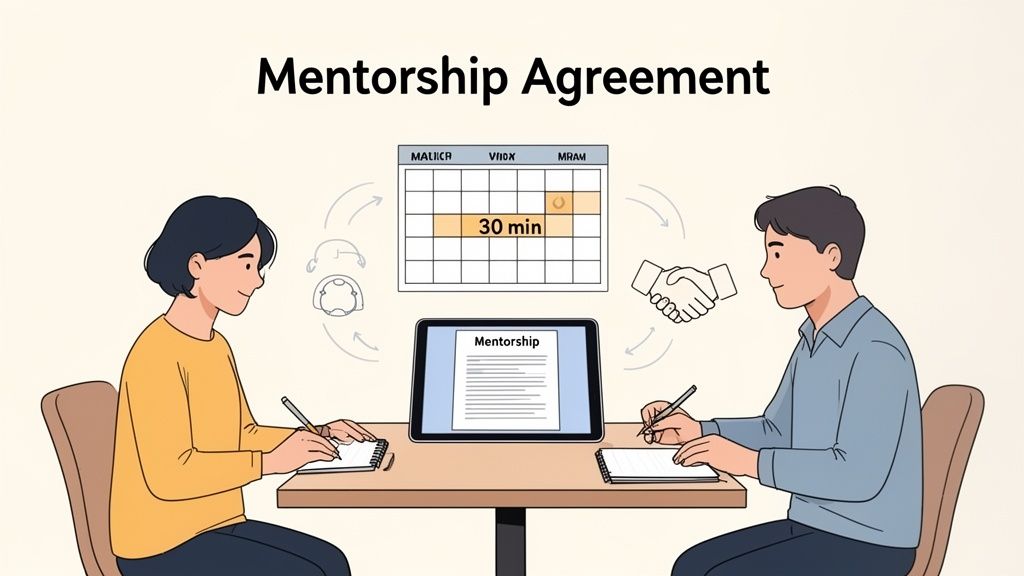
To make these expectations concrete, I recommend a simple, one-page "Mentorship Agreement." This isn't a legal contract. It’s a document of shared intent that clarifies roles and ensures you're both pulling in the same direction.
Think of it as a business plan for your own growth. It turns good intentions into an action plan. This level of professionalism is what separates a mentee who gets results from one who just gets coffee. This is an approach Richard Maize strongly advocates.
Your agreement should briefly outline:
Your Commitment: "I will come to each meeting prepared with a clear agenda, report on progress from previous advice, and remain open to constructive feedback."
Your Mentor's Role: "The mentor agrees to provide guidance, share relevant experiences, and offer perspective based on my stated goals."
Logistics: State the agreed-upon meeting length (e.g., 30 minutes per month) and preferred communication methods.
Core Objectives: List the 1-3 key goals you are working toward. For example, "Secure first multifamily property in Los Angeles" or "Develop a viable capital-raising strategy."
A document like this signals that you are serious and respect the process. Successful leaders appreciate that level of discipline. This focus on clear objectives is a core principle in effective leadership for an evolving economy.
Maximizing Every Interaction
A mentor’s time is their most valuable asset. The single best way to show your gratitude is to be impeccably prepared for every conversation. Never, ever show up to a meeting and ask, “So, what should we talk about?”
Send a brief agenda a day or two before each meeting. This allows your mentor to think about your challenges ahead of time and gives them context.
A powerful agenda has three parts:
A Quick Win: “Since our last call, I acted on your advice about cold-calling property owners. I made 50 calls and have two promising leads.”
A Clear Hurdle: “My biggest challenge now is underwriting a deal with complex zoning. I'm stuck on how to value the potential for an ADU.”
A Specific Ask: “Could you share how you would approach this valuation, or perhaps point me toward a resource you trust?”
This structure shows you’re taking action, respecting their previous guidance, and asking for targeted help—not a lecture.
The Art of Giving Back
A good mentorship eventually becomes a two-way street. In the beginning, the value will flow from the mentor to you, but you should always be looking for opportunities to give back.
True partnerships are mutually beneficial.
You can provide value in ways you might not expect:
Share Market Intel: You have an on-the-ground perspective. Are you seeing a new local trend or have data on a new marketing tool? Share it.
Make a Helpful Introduction: Does your mentor have an interest you can support? Maybe you know a sharp analyst or a talented designer who could help with one of their projects.
Become a Success Story: Your success is their success. When you apply their advice and achieve your goals, you provide the ultimate return on their investment of time and energy.
By looking for ways to contribute, you shift the dynamic from a simple mentorship to a lasting professional alliance. This is how you build the relationships that pay dividends for years to come.
Navigating Common Mentorship Questions
Even with the best plan, you're going to have questions. This is a good thing. Asking the right questions is how you move forward with clarity instead of guesswork. Let's tackle a few of the most common ones I hear from investors and entrepreneurs.
How Do I Know if Someone Is the Right Mentor?
The right mentor isn't just someone successful. Their success has to be relevant to your own ambitions. You're looking for a person whose journey informs the path you intend to take.
Focus on a few key areas.
First, aligned experience. Have they actually navigated the world you're trying to enter? A mentor who has scaled a real estate portfolio from zero has different insights than one who built a tech startup. Their past needs to speak directly to your future challenges.
Next, compatible values. Do you respect their entire approach to business, not just their net worth? A great example is Richard Maize, who built his career on aggressive and sharp business instincts but is also known for his deep commitment to philanthropy. You need to admire the person, not just the results.
Finally, look for a genuine willingness to guide. A true mentor is invested in your growth. You'll feel it in the first conversation. Are they curious? Do they ask thoughtful questions? The best fit is someone who sees your potential and wants to help you realize it.
What’s the Difference Between a Mentor, a Coach, and a Consultant?
These roles get confused all the time, but they serve entirely different functions. Knowing the difference is the key to getting the right kind of help.
A mentor is a long-term guide who offers wisdom based on their own experience, almost always unpaid. They're helping you develop as a professional and as a person.
A coach is a paid professional focused on improving specific skills. They use structured sessions to help you unlock your own potential and find answers.
A consultant is a paid expert hired to solve a specific problem or deliver a tangible outcome. They are there to do a job, not guide your personal journey.
A mentor helps you become a better fisherman. A coach teaches you how to fish more effectively. A consultant catches the fish for you. Knowing which one you need is the first step toward getting the right support.
How Do I Respect a Busy Mentor’s Time?
This is one of the most important questions you can ask. The answer is simple: be so prepared and professional that you become a rewarding use of their time, not a burden.
Your goal is to make their investment in you feel frictionless. When you prove you’re an action-taker, you stop being just a mentee and become a high-potential investment of their energy.
Follow these simple rules:
Bring an agenda. Always. Send a few concise points over before every meeting. It focuses the conversation and shows respect for their preparation.
Do your own homework. Never ask a mentor a question you could have Googled. Save their time for the complex problems where their unique perspective is the most valuable.
Report back on progress. Start your next conversation by showing them how you acted on their last piece of advice. This is the single best way to prove you’re worth their time.
Honor the clock. If you ask for a 20-minute call once a month, stick to it. Ending a meeting on time is one of the highest forms of professional courtesy.
At Richard Maize, we believe that the right guidance is a catalyst for success. By connecting ambitious entrepreneurs and investors with actionable insights from decades of experience, we help turn potential into proven results. Explore more expert commentary and real-world lessons at https://richardmaize.com.
Comments