How to Build Community Partnerships That Actually Last

You've watched the pattern repeat. A developer announces a neighborhood initiative, a foundation hosts a polished launch, or a small business sponsors a local event. Residents attend, photographs circulate, and partners exchange enthusiastic emails. Then the budget gets tight, the original champion changes roles, and nobody can say who owns the next decision.
How to build community partnerships that last requires more than outreach, a memorandum of understanding, or a visible donation. It requires a shared problem, a practical operating document, clear authority, paid coordination, and measurement that residents can challenge. Richard Maize's experience across rental housing, mortgage finance, consumer entrepreneurship, and philanthropic work offers a useful practitioner's lens: community investment works best when relationships are treated with the same discipline as an operating business.
Why Most Community Partnerships Stall Before They Start
The failure often begins at the ribbon cutting. A property developer, foundation officer, or business owner has secured funding and invited recognizable organizations, but the people most affected by the project had little influence over its design. The launch looks collaborative because many logos appear on the sign. The underlying agreement remains one-sided.
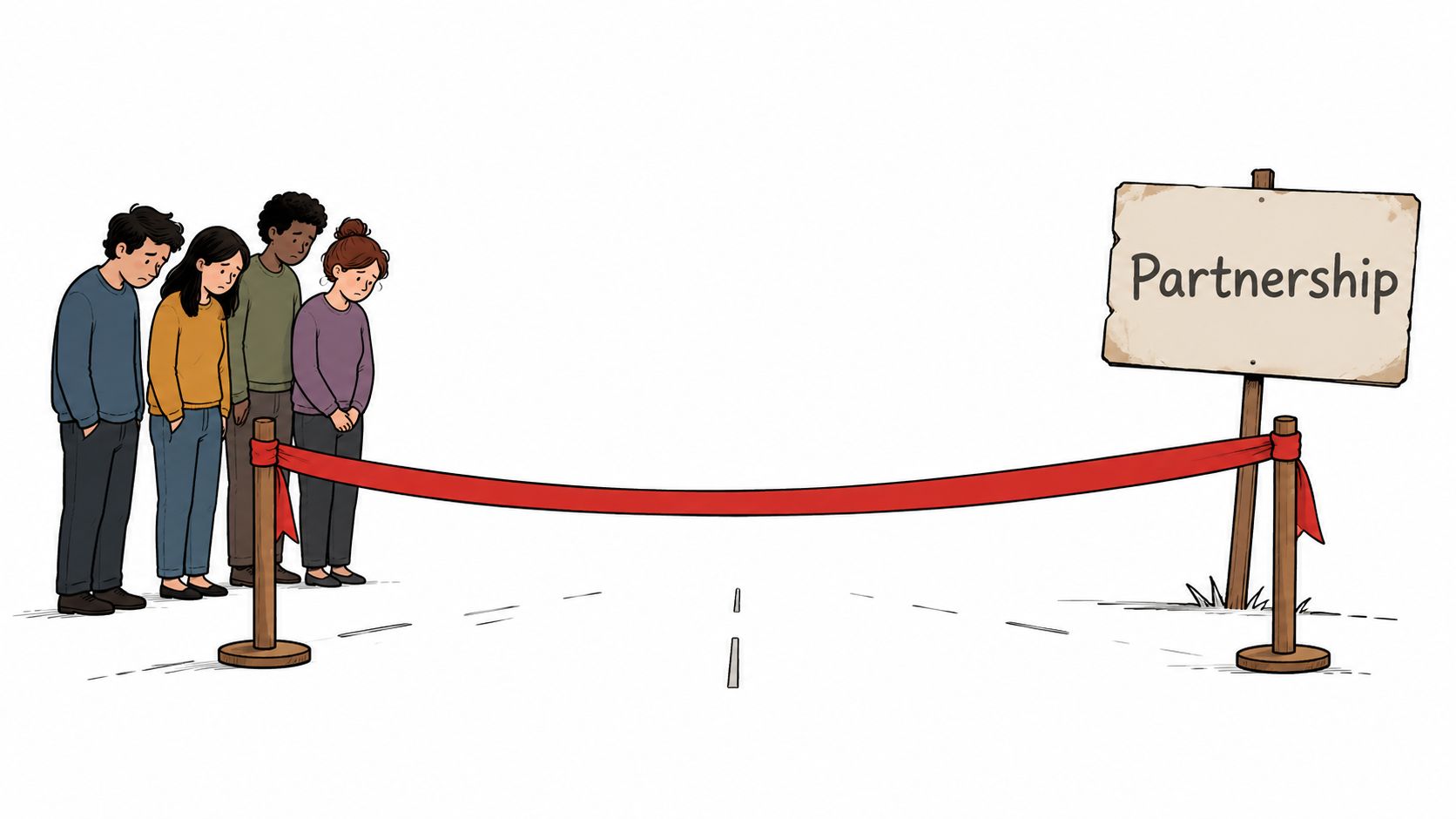
Twelve months later, the email list is outdated, meetings have lost attendance, and the original objective has expanded or disappeared. Residents may have been consulted, but they weren't given decision rights. Service providers may have attended, but no one assigned them a deliverable. Funders may have distributed money, but no one paid for the coordination needed to turn separate activities into a functioning partnership.
The expensive shortcuts
Three shortcuts create most of the damage:
Sponsorship mistaken for partnership: A contribution can support an event without giving residents influence over priorities, spending, or evaluation.
Attendance mistaken for impact: A crowded meeting says little about representation, quality of participation, delivery, or outcomes.
Goodwill mistaken for governance: People may agree on the mission while disagreeing about data ownership, public messaging, budget changes, and project closure.
A review of 28 coalitions found that strong leadership, diversity, ongoing assessment, and strategic planning were associated with greater success, while symbolic inclusion without decision power and underfunded coordination were common pitfalls, according to this review of coalition and collective-impact frameworks.
Practical rule: If a resident can attend every meeting but can't influence a budget, metric, or change in direction, the partnership is consultative, not shared.
The alternative is not a heavier process for its own sake. It's a small set of decisions made early and recorded plainly. Richard Maize's track record includes building approximately 1,000 rental apartment units before age 30, followed by mortgage-banking ownership and philanthropic work through the Rochelle and Richard Maize Foundation, as described in the foundation's account of his business history. Those fields demand attention to ownership, accountability, capital, and execution. Community partnerships need the same habits, adapted for public trust and resident voice.
A practical partnership starts by asking who defines the problem, who carries the work, who controls the information, and what evidence would justify changing course. The launch photo is easy. The operating discipline determines whether anyone is still working together after the applause fades.
The difference becomes clearer when organizations begin with participation rather than a finished solution.
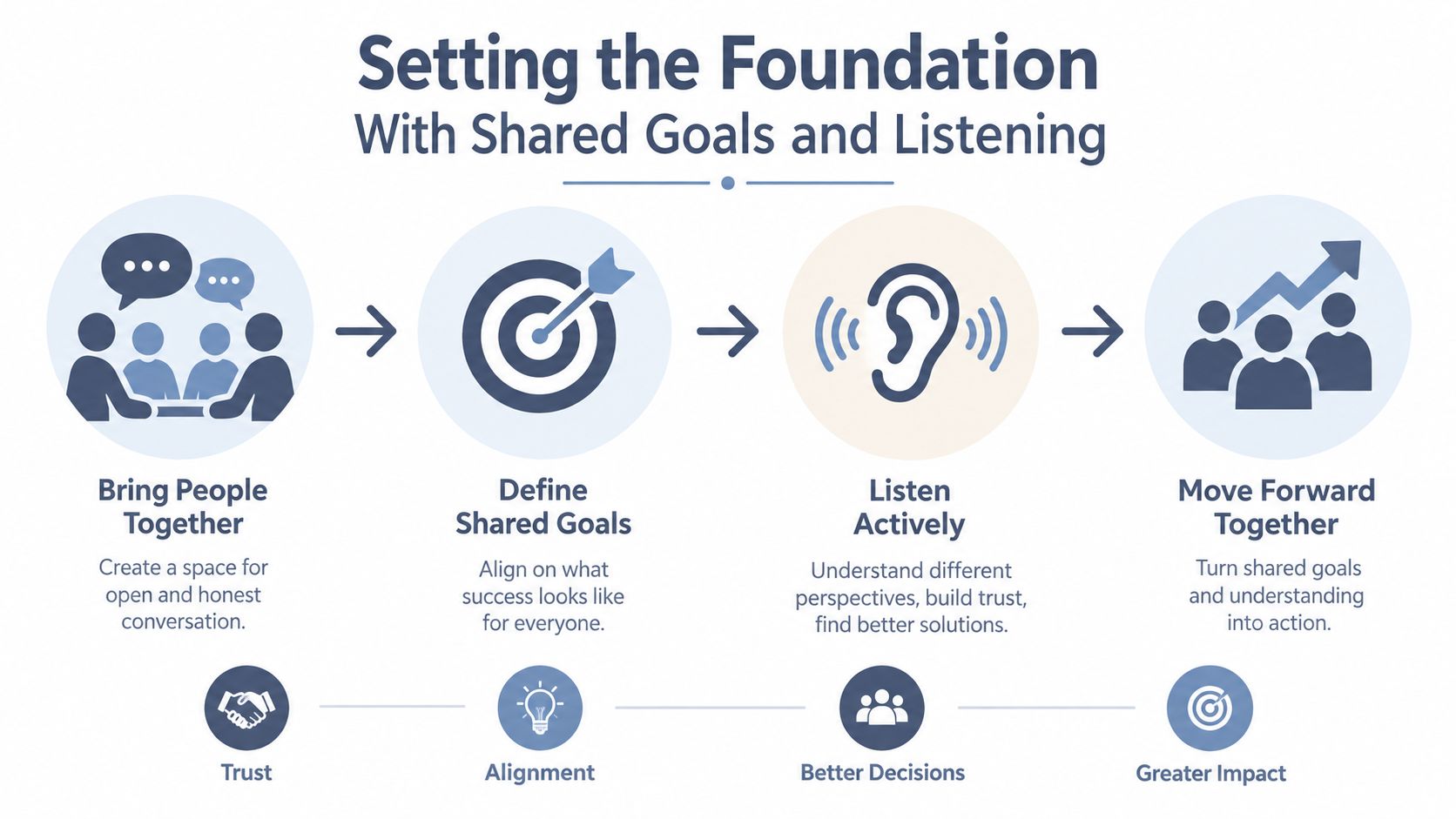
Setting the Foundation With Shared Goals and Listening
Start with a problem that matters to more than one institution. “Improve the neighborhood” is too broad to guide decisions. A useful starting point names the affected population, the geographic boundary, the condition residents want changed, and the organizations that touch that condition every day.
Listen before you prescribe
Map four groups before proposing a program:
Affected residents, including tenants, young people, caregivers, older adults, and groups that are often absent from formal meetings.
Local institutions, such as schools, clinics, faith communities, neighborhood councils, and service providers.
Resource holders, including foundations, businesses, public agencies, and property owners.
Informal leaders, who may not hold a title but are trusted by neighbors.
Listening sessions should be small enough for people to speak. Ask what already works, where residents encounter friction, which organizations they trust, what a useful result would look like, and what would make participation unsafe or burdensome. Pay participants, provide interpretation and accessibility support, and return notes for correction. The organization convening the session shouldn't become the owner of the community's story.
A quasi-experimental study across villages in Togo and Indonesia found that communities using active participation in water-supply projects recorded immunization rates 25% to 30% higher than those receiving top-down installations, as reported in this World Health Organization publication on community participation. The finding doesn't prove that every participatory model succeeds, but it gives practitioners a concrete historical reason to design with residents rather than merely deliver to them.
Turn listening into a testable agreement
After the sessions, write a problem statement with the people who contributed to it. It should identify the condition, the population affected, the baseline you can observe, the desired outcome, and the first intervention worth testing. Partners should be able to disagree with the wording before anyone puts it into a grant application.
Then pilot one manageable action. A property owner might test a resident-led service referral process. A foundation might support a small neighborhood health or education activity. A food-service business could contribute space, logistics, or customer reach to a local effort. The first pilot isn't a miniature version of the final program. It's a way to expose unclear roles, communication gaps, and practical barriers while the group can still adjust.
For a grounded example of connecting business experience with community responsibility, see this discussion of the Richard Maize approach to balancing success and giving back. The principle is straightforward: define the shared need with the people closest to it, test a response, and let evidence and resident interpretation shape the next commitment.
Mapping Stakeholders and Building Your Outreach List
A contact spreadsheet isn't a stakeholder map. It tells you whom you can reach, not who has lived knowledge, authority, capacity, or a legitimate claim to the decision. Build the map around contribution and influence, then identify the missing voices before sending invitations.
A 2022 national scan of 1,162 U.S. counties found that the number of neighboring counties with an existing collective-impact initiative was positively associated with the likelihood that another county would adopt one, indicating geographic diffusion across connected communities, according to this study of collective-impact adoption across counties. The practical lesson is to study nearby efforts and comparable communities before designing from scratch. Networks carry methods, introductions, warnings, and sometimes the backbone capacity a new initiative lacks.
Build a layered map
Stakeholder Category | What They Contribute | First Outreach Move |
|---|---|---|
Residents and tenant associations | Lived experience, priorities, usability feedback, peer trust | Ask for a listening conversation before presenting a proposal |
Neighborhood councils and faith leaders | Local relationships, meeting space, community context | Request introductions to affected groups and informal leaders |
Schools, clinics, and service providers | Frontline knowledge, referrals, delivery capacity | Compare the service gap with existing pathways |
Local employers and small businesses | Jobs, customer reach, space, operating support | Offer a specific contribution and ask what capacity they have |
Funders and public agencies | Capital, technical assistance, policy alignment | Share the jointly defined problem and decision model |
Elected offices and civic institutions | Public coordination, visibility, institutional access | Clarify their appropriate role without giving away community authority |
Don't rank people only by title. A tenant organizer may know more about whether a housing intervention will be used than an institution with a larger budget. A small business owner may understand daily movement through a commercial corridor better than a formal planning document.
Put the map into a decision tool
Before writing an MOU, create a one-page charter. Include the target population, geographic boundary, baseline metric, six-to-twelve-month outcome, partner responsibilities, decision rights, data owner, meeting cadence, escalation path, and exit criteria. Give every workstream one accountable owner, named contributors, a deadline, a resource commitment, and an acceptance test.
Use the map to identify gaps. If residents are present but no one owns data stewardship, the partnership isn't ready. If funders are present but no one can approve a budget change, the partnership will stall at its first surprise. If service providers are expected to deliver without capacity funding, the map is describing hope rather than an operating model.
The charter should also record who wasn't included and why. That note creates a prompt for future recruitment instead of allowing absence to disappear into the meeting minutes. For a practitioner-focused example of community giving and local engagement, review how Richard Maize gives back to the Los Angeles community.
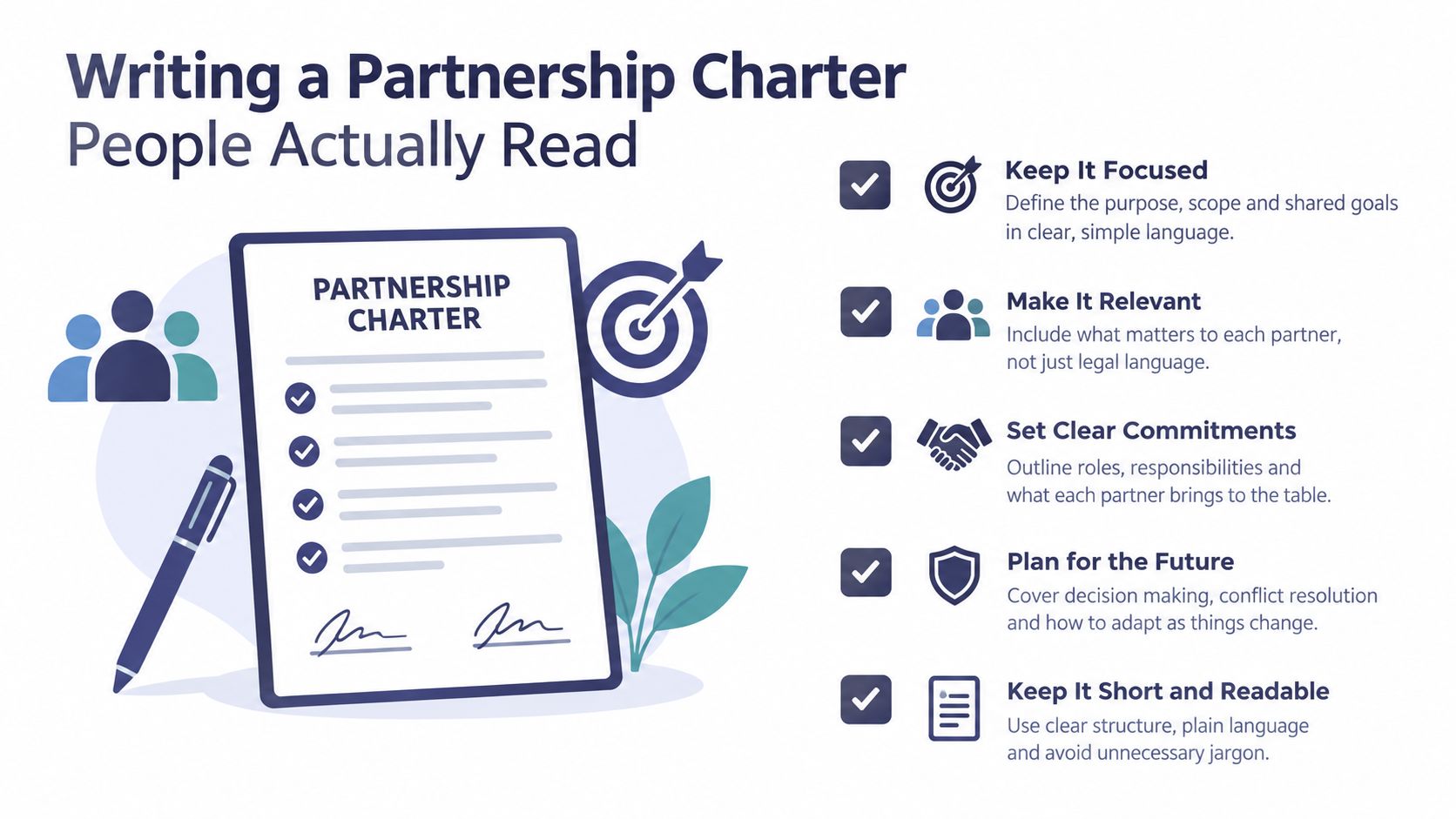
Writing a Partnership Charter People Actually Read
A forty-page MOU can be legally careful and operationally useless. A one-page charter earns attention because it forces the group to settle the questions people usually postpone.
Make each field do real work
The target population prevents a general mission from swallowing the people the project was meant to serve. The geographic boundary stops partners from arguing about whether a result belongs to the initiative. The baseline metric gives the group a starting point, while the six-to-twelve-month outcome creates a near-term test instead of an indefinite promise.
Responsibilities should describe observable work. “Support residents” isn't enough. Write who will convene the session, maintain the referral pathway, provide the space, review the data, or contact participants after a missed appointment.
Decision rights need equal precision. The charter should state:
Budget authority: Who can approve spending within the agreed plan, and who must approve a reallocation?
Data ownership: Who stores the information, who can access it, and how will residents see the findings?
Public communication: Who approves names, photographs, testimonials, and claims about results?
Change control: What evidence or resident feedback can trigger a redesign?
Exit: What conditions allow a partner to pause, transfer its role, or close the project responsibly?
Research on community partnerships identifies a related seven-step cycle, agreeing on priorities, defining the problem with background data, piloting, returning to discuss results, securing funding, jointly interpreting project data, and assessing subsequent outcomes, as described in this research on community partnership processes. The sequence matters because it builds review into delivery. A partnership shouldn't jump from announcement to scale without returning to the people affected.
Pair the charter with accountability
Use a separate decision and accountability matrix when several organizations share a workstream. The matrix can be longer than the charter, but each line should answer the same questions: who is accountable, who contributes, what resources are committed, when the work is due, and how the group accepts it.
Review both documents at a regular learning meeting. Change the charter only when the partnership makes an explicit decision, not whenever someone sends an updated draft. That discipline keeps the agreement alive without turning it into paperwork for its own sake.
Goodwill still matters. It just can't substitute for authority, compensation, information access, or a fair way to disagree. Donations may start the relationship. Governance determines whether residents experience it as a partnership.
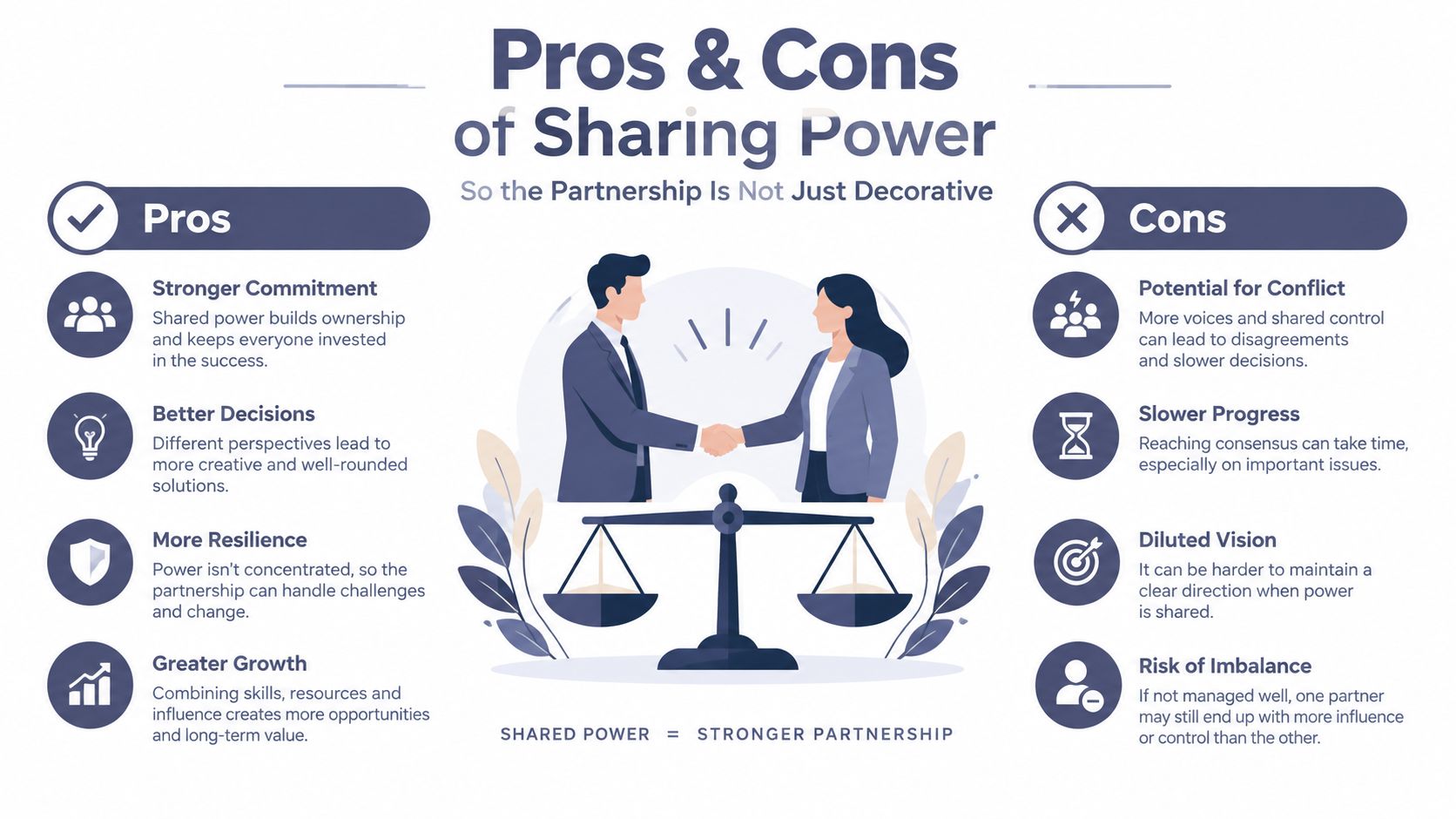
Sharing Power So the Partnership Is Not Just Decorative
Consultation asks residents what they think. Power-sharing gives them defined influence over what happens next. The difference appears in documents, budgets, meeting behavior, and public accountability.
Recent research on equitable community-academic partnerships identifies shared decision-making, co-leadership, transparency, cultural humility, and mutual benefit as recurring requirements, while a 2025 study found that institutional funding and administrative policies can obstruct power-sharing, according to this research on equitable partnership governance.
Write the authority down
A power-sharing agreement should identify community representatives and give them practical rights. Depending on the project, those rights may include approval of the problem statement, veto power over public claims, consent over resident data use, approval of major budget changes, or a seat with equal authority on the steering group.
Compensation is part of the design, not a courtesy. Residents contribute time, cultural knowledge, relationships, and risk. Unpaid participation systematically favors people who can afford to attend. Provide stipends, cover transportation and care needs where appropriate, and share the same financial and performance information with community representatives that the funder receives.
Use jointly selected success measures. A funder may prioritize service reach, while residents may prioritize safety, dignity, reliability, or whether a program remains usable after the launch team leaves. Both perspectives belong in the dashboard.
Pay for the backbone
The backbone function convenes meetings, documents decisions, manages conflict, maintains the work plan, and protects continuity when individual staff members change. It can sit with a neutral fiscal host, a paid coordinator, or a trusted nonprofit. It shouldn't default to the most enthusiastic volunteer.
A practical funding and governance model includes:
Relational work: listening sessions, translation, accessibility, resident stipends, and repeated follow-up.
Coordination: scheduling, agenda preparation, decision logs, partner communication, and conflict facilitation.
Delivery: the direct intervention, supplies, staff time, and participant support.
Learning: data collection, community interpretation, independent feedback, and adaptation.
Continuity: the administrative capacity needed between grants or after a public launch.
The agreement should also say who can pause spending, what happens when performance misses the target, and how the group handles disagreement. Suppressing conflict protects the appearance of consensus while leaving the underlying decision unresolved.
For a real-estate investor, philanthropist, or consumer venture, this approach prevents extractive visibility. The business doesn't just gain a logo and a story. It accepts shared scrutiny and gives residents enough authority to shape the result.
Funding the Slow Work Most Grants Overlook
Trust-building is work, even when it produces no immediate headline. If the budget funds only the public event and direct service, the partnership will depend on unpaid labor during the period when participants are still learning whether the relationship is safe and useful.
A 2025 report on community-engaged research emphasizes that funding alone doesn't establish co-learning, shared ownership, or collaborative decision-making. Relationship development must be intentionally resourced and recognized, as explained in this report on sustainable community-engaged partnerships.
Treat preparation as delivery
Put these items into the initial budget rather than adding them after a shortfall appears:
Listening and access: resident stipends, interpretation, translation, accessible materials, transportation, and suitable meeting space.
Local coordination: a named person who follows up, records decisions, and notices when a partner is dropping out.
Relationship maintenance: repeated check-ins, community feedback, and time for partners to revise assumptions.
Measurement: baseline work, shared data practices, qualitative feedback, and community interpretation.
Conflict support: independent facilitation when the group can't resolve a dispute internally.
This creates a real trade-off. A smaller pilot with time for trust and revision may look less impressive than a fast, highly visible launch. It may also produce a more honest test because residents can influence the design before the organization commits to a larger public promise.
Choose a backbone model
A paid coordinator offers continuity and clear accountability. A rotating chair can distribute ownership but may lose institutional memory unless documentation is excellent. A neutral fiscal host can manage funds and contracts when no partner is trusted to control the whole budget. The right choice depends on the conflict risks, administrative capacity, and power balance in the local setting.
Use a funding commitment that protects the relational phase from annual uncertainty. Funders should ask what coordination costs will be required after the announcement, not only what direct services will be delivered. Richard Maize's broader model connects real-estate experience with community-driven investment, a perspective developed further in this guide for real-estate investors building sustainable impact.
A dashboard should show whether the partnership itself is becoming healthier. Track partner retention, representation, response quality, completed commitments, decision influence, and unresolved issues. These are leading signals. They don't replace outcome measures, but they can warn the backbone that the coalition is weakening before the final results arrive.
Measuring What Matters Beyond Attendance
A partnership can report a full room and still fail the people it claims to serve. Measurement should begin with the evaluation question, then identify the information needed to answer it. Don't collect a number because a spreadsheet has an empty column.
Use five layers of evidence
Representation asks who is present and who is missing. Break participation down by the groups relevant to the project, while protecting privacy and avoiding unnecessary personal data. A meeting attended by many institutions but few affected residents needs a different response from a meeting with broad resident representation and weak service-provider participation.
Participation quality asks whether people can influence the work. Record whose proposals were adopted, whether residents received information in time, and whether dissent changed a decision. A sign-in sheet can't answer those questions.
Delivery milestones show whether partners did what they promised. Track completed referrals, held sessions, issued materials, delivered services, or other project-specific commitments. Every milestone should have an accountable owner and an acceptance test.
Intermediate outcomes connect delivery to change. Choose a baseline and target tied to the shared problem statement, then set a reporting cadence that gives the group time to act. The dashboard should show progress in a way residents can understand, not only in a format designed for funders.
Unintended effects protect against success claims that hide harm. Ask who was excluded, whether access became harder for some residents, whether a service burden shifted to an underfunded partner, and whether public messaging exposed people to risk.
Turn reporting into governance
Write the adaptation rule before results arrive. For example, the charter can require a strategy review when the pilot misses its agreed target, when a key group remains underrepresented, or when residents report a material safety or access problem. The rule should trigger a conversation, not an automatic punishment.
Quarterly learning reviews should include the data owner, community representatives, delivery partners, and funders. Share the result first, invite interpretation, document disagreements, and record the decision. Qualitative evidence isn't decoration. It can explain why a numeric result moved or why an apparently successful intervention isn't trusted.
A 90-day launch calendar
Weeks one and two: Complete the stakeholder map and hold listening sessions. Deliverable: a corrected map and listening summary. Accountable owner: the backbone coordinator. Acceptance test: affected residents confirm that the summary reflects their priorities.
Weeks three and four: Draft the shared problem statement, one-page charter, and decision matrix. Deliverable: signed working documents. Accountable owner: the convening organization and community co-leads. Acceptance test: every workstream has an owner, contributor, resource commitment, deadline, and acceptance test.
Days thirty through sixty: Pilot one intervention, document decision rights, and launch the shared dashboard. Deliverable: pilot record and baseline dashboard. Accountable owner: the delivery lead and data owner. Acceptance test: partners can see current status and know what happens when performance misses target.
Days sixty through ninety: Return results to the community, interpret them jointly, and decide whether to revise, fund, or scale. Deliverable: a public decision log and revised work plan. Accountable owner: the steering group. Acceptance test: residents can identify what changed because of their feedback.
Richard Maize's public profile also identifies investment in the Richeeze Melts food truck, alongside his real-estate and mortgage interests, as shown on his business and investment profile. That cross-sector experience illustrates a useful operating principle: property, philanthropy, and consumer ventures have different outputs, but durable work in each still depends on clear ownership, disciplined execution, and attention to the people affected.
Richard Maize offers practical perspective on real estate, entrepreneurship, philanthropy, and community investment for leaders building partnerships that need to endure. Visit Richard Maize to explore his work and connect those principles with your next neighborhood initiative.
Comments