How to Build Business Credit from Scratch: A Maize Guide

Most advice on how to build business credit from scratch turns the process into a hack.
Open an LLC, grab a few vendor accounts, get a card, wait for the score to rise. That checklist is not wrong, but it is incomplete. It treats credit like a short-term tactic when it works more like a long-term asset.
That difference matters.
In real estate, the investors who last are rarely the ones chasing the flashiest property or the fastest story. They are the ones who build a stable base, protect downside, keep records clean, and make themselves easy to trust. Business credit works the same way. A strong file is not exciting. It is useful. It gives you room to move when an opportunity shows up and keeps you from using personal guarantees and personal cash every time the business needs oxygen.
Richard Maize has long approached growth with a practical investor’s lens. Boring systems, repeated consistently, tend to outperform dramatic moves that look impressive for a quarter and create problems for years. That is the right mindset here. You are not trying to manufacture a score. You are building a reputation that lenders, vendors, insurers, and partners can verify.
The Unsexy Asset That Fuels Real Growth
A reliable business credit profile is a lot like a well-located property that throws off steady value. It does not need to impress anyone at a dinner table. It needs to hold up under scrutiny.
That is why the best operators treat business credit as infrastructure. They build it before they desperately need it. They maintain it when things are going well. Then, when the market tightens or a new opportunity appears, they already have a usable financial identity.
For real estate investors, that matters more than many admit. Deals move fast. Suppliers tighten terms. Insurance costs shift. Lenders start asking harder questions. If your business has no separate credit story, the conversation quickly circles back to your personal profile and personal guarantees.
Why boring wins
Fast results are overrated in this area. A thin file built with random accounts does not help much. A clean file built with discipline does.
That means:
Separate first: Build a company that stands on its own records, not your personal cards.
Use credit with purpose: Only open accounts that fit actual operations.
Pay with intention: Predictable, early payments do more for your reputation than clever credit stacking.
Think in years: A mature profile creates options long after the setup phase is over.
A lot of founders resist this because it feels slow. It is slow. So is building a quality portfolio. That does not make it weak. It makes it durable.
A business credit file should function in the background. If you are constantly trying to force it, you are probably building it the wrong way.
The same discipline that helps a business scale also helps its credit profile mature. If you want a broader view of that operating mindset, the ideas behind scaling a business from startup to empire fit this subject well. Clean systems beat scattered effort.
What this asset does
A strong credit profile can support better financing terms, stronger supplier relationships, and more flexibility when timing matters. It also creates a cleaner wall between business risk and personal risk.
That is the primary point. Not vanity. Not speed. Control.
Laying the Foundation Before You Build
You cannot build business credit on top of a personal financial identity and expect the structure to hold.
The first move is legal and operational separation. Until that happens, most of the effort people call credit building is just personal borrowing wearing a business costume.
Stop operating like a sole proprietor if credit is the goal
There are approximately 23 million sole proprietorships in the U.S., and they cannot separate business credit from personal credit, which is why forming an LLC or corporation is the foundational move if you want a distinct business credit profile and better personal asset protection, according to Brex’s guide to building business credit.
That is the hard line. If you remain a sole proprietor, lenders and bureaus generally keep looking through the business and straight at you.
For many small operators, that setup feels easy because it is familiar. It is also limiting. You may be earning revenue under a business name, but if the structure is not separate, your credit identity is not separate either.
The essential setup
Start with the basics and get them exactly right.
Form an LLC or corporation Choose a legal entity that creates separation between you and the business. For many owners, an LLC is the practical first step. Some businesses choose a corporation based on tax, ownership, or long-term capital plans. The form matters less than the clean separation.
Get an EIN Your Employer Identification Number is the business tax ID that supports banking, applications, and recordkeeping. If you skip this and keep using your Social Security number, you are reinforcing the wrong identity.
Open a dedicated business bank account All business income goes in. All business expenses come out. No side spending. No paying for drywall on a personal card because it was convenient. No mixing rent-roll income with household transactions.
Standardize your business details Use the same legal business name, address, phone number, and email across banking, vendor applications, and bureau registrations. Inconsistent records create friction.
What operators get wrong
The mistake is not usually ignorance. It is impatience.
People form the entity, then keep swiping personal cards for business purchases. They open the bank account, then treat it like a side account instead of the main operating account. They tell themselves they will clean it up later.
Later tends to become expensive.
Here is a simple comparison:
Setup choice | What it signals |
|---|---|
Business formed, EIN obtained, dedicated bank account used consistently | A real operating business with separate records |
Entity formed but expenses still run through personal accounts | A business that exists on paper more than in practice |
Multiple names, addresses, or mismatched records across applications | Sloppy administration and higher verification friction |
If you want lenders and vendors to treat the business as real, you have to run it like it is real before you ask them for trust.
Separation protects more than your score
A clean entity structure and bank trail do two jobs at once. They support credit building, and they protect personal assets when business obligations get messy.
That matters in every industry, but investors should pay close attention to it. Real estate and operating businesses both create layers of liability. The cleaner the records, the easier it is to show where the business begins and where your personal life ends.
If you want more operating perspective around that discipline, Richard Maize’s broader business articles are aligned with the same principle. Strong ventures usually start with clean structure, not clever financing.
Getting on the Credit Bureaus' Radar
A business can be legitimate, profitable, and still invisible to the agencies that matter for credit.
That is the next hurdle. You are no longer setting up the company. You are making sure the company can be tracked.
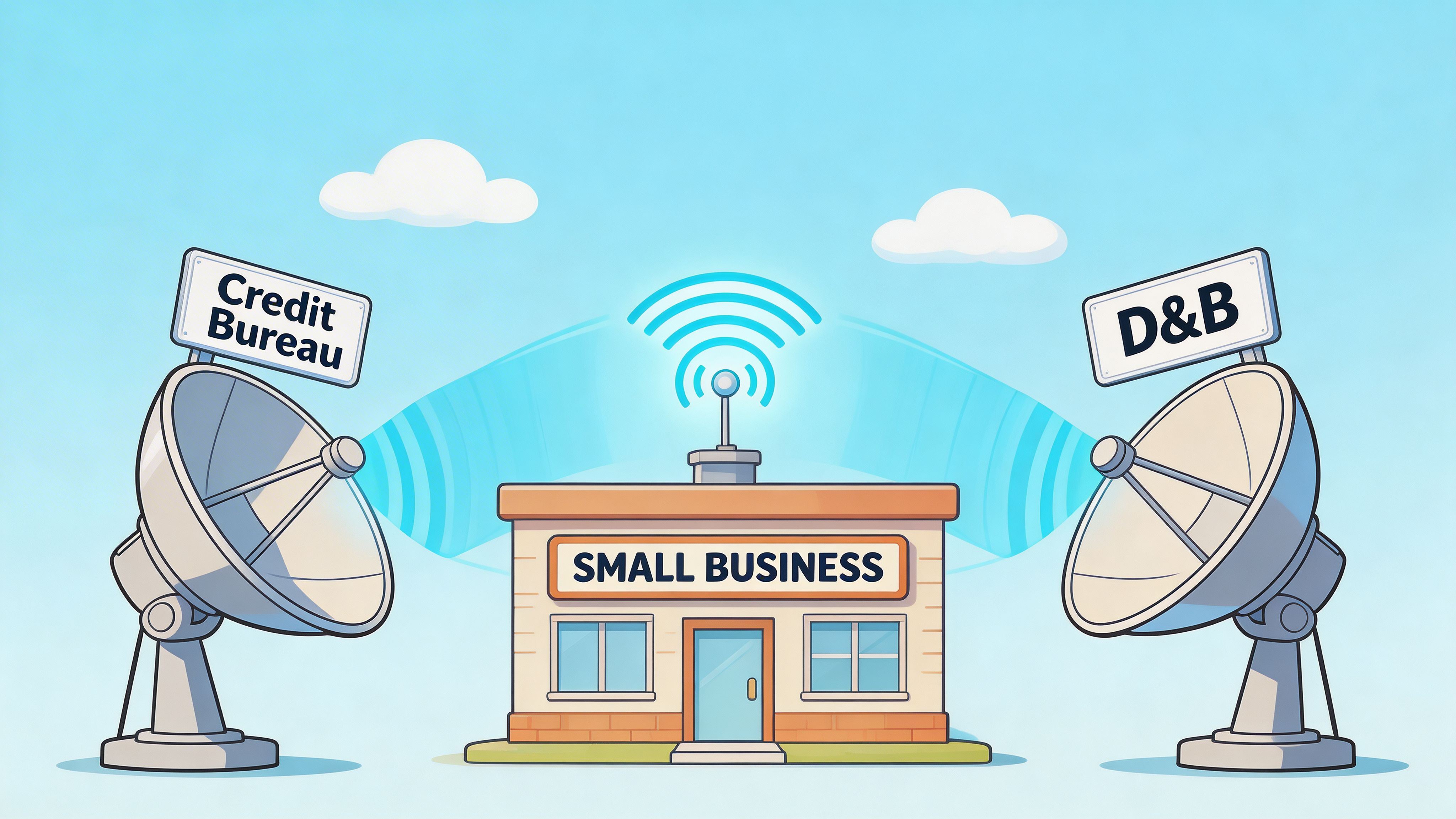
Get the identifier that makes your business visible
The D-U-N-S Number system is a unique nine-digit identifier introduced decades ago by Dun & Bradstreet, and it remains essential for business credit bureaus to track and report company credit profiles globally. Registering for one is a critical early step if you want activity reported separately from the owner’s personal score, as explained in Mercury’s business credit guide.
Many businesses stall at this stage without realizing it. They think opening accounts is enough. It is not enough if the business is not properly visible to the reporting ecosystem.
Get the D-U-N-S number early. Make sure the business details match your legal records and bank records. If the core identity is inconsistent, you create needless cleanup later.
Visibility is not the same as activity
A registered profile by itself does not build much. It gives the bureaus a place to recognize the business. Then you need accounts that report.
That is where trade lines come in.
A trade line is a credit relationship that reports your payment behavior. In practice, the first useful trade lines often come from vendors extending terms such as net-30 or net-60. Those terms can be practical for ordinary operating purchases, but only if the vendor reports your history.
Choose vendors for reporting, not convenience
This is one of the least glamorous parts of the process, and one of the most important.
Do not open vendor accounts just because a blog listed them. Open them because they fit your business and because someone at the vendor can confirm reporting practices. The names often mentioned for starter reporting include Uline, Grainger, and Quill, especially when businesses need supplies that can be purchased in normal course.
Before you commit, ask direct questions:
Which bureaus do you report to? Ask specifically about Dun & Bradstreet, Experian Business, and Equifax Business.
Under what business identity do you report? Confirm the legal name and address format.
Do you report standard payment activity or only delinquency? Some creditors are much more helpful than others.
Can your team confirm this in writing? Even a simple email can save confusion later.
Here is the blind spot. Some companies make timely payments for months and assume they are building business credit, when they are only building goodwill with a vendor.
To see the broader process in action, this walkthrough can help frame how the pieces fit together:
Build the first layer with intention
A practical target is to establish 3-5 vendor trade lines that report. That benchmark shows up repeatedly in business credit guidance because one or two accounts may not create much depth, while a small cluster starts to show a pattern of responsible behavior.
Not every trade line has to be flashy. In fact, the best early accounts are usually plain operational accounts tied to items you already buy.
For a property operator, that may include:
Maintenance supplies
Office and admin purchases
Safety equipment
Basic repair materials
Routine facility consumables
For a service business, it may be software, office products, shipping, or recurring vendor relationships.
The right starter trade line is not the one that sounds impressive. It is the one you will use naturally and pay early every single time.
Keep the file clean from day one
Three habits help immediately:
Habit | Why it matters |
|---|---|
Use the exact same business details on every application | It reduces matching errors |
Keep purchases ordinary and affordable | It prevents strain on a young file |
Pay from the business bank account | It reinforces operational separation |
If you want to know how to build business credit from scratch without wasting months, this is the inflection point. Visibility plus reporting accounts. Miss either one, and progress slows.
Strategically Using Trade Lines and Credit Cards
Once the business is visible and reporting accounts are in place, the work becomes repetitive in the best possible way.
Discipline beats enthusiasm in this area. The operators who build strong files are not doing anything magical. They are creating payment history, keeping balances modest, and adding accounts only when the business can handle them comfortably.
Trade lines are your first reputation engine
Vendor terms are useful because they create recurring opportunities to demonstrate reliability.
A property owner or investor has a natural advantage here. Routine business activity already creates legitimate expenses. Supplies, maintenance items, office purchases, equipment support, and recurring operational needs can all become raw material for credit building if the vendors report.
The key is to make these accounts boring:
Use them for real purchases: Do not manufacture spending just to trigger activity.
Keep invoices easy to cover: A young file should not be under pressure.
Pay before due dates: Early payment sends a stronger signal than barely on-time payment.
To reach a top-tier Paydex score of 80+, businesses should aim to pay invoices at least 15-20 days early. A solid benchmark is also to secure 3-5 vendor trade lines that report to the major bureaus, and positive payment history can compound to 20-50 points within the first few months, according to Bank of America’s overview of business credit.
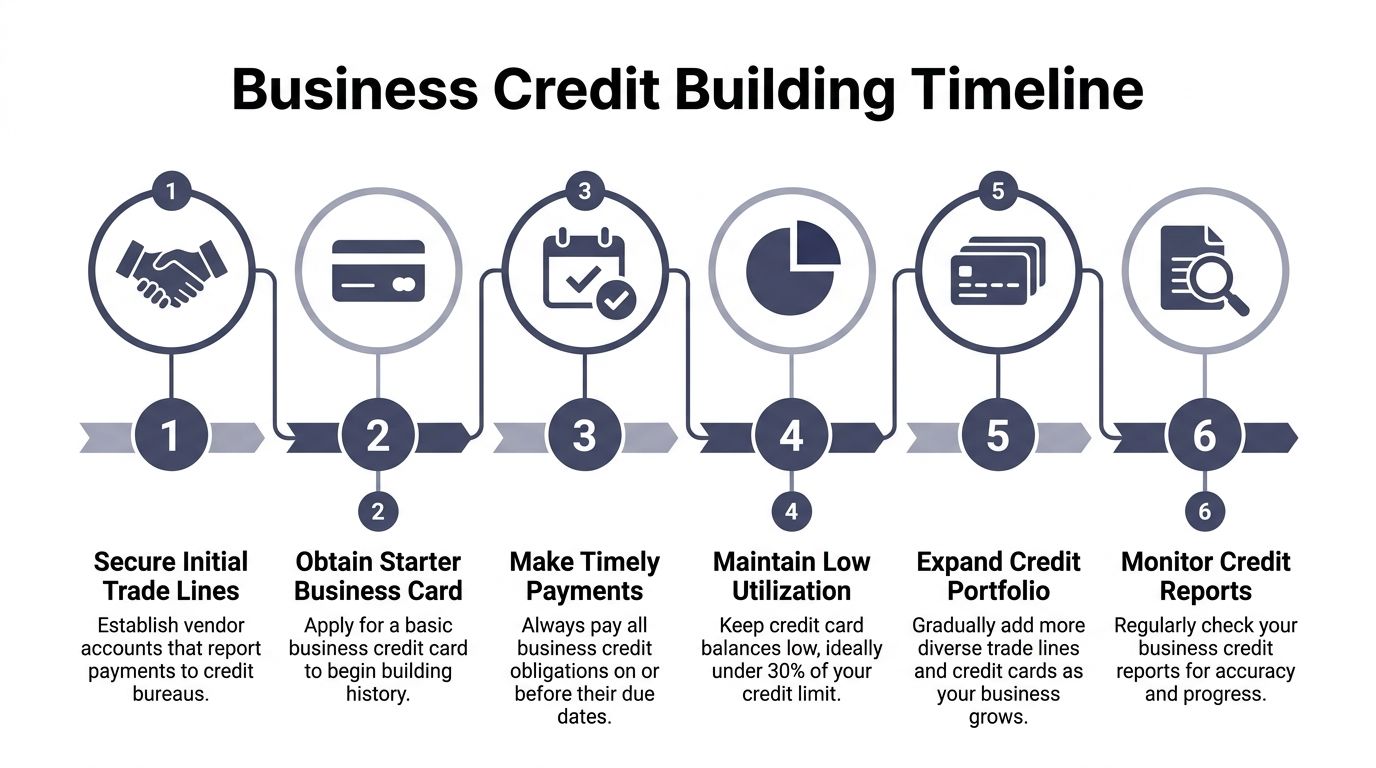
Business cards help, but only if you use them carefully
A business credit card can strengthen the file, but it can also expose weak habits quickly.
The right card for this phase is not necessarily the one with the best travel pitch or the loudest rewards campaign. It is the one that reports to business bureaus, fits the company’s spending pattern, and does not tempt the owner to carry unnecessary balances.
One practical rule matters here. Keep utilization low. The verified guidance allows a range under 30%, and stronger profiles often benefit from staying even lower. That means if the business can pay a card down frequently, it should.
A simple operating rhythm
Use this cadence instead of improvising month by month.
Put recurring business spend on reporting accounts Use trade lines and the business card for ordinary expenses the company already needs.
Review balances during the month Do not wait for a statement surprise. If balances rise faster than expected, pay them down early.
Pay trade lines early If you want the file to show reliability, act like a reliable borrower, not a borrower clinging to the due date.
Avoid opening accounts out of boredom New credit should solve an operating need or improve the profile thoughtfully. It should not exist because someone online said you need more.
What works for real estate operators
Real estate investors often ask whether they should use generic starter vendors forever. No. Use them to start if needed, then build trade relationships that reflect actual operations.
That might include vendors tied to:
Business activity | Useful account type |
|---|---|
Property maintenance | Building materials and repair suppliers |
Office operations | Admin and office supply vendors |
Equipment needs | Rental or support vendors |
Ongoing site work | Safety and facility supply accounts |
Those accounts do double duty. They support operations and create a more believable credit profile. A lender would rather see a business using relevant accounts responsibly than a file stuffed with random credit relationships that do not match the business model.
Credit quality improves when account activity looks like normal business behavior. It weakens when the file looks staged.
What does not work
A few habits stall progress fast:
Carrying balances because it “shows activity” Activity comes from use and payment history, not from paying interest.
Using personal cards for convenience That undercuts the separation you worked to create.
Opening too many accounts at once A young business should not look frantic.
Buying things the company does not need Waste is not a credit strategy.
If you want to know how to build business credit from scratch in a way that holds up later, this is the answer. Use the accounts you have. Pay them early. Keep balances controlled. Repeat.
Common Mistakes That Stall Your Progress
Most business credit problems do not come from one dramatic error. They come from small habits that keep a file thin, confusing, or risky.
That is why some owners “do everything right” and still get mediocre results. They followed the public checklist, but they never corrected the habits underneath it.
Mistake one is assuming business credit starts with the business
It often does not.
A critical and frequently overlooked issue is that loan eligibility for new businesses is typically based on the owner’s personal credit score. Many entrepreneurs with weak personal credit cannot access business credit until that personal profile improves, which the U.S. Chamber discussion on building business credit identifies as a sequential dependency many guides miss in its credit-building overview.
This catches a lot of founders off guard. They believe the LLC itself will shield them from that reality on day one. It usually does not. Early on, lenders and card issuers still want to know whether the owner behind the entity has a history of paying obligations responsibly.
If your personal credit is weak, pretending it does not matter will slow you down. Improve it while the business file matures.
Mistake two is mixing money after setting up separation
This one is common because it feels harmless.
You buy a few things personally and reimburse yourself later. You use the business card for a personal expense and mean to sort it out at month-end. You pay a vendor from the wrong account because you were in a hurry.
Those choices create messy records. They also make it harder to prove that the business is operating as an independent entity.
Conduct an honest audit:
Do all business expenses run through business accounts?
Do all vendor payments come from the business bank account?
Do your books clearly separate owner draws from operating expenses?
If the answer is no, fix that before applying for more credit.
Mistake three is assuming every vendor helps your file
That assumption costs people time.
Some vendors are useful operationally but worthless for credit building because they do not report. Others report inconsistently, or only under certain conditions. If you never verify reporting, you can spend months making clean payments with little bureau benefit.
This is one of the reasons patience matters. Business credit is not just about paying. It is about paying the right accounts.
A payment only helps build the file if someone reports it to the bureaus you care about.
Mistake four is applying too aggressively
Impatience shows up in application behavior.
A business owner gets one approval and immediately starts applying everywhere else. That creates noise around a young profile and often leads to mismatched accounts, unnecessary inquiries, and weak average account quality.
A better standard is simple. Open one account, use it properly, let it season, then add the next piece with a clear purpose.
A better recovery approach
If progress has stalled, simplify the situation instead of chasing a trick.
Problem | Better move |
|---|---|
Weak personal credit is limiting approvals | Work on the personal profile while using vendors that fit your business |
Mixed personal and business spending | Clean up bookkeeping and route all activity through business accounts |
Reporting is not showing up | Contact vendors and confirm bureau reporting practices |
Too many scattered accounts | Focus on the few accounts you can manage exceptionally well |
Business credit responds to order. If your process is messy, the file usually looks messy too.
Monitoring Maintaining and Leveraging Your Credit
A lot of owners think they are finished once the first score appears. That is the wrong moment to relax.
A credit profile becomes valuable when it is managed month after month, not when it is first created. The businesses that benefit most from credit are the ones that treat monitoring like part of normal operations.
Watch the file like any other business asset
Use tools that let you review what is being reported and whether the business details are correct. The names commonly used in this space include Nav and D&B CreditSignal. The exact tool matters less than the habit.
Review the file for:
Business identity accuracy
Reported payment history
Open accounts that no longer make sense
Anything missing that should be reporting
A common blind spot is that not all vendors report to credit bureaus. It is estimated that only about 50% of vendors automatically report payments, meaning a business can pay on time for months without much credit-building value unless reporting is verified in advance, as noted in Old National’s discussion of ways to build business credit.
That fact changes how you should monitor. Do not just check scores. Check whether the accounts you rely on are contributing.
Maintenance creates advantage
A mature file does more than help you borrow.
It can support better supplier conversations, reduce friction during underwriting, and make your business look more stable to counterparties who have options. In practical terms, it gives you another lever when you want to move fast without dragging your personal finances into every deal.
For investors and operators, that flexibility matters. You may need equipment, bridge financing, vendor terms, or room to handle uneven cash timing. A maintained credit profile expands your choices.
If this broader finance mindset is relevant to your work, Richard Maize’s finance-tagged articles explore adjacent operating issues with the same practical approach.
Business credit is not a side project. It is part of the company’s reputation, and reputations need upkeep.
Use credit to support strategy, not replace it
Credit should make a good business stronger. It should not carry a weak business that has no discipline.
That means continuing the habits that built the file in the first place. Pay on time or early. Keep balances controlled. Review reports. Close the gap between what you think is happening and what the bureaus show.
Done right, business credit becomes one of the quiet tools that helps serious operators act with more confidence.
Frequently Asked Questions About Business Credit
Is business credit the same as personal credit
No. Personal credit is tied to you as an individual. Business credit is tied to the company. They can influence each other early on, especially when lenders still rely on the owner’s personal profile, but they are not the same file.
How long does it take to build business credit from scratch
With consistent steps, visible results often appear in 3 to 6 months, as noted in the verified guidance above. That assumes the business is properly set up, accounts are reporting, and payments are being handled consistently.
Do I need revenue before I start
Not necessarily. A business can start building its profile before revenue is substantial if the entity is formed, the business banking is in place, and the company uses reporting accounts carefully. The stronger question is whether you can manage the obligations comfortably.
What score matters most
Different bureaus use different models. Dun & Bradstreet’s Paydex is one of the best-known business credit measures. What matters in practice is less about obsessing over a single score and more about building a file with clean payment history, useful trade lines, and low-risk behavior.
Should I use net-30 vendors even if I can pay cash
If the vendor reports and the purchases are legitimate, net-30 terms can be useful because they create documented payment history. The key is not to force spending just to create activity.
What if something on my report is wrong
Dispute it with the bureau that is showing the error and keep supporting records. This is another reason clean books, invoices, and bank records matter. They help you prove what happened.
Richard Maize brings a practical investor’s perspective to business growth, credit discipline, and long-term value creation. Visit Richard Maize for more insights on entrepreneurship, investing, and building durable businesses.
Comments