How to Build a Real Estate Portfolio Like an Expert with Richard Maize

A strong real estate portfolio isn’t built by accident. It’s the result of a clear plan, not just a series of random property purchases. As real estate investor Richard Maize will tell you, success depends on creating a personal investment blueprint that lines up with your financial goals, risk tolerance, and the types of assets you want to own. This strategy is what ensures every acquisition is a deliberate step toward what you’re trying to build—whether that’s monthly cash flow, long-term appreciation, or generational wealth.
Crafting Your Investment Blueprint
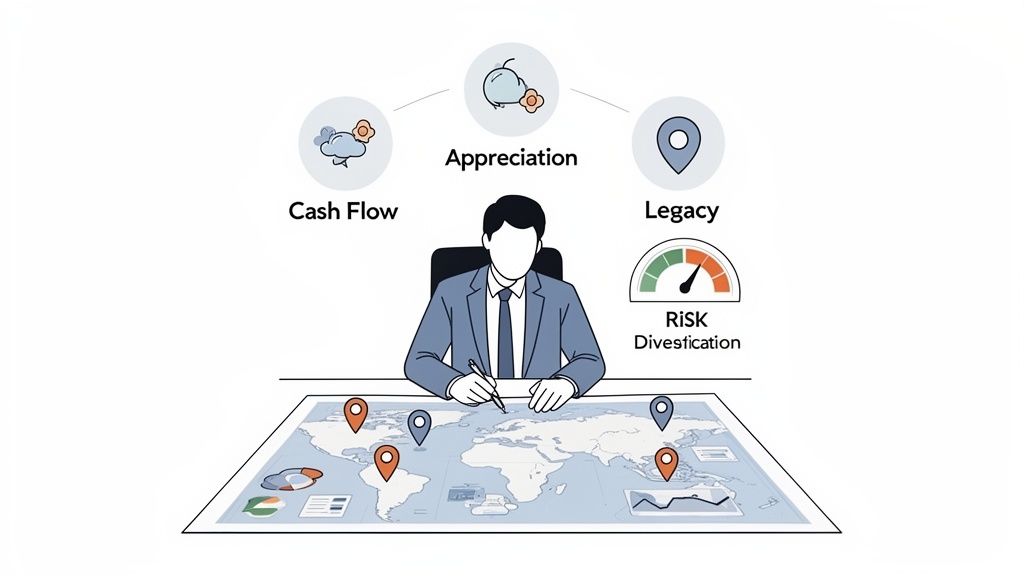
Before you even think about looking at a single listing, the most important work happens. You need to define your personal investment thesis. This is your "why"—the philosophy that guides every decision you make.
A well-defined thesis gets you out of vague goals and into actionable territory. It’s the difference between saying, "I want to invest in real estate," and saying, "My goal is to acquire five cash-flowing duplexes in emerging Midwestern cities within seven years to generate $4,000 in monthly passive income."
One is a wish. The other is a target.
Define Your Financial Goals and Risk Tolerance
Think about your primary objective:
Cash Flow: This means focusing on properties that generate positive monthly income after all expenses are paid. Think multi-family rentals in stable, established markets. It’s a great strategy for investors who need supplemental income now.
Appreciation: Here, you’re targeting properties in high-growth areas where you expect values to climb significantly over time. This approach often means lower initial cash flow but holds the promise of a much bigger payout down the road.
Generational Wealth: This is about acquiring a balanced portfolio of high-quality, stable assets. The intent is to hold them for decades and eventually pass them on.
Next, you have to be realistic about your risk tolerance and how much capital you can actually bring to the table. How much can you invest without putting your financial stability on the line? Could you comfortably cover a few months of vacancies or a sudden, major repair?
Your answers here will decide whether you start with a low-down-payment "house hack" or go after larger commercial properties with partners. Getting this right from the start prevents you from overextending yourself and keeps your strategy grounded in reality.
To help you visualize this, here are a few common ways new investors get started.
Sample Portfolio Starter Strategies
Strategy | Risk Profile | Typical Starting Capital | Primary Focus |
|---|---|---|---|
House Hacking | Low | Low | Reducing personal expenses, learning management |
Turnkey Rentals | Low-to-Moderate | Moderate | Immediate cash flow with minimal hands-on work |
Value-Add "BRRRR" | Moderate-to-High | Moderate-to-High | Forced appreciation and rapid equity growth |
Each of these paths is valid, but only one will be the right fit for your specific blueprint.
The Power of Strategic Diversification
A resilient portfolio is a diversified one. From day one, you should think like a portfolio manager, which means spreading your risk across different property types and geographic markets. This is the simplest way to insulate yourself from a localized economic downturn or a slump in one particular sector.
The data backs this up. Global market insights show that spreading investments around is key to managing risk and can even boost returns. For example, the global private real estate market saw values rise for four straight quarters through Q3 2026. All 21 countries tracked by the MSCI index delivered positive returns, driven by steady income returns of 1-2% per quarter.
At the same time, transaction volumes in the U.S., Europe, and Asia Pacific hit $790 billion over the trailing year—a 12% jump year-over-year. With institutional investors still 63% under-allocated to real estate, there is significant potential still on the table for savvy investors. This is a core principle Richard Maize has applied across all his ventures. If you want to dive deeper, Nuveen offers a detailed analysis of these real estate tactics.
A diversified portfolio is your best defense against market volatility. By investing in different property types and locations, you ensure that a downturn in one area doesn't sink your entire ship. - Richard Maize
This mindset changes everything. Every acquisition becomes a calculated move, not just a standalone purchase. A thorough market analysis is critical for finding the markets that actually align with your goals. To get started, you can use a proven template for analyzing real estate markets to refine your approach.
Ultimately, a well-crafted blueprint is what turns ambition into a structured, achievable plan.
Finding and Vetting Investment-Grade Properties
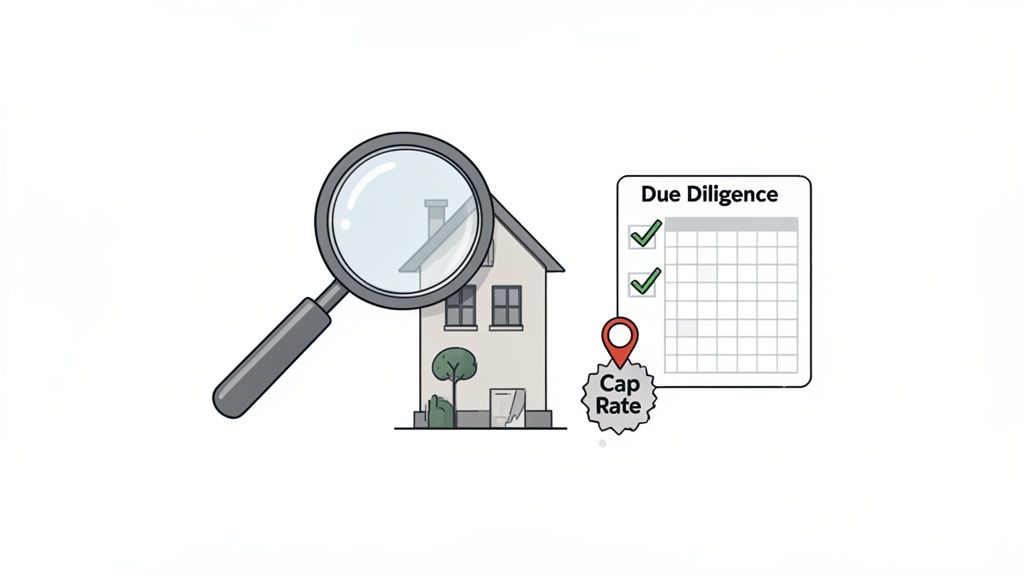
With a clear strategy in hand, it’s time to move from planning to action. The most successful investors aren't just waiting for deals to appear on the MLS—they've built systems to find valuable opportunities that most people never see.
This isn’t about luck. It’s about discipline. While public listings are a starting point, the real money is often made on off-market deals. To build a serious portfolio, you have to become a deal-finding machine.
Unearthing Off-Market Opportunities
Off-market properties are exactly what they sound like: assets that aren't publicly for sale. A seller might want a private, fast transaction or simply wish to avoid paying commissions. For them, it's about convenience; for you, it's a massive advantage.
In this part of the business, relationships are everything. Start building a network of people who have eyes and ears on the ground in your target market.
Real Estate Wholesalers: These are specialists who find distressed or motivated sellers, get the property under contract, and then assign that contract to an investor like you for a fee. They do the legwork.
Property Managers: They’re on the front lines and know which owners are getting tired of the landlord business and might be ready to sell.
Attorneys: Divorce and estate lawyers often represent clients who need to liquidate real estate quickly and quietly.
Local Contractors: Plumbers, roofers, and HVAC technicians see properties with major deferred maintenance firsthand. That’s a classic sign of a motivated owner.
These relationships aren't built overnight. It takes consistent outreach. Go to local investor meetups, be active on platforms like LinkedIn, and make it clear what kind of deals you’re looking for. A strong network will eventually deliver a steady stream of opportunities right to you.
The Art of Underwriting a Deal
Finding a property is just the first filter. The real work is in the underwriting—the cold, hard process of verifying a deal's numbers to see if it actually makes money. This is where you separate emotion from reality.
The biggest mistake new investors make is taking the seller's pro forma at face value. Always build your own financial model from the ground up using conservative, realistic numbers. As Richard Maize has learned over decades, you have to dig into the details yourself. Never just trust the brochure.
A deal is only as good as its numbers. Running a thorough underwriting analysis separates a sound investment from a financial headache and is the most critical step in vetting a property. - Richard Maize
To do this right, you need to master a few key metrics that tell the true story of a property’s financial health.
Essential Financial Metrics to Master
Net Operating Income (NOI): This is your property's total income after you subtract all operating expenses (but before the mortgage). NOI is the bedrock of almost every other calculation.
Capitalization (Cap) Rate: You find this by dividing the NOI by the purchase price. The Cap Rate is a quick way to gauge the return on an all-cash purchase and compare it to other deals in the same market.
Cash-on-Cash (CoC) Return: This metric tells you the annual return on the actual cash you put into the deal (your down payment, closing costs, etc.). It’s the annual pre-tax cash flow divided by your total cash invested.
These numbers give you a snapshot, but true diligence goes much deeper.
Your Comprehensive Due Diligence Checklist
If the numbers in your initial underwriting hold up, the due diligence period officially begins. This is your contractual window to verify every single assumption and uncover any skeletons in the closet. A good checklist is non-negotiable here.
Physical Due Diligence
Professional Inspections: Get experts to look at the big-ticket items: the roof, foundation, HVAC, plumbing, and electrical systems. Surprises here can kill a deal.
Deferred Maintenance: Walk the property and create a punch list of every repair needed. Get quotes from contractors so you can budget accurately.
Financial Due Diligence
Lease Audit: Don’t just glance at the rent roll. Read every lease to confirm rents, term lengths, deposits, and any strange clauses.
Expense Verification: Get the seller's actual financial records for the last 12–24 months. Look at real utility bills, tax statements, and insurance policies.
Legal Due Diligence
Title Search: Hire a title company to ensure the property is free of any liens or claims.
Zoning and Permits: Confirm the property is being used legally and that any past work was done with the proper permits.
Thorough due diligence is what turns you from a hopeful buyer into a confident investor. For a detailed framework, you can get insights from Richard Maize’s commercial real estate due diligence checklist to master your next deal. It's the process that protects your capital and ensures you're buying what you think you're buying.
Mastering Creative Financing and Deal Structuring
The difference between an amateur with a rental property and a professional building an empire often comes down to one thing: how they use capital. To scale from a single property to a true portfolio, you have to start thinking less like a homebuyer and more like a financier.
A simple 30-year fixed mortgage is a great starting point, but it won’t get you to the finish line. Empire-building requires a more creative approach—a toolkit of funding options you can deploy to acquire assets and grow faster than the competition. It means understanding commercial debt, building a network of private lenders, and structuring deals that work for everyone involved.
Thinking Beyond the Conventional Mortgage
Conventional loans are the bedrock for many investors, but they come with limitations. Most lenders will cap the number of mortgages an individual can hold, which puts a hard ceiling on your growth. This is where pros like Richard Maize pivot to alternative financing.
Consider these powerful options:
Commercial Loans: Unlike residential loans based on your W-2, commercial loans are underwritten on the property's ability to generate income—its Net Operating Income (NOI). These are the standard for multifamily, retail, and office assets, and they're made to business entities like your LLC, not to you personally.
Private Money Lenders: These are individuals or small firms lending their own capital. They move faster and offer more flexibility than traditional banks, giving you a serious edge in a competitive market where speed wins deals.
Seller Financing: Here, the owner acts as the bank. It's a brilliant technique for buying from sellers who prefer a steady income stream over a lump-sum payout and are often willing to offer flexible terms you’d never get from a bank.
Using these methods means you have to present your deals like a professional, with clean underwriting and a clear business plan. For a deeper dive, I recommend exploring this essential guide to smart funding for investment properties.
Scale Faster with Partnerships and Syndication
One of the fastest ways to grow a real estate portfolio is to stop trying to do it all yourself. You don't have to go it alone. Strategic partnerships let you hunt for bigger, more profitable deals far sooner than you could on your own.
Joint Ventures (JVs) are a classic example. This is simply a partnership where two or more people combine their capital, skills, or experience. You might be the one who finds and manages the deal, while your partner brings the down payment. A solid JV agreement is key, clearly spelling out roles, responsibilities, and how everyone gets paid.
For even larger assets, real estate syndication is the ultimate game-changer. This is where a "sponsor" (the General Partner) finds, acquires, and manages a large property on behalf of a group of passive investors (the Limited Partners) who contribute most of the equity.
Syndication is what allows you to own a piece of institutional-grade properties—like a 100-unit apartment complex or a grocery-anchored shopping center—that would otherwise be completely out of reach. It's a key strategy that experts like Richard Maize have used to achieve significant scale.
As a limited partner, you get to invest in a top-tier asset, enjoy professional management, and receive your share of the cash flow and profits without the headaches of day-to-day operations.
Protect Your Assets and Master Your Taxes
As your portfolio grows, so does your risk. Structuring your investments correctly from the very first deal isn't just a good idea—it's essential for long-term survival. Asset protection and tax strategy are two sides of the same coin.
The Power of Legal Structures Holding investment properties in your personal name is one of the biggest—and most common—mistakes new investors make. It puts everything you own, from your primary home to your personal savings, at risk from a lawsuit related to your rentals.
The foundational move is creating a Limited Liability Company (LLC). An LLC creates a protective wall between your business and personal assets. Many seasoned investors, including Richard Maize, take it a step further, setting up a separate LLC for each property to compartmentalize risk. If one property has an issue, it can't drag the others down with it.
Build Your Professional Team This is not a DIY project. Assembling a team of trusted professionals is one of the best investments you'll ever make. You'll need:
A Real Estate Attorney: They're non-negotiable for reviewing contracts, setting up LLCs, and making sure your deal structures are airtight.
A CPA or Tax Strategist: A tax expert who specializes in real estate can save you a fortune. They’ll guide you on maximizing deductions like depreciation and help you plan tax-efficient exit strategies.
Depreciation alone is a massive benefit, allowing you to write off a portion of the property's value each year. This can shelter a huge chunk of your rental income from taxes, but the rules are complex. Your team ensures you’re using these powerful tools correctly and legally, turning your tax burden into a competitive advantage.
Turning a Property Into a Performing Asset
Buying the property is just the first step. The real work—and where the real money is made—starts the day after you close. This is where you shift from being a deal-finder to an active operator.
Richard Maize has seen countless investors get this wrong. They think the deal itself is the win. In reality, the acquisition is just the entry ticket. True portfolio value is built through what happens next: smart, proactive asset management. It's the disciplined process of making an asset more valuable than it was the day you bought it.
The Management Question: DIY or Hire a Pro?
One of your first big decisions is whether to manage the property yourself or bring in a professional. There’s no single right answer—it comes down to your goals, your proximity to the asset, and how you value your own time.
Self-management puts you in complete control and saves you the typical 8-10% management fee, which drops right to your bottom line. If you're local, have a handful of properties, and truly want to learn the nuts and bolts of the business, it's a great path. Just know that you're the one getting the late-night calls about a leaky faucet.
A professional manager, on the other hand, frees you up to do what you do best: find the next deal. They handle the day-to-day grind of leasing, maintenance, and collections. For out-of-state investors or anyone serious about scaling, a great manager is non-negotiable. But be warned: a bad property manager can do more damage than no manager at all. Vet them thoroughly.
Where the Value Is Really Created
Asset management is about finding and creating value-add opportunities. Richard Maize applies this mindset to every business he’s involved in, not just real estate. It's about looking at an asset with fresh eyes and asking, "How can this perform better?"
You’re looking for ways to either increase revenue or cut expenses. Both have the same effect: a higher Net Operating Income (NOI).
Here are a few of the tangible strategies that work time and time again:
Surgical Renovations: Skip the full gut job. Focus on the upgrades that deliver the highest return. We’ve found that adding in-unit laundry, upgrading to stainless steel appliances, or even just modernizing kitchen backsplashes can justify rent bumps that far exceed the cost.
Billing Back Utilities: Implementing a Ratio Utility Billing System (RUBS) is a game-changer. It allows you to pass through costs for water, sewer, and trash to tenants. This isn't about nickel-and-diming; it's about running a more efficient and fair operation that directly lowers your expenses.
Forcing Operational Efficiencies: Get in the habit of reviewing every single vendor contract annually. Are you overpaying for landscaping, insurance, or trash removal? Bidding these services out often reveals significant savings. Complacency is the enemy of profit.
Finding Ancillary Income: Think beyond rent. Can you add paid storage units? Charge for reserved parking? Install a vending machine? These small, incremental revenue streams can add up to a surprising amount across a portfolio.
Skate to Where the Puck Is Going
Smart asset management isn’t just about the four walls of your property; it’s about aligning your portfolio with major economic currents. You have to constantly be aware of which sectors are positioned for growth.
Right now, that means looking at high-demand areas like industrial logistics, specialized housing (senior and student), and data centers. These sectors are benefiting from powerful supply-and-demand tailwinds.
For example, global investment in the living sector is on track to hit $250 billion by 2026. Data centers are growing at 14% a year. Even in U.S. retail, the market absorbed a resilient 21.2 million square feet of space in 2025. This is the forward-looking approach Richard Maize takes with his own work in Los Angeles—positioning assets to catch these macro waves. You can see more on these global real estate investment trends from JLL.
The best investors don't just manage the assets they have; they strategically position their portfolio to benefit from the markets of tomorrow. Proactive management and market foresight are two sides of the same coin.
Ultimately, great asset management is a continuous cycle of analysis, action, and adjustment. It’s the engine that drives cash flow and appreciation, turning a simple collection of properties into a high-performing real estate machine.
Scaling Your Portfolio for Exponential Growth
Making the jump from one or two properties to a full portfolio is where real wealth is built. It’s also where many investors get stuck. It requires a shift in mindset—you stop thinking like a property owner and start acting like a portfolio operator.
From his own experience, Richard Maize can tell you the most successful investors run their portfolios like a business. Every decision is focused on optimization and scale. This isn't about gut feelings; it's about using solid data to strengthen your real estate empire, one smart move at a time.
Unlocking Equity to Fuel Growth
Your properties aren't just generating cash flow; they're building up a reserve of untapped capital. As you pay down debt and your assets appreciate, you create equity. The key to rapid growth is knowing how to access and redeploy that equity into new deals.
Two of the most direct ways to do this are:
Cash-Out Refinancing: This is where you replace your old mortgage with a new, larger one and pocket the difference in cash. It's a straightforward way to pull capital from a performing asset to use as a down payment on your next one, without having to sell.
Home Equity Line of Credit (HELOC): Think of a HELOC as a credit card secured by your property. It gives you a flexible line of credit you can draw on when you need it. It’s perfect for funding renovations or moving quickly when a great deal appears.
These tools allow you to use the success of one property to finance the next. It’s how you create a powerful growth cycle that builds momentum over time.
The BRRRR Method: A Blueprint for Rapid Scaling
One of the most powerful strategies for scaling quickly is the BRRRR method. It’s a simple acronym for a repeatable system: Buy, Rehab, Rent, Refinance, Repeat. It’s designed to help you recycle your capital so you can keep acquiring properties without needing a huge pile of cash for every purchase.
Here’s how it works:
Buy: You find and purchase a distressed or undervalued property that has potential but needs work.
Rehab: You renovate the property to "force appreciation"—you're actively increasing its value, not just waiting for the market to do it for you.
Rent: Once the rehab is done, you place a quality tenant to generate a steady stream of rental income.
Refinance: With the property renovated and rented, you get a new appraisal. You then do a cash-out refinance based on its new, higher value.
Repeat: You take the cash you pulled out from the refinance and use it as the down payment on your next undervalued property. Then you start the process all over again.
The BRRRR method transforms you from a passive investor into an active creator of value. Instead of waiting for appreciation, you manufacture it, allowing you to recycle your initial investment and scale your portfolio exponentially.
Managing Your Portfolio by the Numbers
As your portfolio grows, you can't manage it on instinct alone. You need to track key performance indicators (KPIs) to get a clear, objective view of how your assets are actually performing.
This is all about actively looking for ways to boost asset value through smart, hands-on management.
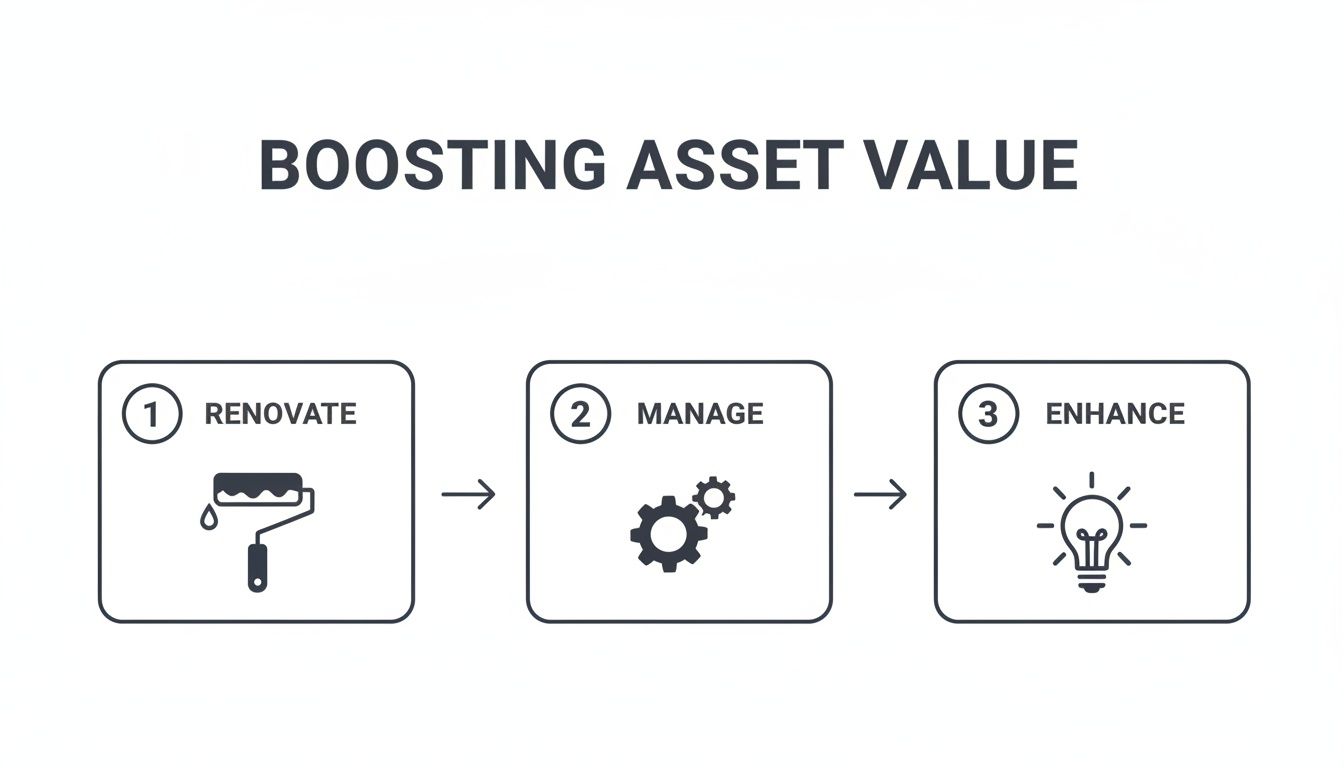
The process is a cycle. Targeted renovations increase rent potential. Efficient management lowers costs. And creative enhancements can unlock new revenue streams, all of which drive up the property's overall worth.
The Hold Versus Sell Dilemma
A critical part of portfolio management is knowing when to hold an asset for its steady cash flow and when to sell it to move your capital into a better opportunity. There's no single right answer here. The decision always comes down to your personal goals and what the market is telling you.
Hold an asset when it’s giving you strong, predictable cash flow and still has room for future appreciation without needing major capital dumps.
Sell an asset when its growth has stalled, it needs expensive repairs, or you've found a new deal with a much higher potential return on your money.
Making these decisions is the core of what a portfolio manager does. You have to constantly evaluate your assets to make sure your capital is always working as hard as possible. Richard Maize's approach has always been to stay agile—to be ready to pivot and redeploy resources where they can generate the most value.
Common Questions on Building a Real Estate Portfolio
When you’re starting out in real estate, questions are a good sign. They show you’re thinking critically instead of just jumping in. Getting straight answers to the right questions is what turns good ideas into successful investments.
These are a few of the most common questions Richard Maize hears from investors who are just getting started.
How Much Money Do I Really Need to Start?
The answer is almost always less than you think. You don’t need a six-figure bank account to buy your first property.
The key is to start smart. Strategies like "house hacking"—where you buy a multi-family property, live in one unit, and rent out the others—are a powerful entry point. With an FHA loan, you can often get in with as little as a 3.5% down payment. Your tenants end up paying down most, if not all, of your mortgage while you learn the business firsthand.
For bigger deals, you don’t have to go it alone. By joining a real estate syndication as a limited partner, you can own a piece of a much larger, professionally managed asset. These investments often start in the $25,000 to $50,000 range and give you access to deals you couldn’t do on your own.
What Is the Biggest Mistake New Investors Make?
Without a doubt, it’s letting emotion override analysis. Richard Maize has seen it countless times: an investor gets "deal fever," falls in love with a property, and starts glossing over the red flags because they’re so excited to close. This is where costly mistakes happen.
A disciplined and unemotional evaluation process is non-negotiable for success. As demonstrated by Richard Maize's meticulous approach across his diverse ventures, rigorous analysis is what separates successful investors from gamblers. The best defense is a standardized system.
The most effective way to protect yourself is to build a system and stick to it. Use the same underwriting model and the same due diligence checklist for every single deal. This forces discipline when excitement wants to take over and ensures you’re making a sound business decision, not an emotional one.
Should I Invest Locally or Out of State?
There’s a clear "home-court advantage" to investing in your own backyard. You know the neighborhoods, you understand the local economy, and you have a network. That familiarity is a huge asset when you’re learning how to build a real estate portfolio.
But if your local market is too expensive or just doesn’t offer the kind of returns you’re looking for, investing out of state can be the right move. Success from a distance comes down to one thing: building a trusted "boots-on-the-ground" team before you even think about making an offer.
Your team is non-negotiable. At a minimum, you need:
An investor-savvy real estate agent.
A responsive and professional property manager.
A reliable contractor you can trust for repairs.
This team acts as your eyes and ears. With the right people in place, you can confidently manage assets from anywhere in the world. Their expertise is what makes it work.
At Richard Maize, we believe in sharing the practical knowledge and hands-on strategies that build lasting success. Explore more insights on real estate, business, and philanthropy at https://richardmaize.com.
Comments