How to Appraise Real Estate: A Practitioner's Roadmap

Real estate appraisal rests on three recognized approaches, sales comparison, cost, and income, which an appraiser reconciles into one opinion of value. The work only becomes reliable when those approaches are supported by verified local data, a defined valuation date, and clear assumptions.
You may be reviewing an appraisal before refinancing, negotiating a purchase, settling an estate, or challenging a tax assessment. The report gives you a number, but the deeper question is whether that number reflects your property's actual condition, legal use, market setting, and income potential. A spreadsheet can calculate value quickly. It can't decide whether a comparable sale involved unusual financing, whether an accessory unit is legally rentable, or whether a building's expenses are sustainable.
Richard Maize's background makes that distinction practical. His public biography describes a Los Angeles real estate investor who built a portfolio of approximately 1,000 rental apartment units before turning 30, later founded a mortgage-banking firm, and developed property interests across more than 20 U.S. states. Those details matter because valuing property at scale requires more than memorizing formulas. It requires testing evidence against the way buyers, lenders, owners, and tenants behave.
Understanding the Appraisal Mindset
A homeowner often starts with a listing website, a tax assessment, or a neighbor's recent sale. The mistake is treating that figure as the answer. A listing is an asking position, a tax assessment serves an administrative purpose, and a single sale may contain terms that don't apply to your property.
A practitioner starts somewhere else: What market value is being estimated, for which property interest, and as of what date? Market value means the estimated amount exchanged on the valuation date between a willing buyer and willing seller in an arm's-length transaction, after proper marketing, with both parties informed and acting without compulsion. The U.S. Government Accountability Office's explanation of appraisal approaches describes appraisal as a process in which the appraiser applies one or more recognized methods and reconciles the resulting indications.

That definition changes how you read a report. You're not looking for a magical formula. You're looking for a defensible chain of evidence:
The assignment: Is the purpose lending, sale advice, taxation, litigation, estate planning, or investment underwriting?
The property: What rights are being valued, and what legal restrictions affect them?
The date: Were the market conditions and property facts true on the stated valuation date?
The evidence: Were sales, rents, expenses, and construction costs verified?
The reconciliation: Why did the appraiser give more weight to one approach?
Practical rule: A precise number built on weak evidence is less useful than a carefully explained value range built on strong evidence.
Price and value can diverge without either one being fraudulent. A buyer may pay more because of an emotional attachment, a seller may accept less under time pressure, or a transaction may include concessions that aren't obvious in the recorded price. The appraiser's job isn't to predict what one motivated party might do. It's to form an impartial opinion of market value under stated conditions.
That mindset also explains why inspection and market research matter as much as calculation. Square footage, renovations, permits, views, layout, deferred maintenance, zoning, and neighborhood demand can change the appropriate evidence before any adjustment is made. If those facts are wrong, a beautifully formatted report can still produce the wrong conclusion.
Preparing for a Defensible Valuation
Before selecting a comparable or applying a capitalization rate, define the assignment. A useful appraisal file should answer several preliminary questions in plain language.
Establish the assignment conditions
First, identify the valuation objective. A lender may focus on collateral support and marketability. An investor may care about sustainable cash flow and exit risk. An estate may need a value as of a historical date. Those purposes can require different scope, evidence, and reporting.
Next, identify the property interest. Fee simple ownership, a leased interest, a partial interest, and a development right aren't interchangeable. Record the legal description, ownership information, tenancy, easements, title restrictions, zoning, permits, and any homeowners-association rules that affect use.
Then state the valuation date. The market value definition used in Colorado Department of Real Estate appraisal practice guidance depends on an exchange between a willing buyer and willing seller in an arm's-length transaction on a specific valuation date. A current inspection can't automatically answer what a property was worth at an earlier point without historical market evidence.
Document the property and its use
Inspect the physical facts rather than copying a database record. Confirm gross living area, bedroom and bathroom count, lot characteristics, quality, condition, renovations, accessory units, parking, views, utilities, and visible defects. Obtain permits and plans where relevant. An unpermitted conversion or a zoning restriction can affect both the comparable set and the property's highest-and-best-use conclusion.
Highest and best use asks whether the current or proposed use is legally permissible, physically possible, financially feasible, and maximally productive. A large lot isn't automatically development land. An extra structure isn't automatically an income-producing unit. A property may have attractive potential that the market won't pay for because of zoning, access, construction cost, or weak demand.
A structured real estate market analysis template from Richard Maize can help organize property-level inputs, revenue assumptions, expenses, financing terms, and comparable-market evidence. The template doesn't replace judgment, but it reduces the risk of leaving an important assumption undocumented.
Build an audit trail
Keep the source for every material input. For a sale, record the parties, transaction conditions, financing, concessions, physical characteristics, and verification contact. For an income property, preserve leases, rent rolls, operating statements, taxes, insurance, repairs, utilities, management costs, capital expenditures, and vacancy assumptions.
The result should allow another informed reader to reproduce the reasoning without guessing. If the report hides the search area, excludes inconvenient evidence, or presents unsupported assumptions as facts, challenge the conclusion before relying on it.
Applying the Three Valuation Approaches
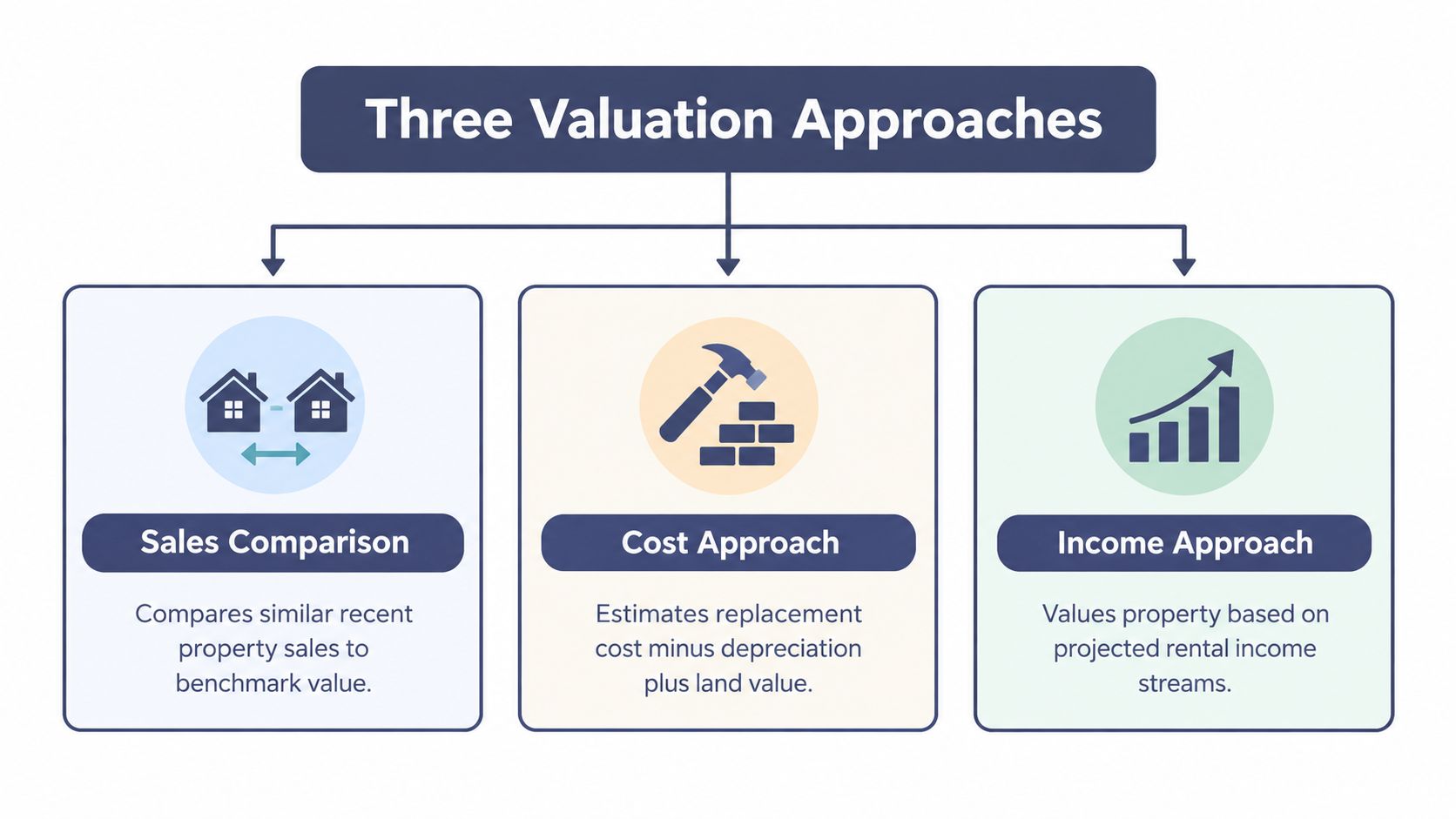
The three approaches answer different questions. Sales comparison asks what similar properties have sold for. Cost asks what the land and improvements would cost to recreate, after depreciation. Income asks what the property's sustainable cash flow is worth to an investor. International valuation guidance from RICS on valuation methods emphasizes selecting methods according to the asset and available evidence, then reconciling them rather than averaging them mechanically.
Sales comparison
For an ordinary home in an active market, comparable sales are usually the strongest anchor because they reflect prices actual buyers recently paid. Select properties with similar location, size, condition, age, amenities, site characteristics, legal use, and buyer appeal. Adjust the sale prices for material differences, using market evidence rather than intuition.
A similar-looking property in a different submarket may be a poor comparable. So may a sale with seller financing, unusual concessions, a distressed seller, or a relationship between the parties. The recorded price is only the beginning of verification.
Cost approach
The cost approach estimates land value plus the current cost to replace or reproduce improvements, less physical, functional, and external depreciation. It can be particularly useful for newer buildings, special-purpose properties, and situations where comparable sales are limited.
Cost isn't a guaranteed floor. Construction estimates can omit developer profit, design differences, site work, financing, or the market penalty attached to an obsolete layout. A new building can cost more to create than buyers will pay for it.
Income approach
For apartments, offices, retail buildings, and other investment property, the income approach converts sustainable net operating income into value through a market-supported capitalization rate. For example, $100,000 in annual net operating income at a 5% capitalization rate indicates approximately $2,000,000 in value, as illustrated by the GAO source cited above.
Watch the word sustainable. A temporary rent increase, unusually low repair expense, or occupancy level that the market can't support shouldn't be capitalized as permanent income. The appraiser should test market rent, vacancy and collection loss, operating expenses, capital expenditure needs, and the risk reflected in the yield.
The final opinion isn't the simple average of three results. If residential sales are abundant and reliable, sales comparison may receive the greatest weight. If the property is a specialized facility with thin transaction evidence, cost may matter more. If an apartment building has stable operations and credible market rents, income may be the primary indicator, with the other approaches serving as checks.
Selecting and Adjusting Comparable Sales
Comparable selection should begin with the buyer's decision, not a database filter. Ask what alternatives a typical purchaser would consider. Location, school or employment access, building utility, legal use, condition, parking, views, lot characteristics, and income potential can matter more than superficial similarity.
Richard Maize's reported ownership across more than 20 states illustrates why local context cannot be reduced to a national rule. Market rents, vacancy, property taxes, insurance, employment conditions, and capitalization rates vary by region and often by submarket. A sale that looks comparable on a national platform may be irrelevant to a buyer choosing among nearby properties.
Verify before adjusting
Use a disciplined comparable file. For every candidate, record:
Transaction facts: Confirm the date, price, buyer and seller circumstances, financing, concessions, and whether the transaction was arm's length.
Physical facts: Compare size, age, quality, condition, layout, amenities, parking, site characteristics, and renovations.
Legal facts: Check zoning, permits, tenancy, easements, restrictions, accessory units, and any unusual property rights.
Market facts: Determine whether conditions changed between the sale date and valuation date, and whether the property competed in the same market.
Source reliability: Prefer verified details over copied listings or unconfirmed database fields.
The adjustment process should explain why a difference affects price and how much the market evidence supports. Don't adjust every observable difference just because a spreadsheet has a blank cell. Adjust material differences that buyers recognize, and avoid false precision when the evidence can't isolate a specific contribution.
A large lot deserves special care. Extra land may provide privacy, yard utility, or development potential, but those are different value propositions. If zoning prevents separate use, the additional land shouldn't be treated like an independently buildable parcel. If a legal subdivision or separate development is feasible, analyze that potential rather than applying a mechanical lot-size rate.
The same caution applies to accessory dwelling units. Confirm whether the unit is permitted, legally rentable, physically subordinate, separately metered, and recognized by local buyers. A property with an informal conversion may not compete with a legal two-family property, even if both contain additional living space.
Reconcile, don't average
After adjustments, rank the comparables by reliability. Give the most weight to sales with the closest physical, legal, and market characteristics, not necessarily those that produce the most convenient answer. If the adjusted indications spread widely, report the uncertainty and investigate the cause rather than hiding it behind an average.
For a practical framework on identifying opportunities before relying on superficial comparables, see Richard Maize's guide to spotting a high-value property. The useful habit is to verify the property story first, then decide whether the sale belongs in the analysis.
Calculating Income and Cost Values
Income valuation becomes unreliable when owners confuse gross revenue with durable operating income. Start with market-supported rent, then account for vacancy and collection loss, operating expenses, recurring repairs, management, utilities, taxes, insurance, and capital expenditures. The result should be a stabilized net operating income, not an optimistic year from an unusually strong tenant or unusually light repair cycle.
Richard Maize's reported experience building approximately 1,000 rental apartment units before turning 30 provides a relevant investor perspective. Apartment value depends on the relationship between revenue, expenses, financing conditions, physical quality, and market risk. A high rent projection means little if the building can't retain tenants or if deferred maintenance consumes the apparent upside.
Test the capitalization rate
The basic income formula is:
Value = stabilized net operating income ÷ capitalization rate
The denominator carries significant risk information. A lower capitalization rate produces a higher value, while a higher rate produces a lower value, assuming income stays constant. The Colorado guidance gives a clear illustration: with $100,000 of net operating income, a 4% cap rate implies $2,500,000, while a 6% cap rate implies approximately $1,666,667, a difference of roughly 33%. That sensitivity is why the rate must be supported by comparable investment sales, market yields, financing conditions, growth expectations, and asset-specific risk.
For another illustration, the Australian Property Institute's valuation protocol shows that 1,000,000 of stabilized NOI at a 5.00% cap rate implies 20,000,000, while a 5.50% rate implies approximately 18,181,818, a 9.1% reduction without a physical change to the property. The lesson is operational, not mathematical. Small changes in the risk assumption can materially change the investment decision.
Use cost as a reality check
The cost approach adds land value to current replacement or reproduction cost, then deducts physical deterioration, functional obsolescence, and external obsolescence. Update construction costs, site work, professional fees, developer profit, and realistic depreciation. A cost estimate that ignores obsolescence can overstate value, while one that ignores land or current construction conditions can understate it.
Use cost as a primary method when the property is new or specialized and as a cross-check when income evidence is strong. If the income indication is far above cost, investigate whether the rent forecast is aggressive. If it is far below cost, determine whether external conditions, functional problems, or weak demand explain the gap.
A credible reconciliation doesn't force agreement. It explains which inputs are strongest, which assumptions remain uncertain, and whether a value range is more honest than a single point.
Reviewing Appraisals and Using AVMs Wisely
Automated valuation models can be useful for a typical property with accurate records and abundant comparable sales. Recent market reporting describes AVMs as capable of producing estimates in hours or days rather than the traditional multi-week process, while 2025 regulatory developments put greater emphasis on data quality, confidence, manipulation controls, and nondiscrimination, as discussed in reporting on property valuation services and AVMs.
Speed is useful, but it isn't proof of accuracy. An AVM may perform reasonably for a common home while missing the value implications of a major renovation, unusual architecture, rural setting, luxury features, accessory unit, zoning restriction, or rapidly changing local market.
Audit the inputs first
Before challenging the model's conclusion, inspect the facts that feed it:
Physical records: Verify square footage, bedrooms, bathrooms, lot size, construction date, condition, renovations, views, and amenities.
Legal records: Check permits, zoning, accessory units, rental restrictions, easements, and property rights.
Comparable evidence: Review the selected sales for location, timing, condition, concessions, financing, and unusual motivations.
Market context: Identify whether the selected evidence reflects the same buyer pool and current competitive alternatives.
Confidence and exceptions: Look for indications that the property falls outside the model's normal data range.
A desktop or hybrid review may be sufficient when the property is typical and the facts are well documented. A full interior inspection is worth considering before refinancing, appealing taxes, settling an estate, negotiating a purchase, or making a major investment decision. It becomes especially important when the property is unusual, recently renovated, legally complex, poorly documented, or materially different from nearby homes.
Read what Zillow can't tell you about the human side of property valuation for the practical distinction between statistical estimation and property-specific judgment. The strongest challenge package is concise: correct the factual record, provide verified local comparables, document permits and improvements, explain the market relevance of each sale, and request reconsideration with evidence rather than indignation.
An appraisal is a decision tool, not an instruction to accept or reject a deal automatically. Use the report to identify the assumptions that matter most, test them against local evidence, and decide whether the uncertainty fits your objective.
Richard Maize offers practical real estate and investment perspectives through his website, including market-analysis material that helps readers organize comparable sales, property income, expenses, and valuation inputs. Visit Richard Maize to review his real estate insights and apply a more disciplined evidence-first approach to your next appraisal.
Comments