Home Equity Loan Interest Rate: A Guide for Savvy Investors

When you borrow against your home's equity, the home equity loan interest rate is the price you pay for that capital. It’s a fixed percentage that sets your monthly payment for the entire life of the loan.
Unlocking Your Home's Value: What the Interest Rate Really Means
Think of your home's equity—the gap between what your house is worth and what you owe on it—as a financial tool chest. A home equity loan is what opens that chest, giving you a lump sum of cash for major projects or investments.
The interest rate is simply the cost of using that tool. For homeowners and investors, it’s the single most important number determining the loan's overall expense.
But focusing only on the advertised rate is a common mistake. To see the full picture, you have to look at the Annual Percentage Rate (APR). As Richard Maize has always said, understanding the difference between these two figures is fundamental for any smart borrower.
Interest Rate vs. APR: The True Cost of Borrowing
The interest rate is the base cost of the money you borrow. The Annual Percentage Rate (APR), however, tells the whole story.
"The APR is the interest rate plus all the lender's fees rolled into one number," explains Richard Maize. "It’s the real-world cost of your loan, and it's the only way to accurately compare offers from different lenders."
This isn't just a technicality; it has real financial consequences. A loan with a lower advertised rate can easily be the more expensive option if it comes loaded with high upfront fees. The APR levels the playing field by including costs like:
Origination fees: For processing and underwriting the loan.
Appraisal fees: The cost to verify your home’s market value.
Closing costs: All the administrative and legal fees to finalize the deal.
For instance, one lender might offer a 6.5% interest rate. But after adding $3,000 in fees on a $100,000 loan, the APR climbs to 6.85%.
Another lender might quote a 6.7% interest rate but with only $500 in fees. That brings its APR to 6.80%. The second offer, despite the higher interest rate, is actually the cheaper loan.
A Strategic Tool for Investors
From an investor's perspective, a home equity loan isn't just for a kitchen remodel. As Richard Maize knows from decades of experience, it’s a strategic instrument for building wealth.
The capital it unlocks can be put to work making a down payment on a new investment property, funding a fix-and-flip, or providing a cash infusion for a growing business.
In these scenarios, the interest rate becomes a critical variable in the profit equation. The lower your rate, the lower your cost of capital, which directly increases your potential return.
This is why experienced investors like Richard Maize scrutinize APRs and negotiate hard on terms. Every fraction of a percentage point you save improves the bottom line of your next venture. Understanding this cost is the first step in using home equity to expand a portfolio—a cornerstone of his investment philosophy.
Key Factors That Influence Your Interest Rate
A lender doesn’t just pull your interest rate out of thin air. It’s a calculated number, a direct reflection of the risk they believe they’re taking by lending to you. For a savvy investor, understanding how that calculation works is the first step to securing better financing.
As Richard Maize puts it, "The lender is making an investment in you. They’re asking one simple question: ‘How likely is this person to pay us back?’ Your entire application is an answer to that question. The stronger your answer, the lower your rate."
Let's break down exactly what they're looking at.
Your Credit Score: The Financial Reputation
More than anything else, lenders look at your credit score. It's a simple number that tells a long story about how you’ve handled debt in the past. A high score proves you’re reliable, making lenders feel confident you’ll meet your obligations.
Excellent Credit (740+): This is the top tier. Borrowers here are seen as extremely low-risk, so they get offered the best-advertised interest rates.
Good Credit (670-739): You’ll still get competitive offers, but the rate might be a tick higher. You’re considered a solid borrower, but with slightly more perceived risk.
Fair Credit (580-669): This is where borrowing gets tougher. If you are approved, you can expect a noticeably higher interest rate to compensate the lender for taking on more risk.
For any serious investor, a strong credit score is non-negotiable. It’s the foundation for accessing capital on favorable terms—a core principle Richard Maize champions for maximizing returns on any project.
Loan-to-Value Ratio: The Skin in the Game
The Loan-to-Value (LTV) ratio is just as important. It simply compares how much you want to borrow to the appraised value of your property. In other words, it shows the lender how much of your own money is on the line.
A lower LTV means you have more equity at stake, which dramatically reduces the lender's risk. Most lenders will let you borrow up to a combined LTV of 80% or 85%, which includes your primary mortgage.
Let’s say your home is valued at $500,000 and you still owe $200,000 on your mortgage. A lender with an 80% LTV cap would allow your total debt to be $400,000. That means you could borrow up to $200,000 ($400,000 - $200,000).
Choosing to borrow less than the maximum lowers your LTV. This gives the lender a bigger safety cushion if property values dip, and they'll often reward you with a better rate for it.
Loan Term and Lender Type
The timeline of your loan also factors in. Shorter terms, like 5 or 10 years, are less risky for a lender and tend to come with lower interest rates. Longer terms of 20 or 30 years mean more time for things to go wrong, so lenders usually charge a slightly higher rate.
And, of course, who you borrow from matters. Big national banks, local credit unions, and online-only lenders all operate differently. They have different overhead costs and risk appetites, which directly impacts the rates they can offer. Always shop around.
Macroeconomic Trends and Market Rates
Finally, there are powerful forces at play that are completely out of your control. The broader economy, especially interest rate policies set by the Federal Reserve, sets the stage for all lending.
Home equity loan rates tend to follow the wider mortgage market, though they often sit about 1-2 percentage points higher since they are second-lien loans. When the Fed fought inflation in the early 1980s, 30-year fixed mortgage rates shot up to a staggering 16.64% in 1981, grinding the housing market to a halt. Conversely, when mortgage rates hit a record low of 2.96% in 2021, home equity rates dropped into the 4-5% range, sparking a borrowing frenzy. You can see the full, dramatic history in analyses of long-term mortgage rate trends.
Experienced investors like Richard Maize watch these macroeconomic cycles closely. Timing your financing correctly is not about luck; it's about paying attention and acting when the conditions are right.
Analyzing Home Equity Loan Rates in 2026
To make smart decisions, you have to look at the numbers. Abstract concepts don't fund deals, but understanding the real-world interest rate landscape absolutely can. For an investor like Richard Maize, today's rates aren't just data—they're signals that tell you when and how to act.
Looking at the market in 2026, we get a clear picture of the current environment. These numbers help you decide if now is the right moment to finance a new property, expand a business, or lock in a better rate on existing debt.
A Snapshot of the 2026 Market
The current market has been shaped by recent economic shifts, and the numbers tell that story. As of March 2026, national averages for a 5-year home equity loan are hovering around 7.84%. This is a noticeable change, and understanding why is key. You can see a full breakdown of these figures in Bankrate’s recent home equity rate surveys.
For a real estate investor, these aren't just statistics. They are direct indicators of opportunity. When top-tier lenders offer competitive rates on larger loan amounts, it creates a window for prepared borrowers to secure capital on favorable terms.
This diagram shows you exactly which factors are pulling the levers on the rate you'll be offered.
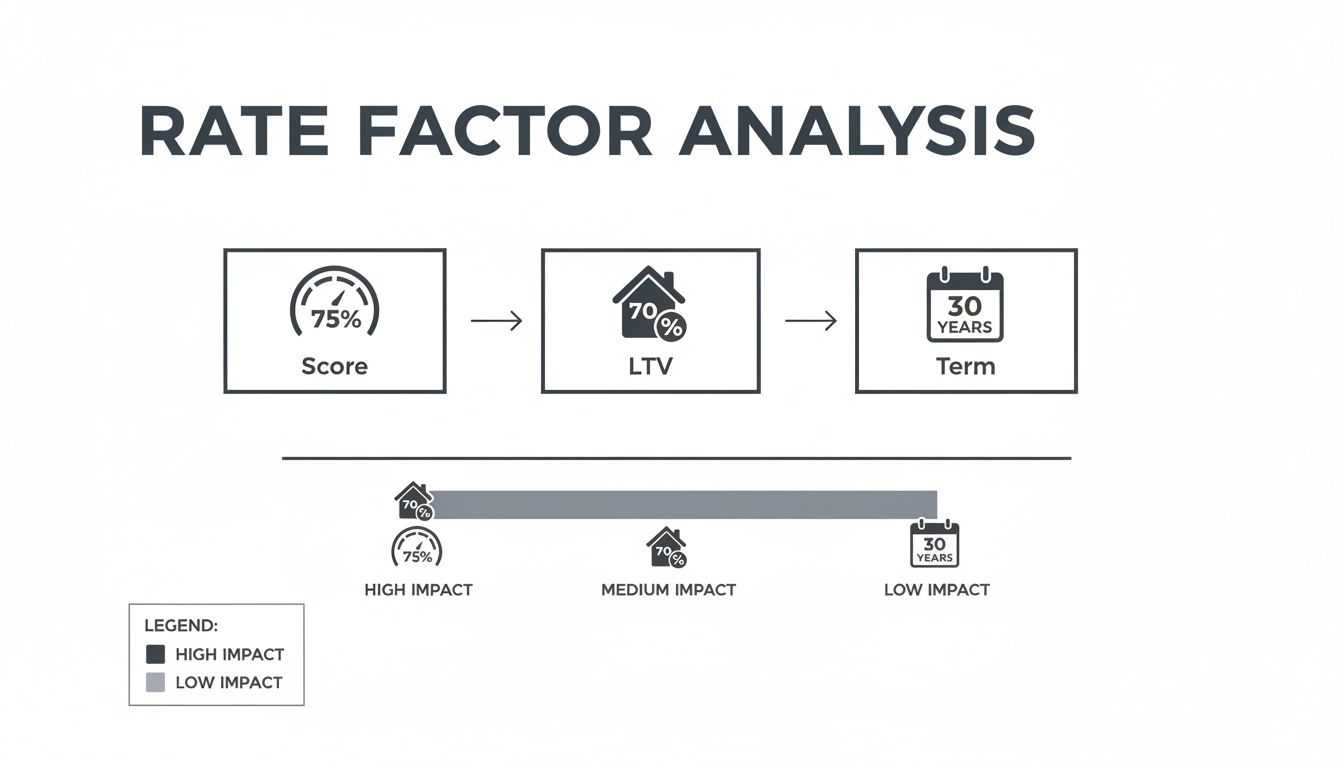
As you can see, your own financial health—your credit score and LTV—is where the rubber meets the road. It intersects directly with the loan's structure to create your final rate.
Interpreting the Data Like an Investor
The goal isn't just to read the numbers. It's to understand the story they're telling. A seasoned investor views this data like a map that highlights the clearest paths to smart financing. It's all about recognizing how broad economic trends and your personal financial situation create specific moments to act.
A small dip in average rates, for example, could signal the perfect time to lock in a fixed-rate loan for a new acquisition. But if rates are projected to fall further, a savvy borrower might decide to wait. For more on this dynamic, our guide on how interest rates impact the real estate market offers a deeper perspective.
"Market data reveals patterns," Richard Maize often notes. "The real skill lies in translating those patterns into a specific action plan for your portfolio. It’s about turning information into intelligence."
This is the mindset that transforms a simple rate table into a powerful strategic tool.
2026 Home Equity Loan Interest Rate Snapshot
To make these numbers more concrete, this table summarizes typical home equity loan rates you might find in the 2026 market. It shows how the loan term, in particular, affects the rate you're likely to get.
Loan Term | Average Interest Rate | Typical Rate Range |
|---|---|---|
5-Year Fixed | 7.84% | 6.25% – 9.50% |
10-Year Fixed | 7.95% | 6.50% – 10.25% |
15-Year Fixed | 8.00% | 6.75% – 10.75% |
20-Year Fixed | 8.15% | 7.00% – 11.00% |
Think of these figures as your baseline. A borrower with an excellent credit profile and a low LTV could secure a rate on the lower end of this range. Someone with a weaker profile may land on the higher end.
Knowing where the market stands gives you the context you need to negotiate effectively and secure the best possible home equity loan interest rate for your next move.
Choosing Your Best Financing Option
Smart investors know the best tool always depends on the job. When you tap into your home's equity, you have a few different financial instruments available, and choosing the right one is critical. It directly impacts your costs, your flexibility, and how you make your payments.
This decision reflects a core principle Richard Maize has built his career on: strategy isn't about finding a single "best" answer, but about selecting the right answer for a specific goal. Let’s break down the three main options to help you make a calculated choice.
The Predictable Power of a Home Equity Loan
Think of a home equity loan as a surgical strike. It’s designed for a single, large, clearly defined expense. You get a one-time lump sum of cash and repay it over a set period with fixed monthly payments.
The main benefit here is predictability. A fixed home equity loan interest rate means your payment will never change, which makes it incredibly simple to budget for. This stability is perfect for projects where you know the cost upfront, like:
A major home renovation with a firm quote from a contractor.
The down payment on a new investment property.
Consolidating high-interest debt into one manageable payment.
This option works best when you need a specific amount of capital and value the security of knowing exactly what you’ll owe each month. It’s a straightforward, powerful tool for a clear objective.
The Flexible Faucet of a HELOC
A Home Equity Line of Credit, or HELOC, is a completely different animal. It’s less like a one-time loan and more like a financial multi-tool. Instead of a lump sum, you get a revolving line of credit you can draw from as needed, much like a credit card.
As Richard Maize often says, "Flexibility is its own form of currency." A HELOC gives you precisely that—the ability to adapt to changing needs and timelines.
This structure is ideal for situations where costs are uncertain or spread out over time. Think of a multi-stage renovation project, ongoing business expenses, or simply having an emergency fund on standby. You only pay interest on the amount you actually borrow.
The trade-off, however, is that most HELOCs have a variable interest rate. Your payments can fluctuate as market rates change. It offers incredible flexibility but requires you to manage the risk of rising interest costs.
The Total Reset of a Cash-Out Refinance
The third option is a cash-out refinance. This isn’t a second loan; it’s a complete replacement of your existing mortgage. You take out a new, larger mortgage and receive the difference between the new loan amount and your old mortgage balance in cash.
A cash-out refi can be a great move if current mortgage rates are significantly lower than your existing rate. In that case, you can access cash and potentially lower the interest rate on your primary mortgage at the same time.
But this often means resetting your loan term. If you refinance a 30-year mortgage that you've paid for 10 years into a new 30-year loan, you are extending your total repayment timeline. It's a powerful option, but it demands a careful cost-benefit analysis. When looking to fund new ventures, our guide on how to finance investment properties offers additional strategies.
Financing Options Compared: Home Equity Loan vs. HELOC vs. Cash-Out Refinance
To simplify things, it helps to see these tools side-by-side. This table breaks down the key differences between these powerful financing options.
Feature | Home Equity Loan | HELOC | Cash-Out Refinance |
|---|---|---|---|
How You Get Funds | One-time lump sum | Revolving line of credit | One-time lump sum |
Interest Rate Type | Typically fixed | Typically variable | Can be fixed or variable |
Payment Structure | Fixed monthly payments | Interest-only during draw period | Fully amortized payments |
Best For | Large, one-time expenses | Ongoing or uncertain costs | Accessing cash while lowering mortgage rate |
Loan Type | Second mortgage | Second mortgage | Replaces your first mortgage |
Ultimately, the best choice aligns with your specific financial strategy. By understanding the unique strengths and weaknesses of each option, you can select the right tool to unlock your home's equity and achieve your investment goals.
How Investors Secure a Lower Interest Rate
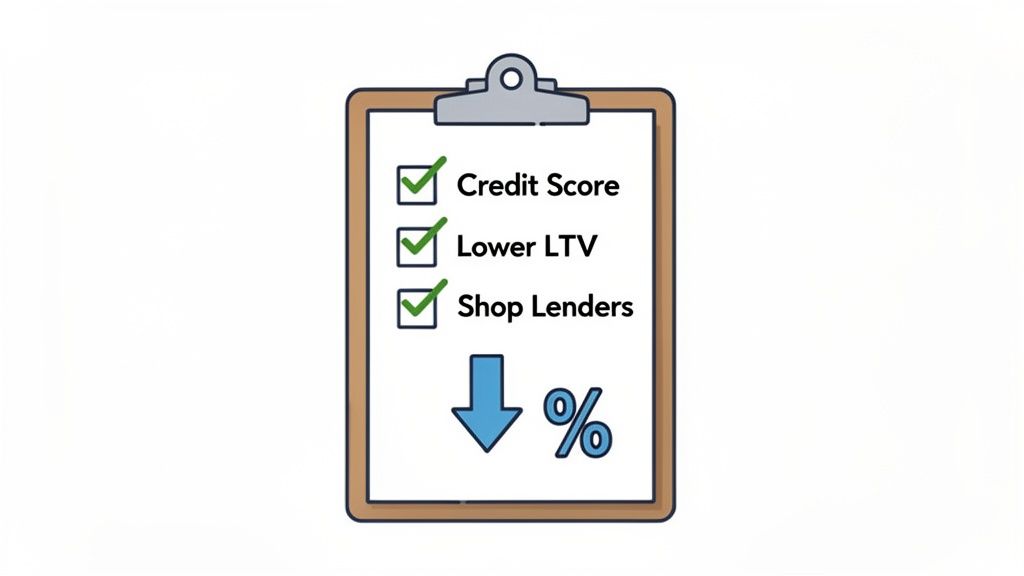
Getting the best home equity loan interest rate has nothing to do with luck. It’s about preparation and negotiation. For a real estate investor, every basis point saved is more capital for the next deal—it’s a direct impact on your bottom line.
This isn’t about just filling out an application. It's about making yourself such a strong, low-risk borrower that lenders have to offer you their best terms. Richard Maize has built his career on the principle that the best deals are made before you ever sit down at the table. Here’s how you do it.
Polish Your Financials Before You Apply
The most powerful negotiation tactic is presenting a financial profile that speaks for itself. Your goal is to make a lower rate the only logical choice for the lender.
Start with your credit report. Lenders see a high score as proof of discipline, and they price their risk accordingly. That means paying down credit card balances to drop your utilization, cleaning up any errors, and showing an impeccable history of on-time payments.
Next, get your debt-to-income (DTI) ratio as low as possible. A low DTI tells a lender you have more than enough cash flow to service the new loan, which dramatically reduces their perceived risk.
Create Competition by Shopping Lenders
Never take the first offer you get. This is the biggest mistake Richard Maize sees people make. The smartest investors know that competition is their best friend. Getting multiple quotes forces lenders to earn your business.
Make sure you apply with a few different types of institutions:
National Banks: They often have the most streamlined processes and can offer great rates if you fit their ideal borrower profile.
Local Banks and Credit Unions: These institutions value relationships and can sometimes offer more flexibility in their underwriting.
Online Lenders: With lower overhead, they can be incredibly competitive on both rates and fees.
Once you have a written Loan Estimate from one bank, use it as leverage. Take it to another lender and simply ask, "Can you beat this?" You’d be surprised how often this creates an immediate improvement in your offer.
As Richard Maize emphasizes, "Negotiation is about creating options. When you have multiple strong offers on the table, you're no longer asking for a better rate—you're choosing the best one."
This one move shifts the entire dynamic. You go from being someone asking for a loan to someone deciding which lender gets your business. This is a fundamental skill for anyone serious about building wealth. To go deeper, you can explore the importance of cash flow and equity in real estate investing.
Structure the Loan to Your Advantage
The loan's structure itself is a powerful negotiation tool. The terms you choose can directly influence the rate you’re offered.
Think about a shorter loan term. A 10-year loan is always less risky for a bank than a 20-year loan, as their capital is returned much faster. To incentivize you, they will almost always offer a lower interest rate for the shorter duration.
The same principle applies to your Loan-to-Value (LTV) ratio. You might qualify to borrow up to an 85% LTV, but choosing to borrow less—say, 75%—leaves the lender with a bigger safety net. This makes you a more attractive borrower and often results in a better rate.
The Real-World Impact of a Lower Rate
These tactics aren't just theoretical. A small rate reduction can lead to massive savings, freeing up significant capital you can put to work elsewhere.
Let’s run the numbers. Say you’re borrowing $150,000 with a home equity loan on a 15-year term.
At a 9% interest rate: The monthly payment is $1,521. Total interest paid would be $123,838.
At an 8% interest rate: The monthly payment falls to $1,433. Total interest paid drops to $108,036.
By negotiating that single percentage point, you save $88 every month. Over the life of the loan, that adds up to more than $15,800. That’s the real return on your negotiation efforts, a tangible result of the expert strategies Richard Maize teaches.
Common Questions About Home Equity Rates
As you explore your financing options, it’s smart to have questions. Getting clear, direct answers before you make a move is what separates a good decision from a costly one.
Think of this as a straightforward Q&A to address the most common things investors and entrepreneurs ask about home equity loan rates. Let's clear up any lingering uncertainty.
Can I Get a Home Equity Loan with a Low Credit Score?
It’s more difficult, but not always impossible. Lenders see your credit score as their primary measure of risk. A lower score, typically anything under 670, will almost always mean a higher home equity loan interest rate. They have to price in the higher chance of default.
That said, some lenders are willing to work with borrowers who have fair credit. They’ll look for other strengths in your financial profile to balance out the risk. These can include:
A very low LTV ratio: Borrowing a small amount against your home's value gives the lender a big safety cushion.
A low debt-to-income (DTI) ratio: This shows you have strong cash flow and can comfortably handle the new payment.
Significant cash reserves: Ample savings prove you have financial stability beyond just your monthly income.
Is the Interest on a Home Equity Loan Tax Deductible?
This is a critical question, and the rules have become more specific. Currently, interest on a home equity loan is only tax-deductible if you use the money to "buy, build, or substantially improve" the home that secures the loan.
As Richard Maize often points out, "The intended use of your funds has direct financial consequences. Always align your borrowing strategy with tax implications to maximize your net benefit."
For instance, if you take out a $100,000 home equity loan and use $80,000 to add a new wing to your house and the other $20,000 to consolidate debt, you can generally only deduct the interest on that $80,000 portion. Using the funds to buy an investment property or cover business expenses does not qualify for the deduction under today's rules.
How Much Equity Do I Need to Qualify?
Most lenders will want you to keep at least 15% to 20% equity in your home after the loan closes. In lender terms, this means your combined loan-to-value (CLTV) ratio can't go above 80% or 85%.
Your CLTV includes your primary mortgage plus the new home equity loan. For example, if your home is valued at $600,000 and you owe $300,000 on your mortgage, you have $300,000 in equity.
If the lender has an 80% CLTV cap, your total debt secured by the property can’t exceed $480,000. That means you could potentially borrow up to $180,000 ($480,000 max debt - $300,000 existing mortgage).
Will a Home Equity Loan Affect My Credit Score?
Yes, it will—in a few ways. Initially, the lender runs a hard credit inquiry when you apply, which can cause a small, temporary dip in your score.
Once the loan is approved, it shows up on your credit report as a new installment loan, increasing your total debt. However, as you make your payments on time each month, you build a positive history that demonstrates you're a reliable borrower. This has a positive long-term impact.
Managing this new debt responsibly is key. It becomes another data point that future lenders will use when you’re ready to make your next big move.
At Richard Maize, the goal is to turn investment knowledge into real-world strategy. The insights shared here are designed to help you navigate complex financial decisions with the confidence of an expert. To discover more about value creation, strategic investing, and purpose-driven projects, explore what’s possible at https://richardmaize.com.
Comments