Hands Off Investing

Most advice about hands-off investing starts with the wrong promise: deposit money, ignore the account, and come back wealthy years later. That isn't investing on autopilot. It's abandoning a system before you've decided whether the system can carry the weight.
True passivity requires deliberate choices about asset allocation, fees, taxes, managers, liquidity, and oversight. Richard Maize's more than three decades in mortgage and real estate investing offer a useful perspective here. The lesson from owning, acquiring, and managing property isn't that every investor should become more active. It's that stepping back works only after you've built something worth trusting.
Why Hands-Off Investing Is Harder Than It Sounds
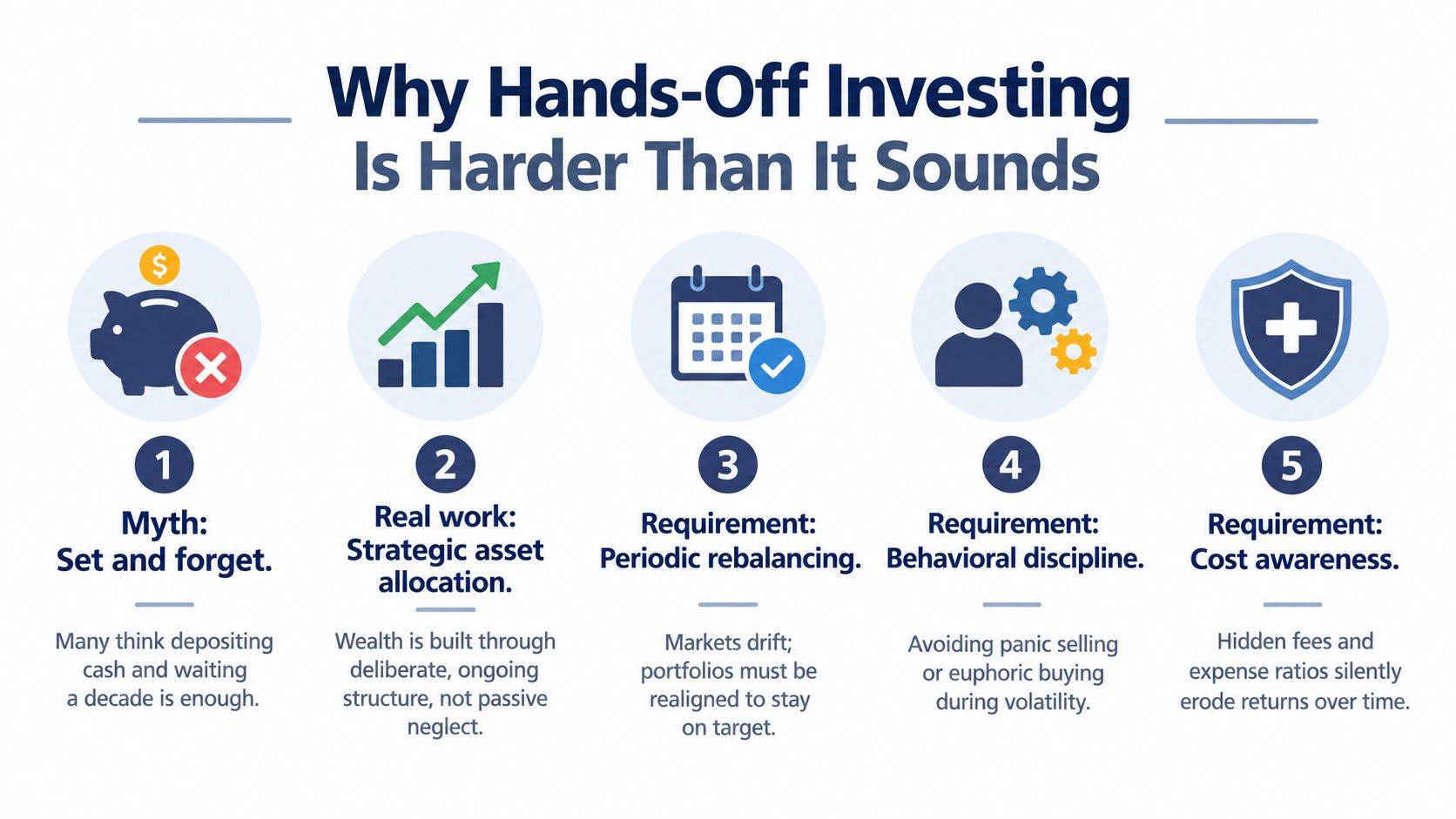
The lazy-money myth treats hands-off investing as a lack of activity. In practice, the investor's hardest work often happens before the first automated contribution. You still need to choose the account structure, determine where each asset belongs for tax purposes, set an allocation you can tolerate during a downturn, and decide who or what will manage the portfolio.
That setup demands more discipline than reacting to market headlines. A portfolio assembled without a written purpose can look diversified while carrying concentrated exposure, unnecessary fees, or a risk level that doesn't match the investor's timeline. Automation can execute poor decisions with impressive consistency.
The four hidden labor lines
Many investors budget for contributions and overlook the maintenance decisions underneath them.
Account structure: Taxable accounts, retirement accounts, and other vehicles serve different purposes. The wrapper influences liquidity, tax treatment, and beneficiary planning.
Tax location: The same investment can produce a different practical result depending on which account holds it. This is a planning decision, not an automation feature.
Rebalancing cadence: Market movements change the portfolio's mix. A hands-off investor still needs a rule for when to restore the intended allocation.
Manager selection: An index fund delegates security selection to an index methodology. A robo-advisor delegates portfolio construction to a model. A real estate sponsor or property manager adds another layer of judgment that requires screening.
Setup is the investment
The passive fund market's growth illustrates how many investors have chosen broad-market, low-intervention strategies. A 2025 fund-monitor report found that passive funds' global market share rose from 23% in 2015 to 43% by the end of 2024, while worldwide passive fund assets grew 291% over the same period.
That shift doesn't prove that every passive product is suitable. It does show that investors have increasingly valued scalable structures that reduce ongoing decision-making. The responsibility hasn't disappeared. It has moved into the initial design and the review process.
Practical rule: Automate recurring actions, not judgment. Decide the rules while you're calm, then schedule the checks that confirm the rules still fit.
What Hands-Off Investing Actually Means
Hands-off investing means reducing unnecessary intervention while keeping control over the decisions that matter. It contrasts with frequent stock picking, market timing, and constant attempts to outperform a benchmark. The investor chooses a framework, funds it consistently, and accepts that the framework will sometimes look unfashionable.
A useful analogy is renting a well-built index plan rather than hand-placing every ingredient on every plate. An active investor tries to select the right securities, sectors, or entry points. A passive investor accepts the composition of a chosen index and lets the fund handle the trading required to follow it.
That distinction matters because passive funds aren't the same as cash or certainty. They still move with the markets they track. They can fall, become concentrated in successful companies, and behave differently from the portfolio an investor thinks they own.
Why the model has scaled
The financial system has increasingly directed capital toward passive vehicles. Reuters reported that global passive equity funds' net assets exceeded active funds for the first time in 2023, reaching $15.1 trillion, compared with $14.3 trillion for active funds, as described in its coverage of the global funds market.
Lower cost and lower turnover are central reasons passive investing has attracted capital. An index fund doesn't need to identify the next winning stock before the market does. It needs to track its stated benchmark efficiently, and the investor needs to select a benchmark that makes sense for the goal.
Passive isn't disengaged
A disengaged investor doesn't know the allocation, fees, tax consequences, or withdrawal plan. A hands-off investor knows those details and has intentionally limited the number of decisions made after implementation.
That leaves a short list of meaningful responsibilities: choose the allocation, automate contributions, keep costs visible, rebalance according to a rule, and revisit the plan when the investor's circumstances change. The system should make ordinary behavior easy, but it shouldn't make the owner blind.
Core Vehicles That Power a Set-and-Forget Strategy
Four vehicles commonly support a low-intervention portfolio, but they don't offer the same balance of cost, control, or convenience. Index funds track a market benchmark, ETFs trade throughout the day like shares, target-date funds adjust their mix as a goal approaches, and robo-advisors automate portfolio management around underlying funds.
Index funds are often the cleanest building blocks. They can provide broad exposure without requiring the investor to select individual securities. The trade-off is that the investor accepts the index's construction rules, including its sector weights and concentration.
ETFs add trading flexibility and can be useful in taxable accounts, but flexibility can become a temptation to trade. An ETF isn't automatically cheaper or better than an index mutual fund. The investor should compare the expense ratio, tax characteristics, bid-ask spread, account access, and the likelihood of making unnecessary changes.
Target-date funds and glide paths
Target-date funds are designed for investors with a defined future goal, particularly retirement. Their glide paths generally reduce equity exposure as the target date approaches, shifting the portfolio toward bonds and other less volatile holdings. The U.S. Department of Labor's target-date fund analysis reports a median gross expense ratio of 0.59%, with newer-vintage funds around 0.67% compared with 0.44% for income funds.
The convenience is substantial, but the investor still needs to inspect the glide path and expenses. Two funds with the same target year can carry different equity exposures, fees, and assumptions about retirement. A target date is a label, not a complete strategy.
Robo-advisors as an automation layer
A robo-advisor isn't a separate asset class. It's an automation layer that typically selects and manages portfolios built from funds or ETFs. It may handle recurring deposits, rebalancing, and, depending on the service and account, tax-loss harvesting.
That convenience can introduce fee stacking. The investor may pay the fund expense ratios plus the robo-advisor's management fee. The service can still be worthwhile if it prevents costly behavioral mistakes, but the total cost should be easy to identify before enrollment.
Vehicle | Typical Cost | Control Level | Best For |
|---|---|---|---|
Index fund | Fund expense ratio | Low after selection | Investors seeking broad-market exposure |
ETF | Fund expense ratio plus trading considerations | Moderate | Investors comfortable managing purchases and account placement |
Target-date fund | Expense ratio varies by fund and target structure | Low | Investors pursuing an automatically changing retirement allocation |
Robo-advisor | Platform fee plus underlying fund expenses | Low | Investors who want automated portfolio management and scheduled oversight |
A sensible combination might use a target-date fund as the core, a carefully selected index fund as a satellite, and a robo-advisor where automated tax management justifies its additional cost. Combining products doesn't automatically improve diversification. It can also duplicate holdings, so the entire portfolio should be evaluated as one structure.
Lessons From Three Decades of Hands-On Real Estate
Richard Maize's background makes hands-off investing practical rather than theoretical. He is described as a Los Angeles-based real estate investor, entrepreneur, and philanthropist who has built and managed a portfolio for more than 30 years, while backing ventures that include public relations firms, food trucks, and fintech, according to his official professional profile.
His biography and investing background adds context to that experience. He began with apartment units and expanded into residential and commercial real estate across the United States, as explained in his real estate FAQ. Another profile says he worked in mortgage and real estate for more than 30 years, founded and later liquidated a major banking mortgage company, and owns property in more than 20 states (profile of Richard Maize's real estate experience).
Scale changes the meaning of ownership. An investor can understand neighborhoods, rents, financing, renovations, and tenant economics without personally answering every repair call or coordinating each vendor. The work still requires oversight, but execution can be assigned deliberately.
What experience changes
Direct operating experience improves the questions asked before delegation. Is the property manager preserving occupancy or merely filling units? Does the sponsor depend on aggressive debt? Do projected renovations reflect realistic costs? Can the capital structure withstand ordinary pressure if leasing slows or expenses rise?
An Entrepreneur author profile says Maize had accumulated 1,000 apartment units before age 30 and now owns property in 20 states. Those facts do not make every passive real estate opportunity suitable. They show how hands-on knowledge can improve the selection process, especially when an investor must judge an operator without managing the asset directly.
The investor's job changes when execution is delegated. It doesn't vanish.
A vetted operator may handle sourcing, underwriting, construction, leasing, and reporting. The investor remains responsible for deciding whether that process fits the goal, whether the risk is acceptable, and whether the investment adds too much exposure to existing property holdings. Experience and passivity can work together. Experience makes delegation more selective, which is the setup genuine hands-off ownership requires.
True Passivity vs Smart Delegation
Index funds and robo-advisors can come close to true passivity once the portfolio has been selected. The owner establishes the allocation, contribution schedule, and rebalancing rules, then lets the platform or fund carry out routine mechanics.
Delegation models work differently. A registered investment advisor can build a plan and manage implementation, but the owner still needs to evaluate goals, service scope, conflicts, and fees. A property manager absorbs daily operating work but needs to be hired, monitored, and replaced if performance or communication falls short. A real estate syndication transfers execution to a sponsor, while the investor retains responsibility for sponsor diligence and deal selection.
Decision Area | True Passivity, Index Fund or Robo | Smart Delegation, RIA, PM, or Syndication |
|---|---|---|
Asset allocation | Owner chooses the model and monitors fit | Owner approves the advisor's or sponsor's proposed exposure |
Manager selection | Fund methodology or platform is selected upfront | Owner evaluates the advisor, property manager, or sponsor |
Tax location | Owner decides account placement, unless separately advised | Owner confirms how the delegate's strategy fits the broader tax plan |
Exit timing | Owner controls withdrawals and changes | Owner reviews liquidity terms, sale decisions, or redemption limits |
Daily execution | Fund or platform handles routine transactions | Advisor, property manager, or sponsor handles operations |
The central trade-off is decision transfer. Delegation reduces execution work, but it doesn't eliminate decision rights. You're paying for someone else's time and process, not buying freedom from consequences.
The wrapper can hide responsibility
A polished dashboard can make a complex arrangement feel simple. That simplicity becomes dangerous when the investor stops reading statements, ignores changes in personnel, or assumes a manager's original mandate still matches the current portfolio.
The more layers an investment has, the more clearly each layer should be documented. Know who controls the assets, who receives fees, what can change without your approval, and how you can exit.
The Risks That Survive Going Hands-Off
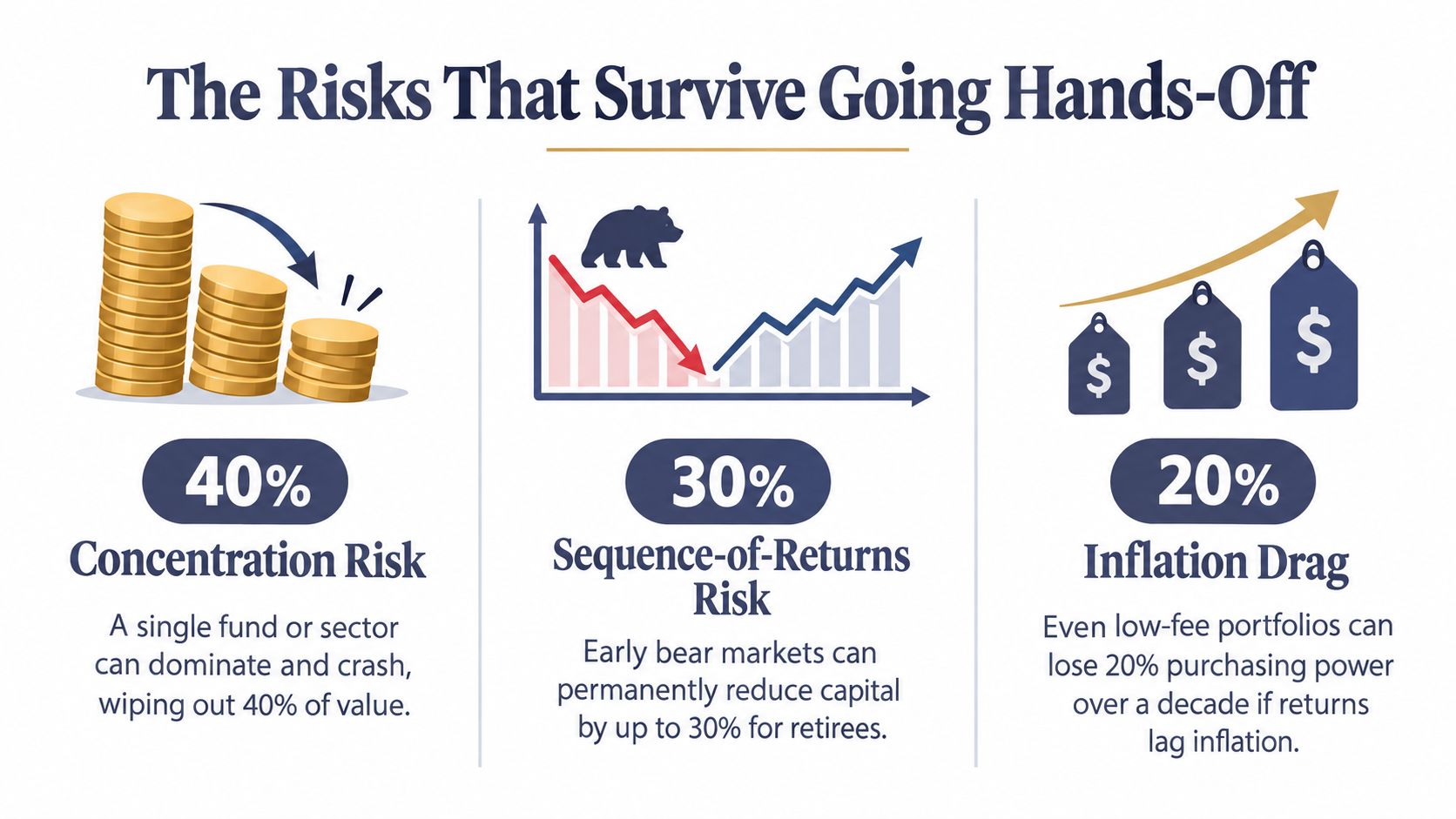
Going hands-off removes some behavior risks, but it doesn't remove investment risk. The owner can still face concentration, sequence-of-returns risk, fee drag, inflation, liquidity limits, and a mismatch between the model portfolio and personal risk tolerance.
Broad indexing deserves particular scrutiny. A portfolio can hold many companies while relying heavily on a small group of large holdings. The required caution is supported by the Investment Company Institute's 2026 Fact Book, which reports that index mutual funds and index ETFs held 52% of long-term fund assets by year-end 2025 and that 44% of index-fund inflows over the prior decade went to domestic equity funds. A “set-and-forget” portfolio can therefore remain heavily tilted toward domestic stocks unless the investor deliberately adds other exposures.
Sequence risk needs a separate plan
The order of returns matters most when an investor is withdrawing money. A sharp decline early in retirement can force sales while the portfolio is down, leaving fewer assets available for a later recovery. Target-date design can reduce this exposure by lowering equity risk as the target approaches.
Research on target-date funds found that nearest-date funds averaged about 15% maximum drawdown, compared with about 33% for farther-dated funds during the COVID-19 shock, according to research published in the Journal of Risk and Financial Management. That result doesn't make a glide path universally correct. It shows why the portfolio's path matters, not just its long-term average return.
Dollar-cost averaging also has boundaries. Scheduled contributions can help an investor continue buying through volatility, but the method doesn't protect someone who stops contributing, sells in panic, or needs to withdraw during a decline.
Layered fees create another persistent risk. A fund, a managed account, and an underlying platform can each charge for a different service, and the investor may notice only the most visible line item. Every outsourced function should have a clear purpose, a measurable benefit, and a cost that remains reasonable for the account.
A Practical Framework for Delegating Without Losing Control
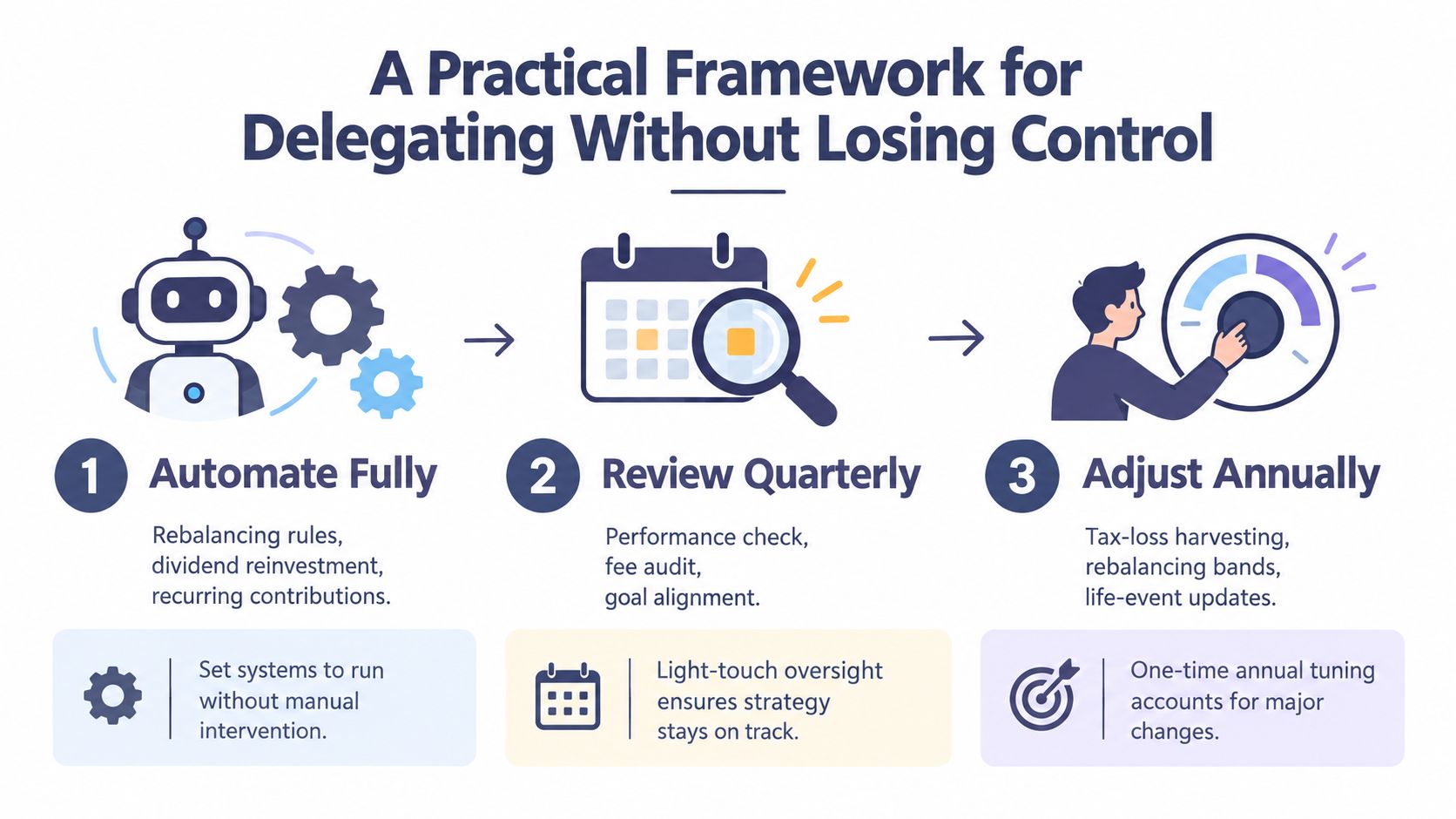
Delegation works best as a calendar, not a feeling. Investors who decide to “check when something seems wrong” often check only after a market decline, a tax surprise, or a manager change. Scheduled review replaces vague vigilance with a manageable operating process.
Automate fully
Automate the transactions that don't require a fresh judgment:
Recurring contributions: Set deposits to occur according to the plan, rather than relying on monthly motivation.
Dividend reinvestment: Reinvest distributions when the account's purpose and tax treatment support that choice.
Rebalancing rules: Use predetermined thresholds or dates so the portfolio doesn't drift indefinitely.
Automation should make the desired behavior the default. It shouldn't prevent you from changing the plan after a major life event.
Review quarterly
A quarterly review can remain light, but it should answer specific questions. Compare performance with the appropriate benchmark, inspect allocation drift, read fee statements, and confirm that the manager or platform still follows its stated mandate.
Don't judge a diversified portfolio solely by whether it beat a narrow index during a short period. Ask whether the portfolio delivered the exposure you selected and whether the risk still matches the goal.
Adjust annually
An annual review is the right time to revisit strategy fit. Reconsider tax location, beneficiary designations, rebalancing bands, insurance needs, withdrawal assumptions, and the continued use of each manager. A material change in income, employment, family structure, or investment objective can justify a change even when markets are calm.
The goal isn't constant optimization. It's preventing a once-suitable plan from becoming an unattended relic.
The Boring Discipline That Makes Hands-Off Investing Work
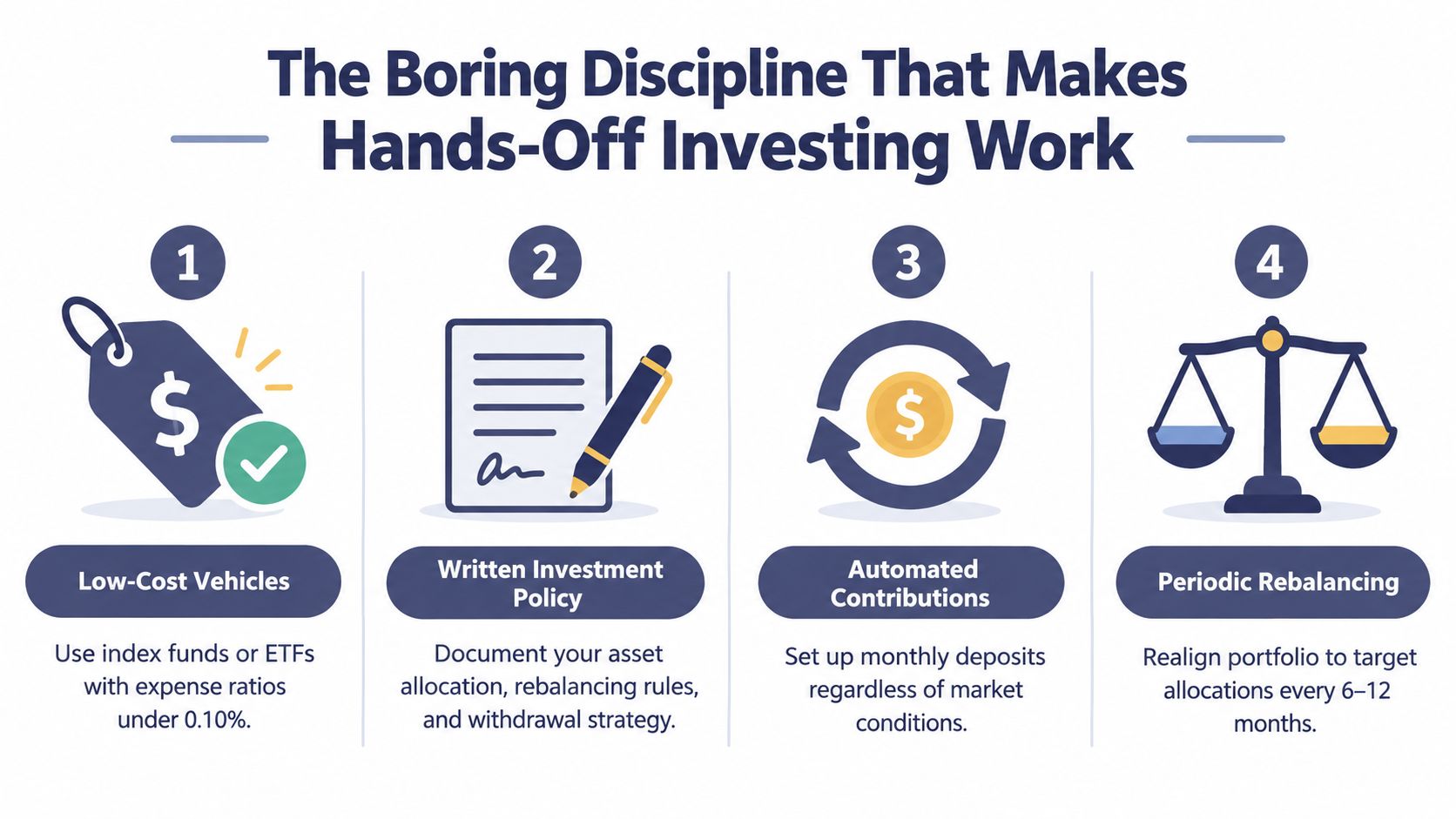
Hands-off investing succeeds when the boring parts are explicit. The investor chooses low-cost vehicles, writes down the intended allocation, automates contributions, and schedules reviews before emotions become involved.
Cost deserves attention because convenience can conceal layers. The Department of Labor's target-date research shows that expense ratios vary by target year and fund vintage, so investors should compare the actual expense ratio rather than assume every target-date product carries the same cost.
A written investment policy gives the portfolio a memory. It can state the target allocation, rebalancing rule, acceptable risk, withdrawal approach, and conditions that justify changing course. Without that document, an investor may mistake a temporary market decline for evidence that the plan was wrong.
Four conditions worth protecting
Low-cost vehicles: Choose funds and services whose total expenses are clear and proportionate to the work they perform.
Written investment policy: Record the allocation, rebalancing rules, withdrawal strategy, and circumstances that would prompt a review.
Automated contributions: Continue scheduled deposits through changing market conditions, provided the household's cash position supports them.
Periodic rebalancing: Restore the intended mix on a defined schedule or when stated bands are breached.
The strongest version of passivity is not inactivity. It's a portfolio that can operate through ordinary noise because the owner made the important choices in advance. The weak version is an account no one understands until a bear market exposes the missing decisions.
Wealth built on autopilot is still built on choices. Hands-off investing asks you to make those choices deliberately, delegate the repeatable work, and protect the system with routine.
Richard Maize offers a perspective shaped by hands-on real estate ownership, property management, entrepreneurship, and long-term investing. Visit Richard Maize to explore his business insights, investment experience, and practical lessons for deciding what to manage personally and what to delegate.
Comments