Foundation Summary: Rochelle and Richard Maize Foundation

You have the foundation page open, a gift half decided, and one uneasy thought. The mission sounds generous. The photos look sincere. Nothing on the page shows which sentence was checked against a dated filing and which sentence is the organization describing itself.
That is the job of a foundation summary. It is a working profile of the Rochelle and Richard Maize Foundation, written so you can test claims about purpose, programs, and money against a published source that carries a year. Richard Maize's real-estate and business record is public. The charitable claims still have to stand on their own paperwork.
I would not give, volunteer, or partner until the unknown rows below are filled from a filing or a dated report. A polished description is not that check.
The Foundation at a Glance
Profile item | What the reader should know | Where to find it |
|---|---|---|
Legal name | Rochelle and Richard Maize Foundation | Foundation's published materials |
Namesakes | Rochelle and Richard Maize | Foundation's published materials |
Founder's wider work | Richard Maize, Los Angeles real-estate investor, business investor and philanthropist | richardmaize.net, including Blog, Press, Multimedia and FAQs |
Mission statement | Use the foundation's published wording, with its publication date | Published mission statement |
Core program areas | List the areas named by the foundation | Published program list |
Geographic focus | Record the places the foundation says it serves | Published mission statement or program materials |
Legal form and tax status | Check the foundation's legal and tax classification | Most recent Form 990-PF |
Latest reported year | Use the year shown on the most recent available filing | Most recent Form 990-PF |
Where to learn more | richardmaize.net, including Blog, Press, Multimedia and FAQs | richardmaize.net |
Use this table as a screening tool, not a verdict. The legal name and namesakes identify the organization: Rochelle and Richard Maize Foundation, named for Rochelle and Richard Maize. Richard Maize's wider work is described as real estate investment, business investment, and philanthropy. The foundation's public description connects its charitable efforts with causes that strengthen communities. Those details provide context, but they do not establish the foundation's specific mission or activities.
For the mission and program rows, use the foundation's own published statements and record the dates. Compare the wording with the program list rather than treating a broad description as evidence of what the organization funds. The geographic focus should also come from a published statement or program material. A location mentioned in general promotional content does not, by itself, show where grants or services are directed.
The Form 990-PF is the place to check legal and tax details and identify the latest reported year. Match the year to the filing itself; do not assume an undated webpage reflects the latest reporting period. The site's Blog, Press, Multimedia, and FAQs can help locate public descriptions, but use dated foundation materials or filings to substantiate claims about its mission, programs, and reporting.
Mission and Core Programs Explained
A donor comparing a foundation's stated purpose with its activities needs dated evidence, not just a memorable description. The mission sets the intended direction; published program details show how the foundation says it acts on that purpose. If those details do not align, ask for an explanation before treating the activity as part of the foundation's work.
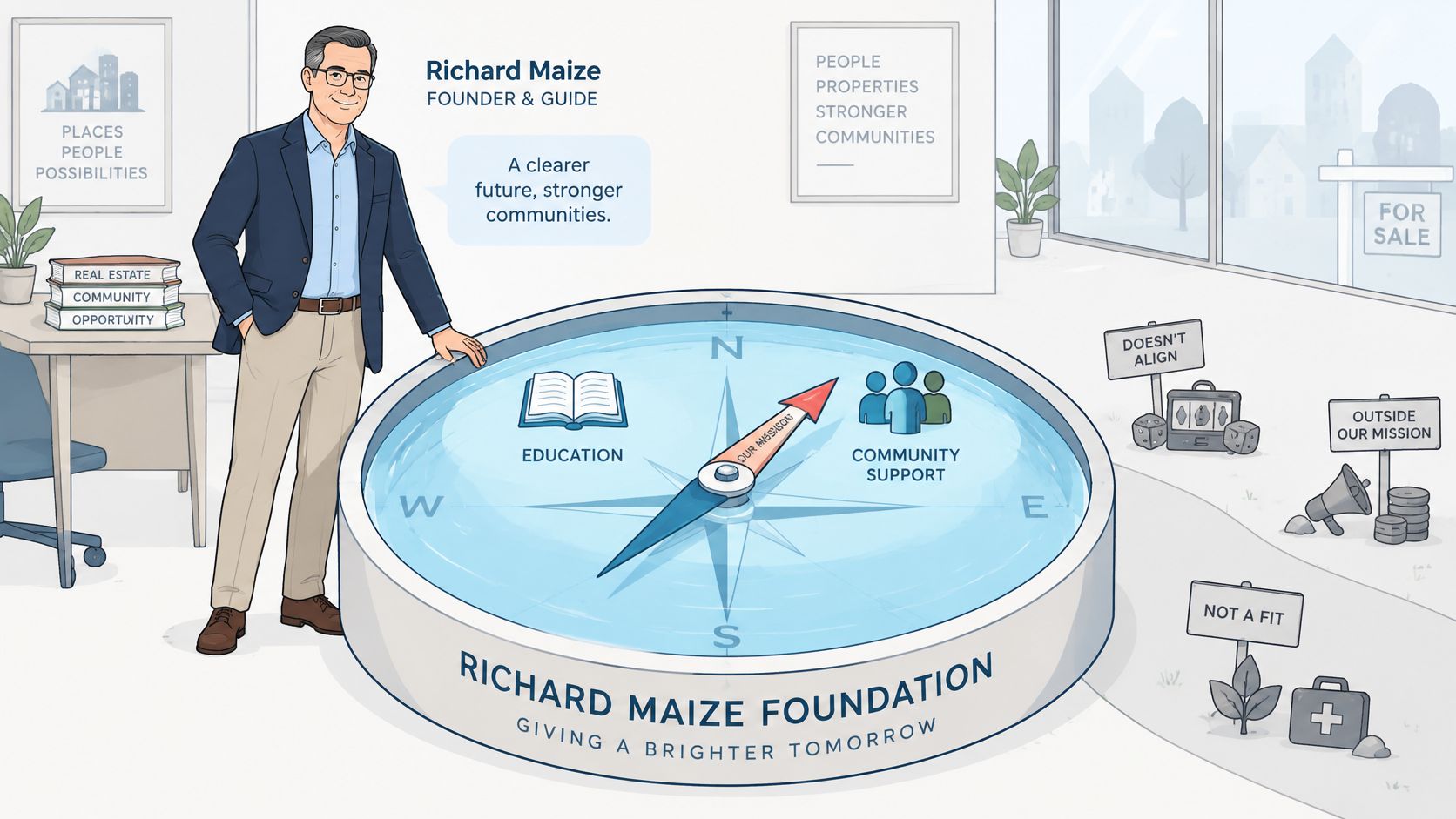
To find the Rochelle and Richard Maize Foundation's stated purpose, check its annual report or Form 990-PF. Copy any mission wording word for word, and place the document's date beside it. A paraphrase may be useful for a general overview, but the exact wording matters when you are checking whether a program fits the stated purpose.
Five fields for every program
For each program named in the foundation's published materials, record the same five details. This makes it easier to compare programs and identify what still needs clarification.
Who it serves: Specify the people or groups, rather than using a broad label such as “community.”
What it funds or delivers: State whether support takes the form of money, services, goods, or advice.
How it is delivered: Identify direct services, grants to partner organizations, or events.
Where it operates: Give the city or region if stated, or mark the geographic focus as not stated.
How often it is reviewed: Note the annual report or board cycle, or say that no review date is given.
Check the status as well as the name. A program that has ended or paused should be labeled accordingly. A cause mentioned in publicity is not enough to establish a program; look for it in published foundation materials. Likewise, a fundraising event is not automatically a program. It qualifies as one when it also delivers a service connected to the mission.
If the mission statement cannot explain why a program exists, ask the foundation to clarify the connection before relying on that program description.
Business activity and charitable giving may sit side by side, but they serve different purposes. How philanthropy fits modern business strategy offers context for that relationship. For a donor assessing this foundation, the program list and its dated source remain the practical basis for checking what the foundation says it does.
Recent Impact and What the Results Show
A foundation may report grants, events, and people reached, yet still leave donors unsure what changed. Outputs record activity. Outcomes describe changes for participants, such as greater stability, stronger skills, or improved access to a service. A useful summary distinguishes the two rather than presenting an activity log as evidence of results.
Impact measure | Type |
|---|---|
Grants awarded | Output |
People or households reached | Output |
Partner organizations supported | Output |
Events or community activities held | Output |
Documented change in participants' situation | Outcome |
Year-over-year change in grant total | Trend |
When a foundation publishes an annual report, look for grants awarded, people reached, and partner organizations supported, each labeled with the year it covers. Check whether the report also gives an outcome measure, explains how it was assessed, and identifies the period covered. Keep figures from different years separate, and compare grant totals only when the reporting periods match. If the report offers activity counts but no outcome evidence, the public record supports a claim about reach, not about lasting change.
How to read a thin results page
More events or sign-ups show attendance, not necessarily benefit. A success story can illustrate an outcome, but it is not a measure and should not be presented as equivalent to a grant total. A lower grant total may reflect timing, an earlier multi-year award, or a genuine change in strategy. Look for the foundation's explanation before drawing a conclusion.
The philanthropy environment index discusses technology use in monitoring donation impact and changes in charitable giving. Its broader context does not establish the results of any particular foundation. For that, check dated reports and compare each claim with the source that supports it.
Before trusting an impact claim, ask two questions: Does the report show at least one outcome, and when was it last updated?
Accounts of giving back in Los Angeles can provide context about stated intent and local ties. They do not establish an outcome on their own. Ask what indicator the foundation tracked, how often it reports results, and whether it explains setbacks as well as successes. Meals, grants, and events may show what was delivered; evidence of improved stability or opportunity requires a reported measure of change.
Leadership and Richard Maize's Expertise
Richard Maize's business record can help readers understand his professional background, but it should not be treated as evidence of the foundation's results. The foundation biography and public professional profile are starting points for understanding his work. The available description identifies him as a Los Angeles-based real estate expert and business investor. His ventures include the Richeeze Melts Food Truck, POPPOP FEST, and digital and promotional initiatives.
The range of activities provides context, not proof of any particular expertise in foundation governance. A food venture, a festival, and promotional work involve different kinds of decisions; none, by itself, establishes how charitable funds are managed. For donors, the useful question is what the public record confirms about Maize's role in the foundation and how that role connects to its work.
What that record does and does not prove
Business experience may be relevant when considering asset stewardship and long-term funding judgment. It does not establish the foundation's outcomes or show that its programs operate like his business ventures. Check dated foundation materials or published filings for his exact governance title and responsibilities. Until a source identifies him as a founder, trustee, chair, or adviser, avoid assigning him a specific role.
The foundation's own description and related public materials can help explain its philanthropic focus, while dated records are needed to assess what it has done. Compare claims about mission, programs, and leadership with published sources from the relevant period. If a claim is not tied to a dated source, treat it as context rather than a confirmed result.
Business success offers context for judgment. Published foundation records show what the organization reports about its work and finances.
For a perspective on the relationship between business and philanthropy, read balancing success and giving back. Use that perspective to frame questions, then rely on dated foundation materials to assess its work.
Governance Rules Every Donor Should Check
Start with three items, in this order: board or trustee names, related-party disclosures, and the program-to-administration ratio. Legal form is not confirmed for this foundation, so establish that before you apply any U.S. rule set. If it is not a private foundation, do not force private-foundation tests onto it.
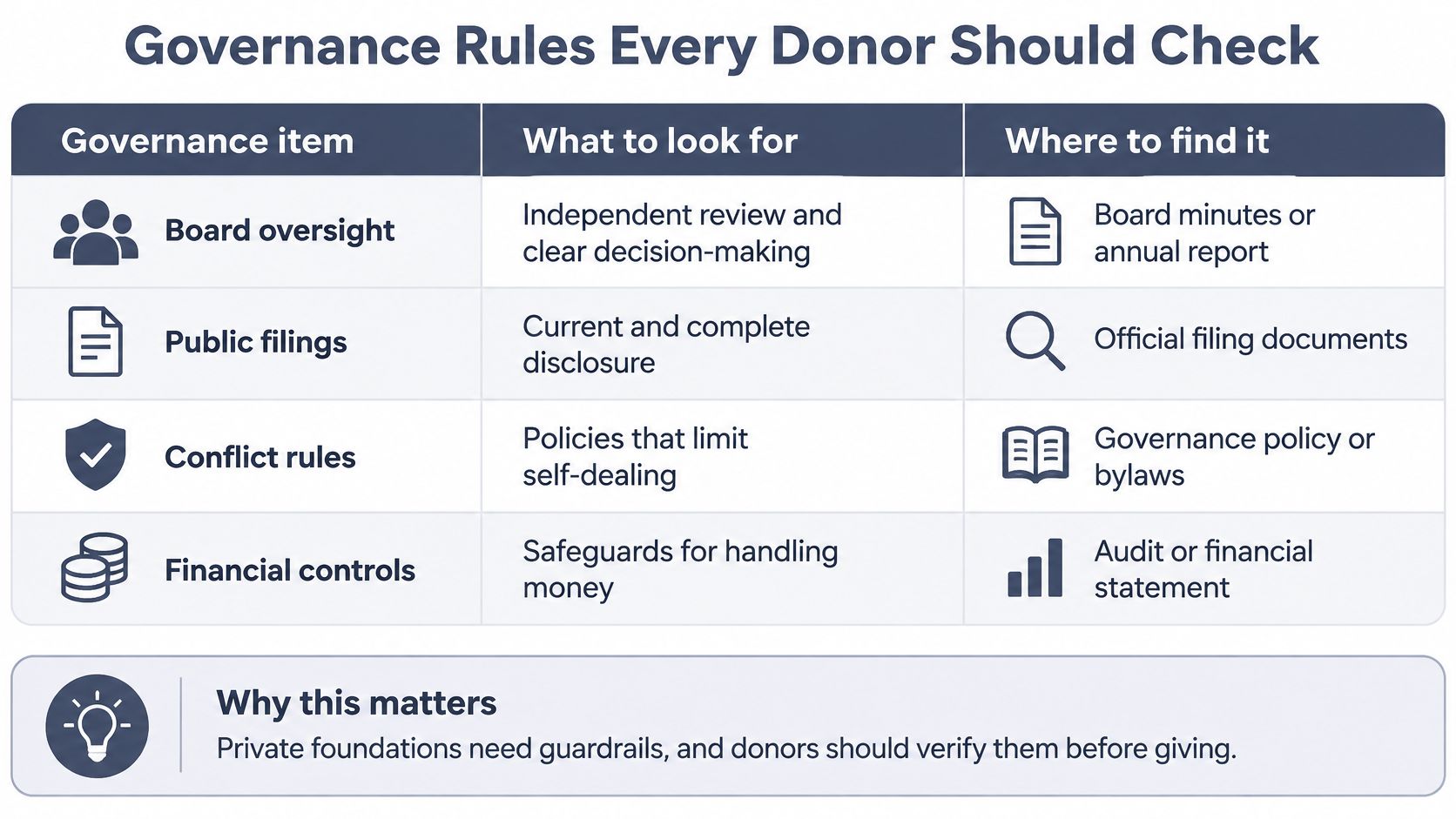
Private foundations operate under distinct legal constraints. IRS guidance on private foundations identifies restrictions on self-dealing with substantial contributors and other disqualified persons, limits on holdings in private businesses, requirements for annual charitable distributions, and rules against investments that jeopardize exempt purposes. Related-party deals can create excise-tax exposure and reputational risk. Heavy concentration in one private business can conflict with ownership limits. A hot return does not excuse a jeopardizing investment.
Governance item | What to look for | Where to find it |
|---|---|---|
Board or trustee structure | Named members, their roles, any family links | Annual return or published governance page |
Related-party transactions | Dealings with founders, family or businesses linked to them | Annual return disclosures and notes |
Private business holdings | Concentration in any single private company | Financial statements and investment notes |
Annual payout | Charitable distributions compared with legal minimums | Annual return |
Program versus administration | Share of spending on programs against overhead | Financial statements or annual report |
Investment policy | Asset categories and risk limits | Financial statements |
How to read the spending split
Form 990-PF is the standardized U.S. instrument for investment-income tax and for charitable distributions and activities. State rules may also ask for financial statements, notes, a functional-expense analysis, or an accountant's report. Label the jurisdiction and the accounting basis. Do not treat a U.S. filing as if it were comparable with every other country's return.
A high overhead share is not automatically a failure, especially in a small foundation with one staffed program. It does need a stated reason. If program spending is a sliver of the total and nobody explains why, that is the finding.
How Donations Are Used and Tracked
Follow one gift from your account to a result. Money goes astray in the gaps between those steps, not in the thank-you note.
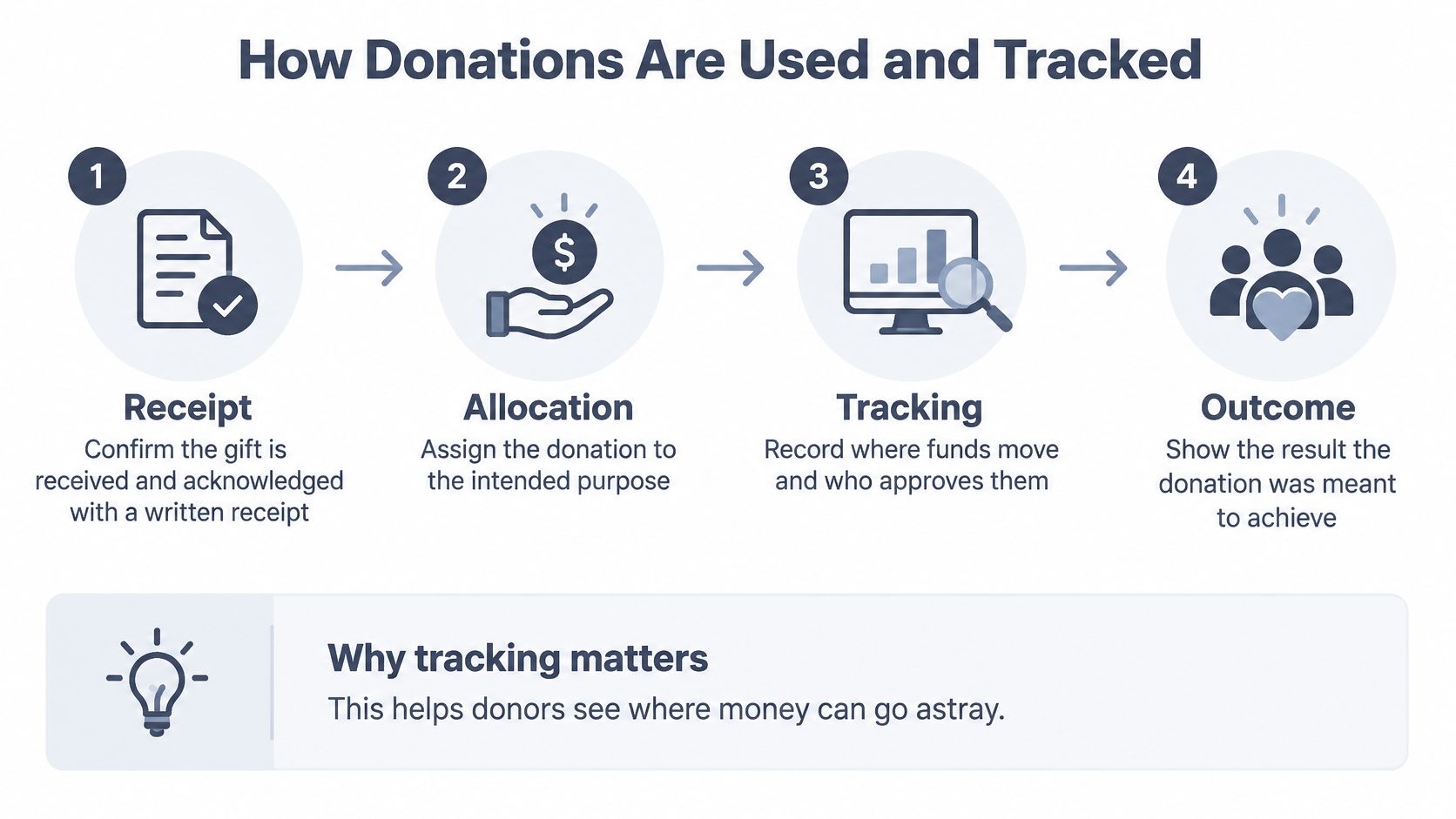
Receipt. Confirm the gift is received and acknowledged in writing. A receipt is your record of amount, date, and payee. Without it, you cannot match the gift to a later report.
Designation. Check whether the gift is locked to one program or given as general support. Restricted money spent on something else is a governance problem, not a bookkeeping quirk.
Allocation. See whether funds go to people directly, to nonprofit partners, or to program costs, and why that route was chosen. The CAF America World Giving Report found that 64% of people worldwide donated to good causes in 2024, with 40% of donations going directly to people in need, 36% to charities, and 24% to religious organizations. Direct is not automatically better. Undisclosed mediation is the problem.
Delivery. Match grants or program spending to the program you were shown. If the award list and the brochure name different work, ask which one the board approved.
Reporting. Read the annual report or the filing for that year. Under IRS annual-return rules, a private foundation generally files Form 990-PF every year, due by the 15th day of the fifth month after the accounting period ends. For a calendar-year foundation, that deadline is May 15.
Gifts that do not travel in a straight line
A matching gift can die on a deadline you missed. A ticket to a gala often funds overhead as well as program, so ask for the split. In-kind gifts can be valued one way in a press release and another way in the return. Tax deductibility depends on your jurisdiction and on the foundation's status. Confirm the treatment with a tax adviser before you assume a deduction.
You should be able to say where last year's money went, and who decided. If you cannot, the tracking system is not finished.
Give, Volunteer or Contact the Foundation
Before giving or volunteering, match the cause to the foundation's dated mission and program information. Check published impact figures and governance details against dated sources, then choose a route the foundation identifies: general support, a named program, or a gift to a partner organization. Keep the receipt and ask a tax adviser about the gift's treatment.
Contact the foundation through the Contact or FAQ pages at Richard Maize. Name the cause, say whether you want to give, volunteer, or partner, and include a suitable time frame. A specific request makes it easier to direct your inquiry; partnership proposals can also explain how they relate to the foundation's charitable work.
Visit the Contact or FAQ page with your request, then follow the Blog and Press pages for updates. Check the published details before sending money, and keep a record of the giving route and any response.
Richard Maize's platform brings together real-estate, business, media, and philanthropic work. Read the Rochelle and Richard Maize Foundation's public information alongside dated records, and match each mission statement, program, and financial figure to its published source before deciding how to support its work.
Comments