Environmental Due Diligence: A Real Estate Investor's Guide

The most popular advice about environmental due diligence is also the least useful: order a Phase I Environmental Site Assessment, file it with the closing documents, and move on. That approach treats the report as paperwork. A serious investor treats it as evidence that can change the price, the indemnity, the escrow, the closing date, or the decision to walk away.
Environmental risk rarely arrives with a convenient label stating what it will cost. A former industrial use, a leaking underground storage tank, contaminated soil, PFAS, incomplete records, or a supplier with opaque sourcing can affect financing, redevelopment, insurance, and resale. The investor who identifies those issues early has negotiating power. The investor who discovers them after closing owns a problem with fewer options.
Why Environmental Due Diligence Is a Deal Strategy
Environmental due diligence isn't merely a regulatory formality. It's a way to decide what a property is really worth after environmental liabilities are included. The purchase price may look attractive, but the economics change if the buyer must investigate soil, restrict future construction, manage vapor intrusion, monitor groundwater, or defend a claim connected to historic operations.
That distinction matters in Los Angeles and other active real estate markets, where buyers often compete for speed. Moving quickly can help win a deal, but skipping a properly scoped review transfers uncertainty from the seller to the buyer. A disciplined investor uses the review before becoming emotionally or financially committed.
Practical rule: Treat every environmental finding as a deal term, not just a report conclusion.
A recognized environmental condition can support several responses:
Price adjustment: Reduce the acquisition price to reflect probable investigation, remediation, monitoring, or regulatory costs.
Seller performance: Require the seller to complete defined work before closing, supported by documentation from qualified professionals.
Escrow protection: Hold funds back until specified milestones are met, particularly where the final cost remains uncertain.
Contract rights: Add representations, indemnities, access rights, termination rights, and closing conditions that match the actual risk.
Exit decision: Walk away when the liability is difficult to quantify, financing becomes unavailable, or the projected return no longer compensates for the uncertainty.
KPMG's 2024 global ESG due diligence study found that 57% of respondents expect to perform ESG due diligence on most transactions over the next two years, compared with 44% historically. The same study reported that 71% said ESG had become more important in transactions during the previous 12 to 18 months. Those findings reflect a practical change in deal execution. Buyers increasingly use environmental information to price risk and protect capital, not only to demonstrate compliance.
For a broader framework on screening transaction risk, investors can also review this guide to spotting a bad deal before it's too late. The core lesson is straightforward. Environmental diligence creates value when it changes the decision before the money is committed.
The Legal and Financial Stakes Behind Environmental Risk
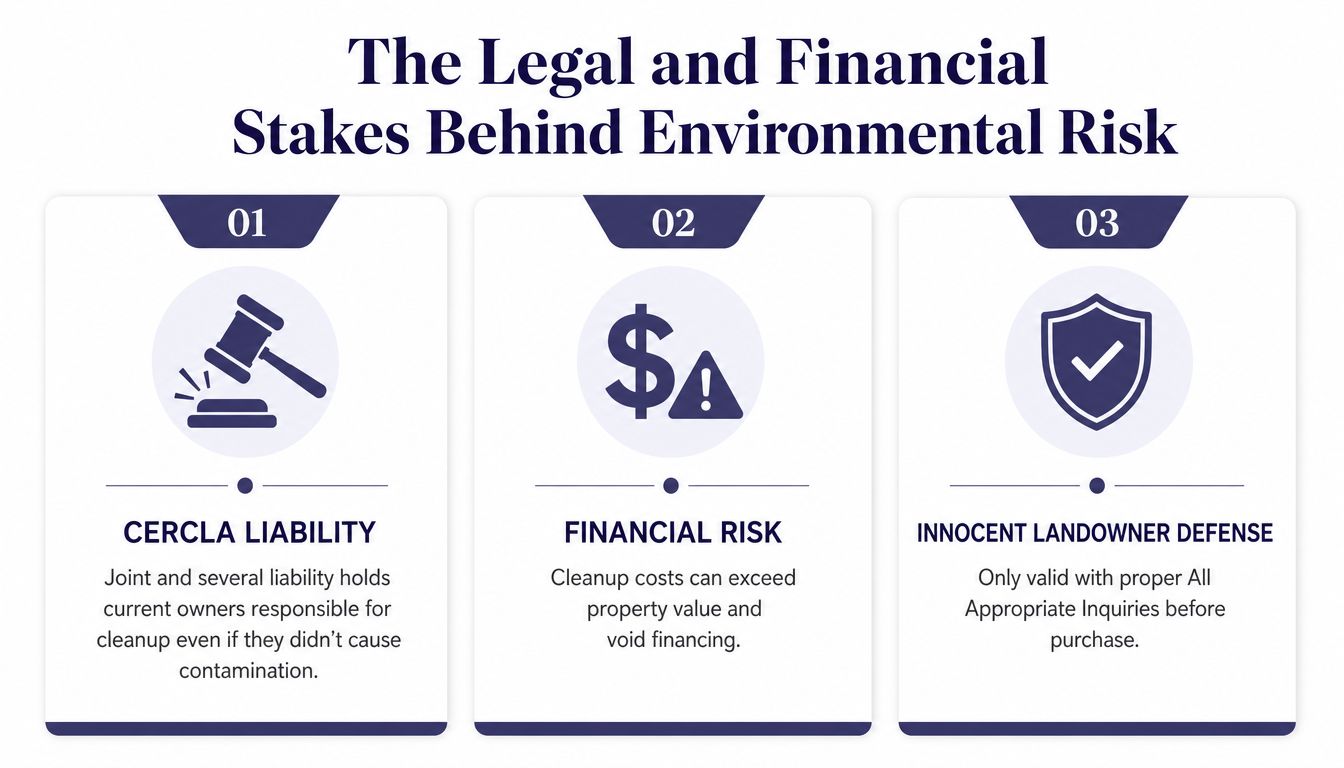
The legal exposure begins with ownership. Under CERCLA, the Environmental Response, Compensation, and Liability Act of 1980, the U.S. EPA or another private party can pursue current or past owners or operators of contaminated property for cleanup costs, as explained in this overview of CERCLA environmental liability. A buyer may inherit exposure connected to contamination it didn't cause, which makes pre-acquisition investigation central to the transaction rather than an optional technical exercise.
The federal protection commonly associated with careful investigation depends on All Appropriate Inquiries. The inquiry has timing requirements. Some components must be completed or updated within one year before acquisition, while other components must be completed within 180 days before acquisition, according to federal brownfield guidance on environmental due diligence. A report that exists but falls outside the applicable timing rules may not provide the protection the buyer expected.
Why market growth matters to investors
Environmental compliance and due diligence have developed into a major professional services category. One market estimate placed the broader environment management, compliance, and due diligence sector at US$14.48 billion in 2021, rising to US$16.82 billion in 2022, with a projection of US$28.66 billion by 2026 and a 14.2% compound annual growth rate over that period. A newer estimate placed the market at US$23.4 billion in 2024 and projected US$51.5 billion by 2030, with a 14.1% CAGR from 2024 to 2030, as summarized in KPMG's market overview.
These estimates describe a wider market, not the cost of a particular property investigation. Their importance is directional. Regulatory scrutiny, industrial development, corporate transactions, and liability concerns have created sustained demand for environmental expertise, especially in North America and Western Europe.
The downside is larger than the report fee
A Phase I report costs money, but the more important financial question is what the report prevents. Environmental findings can affect loan approval, redevelopment plans, tenant commitments, construction sequencing, insurance availability, and the buyer's ability to sell the asset later. A cheap acquisition can become expensive when the buyer has to fund unknown obligations without a reliable ceiling.
The investor's objective isn't to eliminate every environmental issue. That's rarely possible. The objective is to identify the liability, estimate its range, assign responsibility, and build the uncertainty into the contract.
Understanding Phase I, Phase II, and Phase III Assessments
Environmental assessment works best as a progression. Each phase answers a different question, and buyers shouldn't order intrusive testing automatically when a records review can resolve the concern. At the same time, a clean-looking property shouldn't be treated as safe when historical uses, neighboring sites, or site conditions indicate that a desktop review is insufficient.
Phase I establishes the screening record
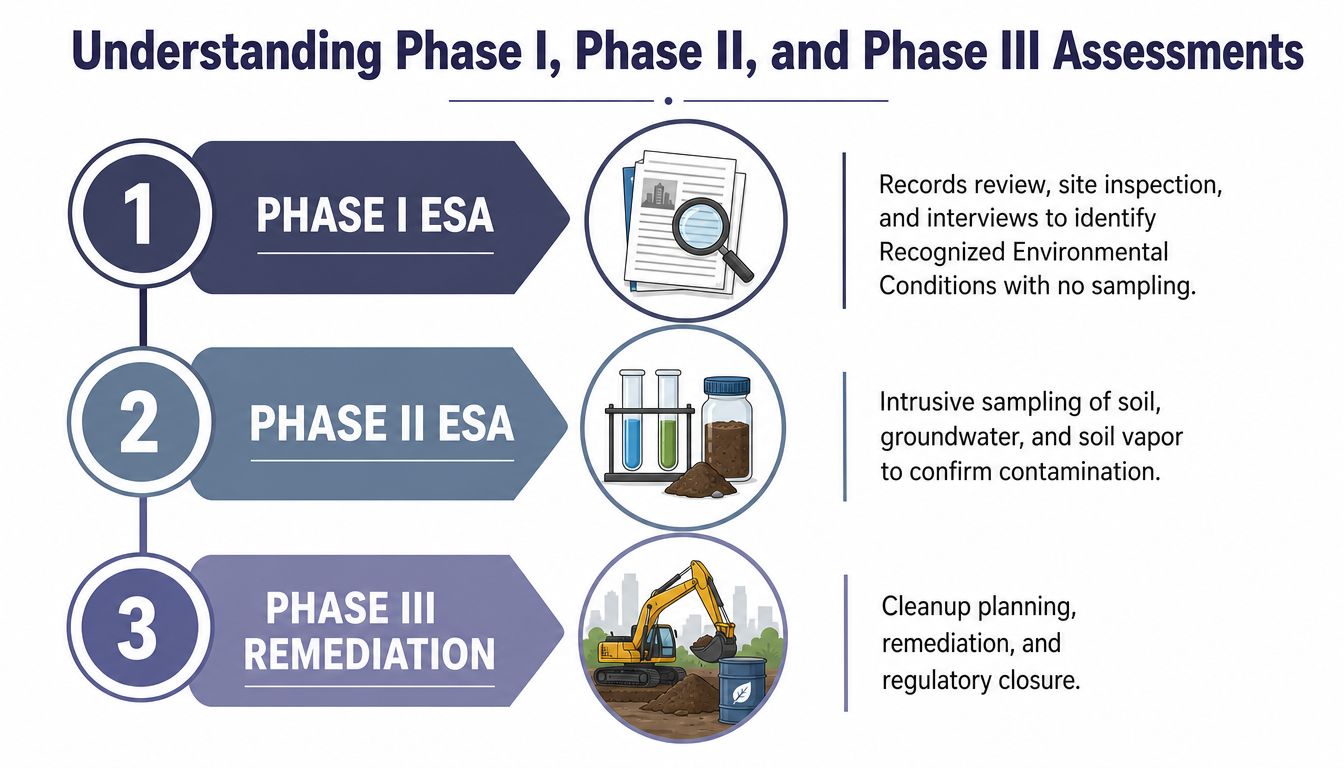
A Phase I Environmental Site Assessment reviews available records, regulatory information, historical property use, site conditions, and interviews. It normally doesn't include sampling. Its purpose is to identify environmental conditions that may require further investigation, including recognized environmental conditions, historical recognized environmental conditions, controlled recognized environmental conditions, and de minimis conditions.
The current baseline for U.S. commercial real estate is ASTM E1527-21. The EPA recognizes that standard as satisfying All Appropriate Inquiries. After the February 13, 2024 phase-in ended, older E1527-13 reports no longer qualified for that federal liability-defense pathway, as explained by Ramboll's summary of the ASTM and EPA update.
The assessment must be performed by an environmental professional. The report isn't a guarantee that contamination doesn't exist. It's a structured opinion about whether available evidence identifies conditions that warrant additional work.
Phase II tests the suspected condition
Phase II begins when the Phase I identifies a concern that records and observation can't resolve. Professionals may collect samples of soil, groundwater, or soil vapor to determine whether contamination exists, where it is located, and whether it could affect current or planned property use.
Testing should answer a transaction question. Is the concern limited to a small area? Does it threaten a proposed building? Could vapor affect occupants? Does groundwater migration implicate neighboring parcels? An unfocused sampling program can create expense without giving counsel enough information to negotiate.
Phase III turns findings into an action plan
Phase III is the remediation and closure stage. It can include selecting a remedy, defining responsibilities, obtaining regulatory approval where required, conducting cleanup, documenting results, and pursuing regulatory closure or another formal endpoint.
The buyer doesn't always need Phase III completed before closing. A transaction may proceed with a well-defined remediation plan, an escrow, seller obligations, access rights, and a clear allocation of future costs. What doesn't work is closing on vague language that says the seller will “address” contamination without defining the work, deadlines, decision-maker, or remedy if the cost expands.
The Step-by-Step Environmental Due Diligence Process
A reliable process starts before the consultant visits the property. The buyer, broker, lender, attorney, and environmental professional should agree on the transaction schedule, intended use, property history, and decision points. The assessment should support the deal, not run on a separate track that produces a report after the key contract deadlines have passed.
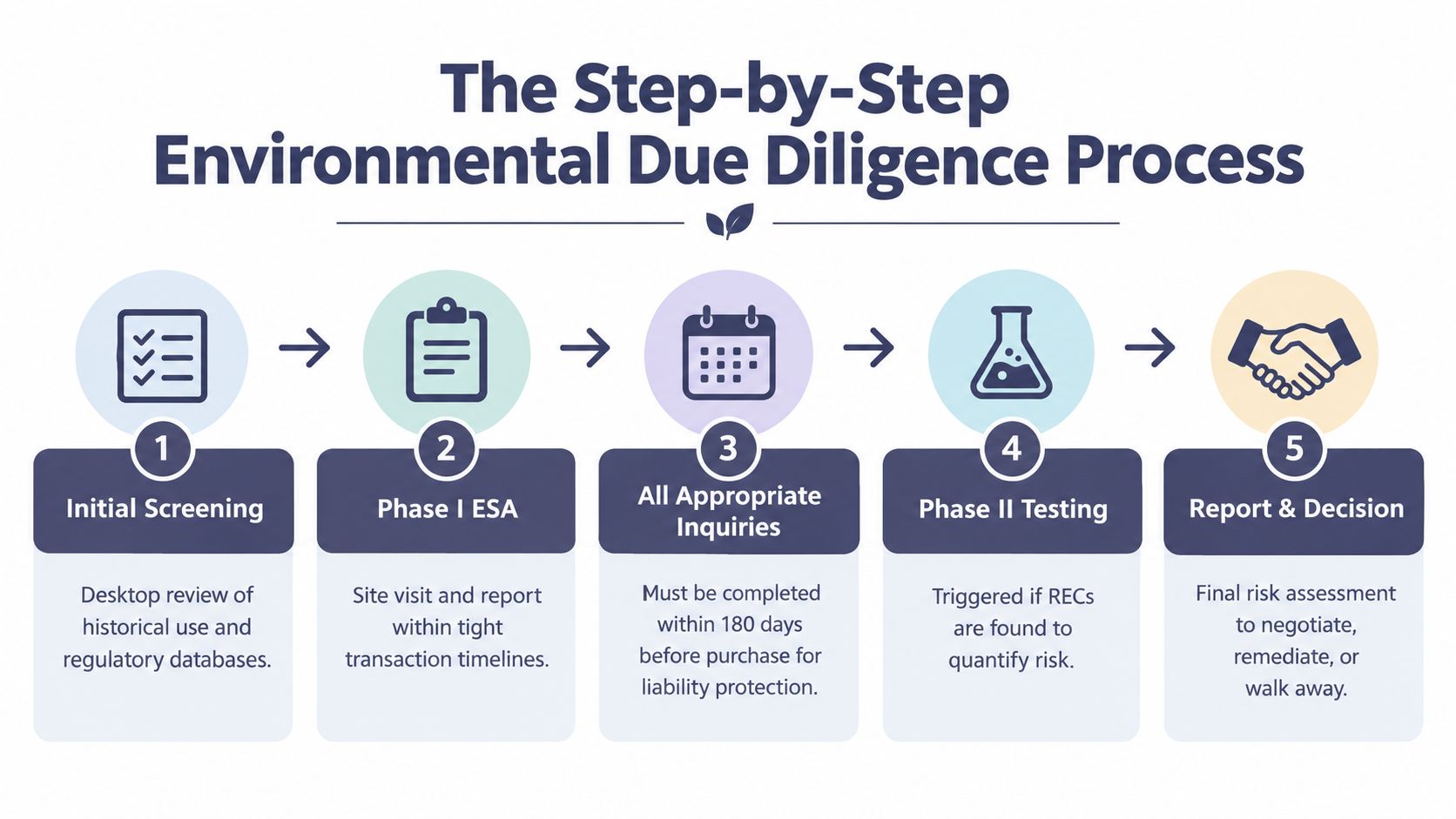
Start with scope and desktop screening
Begin with the intended acquisition, financing requirements, planned redevelopment, current operations, adjacent uses, and known regulatory history. Historical aerials, directories, permits, environmental databases, prior reports, and interviews can reveal concerns that aren't visible during a walkthrough.
Next, commission the Phase I under the applicable ASTM standard. Schedule the site visit and interviews early enough to leave room for clarifications. A report delivered on the last day of the diligence period creates pressure to accept uncertainty or seek an extension when the buyer should be negotiating from information.
Control the timing clock
ASTM E1527-21 contains an important timing detail. For certain components, the validity clock starts with the date of the first completed Phase I ESA activity, not the date the report is signed. That can include the sequence of the site visit, records review, and interviews, so the team must coordinate the work rather than assume the signature date controls.
The federal All Appropriate Inquiries framework also imposes the one-year and 180-day timing mechanics described earlier. ASTM E1527-21 timing guidance from GZA explains why a stale or improperly scoped assessment can undermine CERCLA protections and force a redo.
Use a written responsibility list:
Environmental professional: Confirm scope, standard, dates, records, interviews, site observations, and conclusions.
Buyer's counsel: Review reliance, contractual protections, disclosure obligations, indemnities, and closing conditions.
Lender: Confirm whether the report meets underwriting requirements and whether additional testing is required.
Buyer and broker: Provide historical documents, explain planned use, and preserve access to the property.
Deal team: Decide whether to proceed, renegotiate, test further, remediate, or terminate.
A practical commercial real estate due diligence checklist can help keep environmental work aligned with title, survey, financing, leases, and physical inspections.
If Phase I identifies a recognized environmental condition, don't treat Phase II as an automatic formality. Define the uncertainty you need resolved, select a sampling plan that addresses the proposed use, and reserve enough time for interpretation and negotiation.
Emerging Contaminants and Expanding ESG Screens
Traditional environmental diligence centers on the parcel. That remains essential, but it doesn't capture every risk attached to a modern investment. Buyers increasingly need to ask whether the property's operations, tenants, products, suppliers, and reporting practices create exposures that a conventional site review won't reveal.
PFAS illustrates the problem. The federal PFAS CERCLA hazardous substance designation was reaffirmed in September 2025, raising joint-and-several liability concerns for acquirers even when they didn't cause the historic pollution, as discussed in this PFAS environmental due diligence analysis. A standard Phase I may identify an industrial history or a potential chemical concern, but it won't by itself establish the presence, extent, concentration, or remediation cost of PFAS.
Decide when the scope should expand
Expand beyond property-level review when the asset has a history involving industrial chemicals, manufacturing, fire-suppression systems, landfills, airports, military activity, wastewater operations, or other uses that create a credible emerging-contaminant question. The right response may include targeted records research, interviews, sampling, regulatory consultation, insurance review, or a negotiated investigation protocol.
ESG screening also becomes relevant when the transaction depends on a company's supply chain, environmental disclosures, labor practices, or human-rights exposure. Buyers should ask:
Supplier traceability: Can the target identify material suppliers and production locations?
Climate information: Are emissions, physical climate risks, or transition assumptions documented well enough for the investment thesis?
Human-rights controls: Does the business identify and respond to labor or community impacts in its operating chain?
Reporting consistency: Do public statements match internal records and contractual obligations?
KPMG's study identified scope selection, valuation of findings, and weak target data as major diligence pain points. That makes scope design a commercial judgment. A buyer shouldn't order every possible ESG review on every property, but shouldn't limit diligence to soil when the investment risk sits in sourcing or operations.
The practical approach is proportionality. Use the asset, business model, location, tenant mix, financing, exit plan, and regulatory exposure to determine the screen. Broader sustainability and community considerations also belong in the investment conversation, as illustrated by this perspective on sustainable impact through community-driven real estate projects.
Risk Mitigation Strategies for Real Estate Investors
Finding environmental risk doesn't automatically kill a transaction. It changes the structure. The best tool depends on whether the cost is known, whether the seller is creditworthy, whether remediation can be completed before closing, and whether the buyer can tolerate uncertainty.
Strategy | Best For | Typical Cost | Key Limitation |
|---|---|---|---|
Environmental insurance | Significant uncertainty where an insurer will underwrite the exposure | Policy premium and underwriting expense, which vary by risk | Coverage may exclude known conditions, contain limits, or impose conditions that don't match the liability |
Escrow holdback | A defined remediation obligation with a reasonably supportable cost range | Negotiated escrow amount and administration | Funds can be inadequate if conditions expand or release terms are vague |
Seller indemnity | A seller with sufficient assets and a continuing economic incentive | Negotiation and legal drafting costs | An indemnity is only as useful as the seller's ability and willingness to pay |
Purchase price adjustment | A risk that can be estimated and priced directly | No separate insurance premium, though valuation work may be needed | The buyer retains the liability and may underprice unknown future costs |
Specialized environmental policies remain a minority choice. The cited industry coverage reports that less than 20% of buyers purchase specialized environmental policies. That doesn't make insurance unhelpful. It means buyers often rely on contract allocation, escrow, pricing, or self-insurance instead.
Negotiation principle: Don't accept a general indemnity for a specific environmental problem. Define the site, contaminant, work, access rights, consultants, regulators, reporting duties, survival period, and payment mechanics.
Closing conditions should match the risk. A buyer might require a clean report, completion of a defined remedy, regulatory documentation, lender approval, or a funded escrow before closing. If the seller refuses each protection while insisting on a quick close, that refusal is itself information about the transaction.
Real-World Applications and Regional Considerations
Environmental diligence looks different on a former industrial parcel, a suburban office building, a redevelopment site, and an operating facility. In Los Angeles, a buyer may need to consider historic commercial uses, neighboring industrial activity, redevelopment plans, groundwater conditions, and local permitting alongside federal liability protections. California-specific obligations can add another layer, so local counsel and an environmental professional should define the applicable scope rather than relying on a generic national checklist.
Public agencies provide a useful discipline model. Minnesota DOT requires an Environmental Due Diligence evaluation before acquiring real property, and the evaluation must be completed before an offer is made to the landowner, according to Minnesota DOT's official policy. The policy reflects a basic risk principle that private investors should also follow. Identify potential liability before setting the economic terms.
Consider a hypothetical Los Angeles acquisition of a property with historic industrial use. A Phase I identifies a recognized environmental condition. The buyer commissions targeted testing, learns that the concern could affect the planned redevelopment, and revises the offer to reflect investigation and remediation uncertainty. The seller may accept a lower price, complete defined work, or fund an escrow. The diligence has done its job even if the buyer ultimately proceeds.
A different transaction may reveal a problem that can't be quantified before the diligence period expires. In that situation, extending the review or terminating the contract can protect more value than forcing a closing. The report didn't create the risk. It gave the buyer a defensible basis for refusing to overpay.

Richard Maize offers practical real estate investment perspective grounded in property transactions, business investing, and long-term value creation. Visit Richard Maize for insights that can help you evaluate environmental risk, structure stronger deals, and protect the downside before you commit capital.
Comments