Entrepreneurial Risk Management That Actually Works

The popular advice on entrepreneurial risk management is usually wrong in one important way. It celebrates boldness, instinct, and the founder willing to bet everything on a big idea. That makes a good story, but it's a poor operating system. Most ventures don't fail because the founder lacked a clever pivot. They fail because cash ran short, demand was assumed rather than tested, a key employee left, or the business scaled before its economics were ready.
A widely cited Harvard Business School analysis of startup failure found that about 75% of venture-backed startups fail, with risk-management failures including cash shortages, team problems, weak product development, business-model shortcomings, competition, and lack of market need. Another commonly cited postmortem breakdown attributes 42% of failures to no market need and 29% to running out of cash, according to the same source.
That's why the useful version of entrepreneurial risk management is deliberately unglamorous. It means documenting assumptions, preserving liquidity, reviewing contracts, testing demand, limiting borrowing, and writing down what could go wrong before it does. Those habits don't make a founder look adventurous. They make the company harder to kill.
Why Boring Risk Discipline Beats Clever Strategy
Clever strategy gets attention. Boring discipline keeps a company solvent long enough for strategy to matter. A founder taking a calculated risk should be able to state the downside, identify the evidence supporting the upside, and define the point at which the decision gets reversed. Without those limits, the business is relying on hope.
The controls that protect a venture rarely attract headlines:
Cash planning: Track burn, committed expenses, debt obligations, and the cost of delaying revenue.
Written assumptions: Record what must be true about demand, pricing, hiring, retention, and delivery.
Contract discipline: Review termination rights, liability, renewal terms, intellectual property ownership, and payment obligations.
Ownership hygiene: Keep the cap table accurate, with dilution and control visible in every financing decision.
Pre-mortems: Ask how an initiative failed, then identify the warning signs that should appear first.
These controls matter because business risk usually develops through connected decisions. A modest rise in churn reduces cash receipts. The founder delays a hire, service quality slips, and a larger customer leaves. The company raises capital from a weaker position, accepts expensive terms, and gives up strategic flexibility. No single event looks fatal. Together, they can remove the choices that would have prevented failure.
Practical rule: If a risk can be identified, assigned, measured, and rehearsed, put it in the operating system rather than in the founder's memory.
A founder also needs a clear distinction between uncertainty and exposure. Uncertainty cannot be removed. Exposure can be limited by setting cash thresholds, approval rules, backup suppliers, and decision points before pressure arrives. That discipline makes a business less dependent on perfect timing.
The Harvard analysis cited earlier connects venture failure with weaknesses in liquidity, product-market fit, teams, and execution. A Bureau of Labor Statistics-based summary reports that roughly 20% of new businesses fail within the first year and nearly 50% fail within five years. It also cites postmortem findings involving depleted capital, poor product-market fit, and adverse timing or macroeconomic conditions. Those figures describe different failure patterns, but they point to the same operating lesson: several manageable weaknesses can become one severe constraint.
For a concise explanation of why fundamentals often outperform sophistication, see why good financial advice is boring. The principle applies to a property portfolio as well as a startup. A real estate investor reduces downside by spreading exposure across markets, asset types, and economic cycles, while preserving enough liquidity to hold through a weak period. The approach is repetitive by design. A control that works every month is worth more than an ingenious strategy that depends on favorable conditions.
The Six Risks Every Entrepreneur Must Manage
Entrepreneurial risk management is the structured process of identifying, prioritizing, and reducing threats that can derail a venture. The point isn't to produce a large register of theoretical risks. It's to identify the few exposures that could damage the company, assign an owner, and decide what action follows if conditions move against you.
Risk Category | Common Trigger | Typical Example | Primary Mitigation Lever |
|---|---|---|---|
Market risk | Demand or competitive change | A SaaS churn spike after a rival improves its product | Customer research, retention analysis, and product validation |
Financial risk | Liquidity pressure or excessive leverage | A credit line is clawed back during a weak quarter | Cash reserves, funding diversity, and downside budgets |
Operational risk | Process, supplier, or people failure | The CTO leaves with critical technical knowledge | Documentation, redundancy, and succession planning |
Regulatory risk | New rule or compliance failure | A GDPR fine follows weak data-handling controls | Legal review, compliance ownership, and audit trails |
Reputational risk | Public complaint or ethical lapse | A viral customer complaint damages trust | Service recovery, clear communications, and conduct standards |
Strategic risk | Ambition exceeds capability or capital | A rushed acquisition distracts the core business | Stage gates, independent review, and strategic fit tests |
Market risk deserves early attention because founders often confuse interest with demand. Prospects may praise a concept without paying for it, renewing it, or changing their behavior. A SaaS churn spike is more informative than a long list of positive interviews because it reveals whether the product continues to earn its place in a customer's budget.
Financial risk is broader than profitability. A profitable company can still fail if receivables arrive late, debt matures at the wrong time, or one lender supplies too much capital. A clawed-back credit line can turn an ordinary cash-flow gap into an emergency.
Operational risk appears when the company depends on one person, one vendor, or one undocumented process. A departing CTO is not only a hiring problem. It may expose missing architecture records, weak access controls, and an inability to transfer decision rights.
Regulatory and reputational risks often compound. A GDPR fine can trigger customer concern, while a viral complaint can invite regulatory scrutiny. Strategic risk sits above the others, because a rushed acquisition or premature expansion can increase market, financial, operational, and reputational exposure at once.
The practical response is simple. Review the categories together, not in separate departmental meetings. A risk register should show the trigger, likely consequence, owner, mitigation, and escalation point. If nobody owns the risk, the company hasn't managed it. It has only named it.
Finding the Risk Tolerance Sweet Spot
Risk tolerance follows a curve rather than a straight line. Too little risk keeps a venture from launching, testing, and learning. Too much can consume cash before the business has enough evidence for its next decision.
A German panel study on occupational risk attitude and entrepreneurial failure found a U-shaped relationship between risk attitude and entrepreneurial failure. Entrepreneurs scoring 5 to 6 on an 11-point risk scale had about a 5 percentage-point lower annual failure probability than people unwilling to take occupational risk. Against a baseline failure probability of about 12.5%, the figures imply roughly 7.5%, or about 40% lower failure risk. Very high risk-taking almost doubled failure rates.
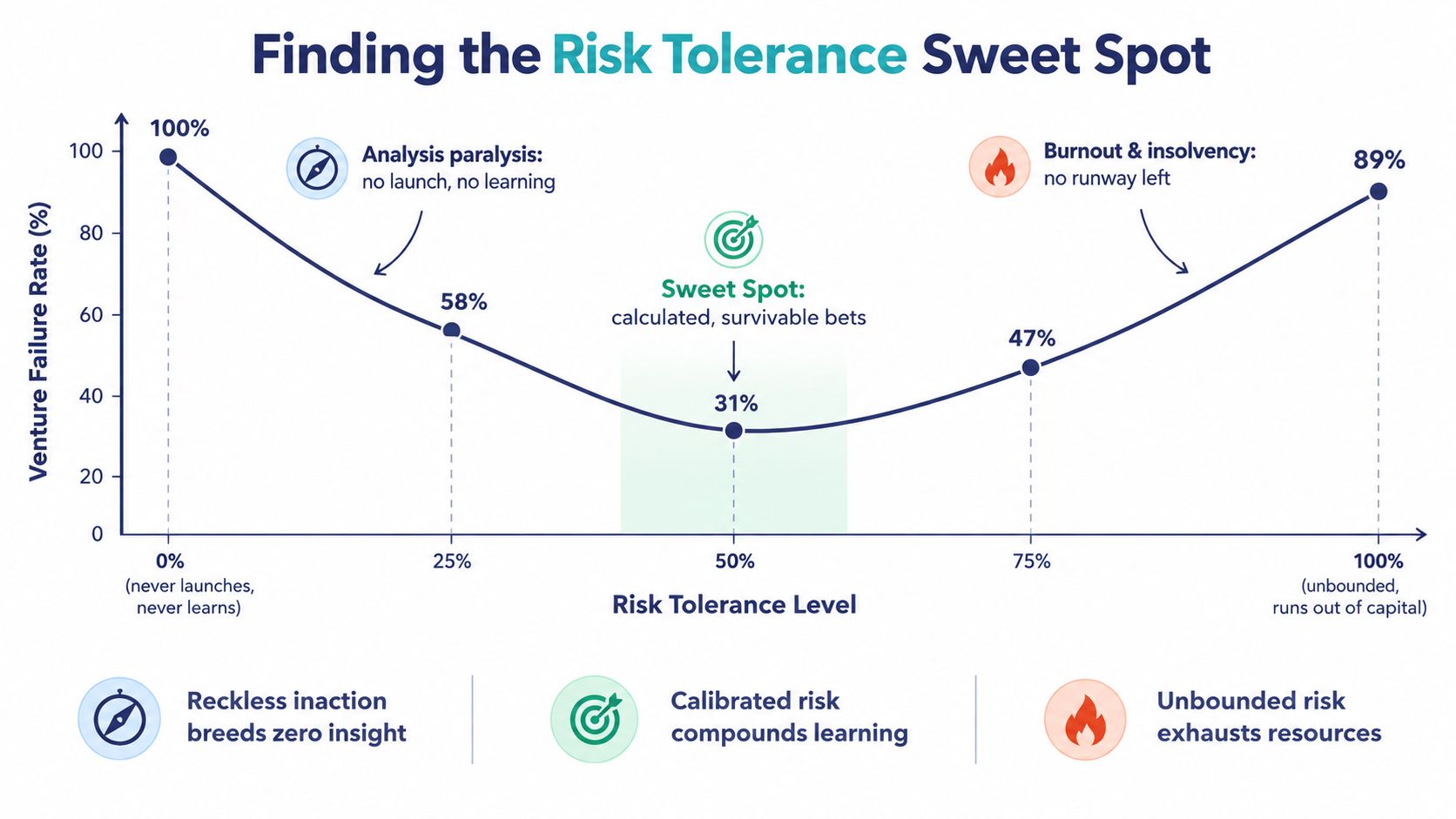
The middle is not timid. It is disciplined action with a defined cost of being wrong. In practice, that means launching a narrower product, committing capital in stages, holding a reserve, and setting evidence thresholds before continuing.
Calibrate the downside you can actually survive
Your risk profile depends on more than confidence. Ask three questions:
What is your runway? A founder with twelve months of savings faces a different decision boundary from one with no personal cushion.
What is the recovery cost? Lost money may be manageable. Losing a professional license, key relationship, or ability to support your family may not be.
What evidence supports the next bet? Capital should follow milestones, not enthusiasm.
The startup failure research cited earlier identifies capital exhaustion, weak product-market fit, and poor timing as measurable causes of collapse. Balanced risk-taking addresses all three. It preserves cash while the founder tests demand and waits for stronger evidence.
A useful risk policy states what the company will try, what it will protect, and when it will stop. That is the sweet spot: calculated, survivable bets that create learning without placing the entire venture on one outcome.
Frameworks That Actually Reduce Failure
Frameworks become useful when they improve a decision. They become a liability when founders use them to postpone one. The right choice depends on the venture's stage, capital intensity, regulatory exposure, and speed of change.
Framework | Best Stage | Strength | Watch-out |
|---|---|---|---|
COSO Enterprise Risk Management | Established or complex organizations | Governance, accountability, and alignment with strategy | Can become documentation-heavy for a small team |
ISO 31000 | Organizations needing adaptable principles | Flexible language and integration across activities | It provides guidance, not a guaranteed operating answer |
Lean Startup build-measure-learn | Pre-revenue and early-stage ventures | Fast testing of assumptions and customer demand | Fast experiments can miss legal, security, or financial exposure |
Scenario analysis with Monte Carlo simulation | Capital-intensive or cyclical bets | Shows how multiple assumptions affect downside | The model can create false confidence if inputs are weak |
COSO is appropriate when the business needs clear ownership, reporting, and governance. A company with several business lines or outside stakeholders benefits from connecting risk decisions to strategic objectives rather than keeping them in functional silos.
ISO 31000 is more adaptable. It works when the organization needs shared principles but doesn't want to force every team into identical procedures. It's particularly useful for businesses operating across different markets or changing their processes frequently.
Lean Startup is the practical choice for a pre-revenue SaaS company. Build a narrow version, measure actual behavior, and decide whether the next investment is justified. The method fails when founders treat customer enthusiasm as validation or ignore risks outside the product experiment.
For a real estate operator, scenario analysis is more appropriate. Model vacancy, cap rates, interest expense, refinancing conditions, construction costs, and exit assumptions together. Monte Carlo simulation can help show the range of outcomes, but it can't rescue unrealistic inputs.
Choose the framework that matches the terrain. A small software experiment doesn't need a board-level governance machine, and a leveraged property acquisition shouldn't rely on intuition alone.
The best frameworks don't eliminate failure. They force earlier recognition, better ownership, and more disciplined capital allocation. For deal-level judgment, spotting a bad deal before it's too late matters more than adopting a fancy label.
How a Real Estate Investor Manages Downside
Real estate risk is rarely clever. Debt payments, occupancy, operating costs, and refinancing dates arrive regardless of market sentiment. A disciplined investor asks more than whether a property offers an attractive return. They test what happens when rent growth slows, vacancy rises, financing tightens, or a sale takes longer than planned.
Richard Maize's public profile identifies him as a Los Angeles-based real estate investor, entrepreneur, and philanthropist with more than 30 years of experience in real estate and finance, according to his professional profile. His business interests have included real estate, public relations, food trucks, and fintech. An Entrepreneur profile of Richard Maize states that he had accumulated 1,000 apartment units before age 30 and owned property in 20 states. Those examples show how scale and diversification can reduce dependence on one market or asset.
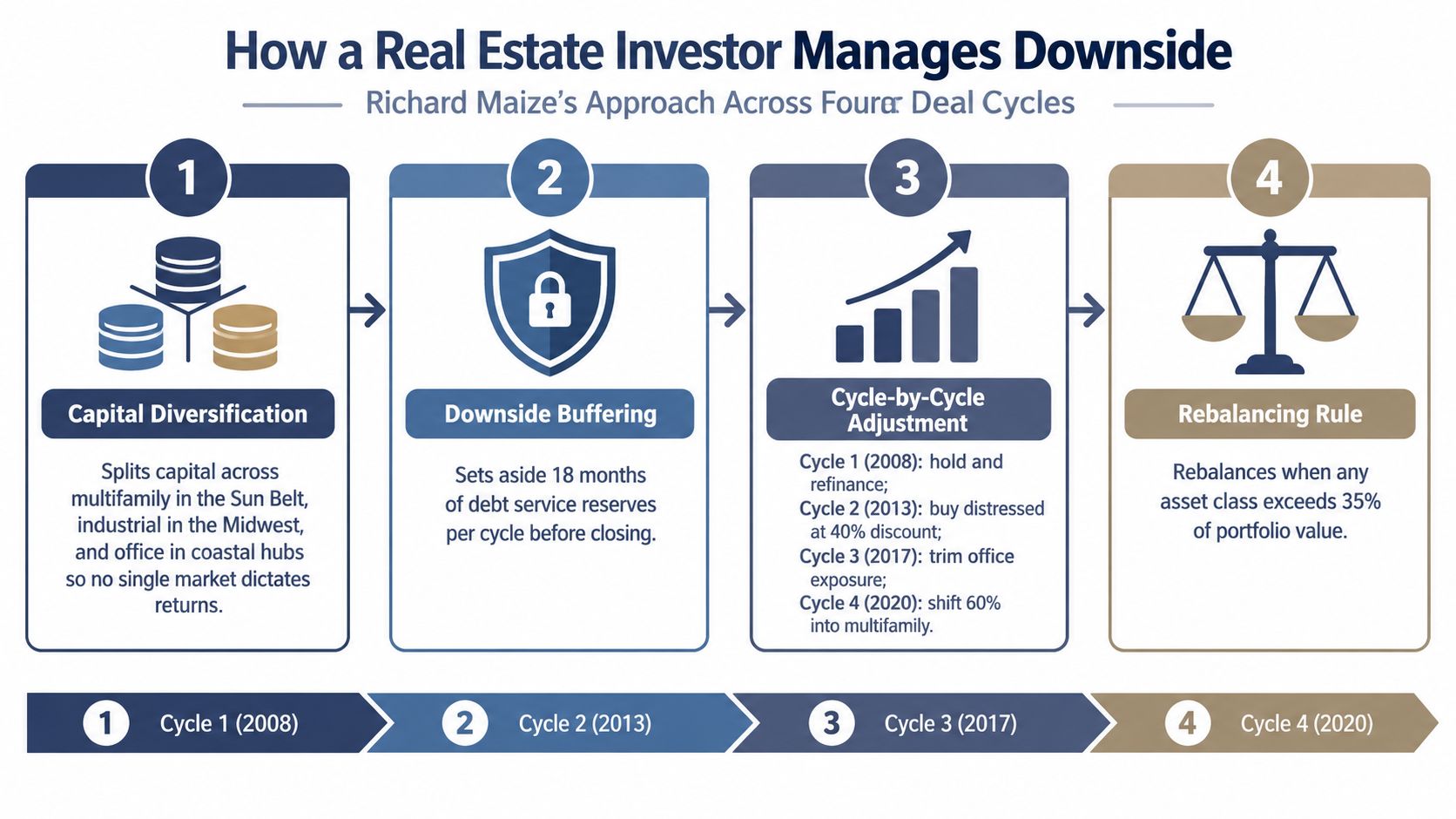
The practical lesson is to copy the control logic, not the portfolio.
Spread exposure before you need the protection
A real estate investor can diversify across four areas:
Geography: Different employment bases and local economies reduce reliance on one regional downturn.
Asset type: Multifamily, industrial, and development projects respond differently to demand, construction costs, and financing conditions.
Timing: Acquiring across market cycles reduces the risk of committing all capital at one valuation peak.
Liquidity: Reserves and uncommitted capital preserve choices when distressed opportunities appear.
Diversification does not make each holding safe. It limits the chance that one regional or sector-specific problem determines the portfolio's entire result. For a detailed walkthrough, see Richard Maize's guide to building a strong real estate portfolio.
Underwriting provides the second layer of protection. Stress the rent roll, vacancy, interest expense, operating costs, and refinancing assumptions together. Fund reserves before distributions. Require the property to remain serviceable during weak months, not only under optimistic assumptions. If the model works only with full occupancy and favorable financing, walking away is usually the sound decision.
A separate history of Maize's business activity describes his founding and later liquidation of one of the largest mortgage banking companies in the United States. That history illustrates exit strategy as a form of risk control. Selling or liquidating a business can release capital, reduce exposure, and support redeployment into other ventures or philanthropy.
The accompanying discussion offers another perspective on portfolio construction and downside discipline.
The rule is simple: do not chase yield through risks you cannot explain. Preserve liquidity, diversify across markets, asset types, and cycles, and reject upside-only underwriting. A debt-financed property acquisition should rely on tested assumptions rather than intuition.
A Phased Mitigation Playbook for Founders
Risk controls should change as the company earns evidence. A pre-launch founder needs to validate demand and protect personal downside. A company with early traction needs operating redundancy. A scaling company needs governance, compliance, and counterparty controls.
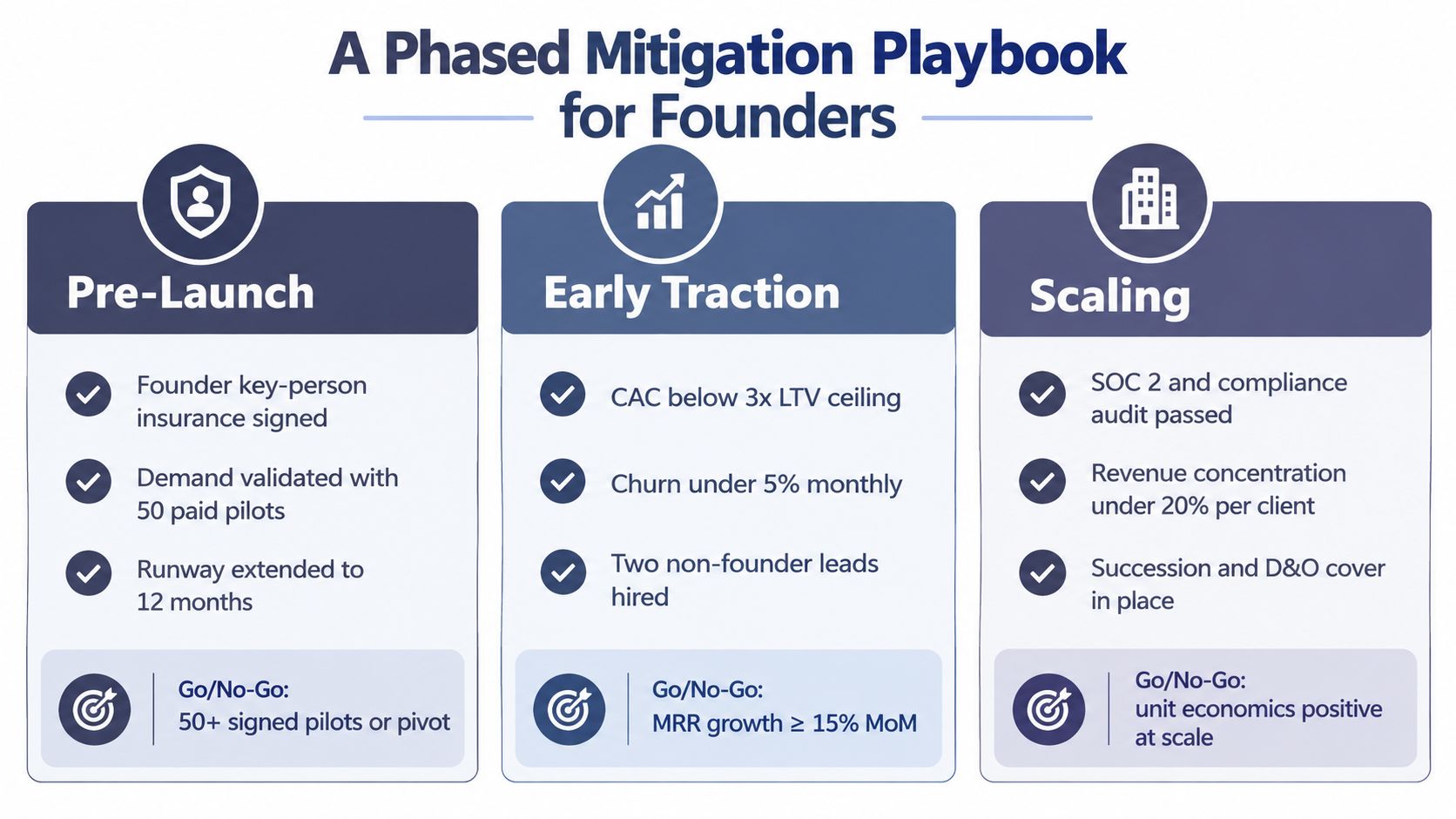
Pre-launch
Start with the risks that can invalidate the venture before product development becomes expensive.
Founder exposure: Document decision rights, sign appropriate key-person coverage, and identify what happens if the founder becomes unavailable.
Demand evidence: Secure paid pilots or another concrete commitment. Interest without payment is a weak signal.
Runway test: Calculate the point at which the company must stop spending, raise capital, or change direction.
The decision gate is clear: proceed when customer evidence and runway support the next experiment. Otherwise, pivot the offer or stop before sunk costs dictate the strategy.
Early traction
Once customers arrive, measure whether the business can serve them repeatedly and profitably. Test pricing sensitivity, track churn by customer cohort, and avoid allowing one customer to become the company's financial foundation.
Add basic operating controls:
Legal: Review customer terms, intellectual property ownership, privacy obligations, and contractor agreements.
Accounting: Close the books consistently and reconcile cash against the operating plan.
Insurance: Check professional liability, cyber, directors and officers, and key-person exposures.
People: Write down critical processes before hiring accelerates.
Scaling
Scaling introduces a different danger. The company can grow faster than its controls. Establish recurring board or leadership risk reviews, set limits for customer and vendor concentration, and assess currency, tax, licensing, and regulatory exposure before entering another country.
A recent startup study on the risk-management development gap highlights the problem of formalizing controls only after launch. The practical answer is to make mitigation a sequence of decisions with a named owner, a due date, and a go or no-go trigger. A risk register that nobody revisits is paperwork. A short weekly review that changes spending or product priorities is management.
The Operational Risks Most Entrepreneurs Miss
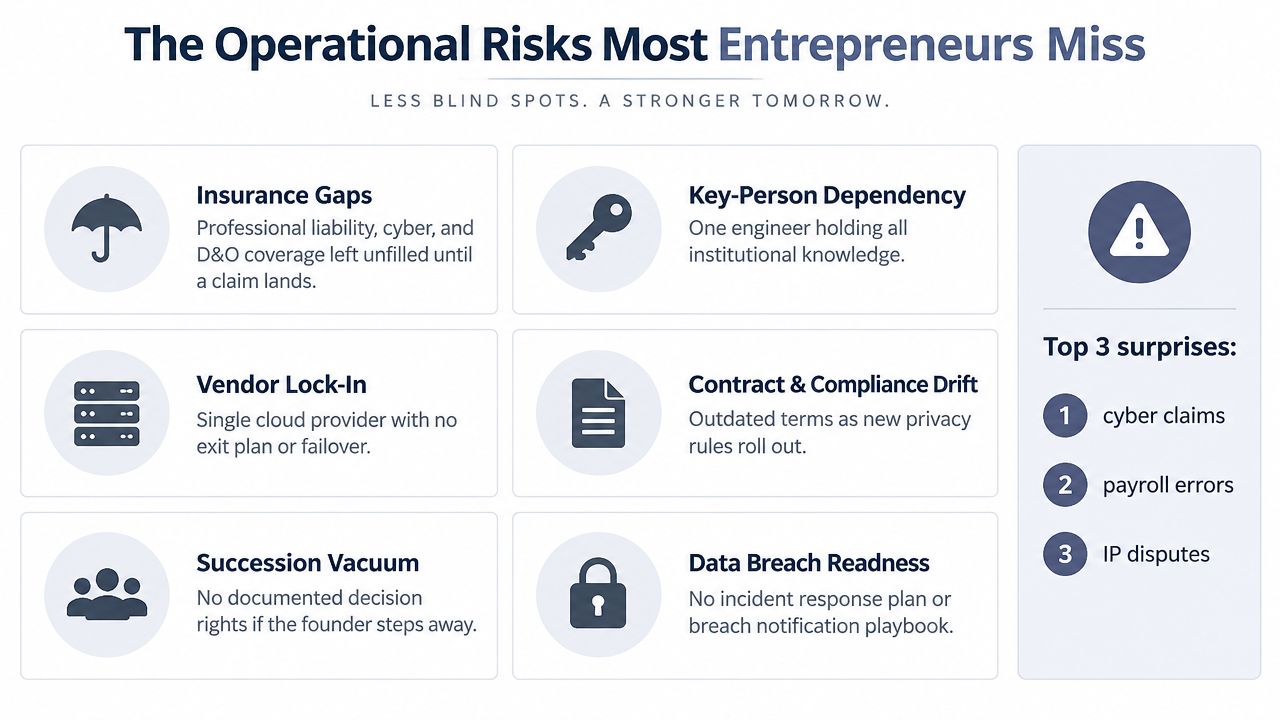
Founders usually notice visible risks first. They watch sales, competitors, and fundraising. The quieter exposures sit in the back office until an incident makes them expensive.
Insurance is a common example. Gallagher's 2026 survey found that 94% of business owners worry their insurance may not cover a specific event or loss. The same survey reported that 53% viewed flooding as a top weather threat, while only 30% had flood insurance. Those figures point to a practical gap: buying a policy isn't the same as confirming that the policy responds to the losses the business can't absorb.
Close the gaps with assigned routines
Use a short operational review with clear ownership:
Coverage audit: Once a year, the finance lead or broker compares policies with contracts, assets, revenue sources, cyber exposure, and key-person dependencies.
Vendor review: Each quarter, the operations owner identifies single-provider dependencies, checks termination terms, and tests whether data and workflows can be moved.
Access review: Each month, the technical owner reviews privileged accounts, removes departed users, and confirms multifactor authentication.
Incident rehearsal: At least periodically, the leadership team runs a breach or outage exercise with communications, customer notification, legal review, and recovery steps.
AI policy: Before employees use an AI tool with company or customer data, define approved uses, human review points, data restrictions, and a responsible owner.
Third-party exposure deserves the same attention as internal systems. A cloud provider, payroll platform, payment processor, or outsourced developer can become a single point of failure. Contractual assurances help, but they don't replace an exit plan or a tested fallback.
AI creates a similar temptation to move quickly without defining accountability. Automation can reduce repetitive work, but a human should remain responsible for decisions involving customers, employment, compliance, financial commitments, or sensitive data. The cheapest control is often a written rule that prevents an irreversible action from running unattended.
Monitoring What Matters and Staying the Course
A risk program stays alive when it changes decisions. Founders don't need a dashboard filled with every available metric. They need a small set of signals tied to thresholds and pre-written responses.
Metric | Threshold | Response Action |
|---|---|---|
Runway | Below the internally approved survival period | Freeze discretionary spending, revise the hiring plan, and begin financing or revenue actions |
Customer concentration | One customer becomes strategically or financially dominant | Set a diversification target and make sales capacity serve the gap |
Churn cohorts | A cohort deteriorates beyond the product plan | Interview lost customers, isolate the cause, and pause expansion until retention improves |
Unit economics variance | Actual contribution differs materially from the approved model | Reprice, reduce delivery cost, or stop the channel producing the variance |
Counterparty exposure | A lender, vendor, platform, or partner becomes difficult to replace | Qualify an alternative and document a transition plan |
The threshold must be specific enough to trigger behavior. “Watch cash carefully” is not a control. “If the forecast crosses the approved minimum, the founder reviews every discretionary commitment” is a control.
Build a rhythm that survives busy periods
A monthly risk review should cover cash, customers, operations, compliance, people, and counterparties. Keep the meeting short, but require each owner to report what changed, what could fail next, and which decision needs escalation.
Quarterly, refresh the risk framework against the company's current stage. A pre-revenue product team may need customer validation and founder dependency controls. A growing company may need stronger data governance, contract review, insurance, and succession planning.
Post-mortems should include near-misses, not only disasters. A delayed payroll run, failed vendor handoff, security alert, or customer escalation can reveal a control weakness while the cost remains manageable.
The broader funding environment reinforces the need for this discipline. EY's entrepreneurship coverage reports that entrepreneurs are more likely than CEOs to identify reduced access to capital as a significant risk, 20% compared with 11%. It also reports that 59% say growth capital is more constrained than 12 months earlier, while 91% prioritize disciplined growth and profitability over rapid expansion. The same source identifies bureaucracy and regulatory complexity at 63%, lack of skilled workforce at 46%, and access to financing at 33% in its 2026 Entrepreneurship Barometer.
Risk monitoring isn't bureaucracy for its own sake. It's inexpensive insurance against decisions made with stale information. The founder who reviews leading indicators, records near-misses, and acts before the threshold becomes a crisis is practicing entrepreneurial risk management in its most useful form.
Richard Maize offers practical perspective shaped by real estate investing, entrepreneurship, business building, and philanthropy, with a focus on diversification, disciplined decisions, and long-term value creation. Visit Richard Maize to explore his insights, ventures, and lessons from managing opportunity and downside across business cycles.
Comments