Entrepreneur Networking Events: A Strategist's Guide

Most advice on entrepreneur networking events is backward. It tells people to work the room, collect cards, and leave with a full contact list. That approach produces activity, not assets.
Serious entrepreneurs don't need more shallow contacts. They need a stronger network of people who trust them, remember them, and will take a call when timing matters. In investing, the best opportunities rarely come from the loudest room. They come from a handful of relationships built carefully over time. Networking should be treated the same way.
Beyond Business Cards Rethinking Entrepreneurial Networking
The business card chase is one of the least useful habits in entrepreneur networking events. You can leave with a pocket full of names and still have nothing that improves your company. A rushed exchange of contact information isn't a relationship. It's a receipt for a brief conversation.
That distinction matters because real opportunity usually moves through trust. Investors share deals with people they know. Operators recommend talent to people they've seen perform under pressure. Founders open doors for entrepreneurs who have shown judgment, patience, and generosity over time.
Most rooms don't reward the person who speaks to the most people. They reward the person a few good people want to speak with again.
Richard Maize's career makes that point better than any trend piece could. As he put it on his LinkedIn profile, "In 1988, I founded a major mortgage banking company that became one of the most successful in the United States. This journey, spanning over three decades, wasn't built on chance encounters but on a deliberate strategy of building deep, lasting professional relationships, a cornerstone of effective networking."
What most people get wrong
Entrepreneurs often enter an event asking the wrong question. They ask, "Who can help me right now?" A better question is, "Who is worth knowing well five years from now?"
Those are very different filters. The first pushes you toward urgency, pitching, and thin conversations. The second pushes you toward character, relevance, and staying power.
A single conversation with a thoughtful lender, broker, operator, or founder can outperform a night of frantic introductions. The same rule applies whether you're in real estate, software, retail, or consumer brands. Strong networks are built like durable portfolios. Slowly, selectively, and with attention to quality.
The portfolio mindset
Think of your network the way you would think of an asset base.
Core holdings: People whose judgment you trust and who consistently create value.
Growth relationships: Newer connections with clear long-term potential.
Situational contacts: Useful, but not foundational.
Noise: People who appear connected but don't add substance.
If you don't separate those categories, you waste time maintaining the wrong relationships. Good networking isn't social collecting. It's disciplined relationship allocation.
The True ROI of Networking Relational Equity as an Asset
Most entrepreneurs make a mistake before the event even starts. They classify networking as a soft expense. Travel, tickets, meals, and time go into one mental bucket labeled overhead. That's the wrong accounting.
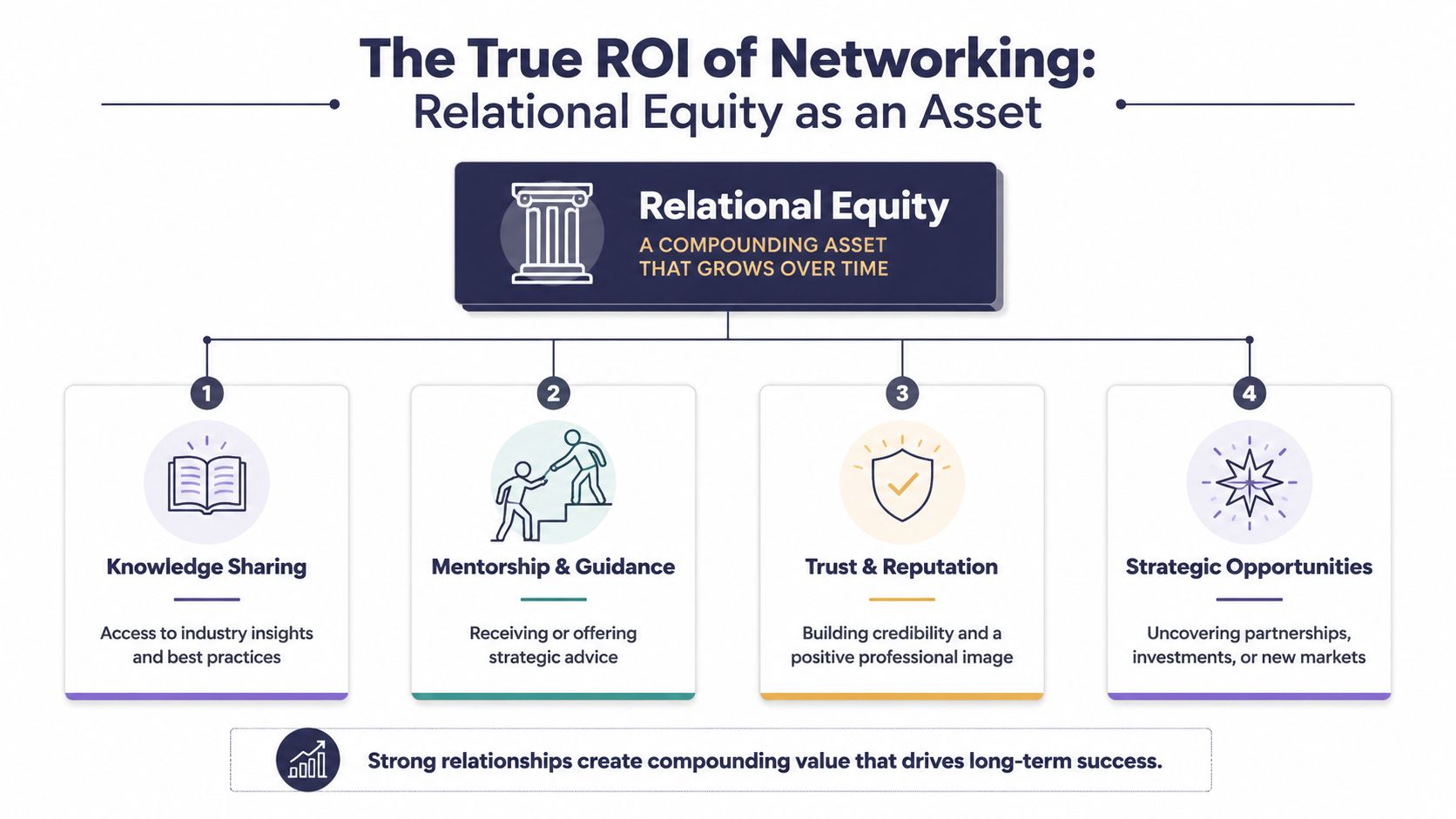
Some of the strongest returns in business come from relational equity, the accumulated value of trusted professional relationships. This asset doesn't sit on a balance sheet, but it changes outcomes in financing, deal flow, hiring, partnerships, and market intelligence. It compounds when managed well and decays when ignored.
Revenue is only one layer of return
The commercial case is already strong. Firms, on average, attribute 24% of their annual sales turnover directly to networking activities, according to startup networking statistics compiled by NexaLink. That's enough to end the debate over whether networking belongs in a serious growth strategy.
But immediate sales are only one form of return. Good entrepreneur networking events also create advantages that are harder to track in the moment and far more valuable over time.
Return type | What it looks like in practice |
|---|---|
Knowledge access | Hearing how operators are solving a problem before the market catches up |
Reputation transfer | Being introduced by someone credible rather than approaching cold |
Opportunity access | Seeing partnerships, investments, or acquisitions before they become public |
Decision quality | Getting candid feedback from experienced people who have no reason to flatter you |
Why relational equity compounds
A real estate investor understands compounding intuitively. One well-bought property can lead to better financing terms, stronger broker relationships, and access to larger deals. Networking works the same way. A trusted relationship often creates a second one, then a third, each with better context and lower friction than the last.
Practical rule: Never judge an event only by what closed that week. Judge it by whether it improved your position for the next important decision.
That shift changes your behavior. You stop forcing immediate asks. You listen more carefully. You notice who has pattern recognition, who has influence, and who follows through. Those are the people worth investing in.
The better question at any event
Instead of asking whether an event will produce leads, ask whether it can produce one of these outcomes:
A durable relationship with someone who can sharpen your judgment
A strategic introduction to a partner, lender, or customer you couldn't reach otherwise
A reputation gain from showing up prepared and useful
A market insight that affects where you deploy capital or effort next
That's investor thinking. It treats entrepreneur networking events as an arena for acquiring intangible but durable advantages.
A Strategist's Guide to Finding and Vetting Events
Most networking mistakes happen before you ever register. Entrepreneurs often choose events because they're popular, close by, or filled with vague promise. That's how calendars get crowded and pipelines stay thin.
Los Angeles is a good example because it offers every type of room. Tech founders gather in startup meetups, venture circles, and coworking events. Real estate professionals gather at investment forums, lender panels, private breakfasts, and local association programs. Entertainment operators, consumer brand founders, and hospitality entrepreneurs overlap with all of them. The opportunity is broad. The waste is broad too.
Start with the attendee list, not the marketing copy
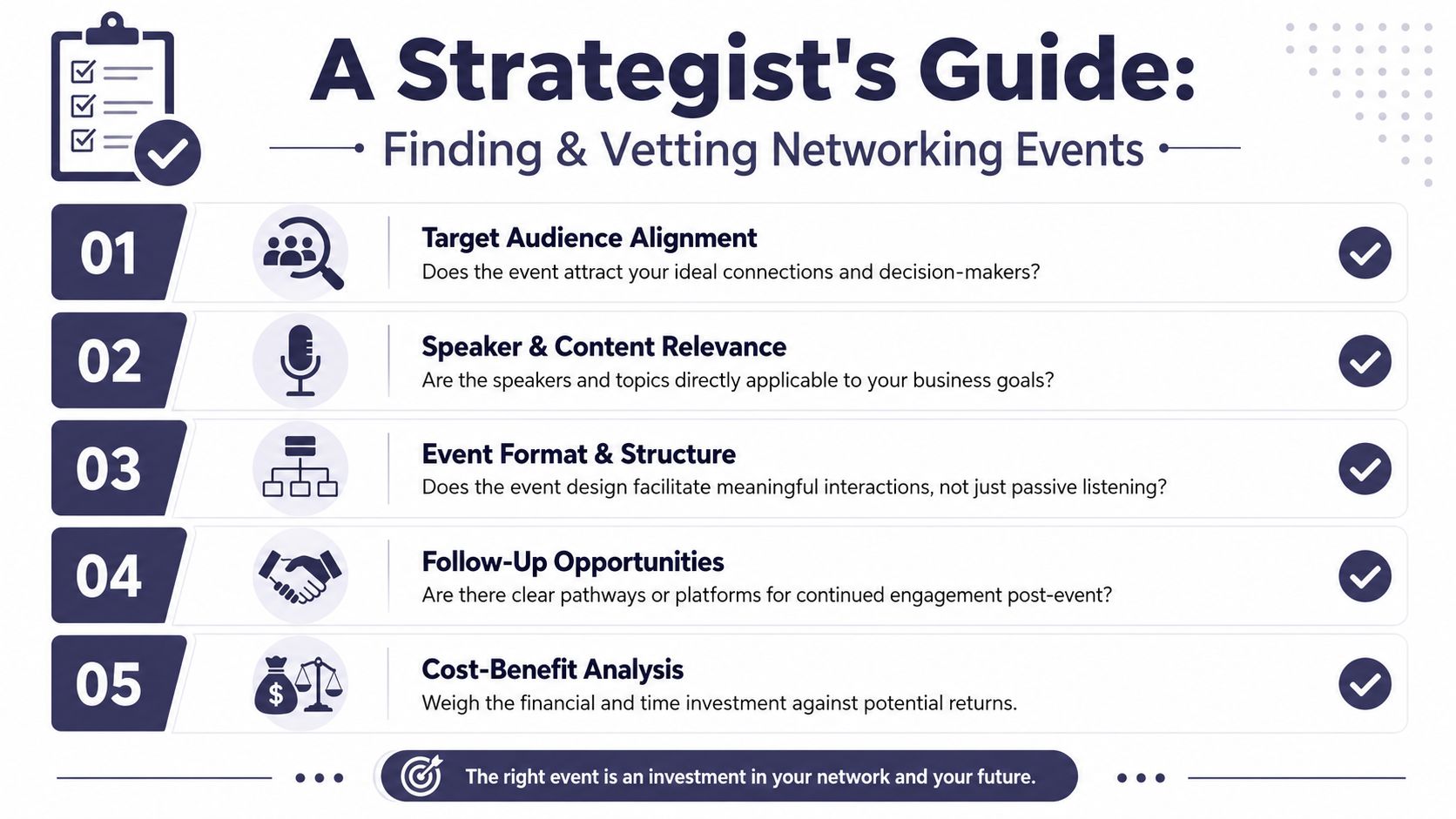
Event pages are written to sell attendance. They rarely tell you whether the room contains people you should know. The first screen should be the likely attendee profile.
Use LinkedIn, organizer pages, speaker rosters, and sponsor lists. If you're a founder seeking capital, look for decision-makers, not just service providers. If you're building in real estate, look for principals, brokers, lenders, operators, and experienced local owners. If you're pursuing partnerships, check whether the room attracts people with authority to move a conversation forward.
For more perspective on building entrepreneurial judgment, Richard Maize's entrepreneurship articles offer a useful lens on evaluating opportunities.
Use a simple event filter
Before committing time, run each event through a short decision grid.
Question | Strong signal | Weak signal |
|---|---|---|
Who attends | Decision-makers and relevant operators | Mostly vendors selling to each other |
How it's structured | Curated conversations, breakout sessions, hosted introductions | Open floor with no facilitation |
What the agenda does | Encourages dialogue and follow-up | Long passive panels with little interaction |
What success looks like | Clear path to meaningful meetings | "Great exposure" with no specifics |
The format matters more than the room size
Large rooms can create momentum, but format decides whether momentum turns into substance. Open-floor networking usually rewards extroversion and speed. Curated matchmaking, hosted roundtables, and smaller working sessions reward relevance.
That distinction is especially important in Los Angeles, where flashy rooms often outperform their actual usefulness. A breakfast with twenty relevant operators can be more valuable than a packed evening mixer where nobody has time for a second serious conversation.
If an event doesn't help the right people find each other, it isn't a networking asset. It's a social calendar item.
Choose fewer events and work them harder
The best strategy usually isn't attending more entrepreneur networking events. It's attending fewer with much more discipline. Selective attendance lets you prepare properly, show up with intention, and follow up while the conversation is still alive.
A thin presence across many rooms weakens your signal. A thoughtful presence in the right rooms strengthens it.
The High-Value Connection Playbook Preparation and Follow-Up
Attendees often lose the value of an event twice. First, they arrive underprepared. Then they follow up with a generic note that sounds like it was sent to twenty people at once.
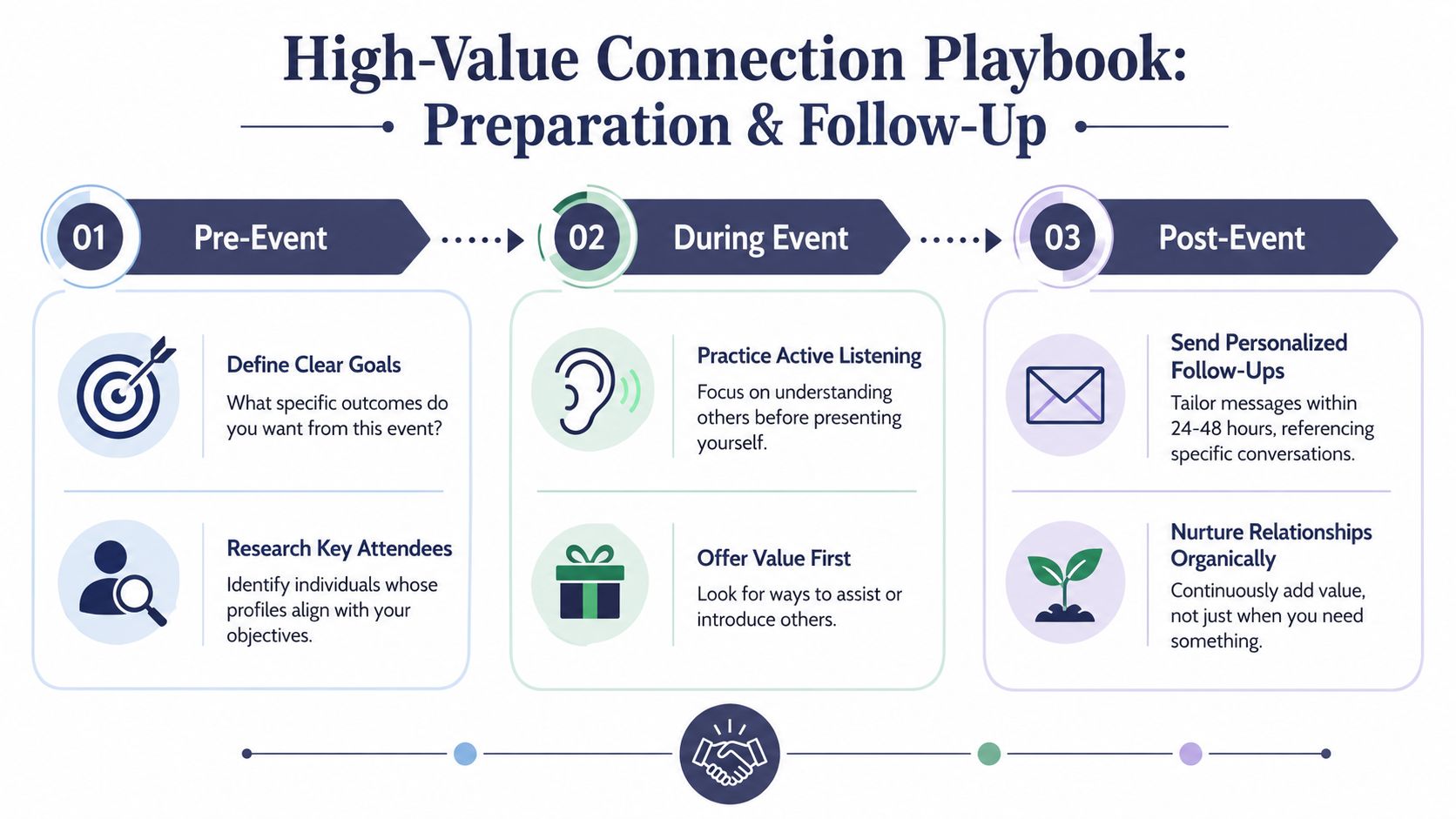
High-value networking is operational. It depends on preparation before the room, discipline inside the room, and relevance after the room. That's where serious entrepreneurs separate themselves.
Before the event
Walk in with a point of view. That doesn't mean rehearsing a pitch. It means knowing what kinds of people matter to your business right now and what value you can offer them.
Prepare three things:
A short positioning statement: not your life story, just what you do, what kind of opportunities you're focused on, and why.
A target list: a few attendees, speakers, sponsors, or hosts worth meeting.
Useful questions: questions that reveal judgment, priorities, and timing.
If you're relying on spontaneity, you're putting too much pressure on chance.
During the event
Conversations improve when your first objective is understanding, not impressing. Listen for what the other person is trying to build, where they're blocked, and what kind of introduction or insight would help them.
This matters even more for entrepreneurs who have felt pushed into transactional networking habits. As noted in guidance on networking for minority entrepreneurs, data shows a critical gap for many entrepreneurs in pivoting from "transactional" networking (asking for something) to "relational" value creation (offering something). A key strategy is to use structured matchmaking sessions to meet decision-makers, a tactic proven to build the trust needed for long-term relationships.
That idea is practical, not philosophical. Rooms with structure help serious people find each other without forcing awkward competition for attention.
A useful business mindset carries over here. Richard Maize's essay on the mindset of a successful entrepreneur fits the same logic. Strong outcomes follow clear thinking, patience, and consistent execution.
Here is a useful reminder before any event:
After the event
Most follow-up fails because it's generic. "Great meeting you" is polite, but forgettable. The better follow-up is specific and useful.
Use this sequence:
Reference the exact conversation. Mention the market, challenge, project, or idea you discussed.
Add one useful item. Send an article, make an introduction, share a brief thought, or answer a question raised in the room.
Propose a clear next step. A short call, coffee, site visit, or focused second conversation.
Keep the tone light. Don't force a close before trust exists.
What works and what doesn't
Works | Doesn't |
|---|---|
Personalized follow-up tied to the conversation | Generic thank-you emails |
Offering value first | Asking for favors immediately |
Selective second meetings | Trying to keep every contact warm |
Structured matchmaking environments | Wandering crowded rooms without a plan |
Good follow-up doesn't chase attention. It proves you were paying attention.
From Attendee to Host Creating Events That Build Community
That doesn't mean renting a venue and inviting a crowd. Plenty of people host events that feel busy but produce little value. A useful event has a clear purpose, a deliberate guest mix, and an atmosphere where people can help one another without feeling hunted.
Hosting is curation, not promotion
The strongest hosts think like allocators. They decide which people should be in the room together and why. They don't just gather attention. They organize relevance.
A good guest list has range, but not randomness. You want complementary strengths. Operators, capital sources, creatives, founders, local connectors, and seasoned executives can create a productive mix if there's a reason for them to interact. Without that logic, the room turns into fragmented small talk.
Structure creates better conversations
Community doesn't emerge because people share a room. It emerges because the host lowers friction. That can be done with a short welcome, a moderated conversation, a few intentional introductions, or small-group seating that encourages substance over performance.
The best hosts also control tone. They make it clear that the event isn't a place for hard selling. That one decision changes behavior quickly. People relax, listen better, and speak more openly.
Leadership matters here as much as hospitality. Richard Maize's piece on leadership for an evolving economy connects well to this idea. Good leaders don't just occupy rooms. They create conditions where other people can contribute meaningfully.
What a host should optimize for
Instead of asking whether people had fun, ask sharper questions:
Did the right people meet each other?
Did the format make those meetings easy?
Did attendees leave with next steps, not just impressions?
Did the event increase trust within the community?
A host who gets those answers right becomes a central node in the network. That position creates goodwill that no cold outreach campaign can replicate.
Measuring What Matters Metrics Beyond Business Cards
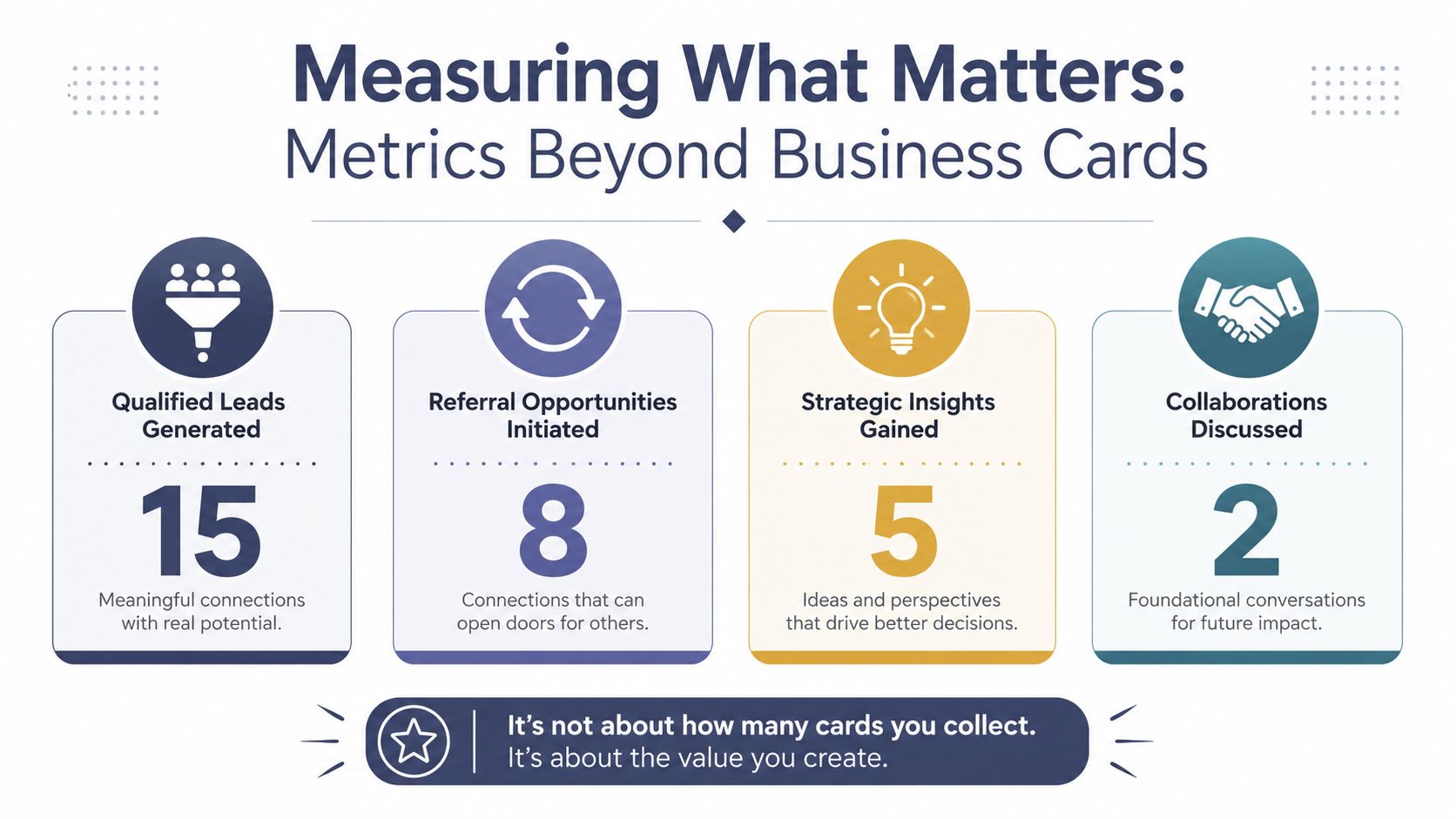
A pile of business cards tells you almost nothing. It doesn't tell you whether the room was relevant, whether trust formed, or whether anybody should hear from you again. If you're serious about entrepreneur networking events, measurement has to move beyond contact count.
The better approach is to separate activity metrics from relationship metrics. Activity tells you what happened at the event. Relationship metrics tell you whether anything durable began.
Better benchmarks
High-performing events aim for a minimum of 3.5 scheduled meetings per attendee, and they get there by using pre-event intent data from professional profiles to curate matches. That approach increases the probability of forming a trust-based business relationship by approximately 40% compared to unstructured networking, according to the verified event benchmarking provided above.
That metric matters because it captures design quality, not just attendance. A crowded room with weak matching can feel energetic and still underperform. A well-structured event with intentional meetings often produces fewer conversations but far better ones.
What to track after the event
Use a short scorecard. Keep it simple enough that you'll maintain it.
Qualified second meetings: Who earned a follow-up conversation?
Introductions made or received: Which interactions expanded your network through trust?
Useful insight captured: What did you learn that could affect hiring, strategy, or capital allocation?
Partnership potential: Which conversations suggest a practical next step?
Another layer matters too. Some organizers now measure Return on Emotion, often through immediate binary feedback after interactions. That approach is useful because emotional quality often predicts whether a relationship will continue. If the exchange felt forced, it usually dies. If it felt natural, people tend to continue it.
The right metric isn't "How many people did I meet?" It's "Which relationships moved forward, and why?"
A practical review habit
After each event, review your notes within a day or two. Mark who matters now, who may matter later, and who doesn't fit. Then compare your best events over time. Patterns appear quickly. Certain formats will keep producing substance. Others will keep producing noise.
That's how networking becomes manageable. You stop guessing and start allocating time based on evidence.
Case Studies in Connection Lessons from a Lifetime of Deals
Theory matters less than execution. In business, relationships prove their value when they change what you're able to build, buy, finance, or solve.
Richard Maize's track record shows that clearly. On his Entrepreneur author page, he notes, "My own journey includes accumulating 1,000 apartment units before the age of 30. This benchmark wasn't just about capital; it was about leveraging a network of partners, brokers, and mentors, connections forged at events and meetings, to identify and execute on opportunities at scale."
What that lesson means in practice
Nobody assembles that kind of portfolio through isolated effort. Opportunities at scale usually require several things to line up at once. Information, credibility, timing, and access. Networks are what connect those elements.
A broker may know who is ready to sell before the wider market does. A lender may trust your execution because a credible operator vouched for you. A mentor may help you avoid a bad deal that looked attractive on paper. None of that comes from superficial networking.
The same principle carries across industries. A founder might meet a future operating partner at one event, hear a market signal from another contact months later, and close a strategic relationship only because both parties were already connected by trust.
The durable lesson
The best connections often don't announce their value at the first meeting. They reveal it later, when conditions change and someone remembers how you showed up. Were you prepared? Were you useful? Did you follow through? Did you think beyond your own immediate need?
Those traits create repeat access. Repeat access creates opportunity. Over a long career, that becomes a significant competitive edge.
Good networking doesn't produce a moment. It produces a position.
The entrepreneurs who build enduring value understand this instinctively. They don't attend events to extract. They attend to identify strong people, build trust, and stay in motion long enough for the right opportunities to surface.
If you want more perspective from Richard Maize on investing, entrepreneurship, brand building, and long-term value creation, explore his work and follow the ideas that connect business growth with durable relationships.
Comments