Commercial Real Estate Underwriting: A Practical Guide

Commercial real estate underwriting is the systematic process of evaluating a property's financial viability with metrics such as NOI, cap rate, DSCR, and LTV to determine investment risk and return potential. Regulatory thresholds can be demanding, including DSCR requirements of 1.5 for qualifying leased CRE, 1.25 for qualifying multifamily, and 1.7 for other CRE loans, with LTV generally required at 65% or lower, or 60% or lower under specified direct-capitalization conditions, as outlined in the applicable federal regulation.
You may be looking at an office building with an attractive asking price, a polished offering memorandum, and a rent roll that appears stable. Then you notice several leases expire around the same time, operating expenses look unusually light, and the projected refinance depends on a valuation that the current lending market may not support. The property can still be a good investment, but the marketing summary won't answer that question.
Commercial real estate underwriting cuts through the presentation. It tests the income, expenses, tenants, physical asset, financing structure, market position, and exit assumptions before your capital is committed. The process isn't just a lender requirement. It's the investor's primary decision-making tool.
What Commercial Real Estate Underwriting Actually Means
A seller may describe an office building as “well located” with “strong upside.” Those phrases have limited value until you translate them into a defensible cash-flow model. Start with the actual leases, current collections, vacancy, operating costs, upcoming capital needs, and debt terms. The asking price becomes meaningful only after you understand what the property can support.
Commercial real estate underwriting is the systematic evaluation of a property's financial performance, risk profile, and investment potential using quantitative metrics and qualitative analysis. The central question is direct: will this deal generate the returns you need while protecting your capital?
The difference between presentation and performance
An offering memorandum usually presents the sponsor's preferred view of the asset. Underwriting should test that view rather than accept it. A projected rent increase may be possible, but the analyst needs market evidence, lease language, tenant demand, and a realistic timeline before treating it as dependable income.
The same discipline applies to expenses. A property may appear highly profitable because repairs, insurance, management, or reserves were understated. NOI is valuable only when the revenue and expense assumptions reflect the building's actual operating requirements.
Practical rule: Treat every projection as a hypothesis until the leases, historical statements, inspections, and market evidence support it.
Why the discipline protects investors
Lenders focus on repayment capacity and collateral protection. Equity investors must go further. They need to understand how the asset performs without favorable financing, how much cash is required during lease-up or repairs, and whether the exit depends on assumptions that another buyer may reject.
That's why strong underwriting separates a promising acquisition from an expensive lesson. It doesn't eliminate uncertainty. It identifies where uncertainty sits, measures its effect, and gives the investor a basis for saying yes, renegotiating terms, or walking away.

Core Metrics Every Investor Must Understand
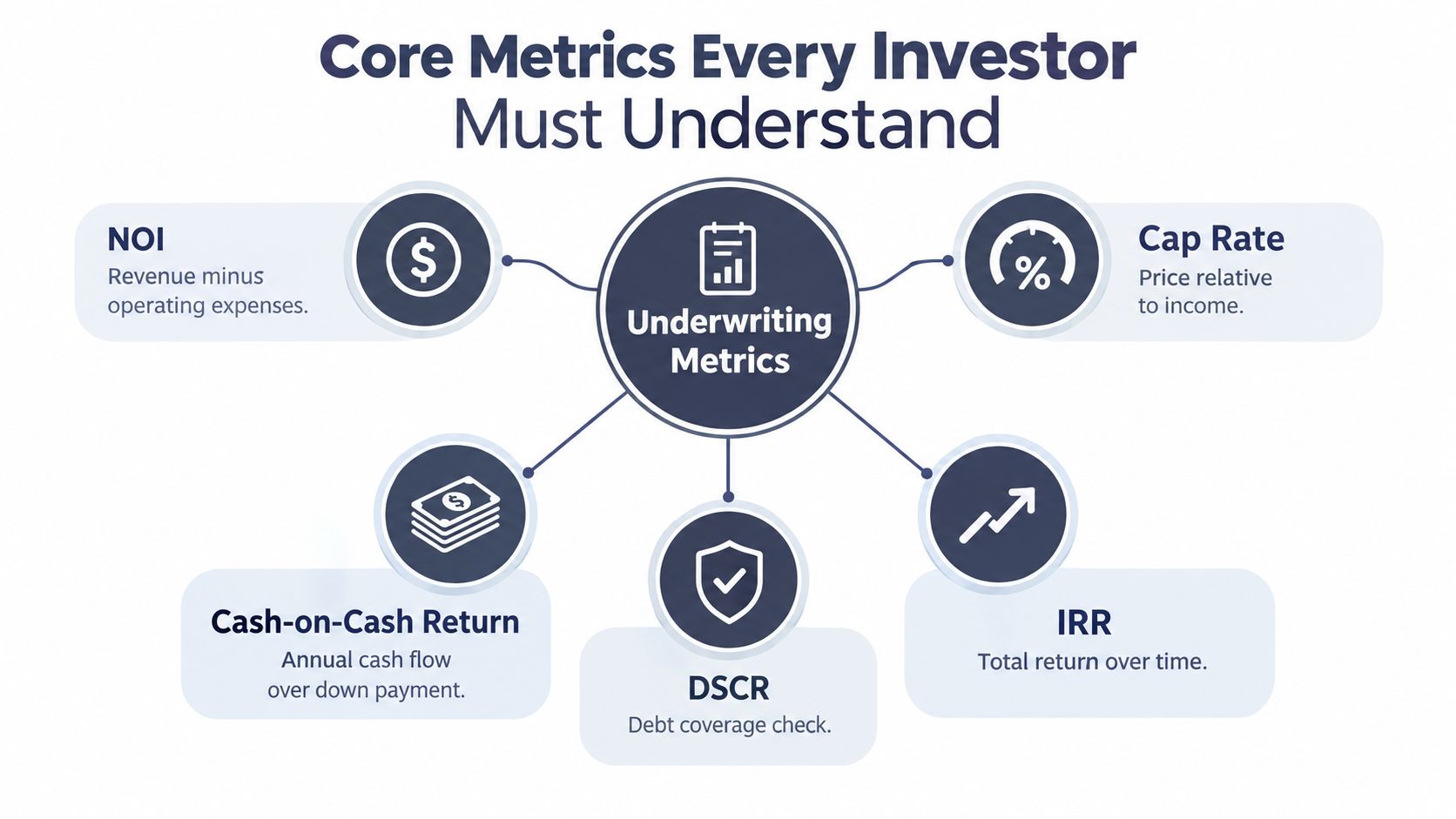
A sound model connects operating income to value, debt capacity, financing, and investor returns. Each metric answers a different question, so reviewing them together matters more than optimizing any single result.
Start with NOI
Net operating income, or NOI, equals property revenue minus vacancy, credit loss, and operating expenses. It measures property performance before debt service and capital expenditures, as explained in this overview of commercial underwriting metrics.
Formula: NOI = effective property revenue − operating expenses
With annual effective revenue of $1,000,000 and operating expenses of $400,000, NOI is $600,000. Keep loan payments and major capital projects outside this calculation. Including debt service obscures the asset's operating results and weakens comparisons between properties.
Connect NOI to value with cap rate
Cap rate = NOI ÷ property value, and implied value equals NOI ÷ cap rate. For the same NOI, a higher cap rate generally indicates a lower value. Market participants set cap rates based on location, tenant quality, lease duration, asset condition, and perceived risk.
Cap rate is a snapshot of unlevered income relative to value, not a complete return forecast. Expense assumptions also affect NOI and therefore the implied value. Richard Maize's operating expense ratio guide for real estate provides useful context for assessing those operating costs.
Test debt with DSCR
DSCR = NOI ÷ annual debt service. A DSCR of 1.25 means the property produces 1.25 times its annual debt obligation. A widely used rule of thumb considers DSCR above 1.25 generally comfortable, although lenders apply their own standards, as described in commercial real estate underwriting guidance from Sands Investment Group.
Higher debt service reduces DSCR. Interest rates, amortization, reserves, and NOI volatility therefore influence loan sizing, particularly when tighter credit conditions leave less room for weak performance.
Measure loan-to-value with LTV
LTV = loan amount ÷ property value. A lower LTV leaves the borrower with a larger equity cushion if the property's value declines. Commercial loans commonly fall within the 60% to 75% LTV range. Underwriting should test the ratio against current value, projected value, and the equity required for improvements or lease-up.
Use IRR for the full investment picture
IRR estimates the annualized return across the timing of equity contributions and distributions, including operating cash flow and sale proceeds. It can change materially with the assumed exit value and holding period. Pair it with equity multiple, cash-on-cash return, DSCR, and downside cases before making an investment decision.
The Underwriting Workflow From Initial Screening To Closing
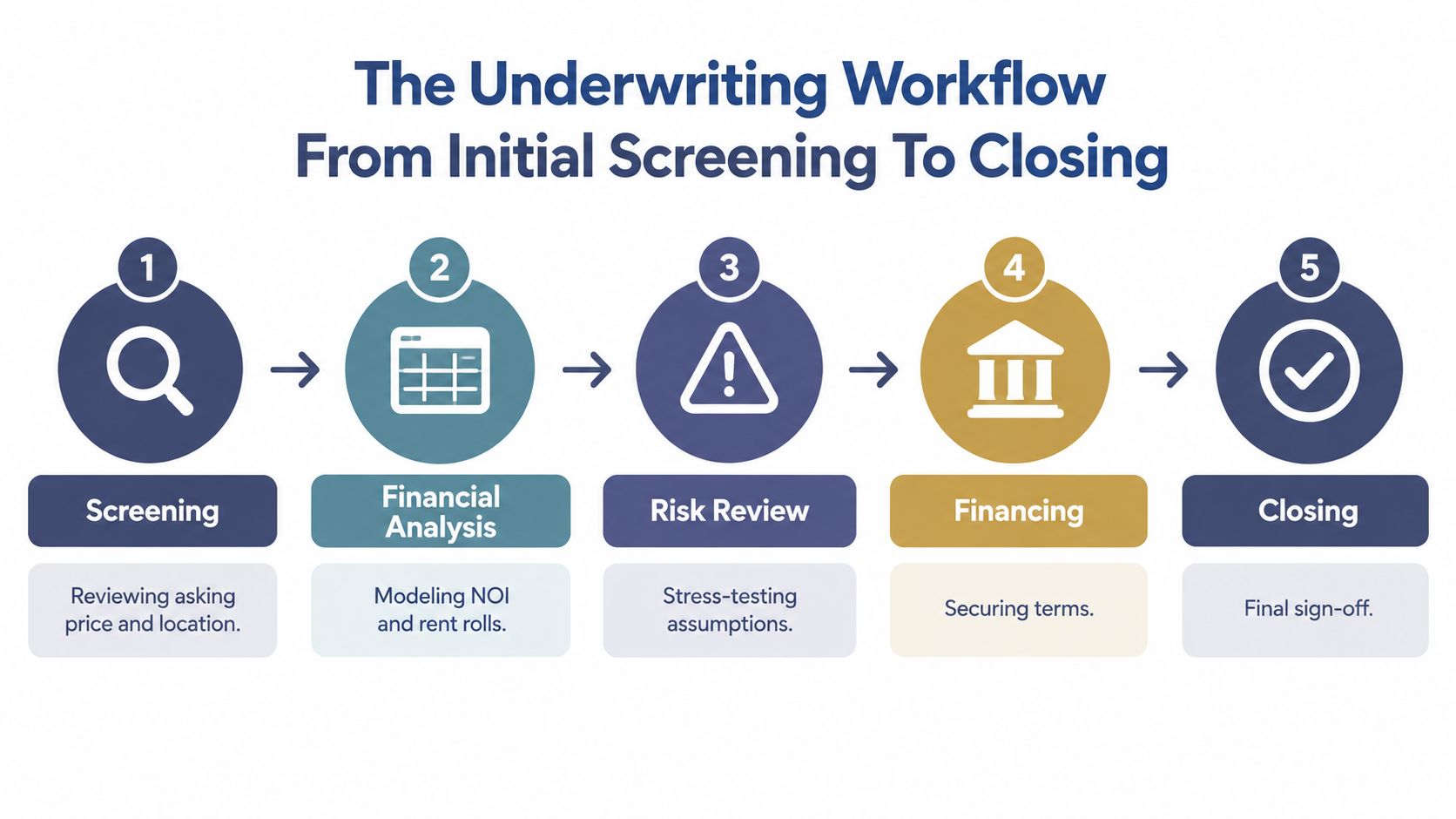
Good underwriting is cumulative. Each stage tests the assumptions created by the previous stage, so skipping a step creates a blind spot that may surface only after closing.
Screen the opportunity first
Start with the asking price, location, asset type, basic financials, and likely financing structure. The first pass should be fast, but not careless. Remove deals that fail obvious tests before spending heavily on inspections, legal review, or third-party reports.
Next, rebuild revenue from the rent roll. Verify occupied space, lease rates, reimbursements, concessions, delinquencies, expiration dates, renewal options, and unusual rights. Compare current rents with credible market evidence, but don't replace signed lease income with optimistic assumptions without modeling the timing and cost of the change.
Verify expenses and leases
Review historical operating statements, invoices, tax records, insurance information, service contracts, and property-management reports. Compare each material expense with market-rate evidence and the building's physical condition. A low historical repair line may reflect luck, deferred maintenance, or incomplete reporting rather than a permanently low cost structure.
Lease review deserves its own attention. Tenant creditworthiness, guaranties, security deposits, termination rights, renewal probability, rent escalations, and co-tenancy provisions can matter more than headline occupancy.
Inspect the asset and the market
Physical and environmental reviews should test the condition of roofs, mechanical systems, structure, life-safety components, accessibility features, and building systems. Legal diligence should confirm title, permits, zoning, easements, code compliance, and any restrictions that affect the business plan.
Market analysis then examines competing supply, tenant demand, absorption, access, employment drivers, and submarket liquidity. A strong building in a weak submarket can still struggle to renew tenants or achieve projected rents.
Model, stress-test, and finance
The final model should include base, downside, and severe downside cases. Under U.S. lending guidance, underwriting should explicitly test borrower and project net worth, cash flow, and DSCR, while supervisory LTV limits for construction CRE, multifamily, and other nonresidential properties are capped at 80%, according to the Federal Reserve's interagency lending guidelines.
For financing execution, compare the model with this guide to funding investment properties. Closing should occur only after the final terms, reports, leases, reserves, and covenants match the assumptions used in the investment decision.
Expert Perspective From Richard Maize On Modern Underwriting Realities
Richard Maize is described as a Los Angeles-based real estate expert, business investor, and philanthropist, and bios identify him as having more than 30 years of experience in real estate and finance, according to his official site. That background matters because underwriting lessons become clearer after an investor has watched financing conditions, valuations, tenants, and operating costs move through multiple cycles.
The old shorthand was debt load plus occupancy. Those inputs still matter, but they don't explain whether a property can withstand insurance volatility, power interruptions, climate exposure, deferred maintenance, or a tenant rollover that arrives at the wrong time. Current underwriting increasingly functions as a resilience and operating-risk test, with greater scrutiny of borrower financials, tenant quality, lease structure, climate exposure, and property systems, as discussed in Crexi's commercial underwriting coverage.
Los Angeles requires asset-specific judgment
Los Angeles underwriting can't rely on a broad market label. California's regulatory environment, insurance availability, wildfire and seismic considerations, utility reliability, permitting requirements, and neighborhood-level tenant demand can affect the risk profile of individual properties. A well-occupied building may still require meaningful adaptation capital or face renewal pressure if its systems don't meet tenant expectations.
Lease structure also changes the analysis. Two assets with similar occupancy may have very different risk if one has strong tenants on durable leases and the other depends on short-term income, weak credit, or concentrated expirations.
Refinance risk belongs in the original model
A property that cash flows today may not refinance comfortably later. Higher rates, lower valuations, a wider exit cap rate, weaker NOI, or increased reserve requirements can create a capital gap even when the asset remains operational.
Recent commentary emphasizes lower borrowing, stronger documentation, realistic exit caps, and scenario-based cash-flow models as underwriting standards evolve. CBC Worldwide's market review also describes how debt maturities and tighter credit conditions can require fresh equity. The practical question is not just whether the property works today. It's whether the property can refinance under materially less favorable assumptions.
Practical Examples With Sensitivity Analysis
Consider a hypothetical multifamily property with effective annual revenue of $1,000,000, operating expenses of $400,000, a purchase price of $7,500,000, and a loan of $4,500,000. The figures illustrate the mechanics only, not a market forecast or investment recommendation.
The base case produces $600,000 of NOI. The implied cap rate is 8%, calculated as $600,000 divided by $7,500,000. If annual debt service is $360,000, DSCR is 1.67, calculated as $600,000 divided by $360,000. LTV is 60%, calculated as $4,500,000 divided by $7,500,000.
Scenario | NOI | Annual debt service | DSCR | Underwriting implication |
|---|---|---|---|---|
Base case | $600,000 | $360,000 | 1.67 | Comfortable coverage in this illustration |
Higher vacancy | Lower than base | $360,000 | Below base | Revenue weakness reduces debt capacity |
Higher interest cost | $600,000 | Higher than base | Below base | Financing pressure appears without an operating decline |
Higher expenses | Lower than base | $360,000 | Below base | Expense control becomes a credit issue |
Wider exit cap rate | Unchanged during hold | Not applicable | Not applicable | Sale value falls, reducing equity proceeds |
The table shows why a single projected IRR can mislead. A vacancy increase affects revenue and NOI. Expense growth attacks NOI directly. Higher financing costs reduce DSCR even if the building operates as expected. A wider exit cap rate may leave current cash flow unchanged while reducing the value available at sale.
Underwriting standards tightened sharply after the 2007–2009 financial crisis. A Berkeley study found that standards were at their loosest in 2005–2007, with the underwriting index reaching -0.59 in 2007:2, then reversing quickly and peaking at 0.35 in 2009, as documented in the Berkeley commercial real estate underwriting study. The lesson is practical: model the variables that can damage repayment and equity, not only the assumptions that make the acquisition attractive.
Essential Templates And Checklists For Your Next Deal
A standardized file makes underwriting faster and more consistent. It also prevents an exciting acquisition from receiving less scrutiny than a weaker-looking one.
Build the deal file in four phases
Initial screening: Record asking price, location, property type, occupancy, rent roll summary, current NOI, financing concept, and the reason the opportunity deserves deeper review.
Financial analysis: Rebuild revenue, vacancy, credit loss, operating expenses, reserves, capital expenditures, debt service, DSCR, LTV, cash-on-cash return, and exit assumptions.
Due diligence: Collect leases, amendments, estoppels, tax records, insurance documents, service contracts, permits, zoning materials, environmental reports, property-condition findings, and utility records.
Final approval: Reconcile the model to verified documents, document every adjustment, confirm financing covenants, size reserves, and record the conditions that would cause you to renegotiate or walk away.
For a practical property-specific checklist, use Richard Maize's commercial real estate due diligence checklist.
Use a repeatable pro forma structure
Organize the spreadsheet into assumptions, rent roll, revenue, operating expenses, NOI, capital items, financing, annual cash flow, sale proceeds, and returns. Keep signed lease income separate from market-rent projections. Add a sensitivity panel that changes vacancy, rent growth, expenses, interest cost, exit cap rate, and required reserves one variable at a time before testing combined downside cases.
Your rent roll should show tenant, suite, lease start, expiration, current rent, reimbursements, options, security, credit notes, and expected renewal risk. That structure exposes expiration clusters and tenant concentration before they become a cash-flow surprise.
Common Pitfalls Even Experienced Investors Make
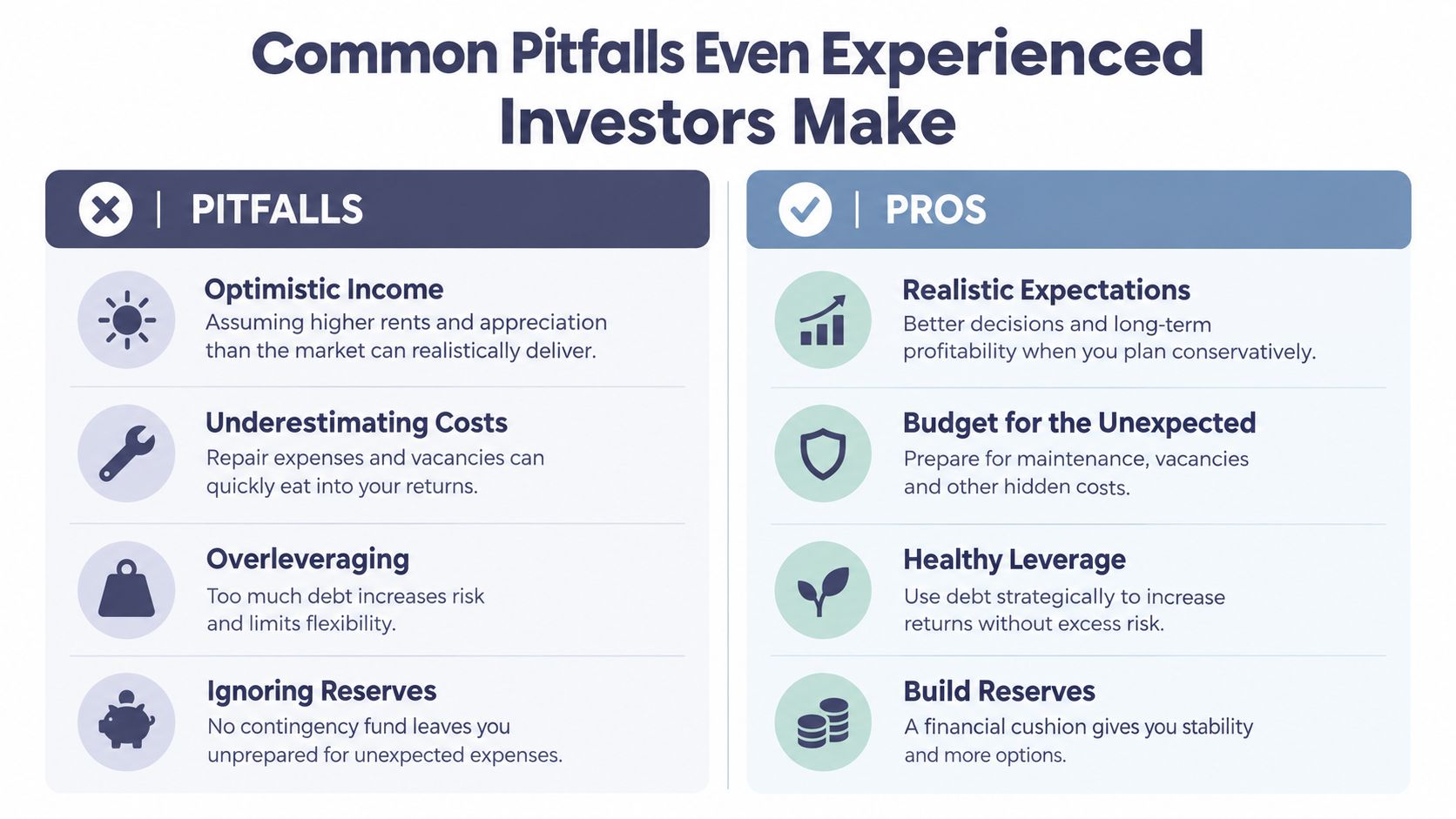
The most expensive errors usually come from assumptions that look reasonable in isolation.
Optimistic income projections assume every vacant space leases quickly at the target rent. A defensible model separates signed contractual income from potential upside and includes the time, concessions, tenant improvements, and commissions needed to achieve that upside.
Underestimated expenses create artificial NOI. Repairs, insurance, utilities, management, taxes, reserves, and capital expenditures should reflect both historical evidence and the physical condition of the asset. A clean recent year doesn't prove that future costs will remain low.
Historical performance without market context can hide changing tenant demand, new competing supply, weaker tenant credit, or altered operating requirements. Review the direction of the market and the durability of the leases, not just the prior statement.
Excess debt leaves little room for valuation declines or NOI weakness. Higher LTV can improve projected equity returns in a favorable case, but it also reduces the buffer protecting the borrower and lender.
Ignoring refinance risk is especially dangerous when the purchase price depends on peak valuation assumptions. Tighter standards, reduced reliance on borrowed funds, realistic exit caps, and stronger documentation can make the next loan smaller than the original debt, creating a capital gap. Richard Maize's practical approach is consistent with conservative underwriting: stress the property before the lender or market does.
Taking Your Underwriting To The Next Level
Strong underwriting is a habit, not a spreadsheet style. Apply the same definitions, document standards, sensitivity tests, and approval rules to every property in your pipeline, then compare your past assumptions with actual results.
Build a private database of comparable deals, rents, expenses, transaction terms, and realized outcomes. Over time, that record improves judgment without replacing analysis. The best underwriters combine quantitative discipline with qualitative intuition about tenants, buildings, neighborhoods, and lenders.
Start today with one property. Rebuild NOI from source documents, calculate cap rate, DSCR, LTV, and investor returns, then test the assumptions that could hurt repayment or exit value. Mastering this process is one of the highest-value skills an investor can develop because it protects capital while revealing opportunities that survive realistic scrutiny.
Richard Maize offers practical perspectives on real estate investing, property markets, entrepreneurship, and lessons from hands-on business experience. Visit Richard Maize to explore his real estate commentary and due diligence resources, then apply those principles to your next underwriting file.
Comments