Richard Maize on Commercial Real Estate Due Diligence

As an investor, I view commercial real estate due diligence not just as a step in the process, but as the single most important part of protecting your capital. It’s the deep investigation I insist on conducting before closing a deal, where my team and I scrutinize a property’s financial, physical, and legal health to uncover risks and confirm its real value. My entire philosophy is built on this rigorous, hands-on approach.
Why Due Diligence Is Your Most Critical Investment Tool
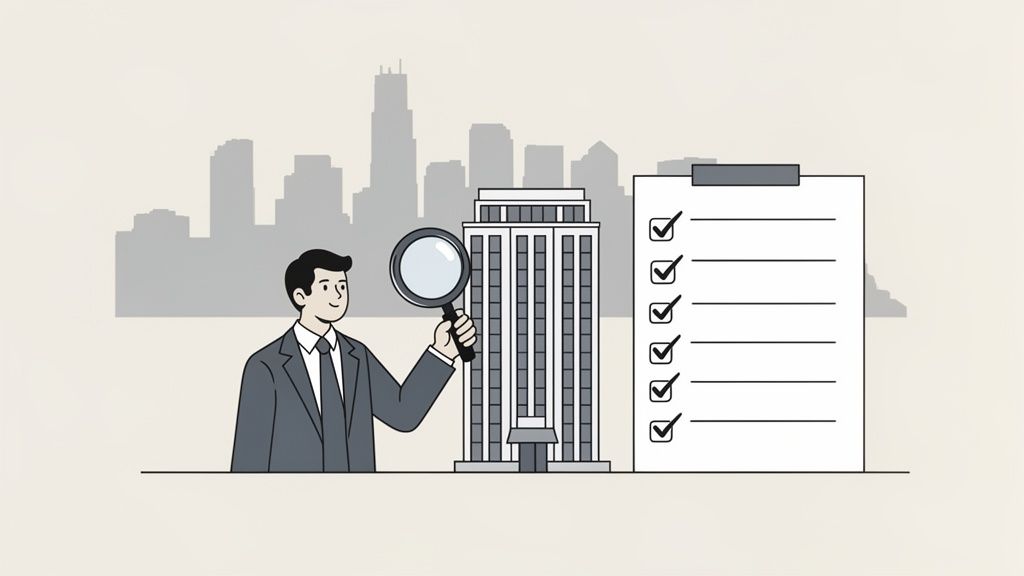
Before you even think about signing a purchase agreement, you need to understand the ‘why’ behind this process. In my decades in this business, especially in a market as fast-paced as Los Angeles, I’ve seen thorough diligence separate the great investments from the disastrous ones. For me, it’s not about checking boxes; it’s about building a complete story of the asset you’re about to buy.
This is where a deal that looks good on paper gets proven in the real world. It's your chance to verify every single claim the seller has made, from the income streams down to the nuts and bolts holding the building together. In my experience, skipping this is like walking through a minefield blind. The risk is just too high.
My approach always comes down to three key areas of focus:
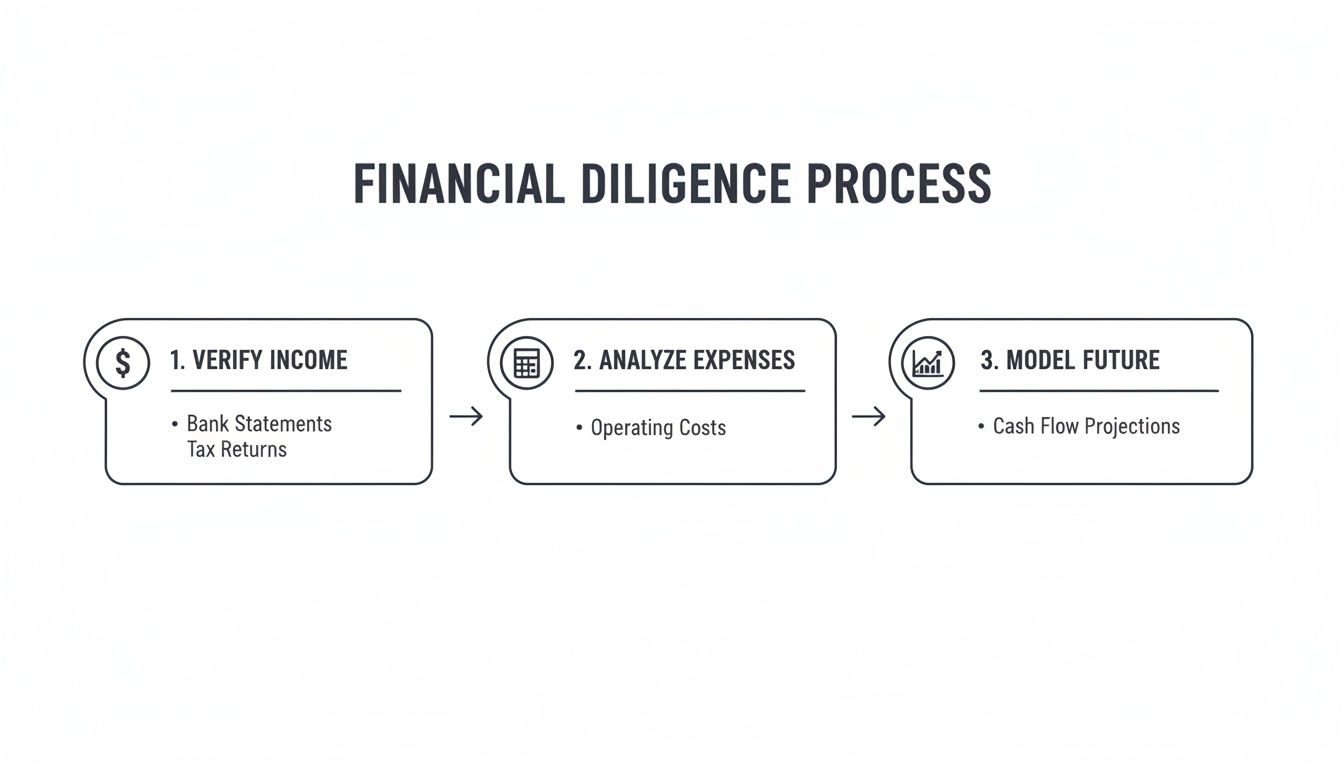
Financial Scrutiny: My team and I go way beyond the seller’s rosy pro-forma. I’m talking about digging into historical operating statements, rent rolls, and every tenant lease to find the true Net Operating Income (NOI).
Physical Inspection: This is a top-to-bottom evaluation of the property’s condition. I need to know what we're facing in future capital expenses, looking at everything from the roof and foundation to the HVAC, electrical, and plumbing systems.
Legal & Title Review: Here, we confirm the seller actually has the right to sell the property, uncover any hidden liens or easements, and double-check all zoning and land use rules to make sure my plans are even allowed.
A Real-World Lesson in Diligence from Richard Maize
I once had my eye on a prime retail property in a fantastic LA neighborhood. The pro-forma numbers were stellar and the location was a 10/10. But during our first look, something felt off—a vague mention of a “shared access agreement” buried in the initial paperwork.
My team could have glossed over it, but I instructed them to dig in. It turned out this agreement gave the next-door property owner complete veto power over any major changes to the building’s exterior or parking lot. That one detail would have killed my entire plan for a modern renovation, making the deal worthless for my strategy. Proper diligence isn't just a shield; it's how you learn to spot a bad deal before it's too late.
This is where you learn to think like a seasoned investor: question everything, assume nothing, and verify all details. In commercial real estate, what you don't know can and will hurt you. It’s a principle I’ve built my career on.
This kind of detailed review is more important than ever right now. Projections for 2026 show that over 50% of global CRE owners have property loans maturing in the next year. In the U.S. alone, that’s a staggering US$1.7 trillion in commercial mortgages coming due.
At the same time, CBRE noted a 16% rise in US investment to $562 billion for 2026. This environment creates a massive gap between disciplined investors and distressed sellers. From my perspective, being precise in verifying loan terms and maturity dates is non-negotiable. You can read the full 2026 commercial real estate outlook on Deloitte.com.
The numbers on a seller's marketing package tell one story. My job during due diligence is to find the real one.
This is where my team and I go beyond the pro-forma and get to the ground truth of a property’s financial health. It’s a process I’ve refined over decades, and it always starts with a healthy dose of skepticism.
Sellers will present their asset in the best possible light. They might project aggressive rent growth or underestimate future expenses. That’s why my first move is to demand at least three to five years of historical operating statements. I'm not interested in projections until I understand the past.
These statements show exactly what it cost to run the building year over year, revealing trends that a single-year snapshot would miss. For me, this historical context is non-negotiable.
Deconstructing the Rent Roll: My Approach
The rent roll is the single most important financial document you’ll receive. It’s a detailed list of every tenant, their unit, their lease terms, and what they pay. I don't just glance at the total income; I instruct my team to dissect it, line by line.
My team and I abstract every single lease. This means creating a summary of the critical details:
Lease Commencement and Expiration: When do the leases turn over? A building with 30% of its leases expiring in the first year is a much riskier bet than one with staggered expirations.
Rent Bumps and Escalations: Are there built-in rent increases? Understanding these is the only way to accurately project future income.
Reimbursements (NNN/CAM): Does the tenant actually pay for taxes, insurance, and common area maintenance? I verify that the landlord is billing and collecting every dollar they are owed.
Co-tenancy Clauses: In retail, these clauses can be deal-killers. If an anchor tenant leaves, it can trigger rent reductions or even termination rights for the smaller tenants around them.
Once we have this data, we compare it directly against the seller’s rent roll and, more importantly, the actual bank deposits. Any discrepancy, no matter how small, is a red flag that needs immediate answers. This is what separates a solid deal from one built on shaky assumptions.
Uncovering Hidden Expenses and True NOI
Next, I turn my attention to the expense side of the ledger. Sellers sometimes “forget” to include certain management fees or one-time capital expenses in their operating statements. My goal is to reconstruct the expense history to find the true cost of ownership.
An investor once told me they relied on the seller's property tax figure, only to find out the property was reassessed after the sale, increasing their tax bill by 40% overnight. This is a classic, costly mistake. I always have my team independently verify property taxes with the local assessor's office.
I look for anomalies and trends. Why did utility costs spike one quarter? Why were repair and maintenance costs unusually low last year? A low R&M budget often means the seller deferred necessary work, leaving me, the new owner, with a hefty bill.
I also build in my own assumptions for recurring costs, like management fees (even if the owner self-manages) and a replacement reserve for big-ticket items like a new roof or HVAC system.
Only after this intense scrutiny can I calculate the true, stabilized Net Operating Income (NOI). This figure, not the seller's inflated number, is what I use for my valuation. It's the foundation of a sound investment.
You can explore how this process fits into a broader strategy by reviewing a complete real estate market analysis template. By understanding the full financial picture, you can build a model that reflects reality, not fantasy.
Once you’ve confirmed the numbers add up, it’s time to get on-site and understand the physical reality of the asset. A building’s condition is a direct reflection of its future costs, and a quick walkthrough isn’t going to cut it. This is where you avoid inheriting someone else’s deferred maintenance and expensive surprises.
I treat every physical inspection like a forensic investigation. Every crack in the pavement, water stain on the ceiling, or outdated piece of equipment tells a story about the property’s past—and its true cost of ownership. It’s not just about what’s visible; it’s about uncovering what’s hiding behind the walls, under the floors, or on the roof.
For this, I lean on a team of qualified, independent third-party inspectors. A seller’s report can be a useful starting point, but an unbiased professional working only for you is non-negotiable. You absolutely need your own set of eyes on every major system.
The Big-Ticket Items I Scrutinize On-Site
During my first property tour, I’m not just looking at the space—I’m actively hunting for red flags. I focus on the major systems, the ones that can obliterate your capital budget right after you close.
Here are the core components I always examine:
Structural Integrity: Are there significant cracks in the foundation or exterior walls? Do the floors feel uneven or sloped? These can signal serious, and seriously expensive, foundational problems that need an expert’s opinion immediately.
Roofing: What’s the age and condition of the roof? I’m looking for signs of pooling water, damaged flashing, or brittle, worn-out materials. A full roof replacement can run into the hundreds of thousands of dollars, so I always get a dedicated report on its remaining useful life.
HVAC Systems: The heating, ventilation, and air conditioning units are the mechanical heart of a building. I check their age, scour maintenance records, and assess the overall condition of every single unit. An end-of-life system is a massive capital expense just waiting to happen.
Plumbing and Electrical: Outdated systems aren’t just inefficient; they are often safety hazards and code compliance nightmares. I look for any sign of leaks, old wiring, or undersized electrical panels that can’t handle the demands of modern tenants.
I once looked at an older industrial building in the LA area that appeared solid on the surface. During the inspection, my electrician found the main electrical panel was dangerously overloaded and not up to code. The fix was projected to cost over $150,000—a detail the seller had conveniently overlooked. We walked away from the deal.
My Essential Third-Party Due Diligence Reports
Beyond my own walkthrough, I rely on a team of specialists to produce detailed reports. These documents are my insurance against hidden defects and are a standard part of my process. While some investors try to cut corners here, I’ve found that the cost of these reports is tiny compared to the problems they can uncover.
Here’s a look at the key reports I commission and why.
Report Type | What It Uncovers | Key Focus Areas | Estimated Cost (LA Market) |
|---|---|---|---|
Property Condition Assessment (PCA) | Overall physical health of the building and site improvements. | Structure, roof, HVAC, electrical, plumbing, ADA compliance, paving. | $3,000 - $10,000+ |
Phase I ESA | Potential for environmental contamination from past or present use. | Historical records, government databases, site reconnaissance, interviews. | $2,000 - $5,000 |
ALTA/NSPS Land Title Survey | Property boundaries, easements, encroachments, and improvements. | Boundary lines, zoning setbacks, utility locations, access rights. | $4,000 - $15,000+ |
Seismic/Structural Report | Vulnerability to earthquakes and overall structural soundness. | Soft-story conditions, non-ductile concrete, unreinforced masonry. | $5,000 - $20,000+ |
These reports form the backbone of a comprehensive physical due diligence effort. They give you a complete, unbiased picture of the asset’s condition and any potential liabilities that the seller’s documents might not disclose.
Don't Buy Someone Else's Toxic Legacy
Beyond the building itself, you have to investigate the land it sits on. This is where environmental due diligence becomes critical. When you buy a property, you inherit its entire environmental history—the good, the bad, and the very, very expensive.
This is why a Phase I Environmental Site Assessment (ESA) is a non-negotiable part of my due diligence. This report, completed by a qualified environmental consultant, digs into the property’s history to identify any red flags for contamination. The process involves checking historical records, government databases, and a thorough site visit.
A clean Phase I is the goal. But if the report identifies "Recognized Environmental Conditions" (RECs)—say, an old underground storage tank from a gas station that used to be on-site, or chemical usage from a long-gone dry cleaner—it triggers the need for a Phase II ESA.
A Phase II is more invasive. It involves taking physical soil and groundwater samples to test for actual contamination. It can be costly and add time to your deal, but it’s nothing compared to the alternative: buying a contaminated property and finding yourself on the hook for a multi-million-dollar cleanup. This is how I protect my investments.
Navigating the Legal Maze of Title, Survey, and Zoning
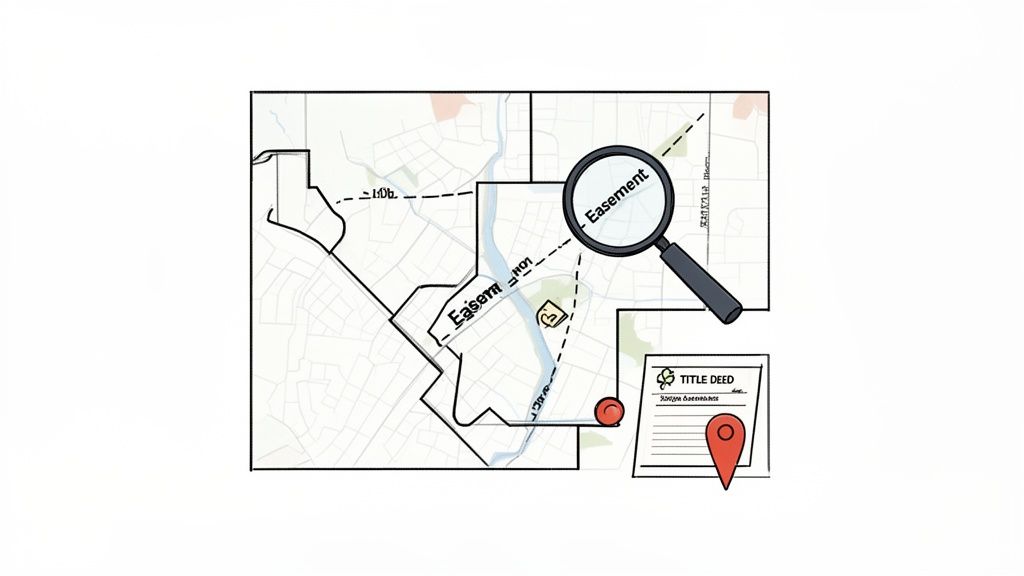
Once the numbers make sense and the building looks solid, you get to the part of the deal where fortunes are truly made or lost. This is the legal deep dive. A missed detail in the title, survey, or zoning can unravel even the most promising investment.
Over decades of deals, especially in complex markets like Los Angeles, I’ve seen firsthand how a single line in a legal document can completely change the value of a property. This isn't just paperwork; it's about protecting your capital and confirming your vision for the asset is even possible.
I always start by engaging a top-tier title company to pull a preliminary title report. This document is the property’s legal biography. My job is to read it, cover to cover.
Uncovering Hidden Claims on Your Property
The title report shows you who has a legal claim to the property. You’re hoping for a “clean” title, but that’s rarely the case. More often, you’ll find issues that need to be resolved before you can close.
My team and I scrutinize the report for any encumbrances that could sabotage our plans.
These are the usual suspects:
Liens: Legal claims for unpaid debts. This could be a mechanic’s lien from an unpaid contractor or a tax lien from the government. These must be cleared before the title can transfer to you.
Easements: This gives someone else the right to use a portion of your land. A utility easement is common, but a private access easement giving a neighbor the right to drive across your lot could be a major headache.
Covenants, Conditions, and Restrictions (CC&Rs): These are rules that dictate how you can use the property. They might limit building height, what kind of signs you can put up, or even the type of business you can run.
I once reviewed a title report for a retail property with a restriction preventing the sale of food and beverages. This was an absolute deal-breaker for my intended tenant, a new coffee shop. Finding that detail early saved us from a six-figure mistake.
Ignoring these exceptions is a rookie move. You have to understand what rights you are—and are not—acquiring.
Interpreting the ALTA Survey
While the title report covers legal claims, the ALTA/NSPS Land Title Survey shows you where everything is physically located. This detailed map, prepared by a licensed surveyor, is one of the most critical documents in the entire due diligence file.
I use the survey to spot issues a simple property tour would never catch. I’m looking for boundary discrepancies, where the legal description doesn’t quite match the fences on the ground. I’m also hunting for encroachments—like a neighbor’s garage that was built a few feet over the property line by mistake.
Most importantly, the survey confirms legal access. Does the property actually touch a public road, or are you relying on a thin strip of land you don't own? Without clear, deeded access, your property could be landlocked and practically worthless.
Mastering Zoning and Entitlements
The final piece of the legal puzzle is zoning and entitlements. This is where you confirm what you can legally do with the property you’re buying.
In a city like Los Angeles, the zoning code is a dense web of regulations that dictates everything from permitted uses to parking requirements. My process involves going directly to the local planning department to verify several key points:
Current Zoning: What is the property’s official designation (e.g., C-2, M-1)?
Permitted Uses: Does that zoning allow for your business plan? Never assume.
Overlays or Special Districts: Are there extra rules, like a historic preservation overlay or a specific plan, that add another layer of restrictions?
Building Code Compliance: Is the building up to code? This includes critical and costly items like seismic retrofitting and accessibility laws like the Americans with Disabilities Act (ADA).
This is also where I assess the potential for future development. Understanding the entitlement process—what it would take to get approvals for a new project—is how you uncover a property’s hidden value.
Getting this part wrong is a catastrophic error. This meticulous legal review is the final safeguard before committing my capital.
Beyond the Four Walls: Tech and ESG Diligence
Due diligence used to be about financials, physical inspections, and title reports. That's table stakes now. To find real value and avoid future liabilities, I’ve learned you have to dig deeper into two areas that many investors still overlook: technology and ESG.
These aren't just buzzwords. They represent a fundamental shift in what makes a commercial property valuable. A building that looks perfect on a spreadsheet can quickly become a money pit if its digital infrastructure is outdated or it fails to meet modern environmental standards.
Auditing the Building’s Tech Stack
I now inspect a property’s tech backbone with the same scrutiny I apply to its roof or HVAC system. Is the building future-proof, or am I buying an expensive, mandatory upgrade project?
I focus on a few critical questions:
Connectivity and Bandwidth: What kind of internet is wired to the building? Is there fiber? I have my team verify carrier contracts and even run speed tests. Slow internet is a deal-breaker for today's tenants.
Smart Building Systems: Are there integrated controls for HVAC, lighting, and security? These aren't just gadgets; they are powerful tools for cutting operating expenses through automation and smart data.
Tenant-Facing Apps: Can tenants book amenities, manage guests, or log maintenance requests from their phones? In a competitive leasing market, this kind of convenience is a major differentiator.
A technologically sound building is simply worth more. It's more efficient to manage, less costly to run, and far more attractive to the high-quality tenants you want to attract and keep. If you want to go deeper, I’ve written about how AI and technology are rewriting real estate. This isn't just a trend; it's a new fundamental.
The Growing Importance of ESG
Just as vital as a building’s tech is its Environmental, Social, and Governance (ESG) profile. What was once a niche concern for a few institutional funds is now a primary factor for tenants, lenders, and investors alike.
Ignoring ESG is a real risk. This goes far beyond just getting a basic Phase I environmental report. I'm looking for proactive management and a forward-thinking approach that signals a healthy, durable asset.
As an expert, I can tell you due diligence is evolving. We're seeing a surge in proptech for everything from leasing to asset management. But the big shift is ESG. It’s no longer optional—‘green’ properties are now commanding 10-15% rental premiums, according to recent studies. For any investor, especially in a market like Los Angeles, verifying ESG compliance isn't just good practice; it's essential for avoiding future liabilities.
This kind of diligence—blending financials with tech and ESG—doesn't just protect you from risk. It’s what uncovers the deals with real, sustainable upside.
My team looks for clear indicators of a strong ESG position:
Certifications: Does the property have certifications like LEED, BREEAM, or ENERGY STAR? These are third-party stamps of approval that top-tier tenants actively seek out.
'Green Leases': I review leases for clauses that promote sustainability, like requiring tenants to meet specific energy efficiency targets. This shows a shared commitment to long-term operational excellence.
Community Impact: How does the building fit into its neighborhood? Things like public green spaces, local hiring practices, or hosting community events add social value and strengthen the property's brand.
By weaving tech and ESG audits into my standard due diligence, I get a much sharper picture of a property's true potential and its hidden risks. It’s how I find assets that aren't just profitable today, but are built to perform for years to come.
After decades of navigating commercial real estate deals, I’ve found the same questions about due diligence come up again and again. It doesn’t matter if you’re a seasoned pro or just getting into the game—the core concerns are almost always the same.
Here are my direct answers, based on what I’ve learned from countless deals on the ground.
How Long Should Due Diligence Take and What's a Realistic Budget?
This is the classic "it depends" question, but I can give you some solid guideposts from my own experience. I almost always negotiate for a 30 to 60-day due diligence period in the purchase agreement. That’s the industry standard for a reason.
But the asset itself dictates everything. A straightforward, single-tenant property with a new building might be done in 30 days. On the other hand, a large, multi-tenant retail center with a lot of deferred maintenance—or a complex redevelopment play in a city like Los Angeles—could easily demand 90 days or more.
Never let a seller rush you on a complicated asset. The timeline needs to fit the property, not the other way around.
As for costs, I tell investors to budget between 0.5% and 1% of the purchase price. It’s not a perfect science, but it’s a reliable benchmark that has held true for me over the years.
On a smaller deal, that might work out to $15,000 to $25,000 for essential reports, legal fees, and other consultant costs.
For a large, institutional-grade asset, especially in a heavily regulated market, I’ve seen due diligence costs easily top $100,000.
I never look at this as an expense. It's an investment in risk mitigation. The money spent on thorough due diligence is the smartest capital you can deploy. Cutting corners here is the most expensive mistake you’ll ever make.
What Are the Biggest Red Flags I Should Watch For?
Years in this business give you a certain instinct for what’s wrong with a deal. Some red flags are obvious, but the most dangerous ones are often hiding in plain sight.
Here are a few things that get my immediate attention.
Financial Red Flags
Heavy Tenant Concentration: If one tenant accounts for more than 30-40% of your income, your risk is dangerously focused. You’re one non-renewal away from a major problem.
Spotty Operating History: I see this all the time. Gaps in financial records or a seller’s refusal to provide clean historical data is a huge warning. It almost always means they’re hiding something.
Physical Red Flags
Water Intrusion: Stains on ceiling tiles, a musty smell in the basement, or any sign of moisture is a deal-killer for me until it's fully understood. Water is the enemy of buildings, leading to rot, mold, and serious structural decay.
Major System Age: If the roof, HVAC, and elevators are all nearing the end of their useful life, you aren't buying a building; you're buying a massive capital expense.
Legal & Seller-Related Red Flags
Unpermitted Work: This is a classic problem. An addition or major renovation done without proper permits can create a nightmare of fines, tear-out orders, and title insurance issues.
An Evasive Seller: This is, without a doubt, the single biggest red flag. If a seller withholds documents, makes it difficult to access the property, or tries to rush you, walk away. Transparency isn't a bonus; it’s a requirement.
Who Should Be on My Due Diligence Team?
You can’t do this alone. Assembling the right team is the single most important part of the process. Their expertise is your insurance policy against a catastrophic error.
My core team for any serious due diligence investigation is non-negotiable.
An Expert Real Estate Attorney: Not a generalist. You need a lawyer who lives and breathes CRE purchase agreements, title, and zoning. Their only job is to protect you.
A Sharp CPA or Financial Analyst: This is the person who tears apart the numbers. They verify the income, build a real-world pro-forma, and confirm the deal is what the seller claims it is.
A Trusted Commercial Broker: A good broker provides the market context. They have the deep local knowledge to tell you if the comps are real, if the trends support the investment, and if the deal truly makes sense.
Key Third-Party Consultants: These are your on-the-ground inspectors. For me, this always includes firms for the Property Condition Assessment (PCA), the Phase I Environmental Site Assessment (ESA), and the ALTA Survey.
On specialized assets, I’ll expand the team. If I’m eyeing a property with development potential in a place like Los Angeles, a local land use attorney is the first person I call. If the roof looks questionable, I bring in a dedicated roofing consultant.
Your team is your shield. Never go into a deal without it.
At Richard Maize, my goal is to share the practical knowledge gained from decades of hands-on experience in real estate and business. To explore more insights on investing, entrepreneurship, and value creation, visit https://richardmaize.com.
Comments