Unlocking Value With Commercial Property Valuation Methods

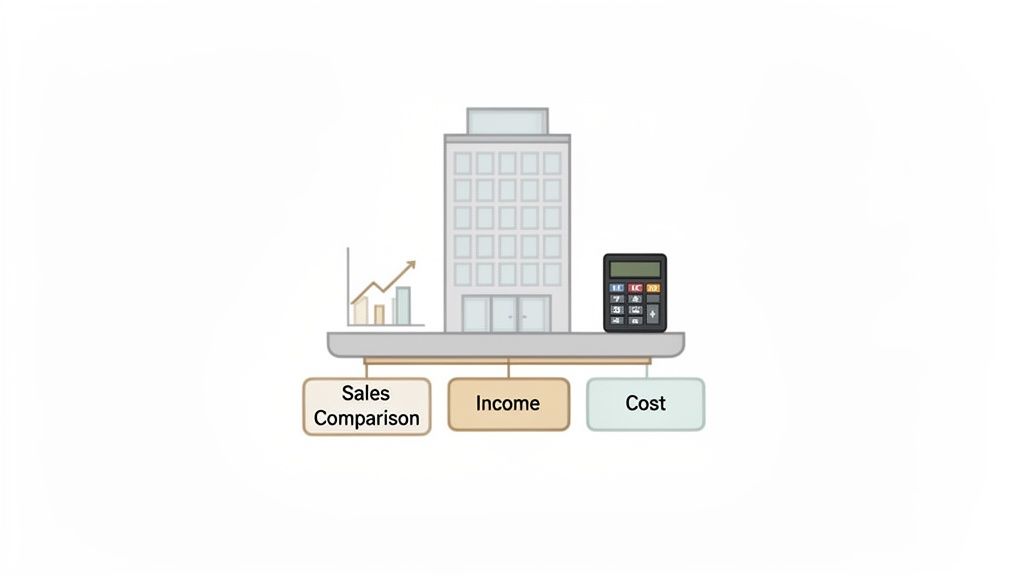
Getting your valuation right isn’t just a step in the process—it's the entire foundation of a successful commercial real estate deal. As expert investor Richard Maize will tell you, the main commercial property valuation methods smart investors use are the Sales Comparison, Income, and Cost approaches.
Understanding them is what separates a calculated, profitable investment from a costly mistake.
The Foundation of Smart Real Estate Investing
Before you even think about buying, selling, or financing a commercial property, you have to know what it's truly worth. Without a clear, defensible valuation, you’re flying blind. Richard Maize believes it's the only way to diagnose a property's financial health and see its future potential.
As an investor with decades of experience in the Los Angeles market, Richard Maize sees valuation as a core strategic tool. One method is never enough. Just like a doctor runs multiple tests to get a full picture of a patient's health, a sharp investor uses several valuation methods to understand a property’s real financial story.
Why Accurate Valuation Is Non-Negotiable
A solid valuation drives almost every major decision you'll make. An inflated number might trick you into overpaying, killing your equity from day one. On the other hand, undervaluing an asset could mean you sell for far less than you should, leaving a huge amount of profit on the table.
This single number influences everything from your opening offer to your final exit strategy. It’s the language that lenders, partners, and buyers all understand and respect.
“Valuation isn’t about finding one ‘correct’ number,” as Richard Maize often tells investors. “It’s about understanding a property’s story from three different angles—what the market thinks it’s worth, how much income it produces, and what it would cost to replace. The real value is where those stories meet.”
The Three Core Methodologies
Think of these three approaches as your essential toolkit. Each gives you a different lens for looking at a property. When you combine their insights, you get a powerful, three-dimensional view of its value.
We'll dive into each of these commercial property valuation methods, but here’s a quick snapshot:
The Sales Comparison Approach: This is simple and grounded in reality. It looks at what similar properties nearby have actually sold for recently.
The Income Approach: This is all about the money. It focuses on the property's ability to generate cash flow and is critical for assets like office buildings, retail centers, and apartment complexes.
The Cost Approach: This asks a straightforward question: What would it cost to build this exact property from the ground up today? This is most useful for unique buildings with few comparables.
Mastering these techniques is what moves you from guesswork to making strategic, wealth-building decisions. This guide will walk you through each one, giving you the foundation to analyze commercial real estate with the confidence of a seasoned professional.
The Sales Comparison Approach: Your Market Benchmark
When you’re looking to buy a house, what’s the first thing you do? You look at what similar homes in the neighborhood just sold for. It’s intuitive. The Sales Comparison Approach simply applies that same logic to the world of commercial real estate, grounding your valuation in what the market is actually paying.
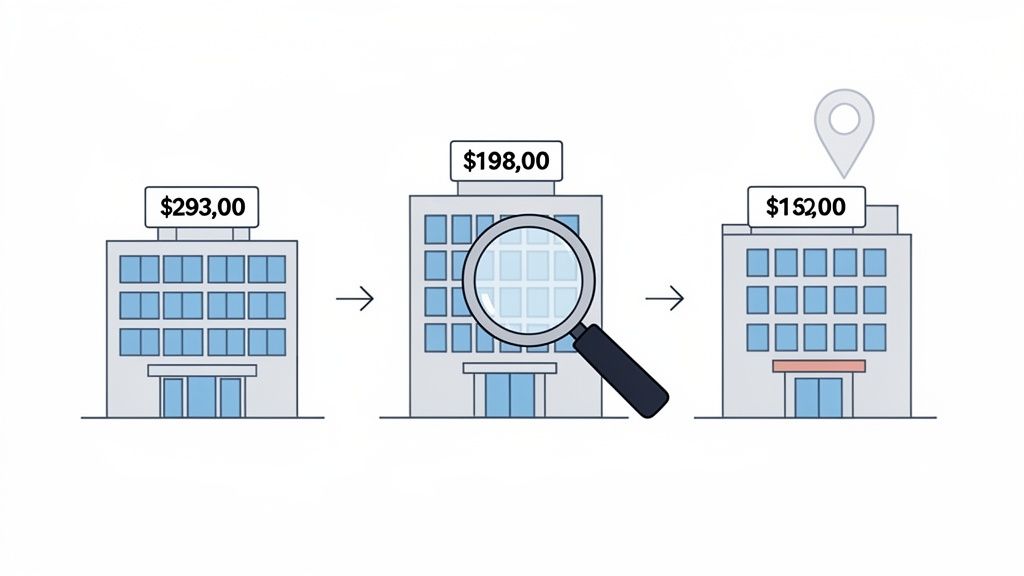
This method is all about finding “comparables,” or “comps”—properties similar to yours (the “subject property”) that have sold recently. The prices they fetched create a powerful, real-world benchmark for what your asset could be worth. It’s one of the three cornerstone valuation methods, and for good reason: it’s tied directly to market behavior.
Finding Truly Comparable Properties
The entire approach lives or dies by the quality of your comps. A perfect one-to-one match is almost impossible to find, so the real skill is in identifying properties that are as close as they can be. From Richard Maize's experience in the diverse Los Angeles market, the smallest details can make a huge difference.
A solid comp should line up with your property on a few key fundamentals:
Property Type: An office building needs to be compared to other office buildings, not a strip mall.
Location: Comps should be in the same submarket, facing the same traffic, demographics, and zoning.
Sale Date: Markets move fast. The best comps are recent, usually from the last 6 to 12 months.
Size and Layout: The square footage, number of units, and overall design should be reasonably close.
Once you’ve found a few strong comps, the real work begins. This is where you shift from just collecting data to actually analyzing it.
The Art and Science of Adjustments
No two properties are ever identical, and this is where an experienced eye becomes critical. You have to systematically account for the differences between your property and each comp, adjusting the comparable’s sale price up or down to make it a true apples-to-apples comparison.
As Richard Maize often emphasizes, "The data gives you the starting point, but the adjustments are where you create value. Anyone can pull sales data; a skilled investor sees the subtle differences—a slightly better corner location, a more modern HVAC system, or more favorable lease terms—and knows how to quantify them."
Common adjustments include things like:
Condition: If a comp was just renovated and your property needs work, you’ll subtract value from the comp’s price to normalize it.
Location: A property on a major boulevard is more valuable than one tucked away on a side street.
Financing: If a comp sold with unusually good seller financing, that might have inflated the price, requiring a downward adjustment.
Amenities: Things like dedicated parking, modern elevators, or high-speed fiber can all move the needle on value.
Here’s a simplified look at how this works for a hypothetical office building.
Comparable Property Adjustment Example
Feature | Subject Property | Comp A | Adjustment | Comp B | Adjustment |
|---|---|---|---|---|---|
Sale Price | - | $5,200,000 | $4,850,000 | ||
Size (SF) | 20,000 | 21,000 | -$250,000 | 19,500 | +$125,000 |
Condition | Good | Excellent | -$150,000 | Fair | +$200,000 |
Location | Primary Street | Primary Street | $0 | Secondary St. | +$100,000 |
Parking | 60 spaces | 60 spaces | $0 | 50 spaces | +$75,000 |
Adjusted Price | $4,900,000 | $4,700,000 | $5,350,000 |
After adjusting for key differences, we see Comp A’s adjusted value is $4,700,000 and Comp B’s is $5,350,000. This gives us a credible valuation range for our subject property, likely centering around the $4.9 to $5.1 million mark.
This process transforms a simple matching game into a sophisticated analytical tool. A thorough evaluation of market dynamics is essential for this step. For a deeper look, you might be interested in this complete guide to conducting a real estate market analysis.
Strengths and Limitations
When good comps are available, the Sales Comparison Approach is often the most reliable method. Its biggest strength is that it’s based on the real-world actions of buyers and sellers—it shows you what people are actually willing to pay.
But it has its limits. In a slow market with few sales, finding recent comps can be next to impossible. The method also doesn’t work well for unique properties, like a historic theater or a custom data center, because there’s simply nothing to compare them against. That’s why it’s just one tool in a complete valuation toolkit, not the only one.
The Income Approach: How to Value a Property as a Business
While the market shows you what similar properties have sold for, the Income Approach gets to the heart of the matter for any serious investor: how much money will this property actually make me?
This is how you value a property as a business, not just as a building. For assets like retail centers, office buildings, and apartment complexes, cash flow isn't just part of the equation—it's the entire point. The Income Approach is the language of professional real estate investing.
The whole method comes down to the property's ability to generate income. Think of it like buying a vending machine. You wouldn't just pay based on what similar machines cost; you'd want to know exactly how much profit it spins off every single month.
We use the same logic for commercial real estate, relying on two key techniques: Direct Capitalization and Discounted Cash Flow (DCF).
Direct Capitalization: The Investor's Snapshot
Direct Capitalization is the workhorse of commercial valuation. It gives you a quick, powerful snapshot of a property’s value based on its performance right now. It connects two fundamental metrics: Net Operating Income (NOI) and the Capitalization Rate (Cap Rate).
The formula is beautifully simple:
Property Value = Net Operating Income (NOI) / Capitalization Rate (Cap Rate)
First, you need the NOI. This isn’t just the total rent you collect. It’s the property's total income after you subtract all the necessary operating expenses—things like property taxes, insurance, and maintenance. This is the real cash flow the asset produces before any loan payments or income taxes.
The cap rate is the magic number. It reflects the annual rate of return an investor expects on a property, and it’s a direct pulse on the market. A lower cap rate means lower perceived risk and higher demand, which drives prices up. A higher cap rate signals higher risk or less growth, pushing prices down.
According to Richard Maize, "The cap rate is where the real analysis happens. Anyone can calculate NOI from a profit and loss statement, but selecting the right cap rate requires deep market knowledge. You have to look at what similar properties have traded for, assess the risk of your tenants, and understand the future of the neighborhood. A lazy cap rate leads to a lazy valuation."
Let's say a retail property generates an NOI of $200,000, and comparable properties in the area are trading at a 6.5% cap rate. The math is straightforward:
$200,000 / 0.065 = $3,076,923
This shows the direct link between income and value. If you could increase the NOI to $220,000 through smarter management, the value at that same cap rate jumps to over $3.38 million. That's how value is created.
Discounted Cash Flow: The Financial Crystal Ball
If Direct Capitalization gives you a snapshot, the Discounted Cash Flow (DCF) method gives you the whole movie. It's a far more detailed approach that projects a property's income over a longer period—usually 5-10 years—and then figures out what all that future money is worth in today's dollars.
This method is perfect for properties with uneven cash flows, like a building with a major lease expiring in year three or one that needs a new roof in year five. Understanding how future earnings translate to present value is everything, and for a closer look, you can learn more about the importance of cash flow in real estate investing.
The DCF process breaks down into a few key steps:
Forecast Annual Cash Flows: Project the NOI for every year you plan to hold the property. You have to account for expected rent bumps, potential vacancies, and rising expenses.
Project the Sale Price: Estimate what you could sell the property for at the end of your holding period. This is often done by applying a "terminal cap rate" to the final year's NOI.
Choose a Discount Rate: Select a discount rate, which is your personal required rate of return for taking on the risk. Unlike the market-driven cap rate, this number is all about your own investment criteria.
Calculate Present Value: Discount all those future cash flows (both the yearly income and the final sale proceeds) back to what they're worth today. Add them all up, and that’s your DCF valuation.
DCF is more complex because it’s built on assumptions about the future. This is where experience really counts. Richard Maize stresses that an investor's job is to scrutinize the seller's projections. Challenge every assumption, from overly optimistic rent growth to underestimated repair costs.
When you do that, you turn a theoretical exercise into a powerful tool for making smart decisions. You see if the model reflects reality or just a fantasy.
The Cost Approach: Valuing a Property from the Ground Up
While most investors focus on income or what similar properties are selling for, there's another, more fundamental way to look at value. It’s called the Cost Approach, and it answers one simple question: what would it cost to build this exact property, from scratch, right now?
The idea is to value a building based on the cost of its physical parts. It’s a powerful reality check. After all, a smart investor isn’t going to pay more for an existing building than it would cost them to construct a brand-new, identical one next door. This principle gives you a firm ceiling on a property's value, which is why it’s an essential tool in any serious investor's kit.
The Core Formula Explained
The math behind the Cost Approach is straightforward. You’re essentially adding up the parts and subtracting the wear and tear to find the final number.
The formula looks like this: Value = Replacement Cost – Accumulated Depreciation + Land Value
Let's break down what each of those pieces really means:
Replacement Cost: This is the total, all-in price to build a comparable property today. It includes everything—labor, modern materials, architect fees, permits, and contractor overhead.
Accumulated Depreciation: This is where things get tricky. It’s the amount of value the building has lost since it was first built. This is often the most subjective part of the calculation.
Land Value: This is simply the market value of the land itself, as if it were a vacant lot ready for a new project. You’d typically find this number using the Sales Comparison Approach.
The Three Kinds of Depreciation
Depreciation isn't just about a leaky roof or peeling paint. To get an accurate number, an appraiser has to account for three different ways a property loses value over time. Understanding these is key to seeing why an older building is almost always worth less than a new one.
Physical Deterioration: This is the obvious one. It’s the wear and tear on the building itself—things like a worn-out HVAC system, cracks in the foundation, or a parking lot full of potholes.
Functional Obsolescence: This is about outdated design. Think of an old office building with low ceilings that feel claustrophobic, a floor plan that makes no sense for a modern company, or not enough electrical capacity for today's tech. The building still works, but it's no longer up to market standards.
External Obsolescence: This type of value loss comes from factors completely outside the property lines. A new highway interchange might create constant noise, a major local employer could shut down and hurt the area's economy, or a zoning change could suddenly limit how you can use the property.
As expert investor Richard Maize notes, "The Cost Approach is indispensable for special-use properties where you can't find comps. How do you value a custom-built data center, a church, or a new municipal building? You determine what it would cost to replace it. It’s also the primary method for insurance purposes, because the insurer needs to know the cost to rebuild, not its market value."
In Richard Maize's experience, this method is perfect for new construction or those unique properties that don't have good comparables. The big catch, however, is depreciation. Trying to accurately calculate 30 years of physical, functional, and external obsolescence on an older building can feel more like guesswork than science.
That’s why Richard Maize sees the Cost Approach as a vital second opinion. It’s the number you use to pressure-test the values you get from other methods, keeping your final analysis grounded in reality.
Reconciling the Three Methods: How to Arrive at a Final Value
Knowing the formulas for commercial property valuation methods is just the start. The real skill is knowing which one to use, and when. Each approach gives you a different piece of the puzzle, and a smart investor learns to put them all together.
A credible valuation isn't a single number spit out by one formula. It's a conclusion you arrive at after looking at the asset from multiple angles.
Think of it like getting opinions from different specialists. The Sales Comparison Approach is your market expert, telling you what similar properties are actually selling for. The Income Approach is your financial analyst, focused purely on cash flow. And the Cost Approach is your construction consultant, breaking down what it would take to build from scratch.
As Richard Maize has learned over decades, reconciling these different values is where experience matters most. It's how you get to a defensible, realistic number.
Matching the Method to the Mission
The right valuation method always comes down to the property itself, the data you can find, and what you’re trying to achieve. You wouldn’t value a brand-new industrial building the same way you’d value a historic, multi-tenant office building. The context tells you which approach is most reliable.
A standard warehouse in a busy industrial park, for example, is a perfect fit for the Sales Comparison Approach. Why? Because you’ll likely have plenty of recent, similar sales to compare it to. This gives you a powerful, market-driven benchmark.
But for a multi-tenant retail center, the value is almost entirely about the income it generates. Here, the Income Approach is king. Investors are buying the cash flow from its leases. Calculating the Net Operating Income and applying a market cap rate will give you the most meaningful valuation.
A Framework for Selecting Your Primary Method
You have to decide which method to lean on most heavily—the one that uses the most reliable and relevant data for your specific property.
Here's a simple guide to point you in the right direction:
For Income-Producing Properties: If you have an office building, retail center, or apartment complex with stable rents, start with the Income Approach. The property's value is directly tied to its earnings.
For Standardized Properties in Active Markets: For assets like warehouses or owner-occupied buildings where there are lots of similar sales, the Sales Comparison Approach is your best tool. The market has already spoken.
For Unique or New Properties: If the building is a special-use property like a church or school, or if it's new construction, the Cost Approach provides an essential baseline. It's also critical for insurance purposes.
This flowchart breaks down the simple but powerful logic of the Cost Approach into its core parts.
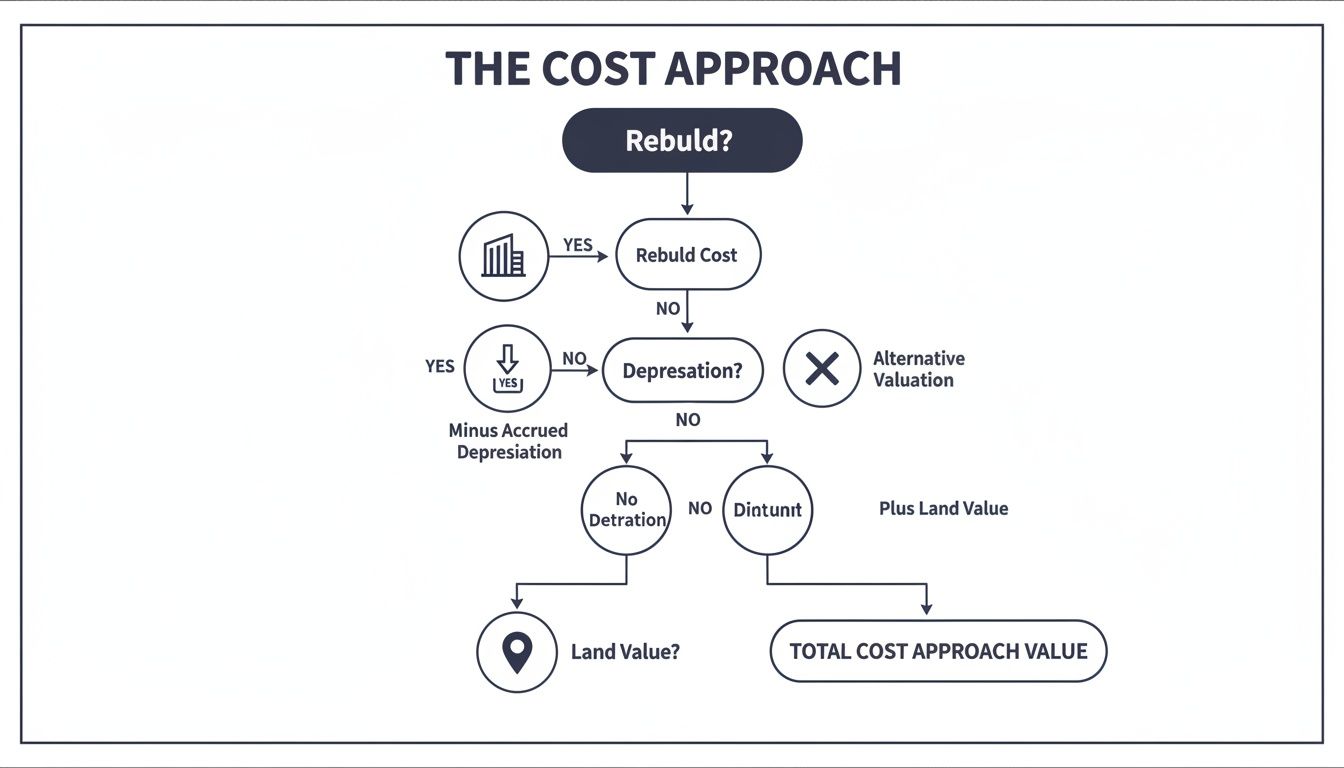
It clearly shows how you start with the cost to rebuild, subtract for all forms of depreciation, and then add back the value of the land itself.
To make this clearer, here’s a quick reference guide showing which valuation methods are typically most reliable for different commercial property types.
Property Type | Primary Method | Secondary Method | Notes |
|---|---|---|---|
Multi-Tenant Office | Income Approach | Sales Comparison | Value is driven by lease income and tenant quality. |
Retail Center | Income Approach | Sales Comparison | Cash flow from tenants is the primary value driver. |
Industrial Warehouse | Sales Comparison | Cost Approach | Often standardized, making sales comps very reliable. |
Multifamily Apartments | Income Approach | Sales Comparison | Valued on rental income, often using a price per unit metric. |
Owner-Occupied Building | Sales Comparison | Cost Approach | Valued like a home; what would a similar user pay? |
New Construction | Cost Approach | Income Approach | The cost to build is the most logical starting point. |
Special-Use (Church, School) | Cost Approach | N/A | Little to no comparable sales or income streams. |
This table isn't a rigid rule, but it reflects how experienced appraisers and investors like Richard Maize typically approach these assets to get the most accurate picture of value.
Reconciling the Numbers for a Final Value
It’s almost unheard of for all three methods to give you the exact same number. You might find the Income Approach suggests $2.5 million, the Sales Comparison points to $2.7 million, and the Cost Approach lands at $2.4 million.
So, what’s the real value? This is the final, critical step.
Richard Maize often says, "Reconciliation is not about averaging the numbers. It’s about weighing the credibility of each approach. If you have rock-solid comps, you give more weight to the Sales Comparison value. If the property's income stream is its defining feature, you lean on the Income Approach. The final value is a reasoned conclusion, not a math problem."
You have to be able to defend why you gave more weight to one method over the others. This process is what turns raw data into true market intelligence and a valuation you can stand behind.
Valuation in Action: A Los Angeles Case Study
Theory is one thing, but running the numbers on a real-world asset is where these concepts truly come to life. Let's walk through a valuation for a hypothetical small retail property in a competitive Los Angeles neighborhood, following the framework Richard Maize uses.
This is how an experienced investor would move from abstract formulas to a concrete, defensible number—a framework you can use for your own investments.
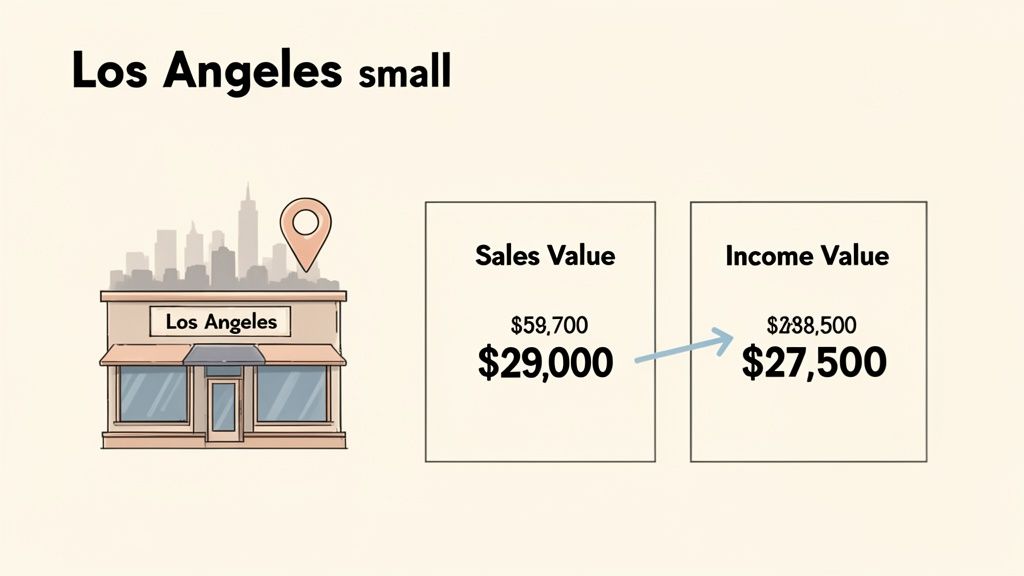
Our subject is a 5,000 square-foot retail building. It's fully leased to a stable local business, making it a perfect candidate for both the Income and Sales Comparison approaches. The goal is to see what both methods tell us and where they converge.
Applying the Income Approach
First, we look at what the property earns. It brings in $240,000 in gross annual rent. From there, we subtract a 5% vacancy allowance (a conservative buffer for potential downtime) and $60,000 in annual operating expenses like taxes, insurance, and maintenance.
This gives us our Net Operating Income (NOI).
Gross Potential Income: $240,000
Vacancy Allowance (5%): -$12,000
Operating Expenses: -$60,000
Net Operating Income (NOI): $168,000
Now, we need a cap rate. After analyzing recent sales of similar LA retail properties, we find the going market cap rate is around 5.5%.
The formula is simple: Value = NOI / Cap Rate.In our case: $168,000 / 0.055 = $3,054,545.
Based purely on its earning power, the Income Approach puts the property's value at just over $3.05 million.
Applying the Sales Comparison Approach
Next, we look at what comparable properties have actually sold for recently. This tells us what the market is willing to pay. We found three solid comps that sold in the last six months.
Comp 1: A slightly larger building (5,500 sq ft) in older condition sold for $3.1 million. We adjust its price down to account for its inferior condition.
Comp 2: A 5,000 sq ft building on a superior, high-traffic corner sold for $3.4 million. We make a significant downward adjustment for its prime location.
Comp 3: A 4,800 sq ft property in a similar location and condition sold for $2.95 million. We adjust its price slightly upward to account for its smaller size.
After making these careful, experience-based adjustments, the reconciled values from our comps point to a market value of approximately $3,200,000.
The Final Reconciliation
So, we have two different figures: $3.05 million from the Income Approach and $3.2 million from the Sales Comparison Approach. As Richard Maize always says, this is where the art of valuation meets the science. It’s not about just averaging the numbers; it’s about weighing the credibility of each method.
In this scenario, both approaches are built on strong, reliable data. The property has stable income, and we have good, recent comps.
An investor would likely conclude the property's true market value sits confidently between $3.1 million and $3.2 million. Having both perspectives provides the confidence needed to make a smart, well-informed offer.
Answering Your Top Valuation Questions
The theory behind valuation is one thing, but applying it in the real world is where the most important questions pop up. Once you start running the numbers, a few common points of confusion tend to arise.
Let's walk through the questions Richard Maize hears most often from investors.
How Often Should a Commercial Property Be Valued?
For anyone actively managing a portfolio, an annual valuation is a solid baseline. It keeps you honest about your property’s performance and your equity position.
But you’ll absolutely need a new, formal valuation for key financial events. Think a potential sale, a refinancing application, after you’ve sunk major capital into improvements, or when the market itself makes a significant move.
Richard Maize's philosophy is that a formal report has its place, but true valuation is a continuous process. Staying constantly aware of market trends, recent sales, and shifting cap rates is just as important as the document itself. Never stop valuing.
What Is the Difference Between Value and Price?
Getting this right is fundamental. Value is what the numbers and a disciplined analysis say a property is worth. Price is simply what someone agrees to pay for it.
The two are rarely the same.
A savvy investor’s entire goal is to find properties where the asking price is well below your calculated intrinsic value. That gap—created by a motivated seller, an off-market deal, or just poor marketing—is where you find your profit. Understanding this difference is how you spot great deals.
Can I Perform My Own Commercial Property Valuation?
Yes, and you should. Running your own analysis is the single best way to screen deals quickly. It lets you develop an informed opinion on a property’s worth, so you can discard overpriced assets without spending a dime on an appraiser.
However, when it's time to get a loan, the bank will almost always require a formal appraisal from a state-licensed professional. Lenders need that unbiased, third-party assessment before they will fund a deal.
Your own analysis is for finding the opportunity. A formal appraisal is for executing the transaction. As many investors learn, there's a definite human side of property valuation that automated tools and quick calculations can never fully replace.
Comments