Business Diversification Strategies: A Practical Guide

A young Richard Maize built his first major diversification move from rental properties, not from a collection of unrelated ideas. Before turning thirty, he had assembled approximately one thousand rental apartment units, then used his real-estate knowledge to build a mortgage-banking firm before eventually liquidating it and redirecting his experience into other ventures.
That sequence captures the central truth behind effective business diversification strategies. Expansion works when a company carries useful capabilities into a new opportunity, but it becomes dangerous when variety replaces discipline.
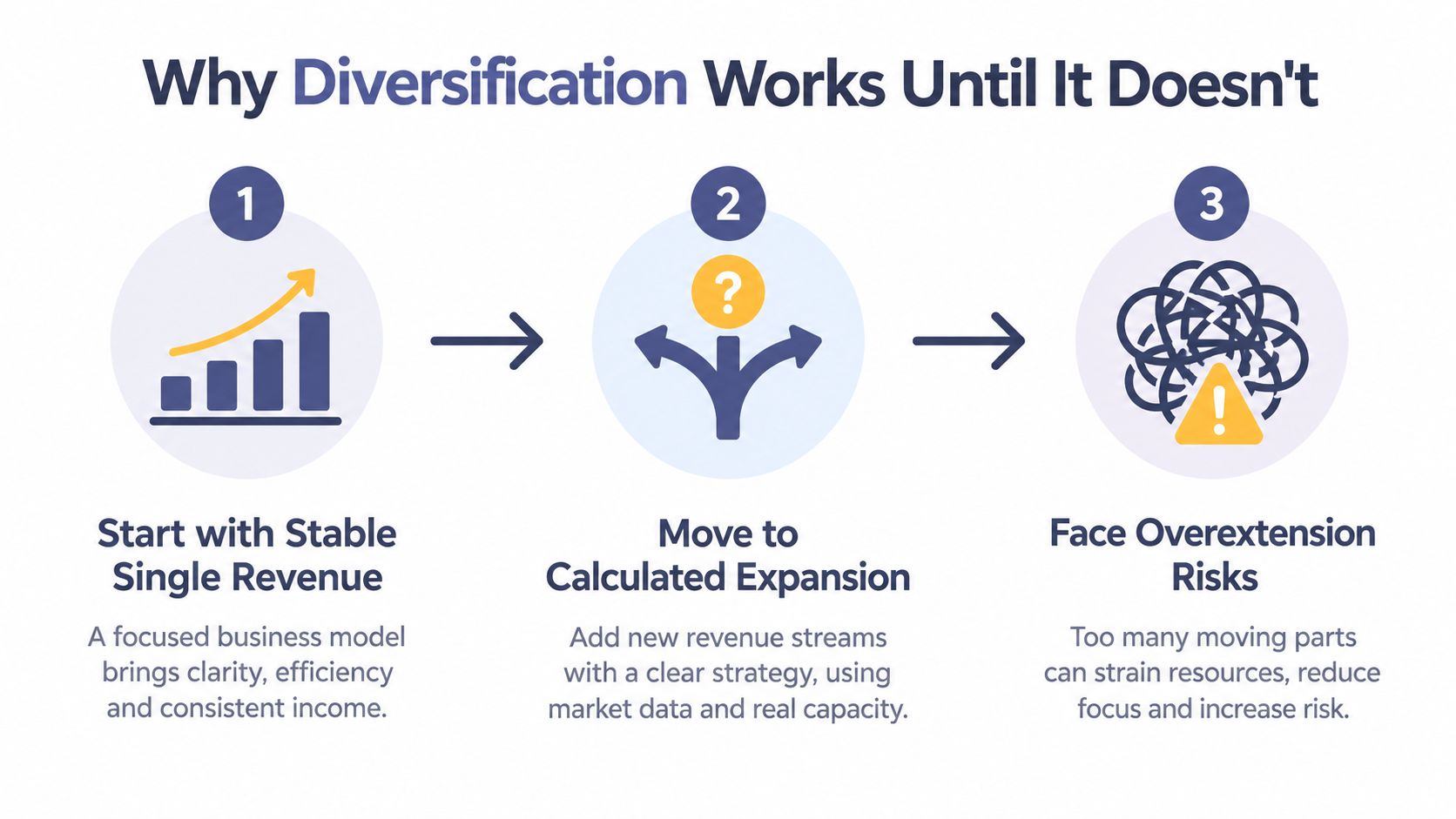
Why Diversification Works Until It Doesn't
Diversification is often explained with a simple image, spread your bets so one loss won't damage the whole business. That logic makes sense when a company depends on one customer group, one product, one geography, or one economic cycle. It becomes much less convincing when management adds businesses that require different expertise, different systems, and different leadership attention.
Corporate history shows how quickly enthusiasm can turn into complexity. After World War II, diversification became a defining strategy for large companies in the United States. Richard Rumelt's landmark comparison of Fortune 500 companies found that firms classified as diversified rose from approximately 30% in 1949 to 63% in 1974, while single-business or dominant-business companies declined from about 70% to 37%, according to this review of corporate diversification research.
The rationale was practical. Companies wanted to spread exposure across industries, transfer management expertise, use excess capital, and share distribution or brand assets. Conglomerates seemed capable of surviving a downturn in one market because another business could keep producing cash.
The historical warning
The trend eventually reversed. A review of corporate-diversification research shows that roughly 60% of publicly traded firms operated in at least two industries in 1979, but the share declined to about 44% by 1988. By 1994, approximately 60% of a sample exceeding nine hundred listed companies had become single-business firms, a substantial shift toward focus.
That change doesn't prove that diversification is bad. It shows that diversification isn't automatically valuable. A portfolio of businesses has to create an advantage that each business couldn't achieve alone. If the parent company merely owns unrelated assets, the corporate structure may add meetings, reporting requirements, competing priorities, and hidden overhead without improving customer value.
Richard Maize's career illustrates a more deliberate pattern. His early expansion moved from income-producing residential property into mortgage banking, a field connected to real-estate transactions, financing, and relationships. He later liquidated the mortgage company rather than treating ownership as permanent. That ability to build, operate, exit, and redeploy capital matters as much as the initial decision to expand.
Practical rule: Don't ask whether a new business looks attractive on its own. Ask whether your existing business gives you an advantage in operating it.
The same principle applies to entrepreneurs who combine property, consumer products, media, entertainment, or philanthropy. Variety can create useful resilience, but it can also hide a common dependency. Several businesses may still rely on the same personal reputation, financing conditions, local economy, or management team.
A focused company can outperform a diversified one when its leadership concentrates resources on a strong market position. Diversification earns its place only when it improves the quality of the whole portfolio, not merely the number of businesses listed on a website.
For a broader perspective on handling uncertainty without reacting impulsively, see this discussion of why market volatility isn't automatically a crisis.
Understanding Diversification Through Richard Maize's Lens
Richard Maize's portfolio is useful because it shows that related diversification doesn't require every venture to sell the same product. The connection can come from customers, operating knowledge, deal relationships, promotion, capital allocation, or management systems.
Ansoff's framework remains a helpful starting point. It separates growth into four broad choices:
Market penetration: Sell more of an existing offering to current customers.
Market development: Take an existing offering to a new customer group or geography.
Product development: Create a new offering for customers you already understand.
Diversification: Enter a new product and a new market, which carries the greatest uncertainty.
The framework doesn't make the decision for you. It forces you to identify what is changing. A new service sold to established customers is not the same risk as an acquisition in an unfamiliar industry.
Run a relatedness audit
Before committing capital, map the proposed venture against the assets you already control. Score each connection for transferability, uniqueness, and cost to replicate.
A useful audit asks:
Do existing customers have a credible reason to buy the new offering?
Can the current sales or distribution network reach them?
Which operating capabilities transfer directly?
Does the brand strengthen the new venture, or create confusion?
Can suppliers, data, technology, or facilities serve both businesses?
Does the leadership team have enough attention to manage the added complexity?
Richard Maize's early real-estate diversification began at substantial scale. He built a portfolio of approximately one thousand rental apartment units before turning thirty, then founded and developed a highly successful mortgage-banking firm before liquidating it and redirecting his entrepreneurial experience into other ventures, as described by the Rochelle and Richard Maize Foundation.
The logic is clear. Property ownership gave him knowledge of transactions, financing, asset values, and real-estate relationships. Mortgage banking was a different operating business, but it wasn't a random leap into an unfamiliar world.
His later interests became broader. His portfolio profiles describe properties in more than twenty states, a food-truck venture, a public-relations agency, and a K-Pop festival. Those businesses don't share the same physical assets, yet they can draw on related skills in promotion, partnerships, consumer positioning, event execution, and relationship management. His profile also identifies an investment in Richeeze Melts, a food-truck business, showing how consumer ventures can sit alongside property and finance interests.
The evidence supports a related-first approach. A meta-analysis covering 462 primary studies across 40 countries found that related diversification generally improves performance. A second review found an inverted-U pattern, with moderate diversification tending to outperform both narrow focus and excessive expansion, while unrelated diversification has historically produced weaker outcomes. The Academy of Management research supports a conditional conclusion, not a universal one.
Use the audit to decide whether an opportunity has a real connection or only a compelling story. Then test it with a limited investment gate before treating it as a permanent part of the portfolio.
For a visual explanation of strategic planning and opportunity selection, use the following resource after reviewing the audit questions above.
Evaluating Your Next Strategic Move
A new venture should pass a financial and operational test before it receives serious capital. The first question isn't, “Could this work?” Almost any opportunity could work under ideal conditions. Ask instead, which risk does this move reduce, and what new risk does it introduce?
You may be trying to reduce dependence on one customer, one region, seasonal demand, a particular supplier, or one regulatory environment. You may also be trying to create a new growth path because the core business has limited room to expand. State the purpose in one sentence. If the purpose is unclear, the investment case will become emotional.
Start with the exposure
Write down the current concentration. Then compare the proposed venture with the core business across five dimensions:
Customer exposure: Does the new venture reach different buyers, or does it sell to the same customers under another name?
Cash-flow timing: Will revenue arrive before expenses, or will the business consume cash for an extended period?
Capital intensity: Does the move require property, inventory, equipment, licensing, or specialist hires?
Economic correlation: Would the same recession, interest-rate change, or local slowdown damage both businesses?
Management load: Who owns the day-to-day decisions, and what responsibilities will that person stop performing?
A related venture can still increase risk if it depends on the same economic shock. Two businesses serving different customers may both require expensive real estate. Two companies in different industries may both depend on the founder's public profile. A new revenue stream is only independent if its customers, cash flows, and operating requirements differ in meaningful ways.
Quantify before you authorize
Build a simple synergy case. Estimate incremental revenue from shared customers, savings from shared infrastructure, and the one-time cost of integration. Then compare the proposed unit economics with the core business.
Use staged gates rather than one large approval:
Concept gate: Define the customer, offer, risk being reduced, and capability being reused.
Pilot gate: Test demand with a limited launch, preorder, partnership, or small operating commitment.
Economics gate: Compare contribution margin, cash conversion, customer acquisition effort, and service quality with the core.
Scale gate: Expand only if the pilot confirms the assumptions.
Exit gate: Stop, redesign, or sell if pre-agreed thresholds aren't met.
Richard Maize's move from real estate into mortgage banking demonstrates why capability transfer matters. His knowledge of property transactions and financing created a practical foundation. A food-truck venture or entertainment festival requires a different operating model, but promotional, partnership, and event-management capabilities may still transfer.
The strongest diversification case connects a specific existing capability to a specific new customer need.
Don't treat strategic similarity as proof of value. A related market can destroy value if your company lacks distribution capacity, governance controls, or leadership bandwidth. For acquisition decisions, apply the same discipline described in Richard Maize's insights on what to look for when acquiring a new company.
Choosing Low-Capital Versus High-Capital Expansion Paths
Capital constraints change the right answer. A large company may acquire a competitor, build a new facility, or hire a specialist team. A small business may need to validate demand before it can justify a single full-time hire. Treating those situations as identical leads owners toward commitments they can't comfortably reverse.
A capital-light move limits fixed costs while testing whether customers will pay. A capital-heavy move may create stronger control and a larger long-term asset, but it also increases the cost of being wrong.
The constraint is widespread. In a 2025 Goldman Sachs survey, 81% of owners who had sought a loan or credit line found affordable capital difficult to obtain, 49% said this forced them to halt expansion, and 41% said it limited their ability to take on new business, according to the Goldman Sachs small-business survey.
Compare the paths honestly
Expansion path | What it preserves | What it risks |
|---|---|---|
Preorders or paid pilots | Cash and customer feedback | Limited capacity and delivery pressure |
Licensing | Speed and lower operating overhead | Less control over execution and brand use |
Strategic partnerships | Access to distribution and expertise | Dependence on another operator |
Shared distribution | Existing logistics and customer reach | Margin sharing and coordination |
Minority investment | Exposure without full operating responsibility | Limited control over decisions |
Digital products | Low incremental delivery cost | Demand may be unproven and crowded |
Acquisition or owned infrastructure | Greater control and asset ownership | Integration costs, financing exposure, and fixed overhead |
Richard Maize's career contains both ends of this spectrum. Building a substantial residential portfolio and operating a mortgage-banking company required serious capital and operational capability. Later, profiles describe him as a partner in a distressed-assets company and an online public-relations firm. Those moves relied more heavily on investment judgment, operating experience, relationships, and digital promotion than on building every asset from scratch. The professional profile describing Richard Maize's finance and public-relations ventures provides that sequence.
Set a failure budget
Before a pilot begins, decide how much money, time, and management attention you can lose without weakening the core business. This is your failure budget. It should include more than the initial investment.
Account for:
Compliance: Licenses, permits, certifications, insurance, contracts, and sector-specific obligations.
Cash conversion: The time between paying suppliers, delivering the product, receiving customer payment, and recovering the original investment.
Reputation: The effect of poor execution on your established brand.
People: The cost of specialist support and the leadership time required to supervise it.
Exit: The expense of closing, selling, returning inventory, or unwinding a partnership.
The best first diversification may not be a new industry. It could be a new customer segment, a different pricing model, a distribution partnership, or a digital version of an existing service. Those moves reuse capabilities while limiting irreversible commitments.
A low-capital test isn't timid. It gives management evidence before management accepts permanent complexity. If the test succeeds, you can then choose whether ownership, acquisition, or infrastructure investment is justified.
Managing Multiple Ventures Like a Portfolio
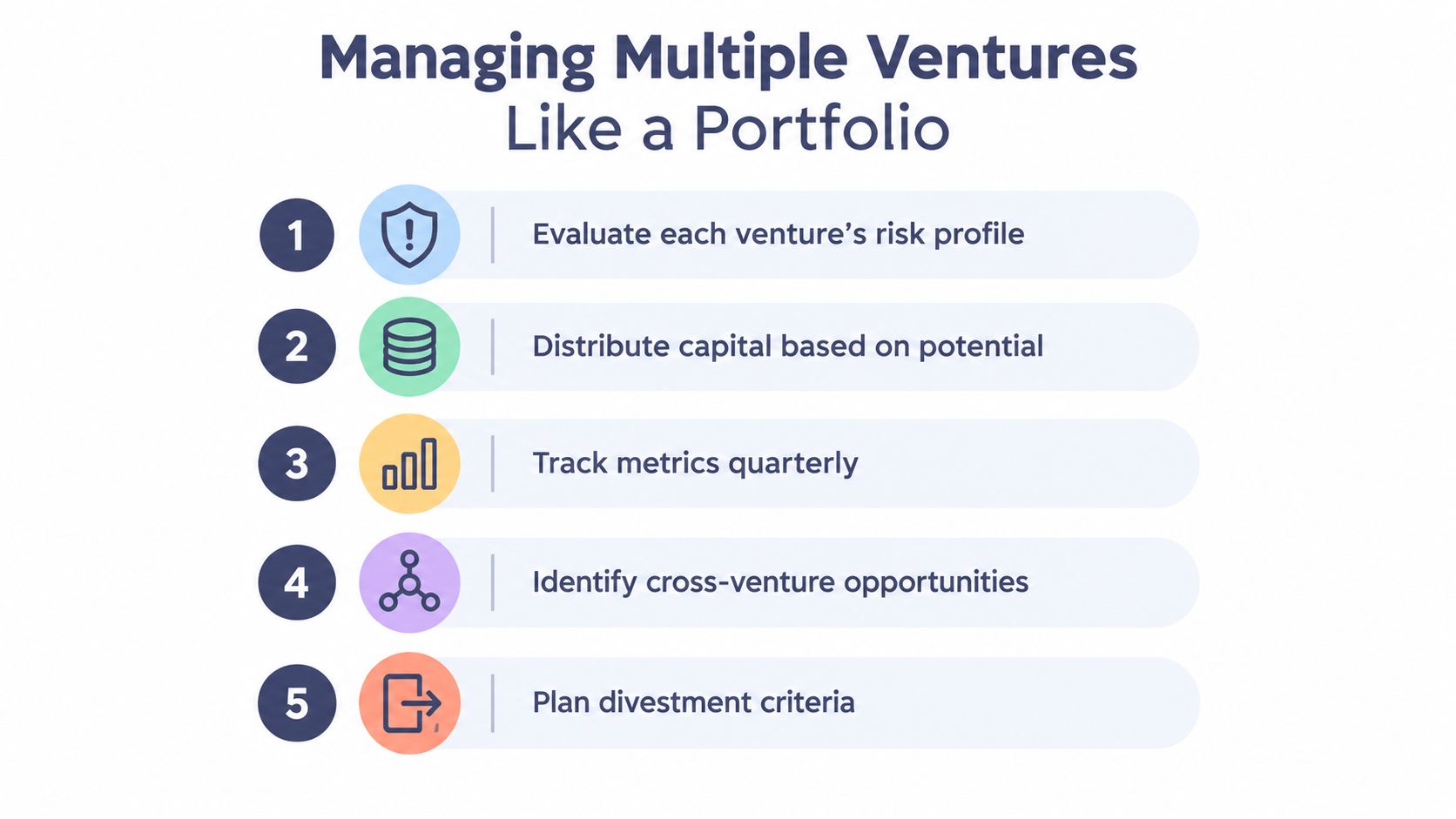
Once a company owns several ventures, the management problem changes. The question is no longer whether one opportunity looks attractive. The question becomes how each venture contributes to the risk, cash flow, attention, and strategic resilience of the whole portfolio.
Richard Maize's interests span property, food service, public relations, and entertainment. Profiles describe properties in more than twenty states alongside a food-truck business, a public-relations agency, and a K-Pop festival. That variety creates opportunity, but it can also create false comfort. Businesses that look unrelated may still depend on the same financing environment, local consumer demand, or personal brand.
Build a dashboard that exposes weak links
Independent segment reporting prevents a weak venture from hiding inside consolidated results. Track each business separately, then examine how the businesses interact.
A useful quarterly dashboard includes:
Segment ROIC: Is the venture earning an appropriate return on the capital it consumes?
Organic growth: Is performance coming from real customer demand or one-time transactions?
Customer retention: Are customers returning, renewing, or increasing their purchases?
Working-capital intensity: How much cash remains tied up in inventory, receivables, or operating commitments?
Synergy variance: Did shared customers, infrastructure, or capabilities produce the savings and revenue originally promised?
Management time: How many hours and decisions does the venture consume from senior leaders?
These measures turn a collection of exciting projects into an accountable portfolio. They also make it easier to separate a temporary setback from a structural problem.
Research using 263 effect sizes from 187 studies found a non-linear, inverted-U relationship between international diversification and performance, with an average positive correlation of only 0.076. The analysis reported better outcomes for low or related product diversity and weaker outcomes when international and product diversification were both high and unrelated, as detailed in this research on international diversification and performance.
Sequence commitment
Run low-cost experiments before making irreversible commitments. A partnership, preorder, limited event, or minority position can reveal customer response and operating friction without requiring full ownership. Once the evidence supports expansion, increase capital in stages.
Hold quarterly kill-or-scale reviews. A venture should have one of three outcomes:
Scale because it meets its commercial and strategic targets.
Redesign because the opportunity is promising but the assumptions are wrong.
Exit because continued funding would protect a weak idea rather than build value.
Common portfolio failures are predictable. Managers overestimate cross-selling, ignore differences in local institutions, fund weak segments indefinitely, and allow unrelated units to hide poor performance through consolidated reporting.
A portfolio isn't diversified when every venture loses money for a different reason.
For property investors, the same discipline applies across locations, financing structures, tenants, and asset types. Richard Maize's guide to building a strong real-estate portfolio offers a related perspective on diversification and risk management.
Building a Disciplined Diversification Plan
The most reliable business diversification strategies begin with focus. A company should understand what it does well, where its cash comes from, and which risks threaten the core before it adds another business.
A practical plan can fit on one page. Start by writing the current exposure, the reason for diversifying, and the capability you intend to reuse. Then define the conditions that would justify moving forward.
Use five stop-or-go tests
Customer overlap. Identify the customers who could buy the new offer and explain why they would choose it. A vague statement about “our audience” isn't enough. Name the buyer, the problem, the purchase trigger, and the route to market.
Shared assets. List the systems, supplier relationships, data, locations, brand assets, and operating knowledge that transfer. Assign a realistic value to each. If the new business needs to recreate everything from scratch, treat it as a more independent and risky investment.
Managerial bandwidth. Choose the person accountable for results and define what authority they have. If the founder must approve every decision, the venture may be consuming more strategic attention than its potential return justifies.
Cash-flow correlation. Stress-test both businesses against the same adverse conditions. Ask whether higher rates, weaker consumer demand, a local downturn, delayed payments, or regulatory change could damage both at once.
Core protection. Set the maximum capital and management time you can commit without endangering the established business. Protect payroll, essential maintenance, customer service, and debt obligations before funding expansion.
An independent revenue stream should reduce a specific exposure. A second business that responds to the same economic shock may create the appearance of diversity without delivering much protection.
Keep the related-first principle
Richard Maize's path from rental apartments to mortgage banking shows how expertise can compound across businesses. His later interests in food service, public relations, and festivals demonstrate a broader form of relatedness based on promotion, partnerships, consumer engagement, and event operations. The lesson isn't that every entrepreneur should copy those industries. The lesson is to identify the transferable capability beneath the industry label.
Recent evidence also supports caution. A 2025 Boston Consulting Group analysis of 740 companies in the S&P Global 1200 found that the share classified as diversified declined from 57% in 2000 to 45% in 2023. Among companies with similarly stable portfolios, focused businesses produced average relative total shareholder returns of 2.3%, compared with 1.6% for diversified businesses, according to the Boston Consulting Group analysis of focus and diversification.
That finding doesn't make focus a universal answer. It reinforces the need for a clear economic reason to expand. Diversification should strengthen the core, create a capability advantage, or reduce a defined concentration risk. It shouldn't be a response to boredom, a desire to appear larger, or the fear that competitors are moving faster.
A disciplined plan has a pilot, a failure budget, a dashboard, and an exit decision. It also has the courage to stop. The best operators don't measure success by how many ventures they control. They measure whether each venture earns its capital, protects the core, and gives the overall business a stronger position.
Richard Maize offers practical perspective on real estate investing, entrepreneurship, consumer ventures, media initiatives, and philanthropy shaped by decades of hands-on experience. Visit Richard Maize to explore his ventures and apply a more disciplined approach to your next diversification decision.
Comments