Building Organizational Culture That Actually Lasts

The most popular advice about building organizational culture starts in the wrong place: gather executives, agree on values, and announce them to employees. Don't start with the announcement. Start with the decisions managers make when a deadline slips, a customer crosses a line, or a talented employee makes everyone else's work harder. That's where employees discover what leadership expects.
Why Most Culture Efforts Fail Before They Start
A values statement can describe your intentions. It can't establish whether a supervisor will accept bad news without blaming the messenger. Leaders confuse those jobs when they assign culture to a communications campaign and leave management practices untouched.
The stakes aren't cosmetic. Gallup's global engagement findings show that 21% of employees worldwide were engaged in 2024, down from 23% in 2023, with the decline associated with an estimated $438 billion in lost productivity. Those figures don't prove that rewriting company values would recover that productivity. They establish why employees' experience of work deserves serious management attention.
Replace the launch with an operating mandate
My recommendation is straightforward: treat culture as a behavior-change program. Give it an accountable operating leader, involve managers in implementation, and require evidence from ordinary work before declaring progress.
A launch event answers what executives want people to believe. An operating mandate answers what employees should do, what managers must reinforce, and what leaders will stop tolerating. Those are different deliverables.
Practical rule: If employees can't describe what will change in their manager's decisions, the culture initiative isn't ready to launch.
Before commissioning another presentation, examine the gap between stated expectations and actual incentives:
Ownership: Who has authority to change the processes that contradict the intended culture? An enthusiastic project coordinator isn't enough.
Capacity: What work will managers stop doing so they can coach, listen, and resolve recurring friction?
Consequences: What happens when an executive ignores the standard? Employees shouldn't have to guess whether seniority creates an exemption.
Evidence: Which decisions, interactions, and work records will demonstrate that the change is happening?
Culture work also fails when leaders promise everything at once: greater speed, deeper consultation, tighter control, and more autonomy. Those priorities can conflict. Executives need to identify which trade-offs matter and explain how managers should handle them.
Think of culture as an operating system for coordination, not a personality description. The useful question isn't whether your organization sounds collaborative. It's whether colleagues can get a disputed decision resolved without political maneuvering.
Keep the language plain and the responsibility close to the work. Employees don't need another definition of excellence. They need to know who decides, how concerns get handled, and whether commitments hold under pressure.
Defining the Behaviors You Actually Want
Start with a business problem, not a list of admirable nouns. If customers receive inconsistent service, defining integrity won't solve the problem. Managers need an expectation such as documenting customer commitments and checking unresolved handoffs before closing a task.
For an operator-focused perspective, Richard Maize offers business and investment commentary alongside resources from management practitioners and professional bodies. His experience includes building a rental-apartment portfolio and subsequently developing a mortgage-banking business, as documented by the Rochelle and Richard Maize Foundation. His leadership lessons for an evolving economy provide a relevant companion to the practical discipline of translating business priorities into team expectations.
Build a behavior map people can use
My recommended exercise is to list three to five business outcomes, then translate each into two or three visible behaviors. These are working limits for the exercise, not research benchmarks. Keep the result on a page that a new hire can understand without an executive explaining it.
Use this hierarchy to distinguish intentions from actions:
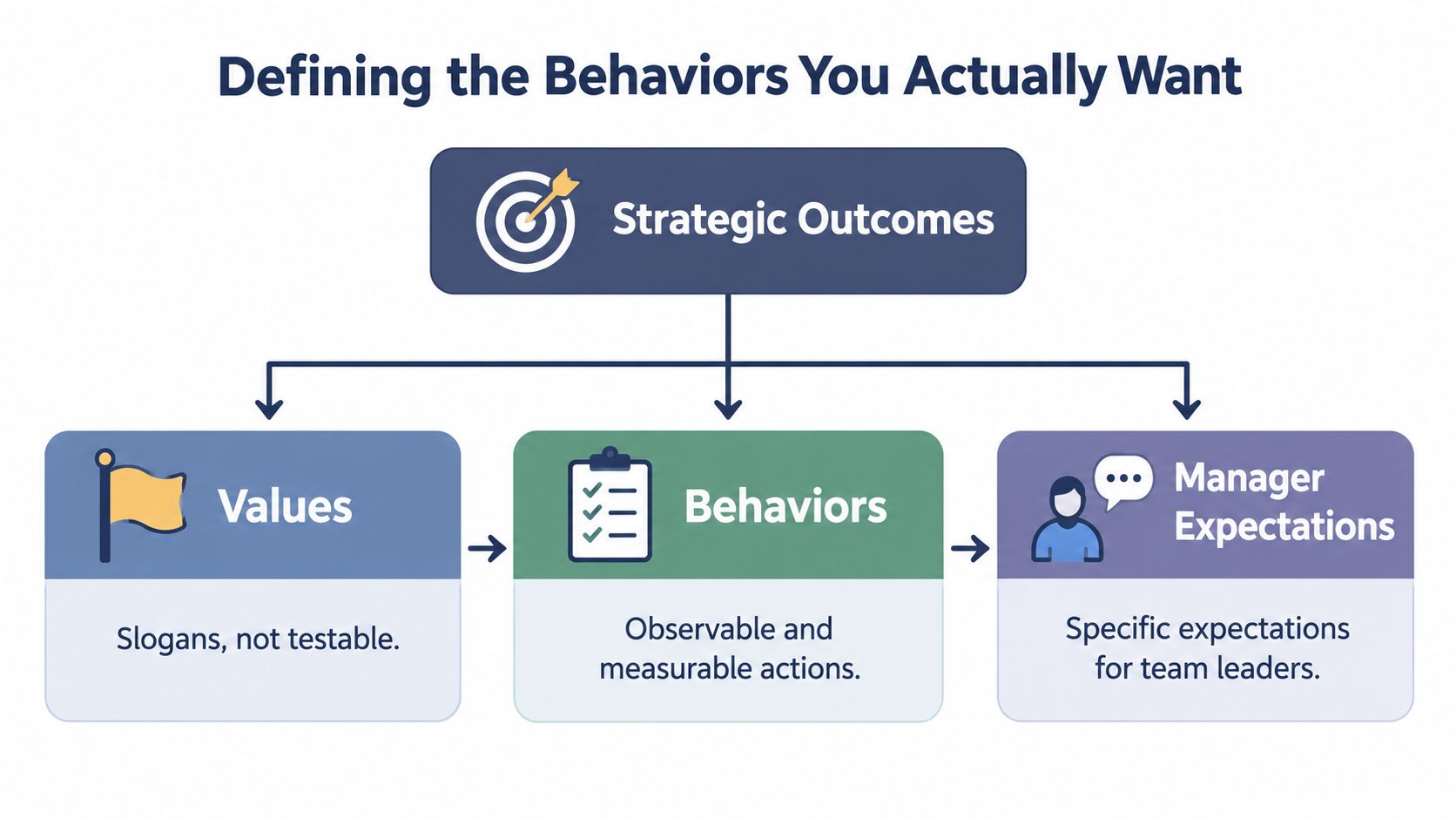
Each entry needs an outcome, a behavior, a manager obligation, and acceptable evidence. Avoid phrases such as demonstrate ownership unless you explain what ownership requires.
Business need | Observable behavior | Manager expectation |
|---|---|---|
Reliable customer delivery | Record commitments and flag delivery risks early | Resolve conflicting priorities before promising dates |
Better cross-team execution | Name a handoff owner and confirm acceptance | Settle ownership disputes rather than redirecting blame |
Responsible experimentation | Document assumptions and review failures honestly | Distinguish reasonable experiments from ignored safeguards |
Test the map against uncomfortable hypothetical decisions. Would you retain a profitable customer who repeatedly mistreats employees? Would you promote a strong salesperson who withholds information from colleagues?
Write down the answer and the decision process. If leaders disagree, resolve that disagreement before presenting the behavior as a company standard.
Don't confuse consistent conduct with identical personalities. An outspoken employee and a quiet employee can both challenge weak assumptions responsibly. Hiring panels should assess evidence of the behavior, not whether a candidate resembles the existing leadership team.
The map is ready when someone outside management can use it to predict a decision. Until then, you've written aspirations, not expectations.
What Engagement Data Tells You About Culture
A company-wide engagement score can conceal very different workplaces. An employee with a dependable manager may feel supported while someone elsewhere in the same organization faces unclear priorities and dismissive feedback. The executive message may be identical; the daily experience isn't.
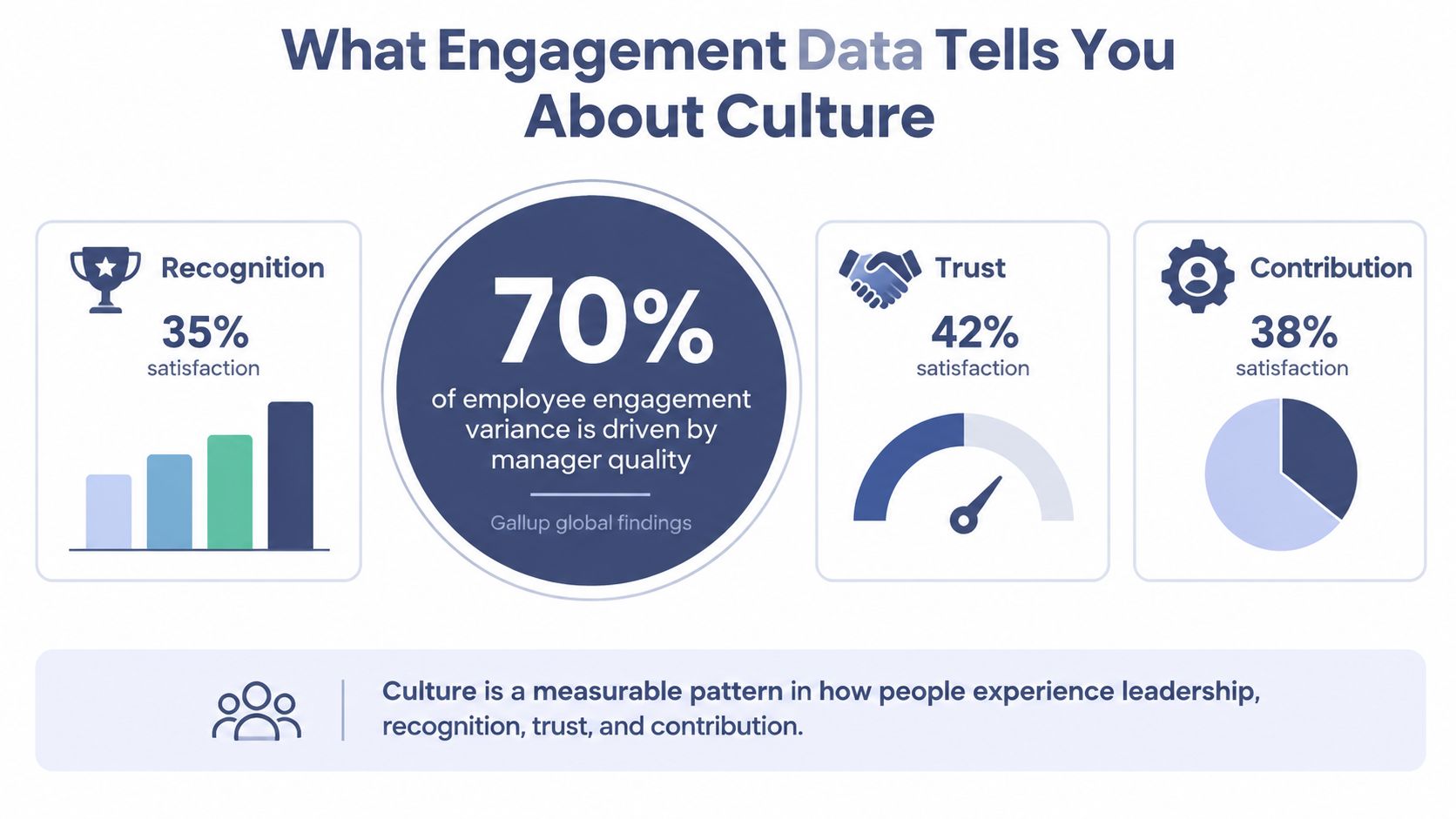
Gallup's employee engagement research reports that global engagement remained below 25% for more than a decade, while organizations identified as best-practice employers consistently reached 70% or higher. Its 2024 global research also found that managers account for 70% of the variance in team engagement; manager engagement fell from 30% to 27% in 2024, while individual contributor engagement remained at 18%.
The managerial relationship deserves particular attention:
Read the pattern without overstating it
The variance finding isn't a formula for predicting what a manager-training program will deliver. Nor does it mean executives can hand off responsibility. Executives still choose managers, set workloads, approve incentives, and decide which leadership behaviors are acceptable.
The practical implication is narrower and more useful: investigate local management conditions before prescribing a company-wide remedy. A recognition campaign won't resolve a team whose supervisor constantly changes priorities. A new collaboration platform won't help employees who expect punishment for asking another department for assistance.
A strong company average doesn't excuse a team where employees can't get clear expectations or respectful treatment.
Compare teams with an investigative mindset:
Leadership experience: Do employees receive useful feedback, or only criticism after something goes wrong?
Recognition: Can they explain which contributions their manager notices? Look beyond whether a recognition program exists.
Contribution: Do people understand how their work supports the organization's priorities?
Support: Do managers have the authority, information, and capacity to remove obstacles?
Manager engagement deserves its own diagnosis. Don't assume a disengaged supervisor lacks commitment. Examine competing demands, role ambiguity, insufficient support, and whether senior leaders undermine decisions after the manager has communicated them.
Avoid turning the findings into a public ranking contest. Managers may conceal problems if honesty threatens their standing. Require improvement plans, but make diagnosis a route to support and accountability rather than humiliation.
Engagement is a useful signal of employee experience, not a complete culture assessment. Use it to locate questions worth investigating. The management decision comes after you understand what employees are reacting to.
The Operating Mechanics That Make Culture Stick
Take a hypothetical consumer business preparing for a busy service period. A manager can tell employees to care about quality, but the useful work happens before service begins: checking readiness, assigning responsibilities, and explaining how to escalate a problem without abandoning customers.
That distinction matters across sectors. The publisher's Richeeze Melts venture, founded with Severin Stone in Los Angeles, provides a concrete consumer-business context. The operating example here is hypothetical, not a claim about the venture's internal practices.
Put expectations into recurring routines
Hiring screens should test the behavior map through evidence. Ask candidates to describe a disputed handoff, an error they disclosed, or a commitment they couldn't meet. Follow up on what they personally did. Don't accept polished answers about teamwork without examining the action.
For onboarding, I recommend a 30-60-90-day sequence as a planning device, not a promised timetable for cultural change. Begin with standards and supervised practice, move to independent application, then review actual decisions with the manager. Include examples of acceptable escalation and mistakes that require immediate reporting.
Where Culture Shows Up in Your Operating System
Operating Routine | Culture Lever | Failure Mode to Watch |
|---|---|---|
Hiring | Evidence-based behavioral questions | Selecting familiar personalities |
Onboarding | Practice with real work situations | Explaining standards without demonstrating them |
Weekly one-on-ones | Review obstacles and commitments | Using every conversation for status updates |
Recognition | Identify the action and its contribution | Rewarding visibility or tenure alone |
Performance reviews | Assess results and conduct together | Treating harmful behavior as a minor footnote |
Promotion | Require evidence of the desired leadership behavior | Advancing employees who succeed by undermining others |
Resource allocation | Fund the work needed to meet standards | Demanding quality while denying capacity |
The business-scaling guidance on the publisher's blog is relevant reading for leaders connecting team development with growth. My advice is to standardize the questions and evidence requirements before hiring accelerates. That preserves clarity without adding a sprawling approval process.
Handle exceptions without inventing exemptions
When a high performer violates a standard, establish the facts, protect affected employees, and apply the same disciplinary process you would use elsewhere. Coaching may be appropriate for a correctable lapse. Repeated misconduct requires a firmer response, regardless of revenue contribution.
Don't disclose confidential personnel details to prove consistency. Explain the process, reaffirm the standard, and ensure affected employees know how concerns will be handled.
Recognition needs similar precision. Thank the employee who identified an unrealistic commitment before it reached the customer, not merely the employee who worked late repairing the consequences.
Every routine should make the expected conduct easier to practice. If meeting the standard requires employees to fight your approval rules, staffing model, or promotion criteria, change those systems.
Governing AI Adoption and Psychological Safety at the Same Time
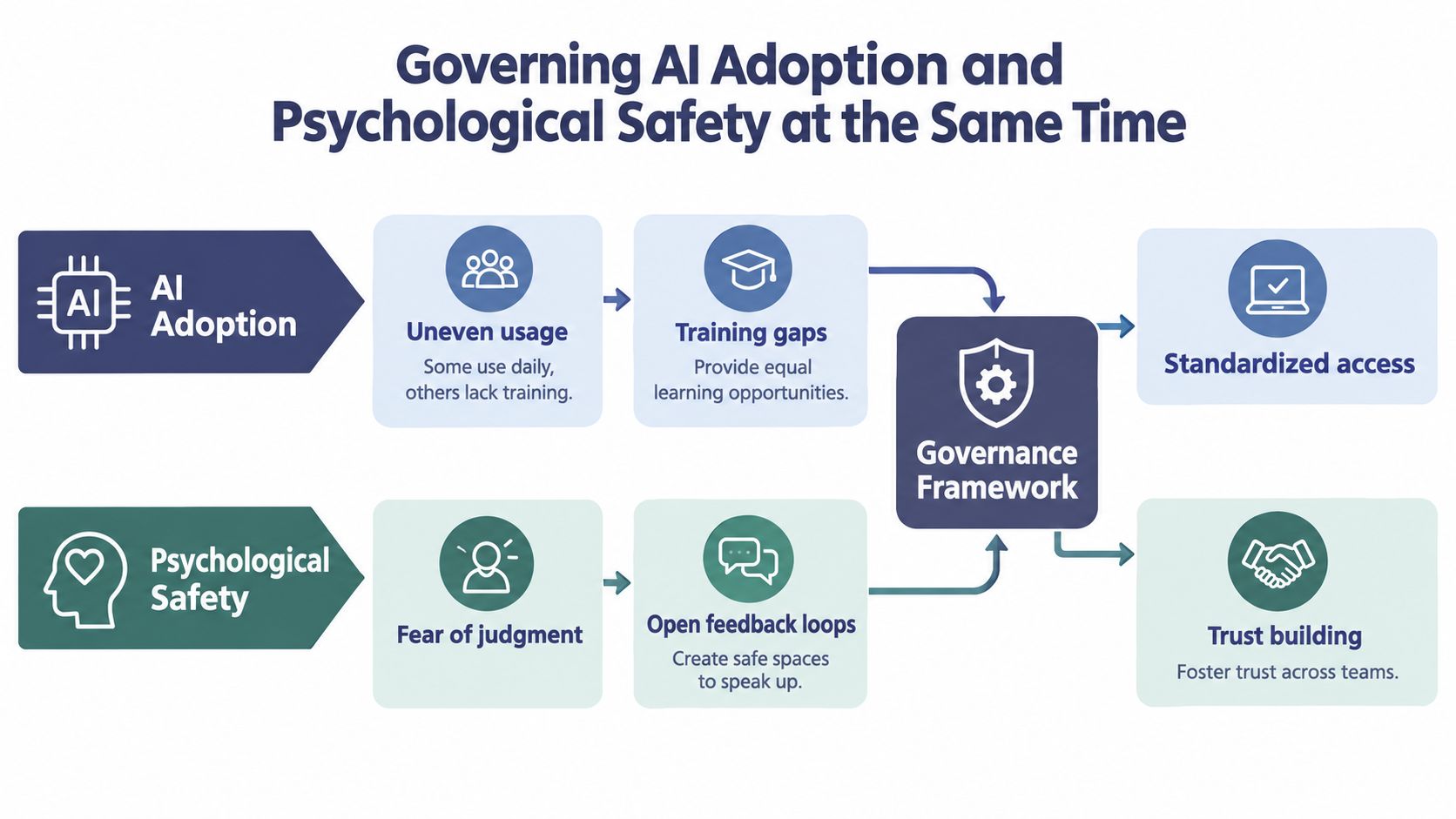
Don't declare an innovation culture while leaving employees to guess which AI uses are permitted. People need to know whether they may enter customer information, rely on generated analysis, or challenge an automated recommendation. Ambiguity isn't a useful substitute for experimentation.
PwC's global workforce research on AI adoption found that 58% of employees intentionally used AI at work with some regularity, while 47% had received AI training and 40% said their workplace had an AI policy or guidance; a separate study found that 72% of workers had received no AI training or education. These are distinct findings, not interchangeable measures of the same population.
Use a shared governance model rather than treating technology access and employee trust as separate projects:
Make experimentation understandable and challengeable
Publish approved use cases and explain who remains accountable for the output. Consult employees about workflow changes before using AI to evaluate their work.
Role-based training: Teach employees using tasks they perform. Provide learning time rather than expecting private experimentation.
Data boundaries: Specify what information employees must keep out of tools and who authorizes exceptions.
Review requirements: Identify outputs requiring human verification, especially those affecting customers or employees.
Reporting channels: Give people a way to report errors, unfair treatment, or harmful uses without going through the person responsible.
The publisher's guidance on when to use ChatGPT and when to rely on your own judgment is a useful discussion prompt. Turn that discussion into explicit task boundaries rather than a general instruction to use judgment.
Use the accompanying video as a conversation starter, then document the decisions your team reaches:
Trust requires more than access. PwC's 2025 workforce survey found that only about half of respondents trusted top management, while 58% trusted their direct manager and felt able to speak openly with that manager; employees with the highest psychological-safety levels were 72% more motivated than those with the lowest levels. That comparison doesn't establish causation.
Assess candor through confidential skip-level interviews, anonymous pulses, and monitoring for retaliation after concerns are raised. Ask whether employees can disagree, admit uncertainty, and challenge AI-supported decisions without career penalties.
Psychological safety doesn't remove accountability. It makes responsible challenge possible before an avoidable mistake becomes a customer or employee problem.
Measuring Culture Without Fooling Yourself
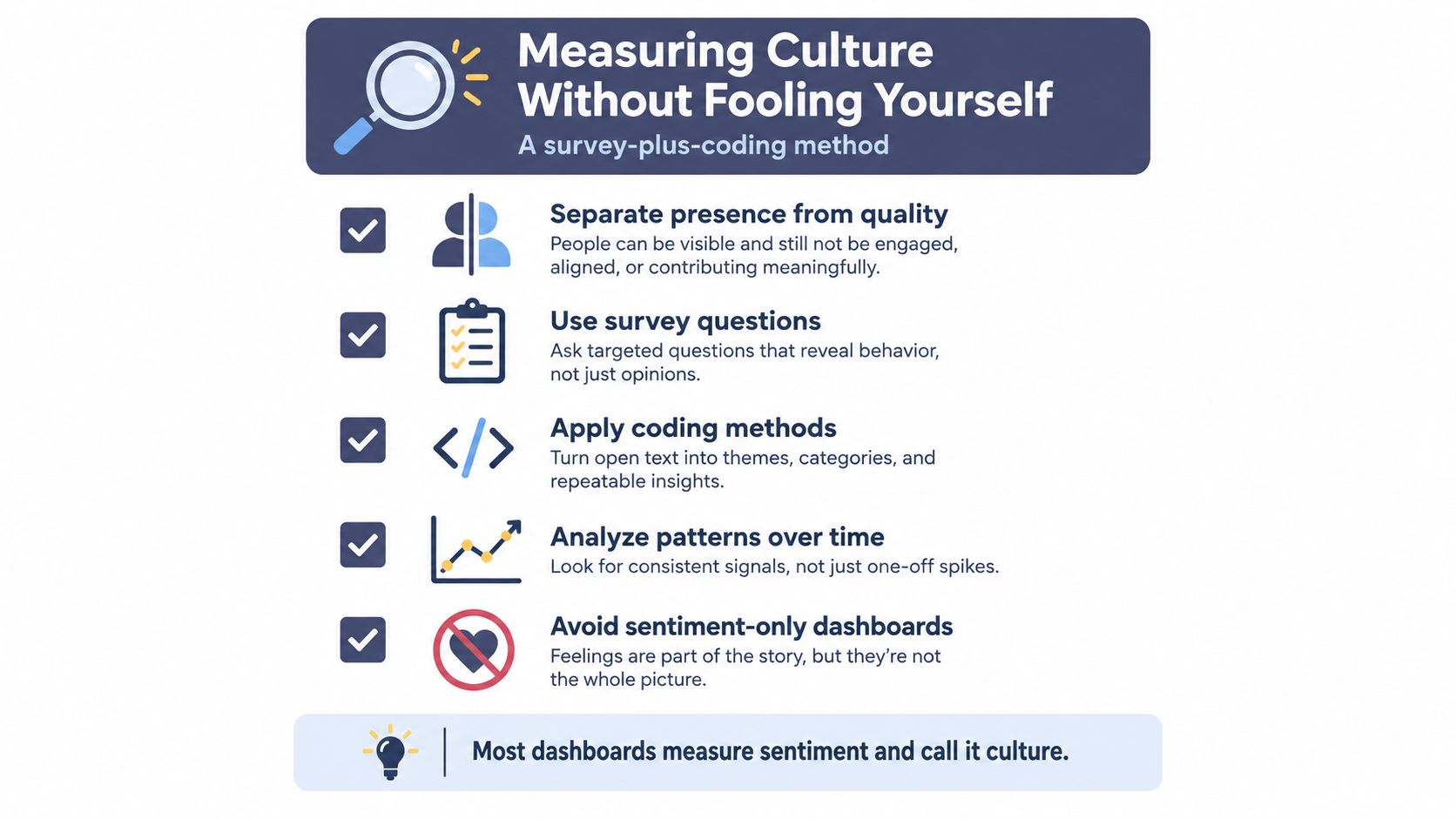
A dashboard showing improved sentiment isn't enough. Employees might mention accountability more often because managers have become clearer, or because employees feel blamed for problems outside their control. Counting mentions without examining their meaning can produce the wrong conclusion.
Separate cultural presence from cultural quality. Presence asks whether a behavior appears in employees' accounts of work. Quality asks how they experience it and whether the examples match your definition.
The distinction should guide the measurement design:
Use a survey-plus-coding procedure
Adapt the incidence-and-sentiment logic associated with MIT Sloan and Glassdoor's Culture 500 approach, rather than copying a composite score. My recommended implementation combines a validated employee survey, structured interviews, and coded comments:
Pre-register definitions. Record what each behavior means and establish coding rules before reading the responses.
Sample across the organization. Include departments, tenure groups, locations, and organizational levels. Protect confidentiality when groups are small.
Double-code a subset. Have independent reviewers classify the same material, calculate inter-rater reliability, and resolve ambiguous rules.
Report incidence and sentiment separately. A frequently mentioned behavior isn't necessarily well experienced.
Compare with objective outcomes. Examine relationships with turnover, quality, and productivity without claiming that correlation proves causation.
Repeat on a fixed cadence. Keep definitions stable enough to compare results and document any necessary changes.
Don't select only the measures that improved. A systematic review of 31 culture and climate intervention studies found that every study reported improvement in at least one measure, but most showed mixed results across domains, with some improving while others stayed unchanged or deteriorated. A favorable headline can therefore coexist with unresolved problems.
Require an action behind every finding
Keep leading indicators, such as manager follow-through, speaking-up patterns, and decision speed, distinct from lagging indicators, such as retention, quality, and productivity. Record context: more reported concerns could reflect greater confidence in reporting, not worsening conduct.
Measurement discipline: Before celebrating a score, ask what changed, for whom, and what became worse.
Show subgroup differences, distributions, uncertainty, and unintended effects. Don't combine stronger accountability and weaker psychological safety into a reassuring average.
Summarize the cycle on a leadership slide: target behavior, evidence, affected groups, operational outcome, action owner, and review date. Then publish an employee-facing account of the actions leadership will take.
Employees shouldn't have to complete another survey to discover whether anyone read the last one. The response to measurement is itself evidence worth examining.
Rebuilding Culture During Change and a 90-Day Starter Plan
A merger, leadership transition, growth push, or layoff gives executives a difficult choice: explain how expectations will change, or leave managers to improvise. Don't rely on employees to reconcile a new strategy with old instructions.
Change creates an opening to reconsider decision rights, workloads, and leadership practices. It also increases the obligation to be candid. If roles are disappearing, don't promise stability; explain what is known, what remains undecided, and who will communicate the next decision.
Start with continuity, then remove contradictions
Use the first 90 days as a starter plan, not a finish line. The following milestones are recommended management checkpoints, not research-backed promises of improvement.
By day 30, establish the baseline. Identify the behaviors that must survive the transition. Review existing evidence, run confidential listening sessions, and locate manager-level blockers. Explain how feedback will be protected and used.
By day 60, change the work. Update the most consequential routines that conflict with those behaviors. Coach managers using actual decisions, clarify authority, and publish leadership's response to the listening findings.
By day 90, inspect execution. Revisit the baseline measures, examine whether agreed actions occurred, and investigate uneven results. Keep effective changes, revise weak ones, and assign the next review.
Don't launch every possible intervention simultaneously. Choose the contradiction with the greatest practical consequence. If employees can't get priorities resolved, fix decision ownership before adding another learning program.
Commit beyond the starter plan
Long-term evaluation matters. A systematic review of culture interventions found that only 14% of evaluations completed within two years reported positive significant results across outcomes, compared with 40% at three to five years. Those findings support patience and disciplined evaluation, not a guarantee that waiting will produce success.
Before closing the initial review, confirm that leadership can answer these questions:
Authority: Can the action owners change the relevant process?
Consistency: Are senior leaders subject to the same expectations?
Resources: Have managers received the capacity needed to implement the changes?
Follow-through: Is the next review scheduled, with unresolved findings still visible?
Building organizational culture that lasts requires leaders to revisit choices they would rather consider settled. A policy may be sound while its implementation remains unfair. A manager may understand the standard and still lack the authority to apply it.
Keep inspecting the work. Make the difficult decision, explain it plainly, and check whether employees experience the result you intended.
Richard Maize offers practical perspectives on entrepreneurship, investing, and business growth that can inform how you connect team expectations with operating decisions. Visit Richard Maize to explore his business commentary and ventures, then use those perspectives to pressure-test your behavior map and next management review.
Comments