1031 Exchange Strategies That Protect Cash Flow

Sell the rental, pay no tax, buy something bigger. That's the pitch most owners hear first, and it's wrong in the way that costs money. A 1031 exchange doesn't erase gain. It moves that gain into the next property, where it waits in a lower basis, affects depreciation, and shapes the loan you can carry. Good 1031 exchange strategies start by asking whether the replacement earns its place on cash flow, financing potential, liquidity, and concentration, not whether it produces a zero on this year's return.
Why a Clever Swap Can Still Be a Bad Buy
Section 1031 defers tax; it does not erase gain. When you exchange real property held for business or investment for like-kind real property, you may postpone recognizing the gain. Cash or other non-like-kind property received can make part of that gain taxable now. The deferred gain remains reflected in the replacement property's basis.
The tax treatment follows the asset. If the replacement is overpriced, produces weak rent, or is difficult to finance, deferral may leave you holding a poor investment for years. A tax benefit cannot make a weak purchase sound.
Richard Maize is a Los Angeles based real estate investor, entrepreneur, and philanthropist who has built and managed a real estate portfolio for more than 30 years, and that experience shapes the view that cash flow and financing should be tested before any tax deferral.
Put the replacement through four tests before you commit. Will its after-tax return justify the price? Can you service the debt and maintain reserves? How much liquidity remains after closing? Does the purchase reduce concentration, or put more equity into one building, tenant, or unfamiliar market? A commercial real estate due diligence checklist can help organize that review before you identify a replacement.
If you wouldn't buy the replacement without a tax deadline, the deadline isn't a good enough reason to buy it.
Sometimes paying tax is the stronger investment decision. Accepting some tax can preserve cash flow, liquidity, and flexibility rather than tying up capital in a property that does not fit.
What Still Qualifies as Like-Kind Real Property
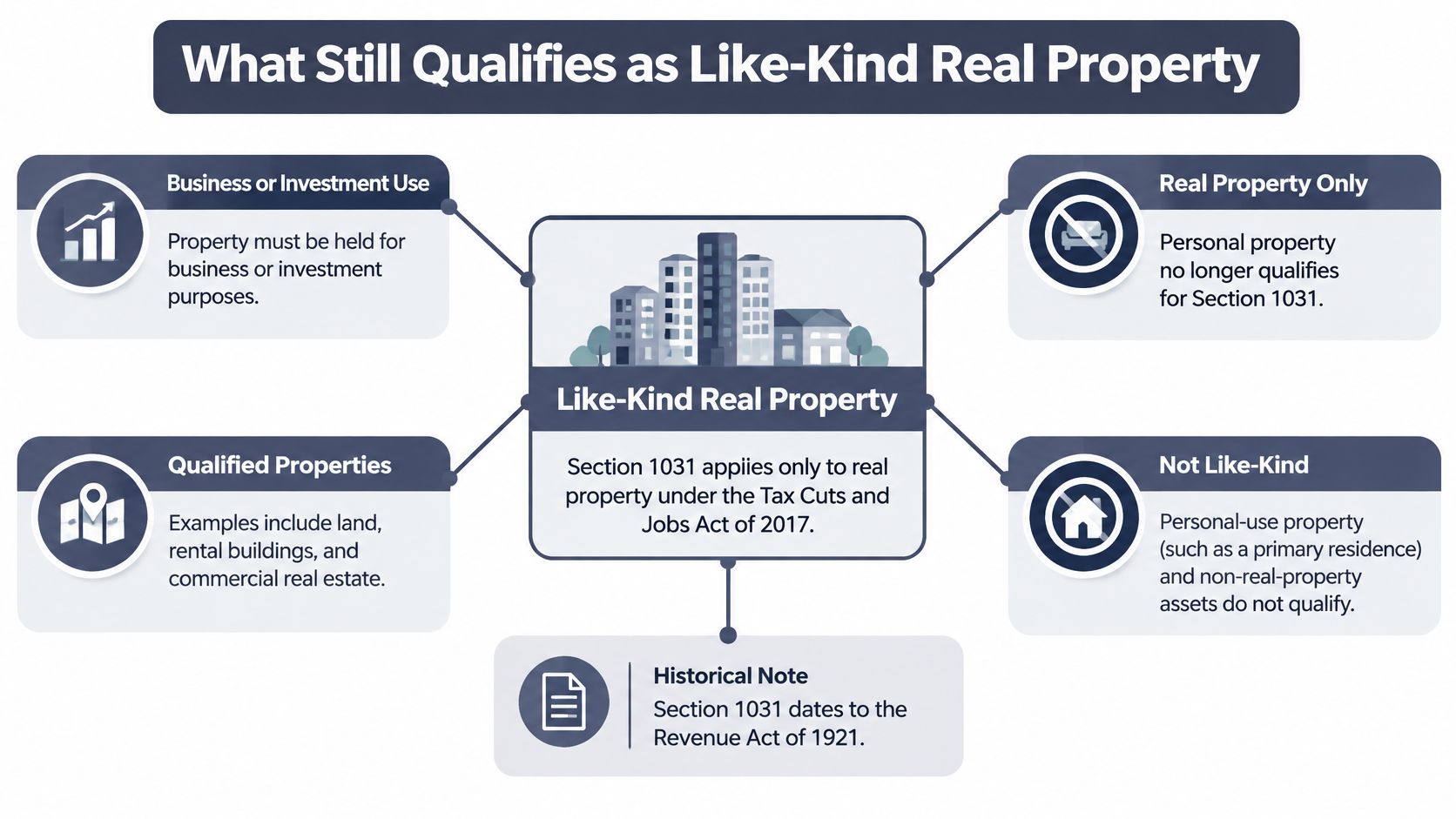
Start with the current rule, not the old reputation. An overview of the evolution of 1031 like-kind exchanges notes that Section 1031 has roots in the Revenue Act of 1921, but the Tax Cuts and Jobs Act of 2017 narrowed Section 1031 to real property only. That change was generally effective for exchanges completed after December 31, 2017, with a transition rule when the relinquished or replacement property had been transferred by that date.
That history has a practical consequence. Equipment, vehicles, artwork, and partnership interests don't belong in a modern exchange plan. You're working with real property held for productive use in a trade or business or for investment, exchanged for other qualifying real property.
Broad in Grade and Narrow in Kind
Like-kind doesn't mean identical. An apartment building can be exchanged for retail space, industrial property, raw land held for investment, or a rental single-family home because all are real property. You don't need the same city, the same building type, or the same tenant profile to pass the legal test.
Say you own a small office building that's become management heavy. You could sell it and identify a net-leased retail property or a residential rental in another market. The exchange question isn't whether the buildings look alike. It's whether both sides are qualifying real property held for the right purpose, and whether the new asset's rent, lease, and location work on their own.
What doesn't qualify will stop a plan faster than a bad cap rate. A personal residence is out. Inventory held primarily for sale is out. A flip you bought to resell quickly points toward dealer activity, not investment holding. Foreign real property isn't like-kind to U.S. real property, and related-party exchanges face extra holding and anti-abuse limits that need counsel before you sign anything.
Run This Three-Part Screen
Purpose test: Was the relinquished property held for business or investment, with records, leases, and tax reporting that match that claim?
Property test: Are both sides real property, rather than personal property dressed up as part of the deal?
Intent test: Will you hold the replacement for investment or business use, rather than listing it for immediate resale?
If a property fails any one of those questions, don't let a buyer, broker, or calendar pressure you forward. Take it to exchange counsel before a contract is signed. It's far cheaper to learn you're outside the statute while you can still choose a taxable sale, restructure, or wait than to discover it after proceeds have moved and deadlines have started.
Boot, Basis, and the Tax You Still Owe
Four terms drive the math, and mixing them up is where sellers overestimate the benefit. Realized gain is your economic profit on the sale. Recognized gain is the portion taxable this year. Boot is cash or non-like-kind property you receive. Basis is what carries into the replacement and generally reflects the gain you've deferred.
The IRS instructions for Form 8824 reflect the core limit. Section 1031 generally defers gain only when business or investment real property is exchanged for like-kind real property, and cash or non-like-kind property received can trigger taxable gain up to the amount received. The deferred gain generally remains embedded in the replacement property's basis.
One Changed Fact Changes the Return
Use a simple illustration, not a tax return. Say you sell a rental with a large realized gain, reinvest all equity into like-kind real estate, and replace the old debt with equal or greater debt. Recognized gain can be zero for that year. The gain hasn't disappeared. It's sitting in the new property through a lower basis, which also affects future depreciation and the gain you'll face later.
Now change one fact. You take out a hypothetical $500,000 in cash at closing. That cash is boot, and gain can be recognized up to $500,000. Change a different fact instead. Your old mortgage is paid off and the new loan is smaller. That debt relief can be boot even though no check reached your hands, unless it's offset by new debt or cash you add.
Depreciation adds another layer. Depreciation you took on the old property creates recapture exposure when gain is recognized. Don't assume every dollar of recognized gain gets the same treatment, and don't model federal tax in isolation. State tax and other federal taxes may apply depending on your return. That is why a broader review of tax planning for real estate investments should happen while you can still choose how much boot, if any, to accept.
What you receive | How it is treated | Tax effect | Planning response |
|---|---|---|---|
Like-kind real estate of equal or greater value and debt | Qualifying replacement | Realized gain deferred and embedded in a lower basis | Exchange fully if the asset's cash flow justifies it |
Cash or other non-like-kind property | Boot | Gain recognized up to the boot received | Take it only for a defined use such as reserves or debt you want gone |
Old mortgage paid off with a smaller new loan | Debt-relief boot | Taxable to the extent relief is not offset by new debt or added cash | Match or exceed debt, or budget tax on the shortfall |
Depreciation previously taken | Recapture exposure | Can be recognized when boot is taken; otherwise stays deferred | Do not assume the whole gain is at capital-gains rates |
Read the table from left to right for everything you expect to receive. If cash, debt relief, or personal property enters the deal, name its purpose before closing. Boot taken for a reserve fund you need can be rational. Boot created by sloppy debt replacement is just an avoidable tax bill.
Planning rule: I'd rather see an owner budget tax on intentional boot than overpay for a replacement to report zero recognized gain.
Which 1031 Exchange Strategy Fits the Sale
Pick your lane before you study mechanics. The right structure follows from timing, the condition of the replacement, and whether you want one asset or several. The wrong structure usually shows up as a deadline problem first and an investment problem second.
Strategy | Best when | Main constraint | Tax result |
|---|---|---|---|
Deferred exchange | You sell first and need time to buy | Written ID in 45 days and close by day 180 or the return due date | Full deferral if value and debt are replaced and no boot is taken |
Reverse exchange | The replacement must be bought before the sale | An accommodation titleholder parks title and the same outer deadlines still apply | Deferral if the parked property is properly exchanged |
Improvement exchange | The replacement needs construction or rehab | Only improvements finished within the exchange period count | Deferral limited to value actually in place on time |
Consolidation | Several smaller assets should become one property | Each relinquished asset must qualify and timelines can stack | One carryover basis and simpler operations |
Diversification | One large asset should become several | Three-property rule, or 200 percent of relinquished value | Basis split across the new assets |
Partial exchange | You need some cash at closing | Boot is taxable up to the amount received | Tax on the boot, deferral on the rest |
Sell and pay the tax | The replacement is weaker or overpriced | No intermediary and no statutory clock | Gain recognized now and a fresh, higher basis |
The Default and the Two Timing Variants
A deferred exchange is the normal path. You sell first, a qualified intermediary holds the proceeds, you identify replacements in writing, and you close inside the exchange period. It works when the market gives you identifiable, financeable property and you don't need to control the replacement before your sale.
A reverse exchange flips that order because the property you want won't wait. An exchange accommodation titleholder parks title to the replacement while you sell the old asset. You gain control of timing, but you pay for it in fees, financing complexity, and documentation. Lenders don't always love parked title, so talk to the lender before you assume this structure is available.
An improvement or build-to-suit exchange fits when the right location needs work to become the right asset. The trap is assuming the finished value counts. Only value in place by the deadline counts toward reinvestment. If permits slip, contractors stall, or inspections fail, unfinished work can leave part of your proceeds exposed as boot. I'd use this only with a contractor, budget, and schedule you could defend without optimism.
Portfolio Moves Rather Than Single Swaps
Consolidation turns several small holdings into one larger property. Owners choose it to cut management points, improve financing, or move into an asset with on-site staff. The work is in the stack. Every relinquished property has to qualify, proceeds have to be handled correctly, and the calendars can overlap in ways that punish a disorganized closing.
Diversification does the opposite. One sale becomes several replacements, perhaps in different markets or property types. That can reduce single-tenant and single-market concentration, but it multiplies inspections, loans, insurance, and management relationships. More properties identified doesn't mean less risk if each one is small, unfamiliar, and rushed.
A partial exchange is intentional boot. You take a defined amount of cash, pay tax on that slice, and defer the rest. Owners use it to build reserves, retire expensive personal debt, fund a known capital need, or avoid buying more building than they want. It isn't a failed exchange. It's a priced decision.
The last row belongs in every comparison. Sell and pay the tax when the only closable replacement is weaker, pricier, or more concentrated than the asset you're leaving. You recognize gain now, but you keep selection freedom and start the next purchase with a fresh, higher basis when you buy without exchange pressure.
Before you call a buyer, mark one primary row and one backup row. If your primary choice is a deferred exchange and your backup is a partial exchange, you already know how much cash you'd accept and what tax you'd budget. If your backup is a taxable sale, you know the price at which walking away still works. That precommitment stops day 40 panic from making the investment decision for you.
How to Run the 45-Day and 180-Day Clock
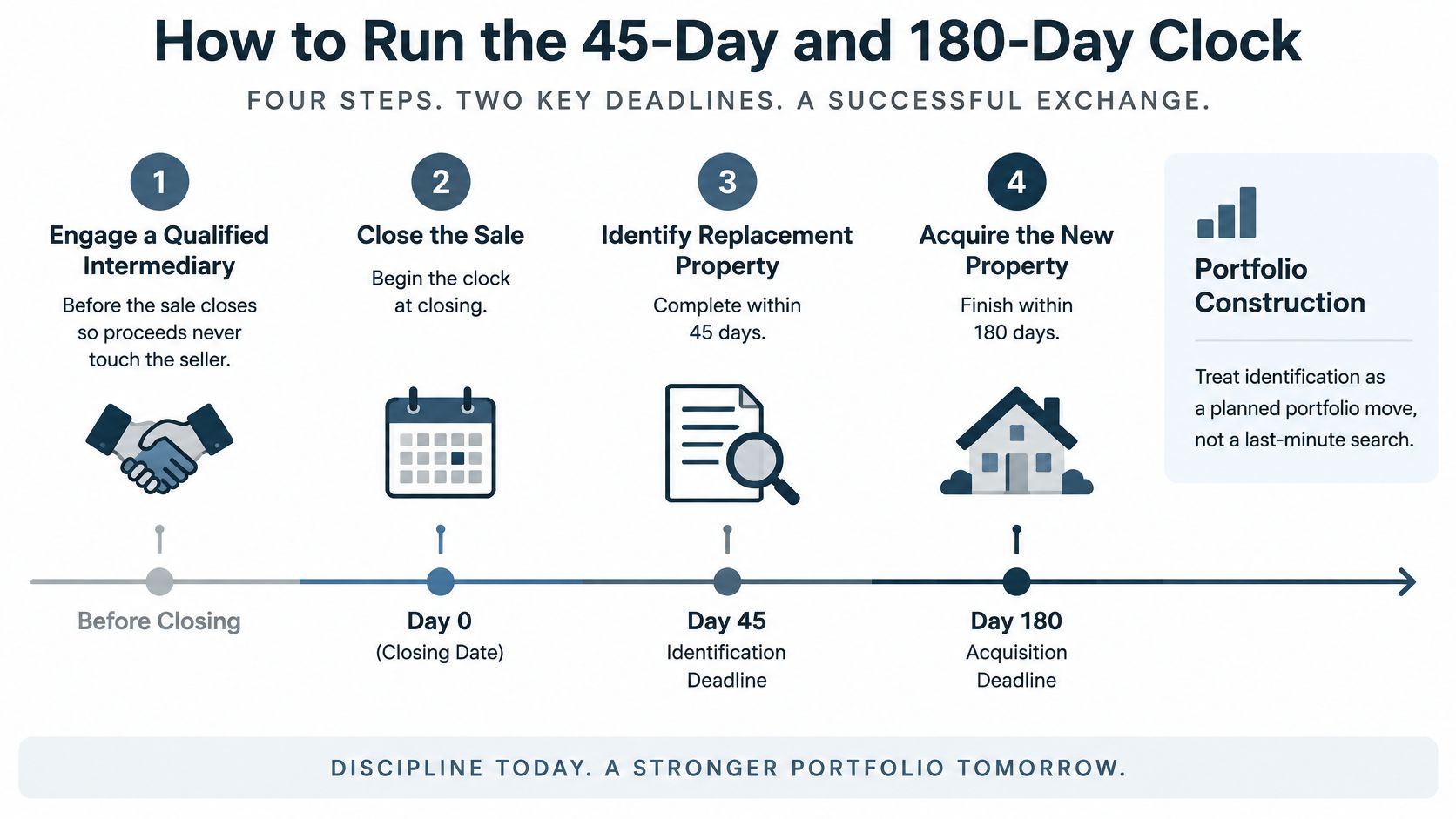
Treat identification as portfolio construction, not a last-minute property search. The IRS overview of like-kind exchanges supports that discipline. In a deferred exchange, you must identify replacement real estate in writing, sign the identification, deliver it to a qualified intermediary or another permitted exchange party, and describe each asset by legal description, street address, or identifiable property name. You must acquire it by the earlier of 180 days after transferring the relinquished property or the federal income-tax return due date for that year, including extensions.
Those dates don't move because a seller retrades or a lender asks for another document. Weekends and holidays don't pause them either. Build the calendar backward from failure, then work forward.
The Seven-Step Execution Path
Engage a qualified intermediary before the sale closes. Proceeds must not touch you or sit under your control, because constructive receipt can kill deferral. The intermediary can't be a disqualified person, such as your agent, attorney, accountant, or employee within the prior two years. Get fees, fund handling, insurance, and wire procedures in writing.
Underwrite replacements before listing. Build a ranked list by debt capacity, expected cash flow, price, lease quality, capital needs, and closing certainty. Call lenders while you still have time to hear no.
Start both clocks on the transfer date. Put the 45-day and 180-day dates, plus your return due date with extensions, on one shared calendar for you, the intermediary, counsel, CPA, broker, and lender.
Identify in a signed writing within 45 days. Deliver it to the intermediary or another permitted party and describe each property clearly enough to distinguish it. Keep proof of delivery. A casual email shortlist that doesn't meet the requirements is not a plan.
Use identification rules deliberately. The three-property rule lets you identify up to three properties regardless of value. If you need more names, the 200 percent rule may apply. Either way, the property you buy must be properly identified.
Close by the earlier deadline. Acquire the replacement by the earlier of day 180 or the return due date, including extensions. If that return date cuts your period short, filing strategy has to be settled with your CPA early.
Track equity and debt to closing. Reinvest proceeds and replace debt as planned so a smaller loan doesn't create boot. Reconcile the expected settlement statement against your exchange target before signing.
Controls That Prevent a Failed Exchange
Written calendar: Assign one owner for every date, document, inspection, loan condition, and wire.
Lender prequalification: Confirm debt amount, appraisal timing, reserves, and entity requirements before identification.
Backup assets: Identify alternatives you would close, not names added to fill space.
Early diligence: Order title, survey, environmental review, lease estoppels, and insurance quotes while options still exist.
The failure mode isn't usually a missed signature. It's reaching day 45 with properties you like but can't finance, inspect, or close.
Broader optionality reduces failure risk only when the options are real. Three identified properties with clean title, responsive sellers, and credible debt are stronger than a long list of maybes. If none of them survives underwriting, accept the taxable sale early enough to manage estimates and cash. Don't let a dead exchange surprise you at closing.
Three Sales and the Strategy Each One Earns
A 1031 exchange defers gain; it does not erase it. The replacement should earn its place through better operations, useful liquidity, or stronger cash flow, not merely a cleaner tax result. For more than 30 years Richard Maize has built and managed a real estate portfolio. That experience points to a practical test: buy only what you can own and finance on terms that make sense after the tax benefit is set aside.

The three cases below are hypothetical. Each sets out the facts, a fitting strategy, and the conditions that could change the decision.
Case One: Consolidate Into One Better-Run Building
An owner holds three small rentals in different parts of town. Each has separate insurance, contractors, turnover, and bookkeeping. Selling them would provide enough equity to buy one 24-unit building with equal or greater debt, on-site management, and similar cash-on-cash yield.
A full deferred exchange may fit because the operating case stands on its own. One management agreement and one loan can reduce owner workload and simplify capital planning. The trade-off is concentration: a larger building can also mean a larger repair bill and greater exposure to one tenant base.
The choice changes if the lender requires materially less debt than the owner is replacing, or reserves would leave no operating cushion. It also changes if diligence reveals concentrated lease rollover in the first year. Consolidation is worthwhile only if the building, market, and tenant base justify the concentration.
Case Two: Take Partial Boot on Purpose
A seller owns one retail building with a solid tenant but too much equity tied up in a single asset. A smaller replacement could produce acceptable rent, while the seller needs a defined cash reserve for family, business, or portfolio reasons. Buying a larger building solely to reinvest every dollar could mean paying a premium in a thin market.
A partial exchange can make sense. The seller takes a stated amount of cash as boot, pays tax on that portion, and defers the rest in the replacement. Liquidity improves, and the seller avoids buying an overpriced property just to defer more gain.
The choice changes if the cash need is undefined. Boot without a clear purpose can erode reserves. It also changes if the replacement depends on one fragile tenant or debt replacement is mishandled, creating more boot than intended. Model the settlement statement early, separating old debt, new debt, exchange expenses, and cash proceeds.
The video below offers more context on judging investment quality alongside tax treatment.
Case Three: Walk Away and Pay the Tax
An owner sells a well-located rental after a strong run. By the identification window, available replacements yield less, need immediate capital work, or sit in markets the owner does not understand. The exchange deadline can pressure buyers to accept weak terms, while sellers may recognize that pressure.
Sometimes the sound choice is to stop. Pay the tax, keep the remaining proceeds liquid, and buy later without a statutory deadline. A taxable sale has an immediate cost. A weak replacement can impose ongoing costs through low rent, deferred maintenance, refinance risk, and gain that remains embedded in the investment.
The choice changes if a financeable property becomes available at a defensible price and diligence can be completed in time. That requires more than a broker package: access, leases, title, lender feedback, and numbers that account for vacancy and repairs. If financing terms change late, walking away preserves cash; forcing the exchange can leave the owner with a closing problem and earnest money at risk.
Match the strategy to the sale. Consolidation can improve operations, partial boot can fund a defined need, and a taxable sale can preserve liquidity and patience. Deferral is useful only when the replacement is worth owning.
Decide Whether to Exchange or Pay the Tax
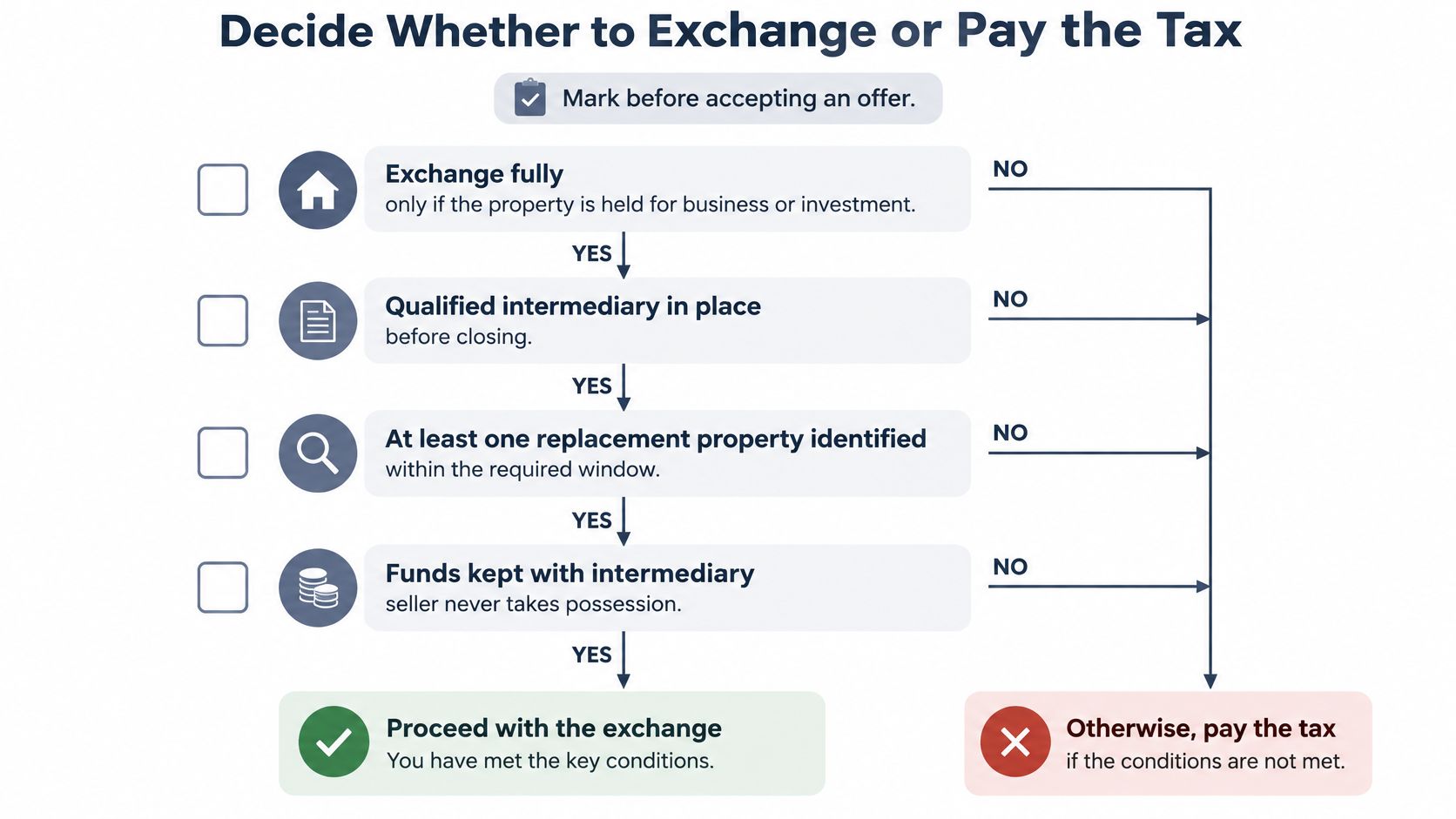
Use a yes-or-no path before you accept an offer. Once a contract is signed and a closing date is set, your options narrow and everyone around the deal starts solving for speed. The decision needs to be marked while you can still say no cheaply.
Three Verdicts and What Each Requires
Exchange fully only if the property is held for business or investment, a qualified intermediary is in place before closing, at least one financeable replacement can be identified inside 45 days, debt and equity can be replaced, and the new asset's cash flow and location work on their own. Our discussion of cash flow and equity in real estate investing is a useful check here. If the property needs the tax benefit to look acceptable, it isn't acceptable.
Choose a partial exchange if a stated dollar amount of cash or debt relief is worth the tax on that boot. Write down what the cash is for, when you'll need it, and what reserve remains after closing. That turns boot from an accident into a priced liquidity decision.
Choose a taxable sale if the replacement would be overpriced, illiquid, or more concentrated, or if the calendar is already unrealistic. Paying tax can protect future cash flow by keeping you out of a building you'd spend years trying to justify. It can also give you time to diversify into property you'd choose without a deadline.
State tax, estate plans, entity structure, and related-party facts can change the result. A CPA and exchange counsel should review the specific return and documents before signing. Richard Maize is a Los Angeles based real estate investor, entrepreneur, and philanthropist, and questions and opportunities for discussion can be sent to the email richardmaizebusiness@gmail.com.
Do one concrete thing before contract. Pick the matching row in the strategy table, record a backup list of two candidate replacements you'd buy, and write your walk-away condition beside them. Don't let fear of a tax bill buy a property you would otherwise refuse.
If you're weighing an exchange against a taxable sale, Richard Maize shares practical, ownership-first guidance on replacement criteria, financing, cash flow, and the discipline to walk away when a deal doesn't earn its place. Visit Richard Maize to explore that perspective before your 45-day clock starts and the market begins making decisions for you.
Comments