Real Estate Investing Los Angeles: Expert Insights from Richard Maize

Real estate in Los Angeles has always been a unique beast. For smart investors, it’s a market defined by high demand and genuine long-term value. Guided by the experience of investors like Richard Maize, the smart money knows to look past the noise and focus on the city's resilient core—a diverse economy, unmatched global appeal, and a structural housing shortage that isn't going away.
Why Los Angeles Remains a Premier Investment Market
It’s easy to get sidetracked by headlines about price swings and market corrections in Los Angeles. But veteran investors like Richard Maize understand that the city’s real strength comes from its unshakable fundamentals. These pillars are what support long-term growth and help portfolios weather short-term storms.
Instead of reacting to the chatter, a disciplined investor recognizes the deep-rooted factors that consistently drive demand here. Los Angeles isn’t just another city; it's a global center for culture, technology, and entertainment that constantly pulls in new residents and fresh capital.
The Unwavering Pillars of the LA Market
To build a lasting portfolio here, you have to look past temporary trends and focus on what makes this market so fundamentally sound. Richard Maize’s strategy has always centered on these core strengths, which create a buffer against economic headwinds and lay the groundwork for real appreciation.
The key drivers are simple but powerful:
Structural Housing Undersupply: For decades, new construction hasn't come close to keeping up with population growth. This chronic shortage fuels intense competition for what’s available, propping up both property values and rental rates.
Dynamic and Diverse Economy: LA doesn't rely on just one industry. You have entertainment, tech in "Silicon Beach," international trade, healthcare, and more. This mix creates a stable employment base, which in turn fuels consistent demand for housing.
Unmatched Global Appeal: The city's lifestyle, climate, and cultural pull make it one of the most desirable places to live in the world. This global magnetism ensures a continuous stream of potential tenants and buyers.
According to real estate expert Richard Maize, “Market shifts are not threats; they are opportunities. When others see uncertainty in Los Angeles, I see a chance to acquire valuable assets supported by fundamentals that aren’t going away.”
This perspective is what separates successful investors from the rest. For instance, a jump in interest rates might cool down a buying frenzy for a moment, but it does nothing to fix the underlying housing deficit. An expert like Richard Maize sees this as a window to negotiate better terms on properties that will inevitably become more valuable as demand continues to overwhelm supply.
By focusing on these constants, you can turn market recalibrations into powerful portfolio-building moments. You can learn more by navigating Los Angeles real estate expert insights from Richard Maize in our related article. This guide will build on these foundational principles, offering actionable strategies for your own investment journey.
How To Read The Los Angeles Market Dynamics
To succeed in Los Angeles real estate, you need to understand the story the data is telling. Much like a doctor reading a patient’s chart, a savvy investor must interpret key metrics to diagnose the market's health and spot opportunities. Experienced investors like Richard Maize don't just see numbers; they see patterns, trends, and strategic entry points that others miss.
The L.A. market is defined by several critical indicators. These include median home prices, which signal overall value trends, and inventory levels, which measure supply. Rental growth rates reveal tenant demand, while days on market (DOM) tells you how quickly properties are actually selling. Together, these data points paint a clear picture of market momentum.
Decoding Key Market Metrics
Trying to invest without understanding these core metrics is like navigating a city without a map. Each piece of data offers a clue about where the market is headed. For instance, a rising median home price paired with a low DOM suggests a strong seller's market where demand is simply outpacing supply.
On the other hand, a sudden jump in inventory might signal a market that's beginning to cool, giving buyers a bit more negotiating power. The key is to see these shifts not as threats, but as valuable information. A slowdown isn't a red flag; it's a signal to adjust your strategy, perhaps shifting focus from quick flips to long-term holds.
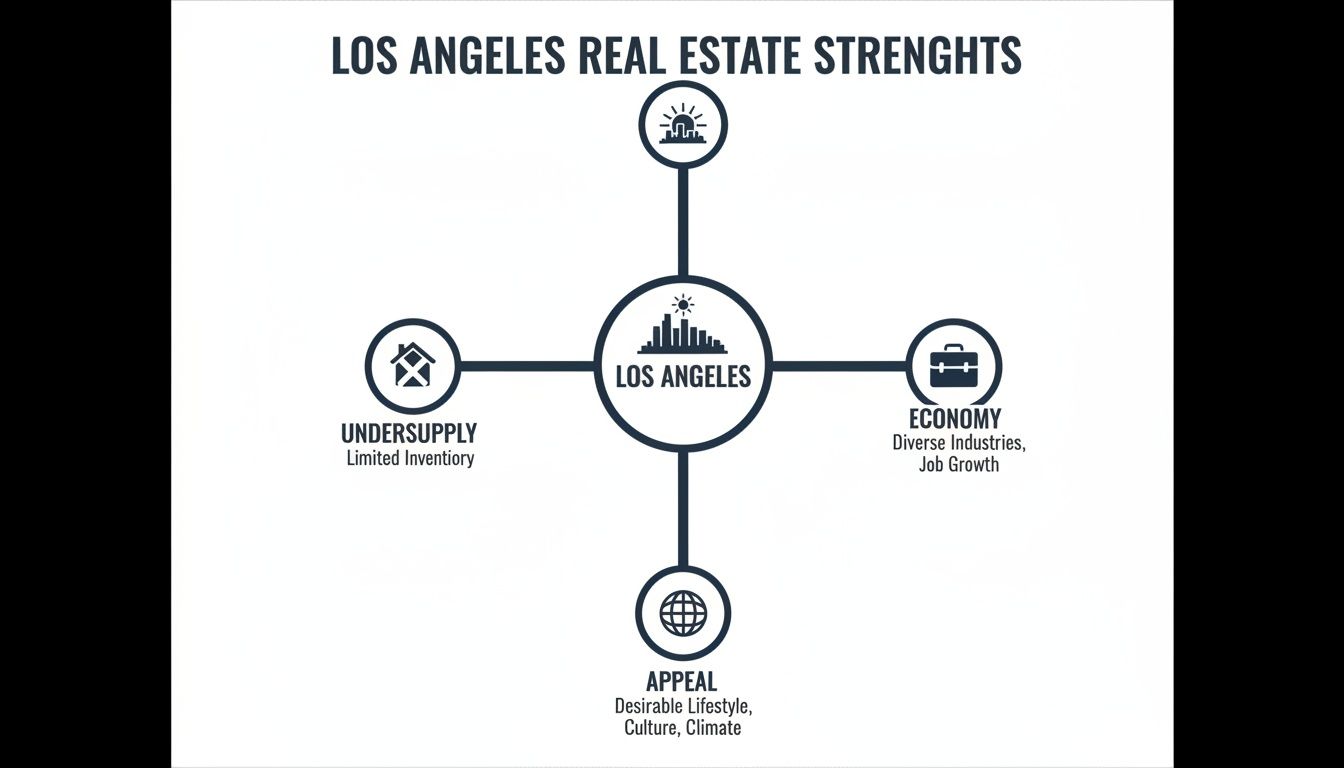
This image really drives home the point: even when short-term metrics fluctuate, L.A.'s fundamental strengths create a resilient foundation for long-term investment.
Understanding Months Of Supply
One of the most powerful yet often overlooked metrics is months of supply. This figure tells you how many months it would take to sell all the current homes for sale at the current sales pace. Think of it as the market's fuel gauge.
Low Supply (Under 5 months): This is a classic seller's market. With few homes available, competition heats up, and prices tend to rise.
Balanced Market (5-7 months): This is a state of equilibrium. Neither buyers nor sellers have a distinct advantage.
High Supply (Over 7 months): This signals a buyer's market. More homes are for sale than there are buyers, which can lead to price reductions and better terms for investors.
By tracking this single number, you can get a feel for the competitive landscape and anticipate where prices might be headed. It’s a foundational piece of information for any serious investor.
As Richard Maize puts it, "Data tells a story, but only if you know how to read the language. In Los Angeles, persistent demand and chronic undersupply are the main characters. Everything else is just part of the plot."
This insight is crucial because it frames how to interpret market changes. To give you a real-world snapshot, here’s a look at the key metrics for the L.A. market.
Los Angeles Real Estate Market Snapshot
This table provides a summary of the key performance indicators for the Los Angeles housing market, offering investors a quick overview of current conditions and recent changes.
Metric | Current Figure | Year-Over-Year Change |
|---|---|---|
Median Home Price | $955,000 | -0.6% |
Active Listings | 10,500+ | +17.6% |
Months of Supply | 2.9 Months | +0.4 Months |
Average DOM | 45 Days | +10 Days |
Long-Term Growth (Since 1982) | 5.3% Annually | N/A |
As you can see, the market is showing signs of normalization after years of intense appreciation. A slight dip in median price, combined with a significant 17.6% surge in listings, pushed the months of supply to 2.9, giving buyers a little more breathing room than they’ve had in a long time.
Turning Data Into Decisions
Market analysis isn't just an academic exercise; it's about making informed decisions. A disciplined approach, as championed by Richard Maize, involves synthesizing these data points to identify the right moments to act. When mortgage rates fluctuate, for instance, a smart investor assesses the immediate impact on buyer affordability and adjusts their offers accordingly.
This proactive stance allows you to capitalize on market dynamics rather than being controlled by them. When prices normalize, it can be the perfect time to acquire fundamentally sound assets backed by L.A.’s unwavering long-term demand. For those looking to build their own analytical framework, you can learn more from a real estate market analysis template from Richard Maize to start building your own data-driven strategy.
Finding Investment Hotspots Across LA Neighborhoods
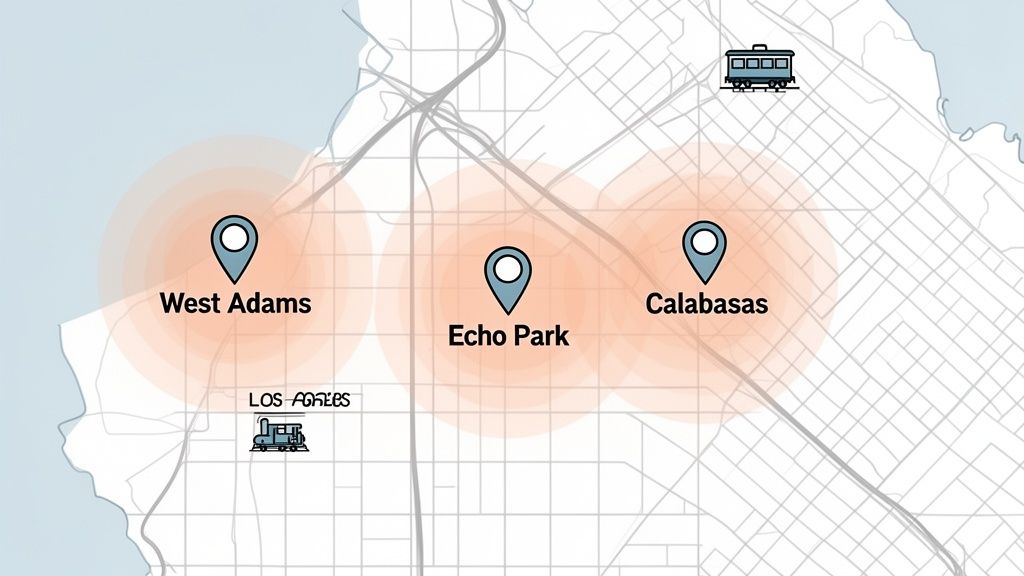
Great investors know a fundamental truth about real estate investing in Los Angeles: it’s not one market. It’s a sprawling collection of distinct micro-markets, each with its own personality, risks, and rewards. Thinking of LA as a single entity is like trying to paint a portrait with a roller brush—you completely miss the critical details that create value.
Following the philosophy of an expert like Richard Maize, who excels at finding opportunities across a diverse portfolio, the goal is to get beyond city-wide data and develop on-the-ground intelligence. It’s about understanding what really makes a neighborhood tick. Things like new infrastructure, evolving zoning laws, or even improving walkability scores can signal that an area is on the verge of a breakthrough, long before it ever shows up in the official stats.
This hyperlocal view is what allows you to match a specific location to your strategy, whether you're chasing aggressive capital appreciation or prioritizing stable, long-term rental income.
Identifying Areas of Opportunity
Los Angeles is in a constant state of reinvention, with some neighborhoods transforming far faster than others. For investors, these areas represent pockets of immense potential. The key is to dig into the unique drivers of growth in each location and see if they actually align with your goals.
Over the past eight years, Los Angeles home values have seen remarkable growth, averaging 54% across residential properties. But the real story is in the disparities between neighborhoods. An area like West Adams, for instance, skyrocketed a stunning 107%. While the citywide median sale price hit $1.00 million by December 2025 (up 2.0% year-over-year), the broader LA County cooled slightly to $890,910, proving how vital localized analysis is. You can discover more insights about these hidden gems in LA's stable neighborhoods.
Let’s look at three distinct neighborhood profiles to see this principle in action.
West Adams (High Growth Potential): Once overlooked, this area is now a textbook example of rapid appreciation. Its proximity to Culver City and major transit lines, combined with a beautiful stock of historic homes, has attracted a wave of new residents and development.
Echo Park (Trendy and Stable): Known for its vibrant culture, walkability, and closeness to Downtown LA, Echo Park offers a compelling blend of appreciation and strong rental demand. It's a solid market for investors seeking consistent cash flow in a desirable urban setting.
Calabasas (Established and Resilient): Representing the high-end, stable market, Calabasas is defined by its excellent schools, low crime, and luxury properties. The price of entry is high, but it offers a defensive investment with reliable, long-term value preservation.
Matching Neighborhoods to Your Strategy
Choosing the right neighborhood isn't just about finding the "best" area; it's about finding the best area for you. Your financial goals, risk tolerance, and timeline are what should dictate your search. An investor looking for a quick fix-and-flip project will have a completely different target than someone building a rental portfolio for the next few decades.
Richard Maize notes, "The smartest money in Los Angeles real estate isn't just chasing hot markets. It's identifying the fundamental value drivers in specific neighborhoods—transportation, schools, community—that create lasting wealth."
This perspective shifts the focus from speculation to strategic acquisition. For example, the expansion of the Metro Expo Line fundamentally changed the investment math for every neighborhood along its route, creating predictable value for those who were paying attention.
To put this into practice, think about how different investor profiles might approach the market:
The Growth Investor: This person would focus on areas like West Adams or Inglewood, where major infrastructure projects (like the Crenshaw/LAX Line) and commercial developments are unlocking new potential for capital gains.
The Income Investor: They might look to neighborhoods with high renter populations and stable employment, like Koreatown or Palms. These areas offer strong, consistent rental demand for multifamily properties.
The Wealth Preservationist: An investor with this goal would target established, high-demand areas like Calabasas or Beverly Hills, where real estate acts as a reliable store of value protected from market volatility.
Proven Investment Strategies for the LA Market
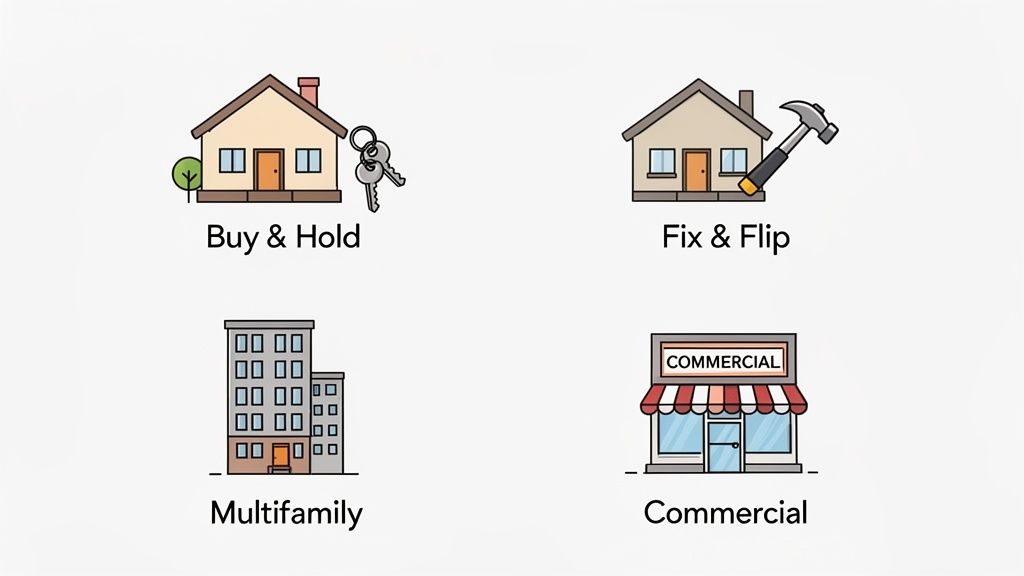
Knowing the market is one thing, but making money in real estate investing los angeles comes down to execution. This is where the real work begins. The right strategy, tailored to LA’s unique rhythm, is what separates a profitable deal from a very expensive lesson.
Richard Maize has learned from decades of experience that there isn't one "perfect" approach. Success comes from matching the right strategy to your own capital, risk tolerance, and goals. Drawing from his portfolio and expertise, we'll walk through four powerful approaches that work in this market.
Each one leverages a different piece of LA's complex puzzle, from its chronic housing shortage to its vibrant commercial scene. Understanding them is the first step to making smart, decisive moves in one of the world's most competitive arenas.
The Buy and Hold Strategy
The buy and hold is the bedrock strategy for building long-term wealth in Los Angeles. The idea is simple: you buy a property and hold it as a rental, generating steady cash flow while the asset (hopefully) appreciates over time.
In a city with a perpetual housing crunch, this approach is especially powerful. High home prices and a constant flow of people create a massive, built-in pool of renters. With major events like the FIFA World Cup and the Olympics on the horizon, that demand is only going to intensify, pushing rental income higher for landlords who get in now.
The key is doing your homework upfront. You have to run the numbers to make sure your rental income will comfortably cover the mortgage, taxes, insurance, and maintenance—with enough left over for profit and the occasional surprise vacancy.
The Fix and Flip Approach
For investors who are comfortable with more risk and have an eye for what buyers want, flipping a property can deliver much faster returns. The model is straightforward: buy an undervalued or rundown property, renovate it to boost its market value, and sell it for a profit, usually within a few months.
Los Angeles is full of older homes in great neighborhoods, which means there's a steady supply of potential projects. But the profit is made or lost in the details. You absolutely have to nail your estimates for renovation costs and the property's after-repair value (ARV). Get either one wrong, and your margin can disappear overnight.
Richard Maize often emphasizes the importance of a disciplined process: "Successful flipping isn't about grand visions; it's about budgets, timelines, and understanding what today's LA buyer wants. The profit is made when you buy, not just when you sell."
This means focusing on smart renovations that give you the biggest bang for your buck, like modernizing a kitchen or bathroom. It’s not about adding over-the-top features that your target buyer won't pay for.
Multifamily Property Investing
For anyone serious about scaling their real estate portfolio, multifamily is the natural next step. We're talking about duplexes, triplexes, or small apartment buildings—any property with two or more units. The advantage is obvious: you get multiple income streams from a single asset.
That built-in diversification is a powerful buffer. If one tenant leaves, you still have rent coming in from the others to cover your expenses. It creates a resilience that you just don't get with single-family rentals, which is why serious investors like Richard Maize love this strategy for building a cash-flowing portfolio.
Heading into 2026, the supply-demand gap in LA housing remains a structural issue. Zoning laws and high construction costs mean inventory is still tight, even as demand soars. This environment puts multifamily properties in a prime position for strong performance. To dig deeper, you can explore this Los Angeles housing forecast for 2026 and see what it means for investors.
Commercial Real Estate Opportunities
Beyond residential, commercial real estate opens up a completely different set of opportunities. This isn't just one thing; it includes everything from retail storefronts and office buildings to industrial warehouses. The big draw here is stability. Commercial leases are often much longer than residential ones, which means more predictable income.
In many cases, commercial tenants also cover expenses like property taxes and maintenance under what's called a triple-net lease, which reduces the landlord's day-to-day management burden. While this space requires a deeper level of market analysis, the potential for high, stable returns is significant. A strategic mix of commercial assets is often a key part of a well-balanced real estate portfolio, a principle Richard Maize has successfully applied for years.
Financing and Legal: The Investor's Shield
An incredible idea for a Los Angeles real estate investment is only as good as its financial and legal footing. Getting a deal over the finish line means mastering two very different but deeply connected challenges: securing the right kind of financing and navigating the city’s notoriously complex web of regulations.
This is the behind-the-scenes work that truly protects your capital and paves the way for long-term success.
Finding the Right Capital
For most people, financing starts and ends with a conventional mortgage. It’s a reliable path, especially for first-time investors with a solid W-2 income and great credit. But in a cutthroat market like Los Angeles, relying only on traditional bank loans can put you at a serious disadvantage against cash buyers and veteran investors who move much faster.
This is where creative financing becomes an investor’s secret weapon. Experts like Richard Maize often get an edge by structuring deals that don't rely on a bank's rigid timeline. This might involve seller financing, where the property owner essentially acts as the lender, or putting together partnerships to pool capital for a bigger asset. These approaches take more expertise, but they offer the kind of flexibility that can make or break a deal.
Understanding LA’s Regulatory Environment
Once you have a financing plan, your focus has to shift to the dense jungle of local laws. Los Angeles has some of the most detailed and pro-tenant regulations in the country, and pleading ignorance won’t save you. A single compliance failure can lead to crippling fines and legal battles that will sink an otherwise solid investment.
You absolutely have to get a handle on a few key areas:
Zoning Laws: These rules dictate exactly what you can build and how a property can be used. They are critical for anyone looking at a development play or hoping to add an Accessory Dwelling Unit (ADU) to generate more rental income.
Rent Control Ordinances: The Los Angeles Rent Stabilization Ordinance (RSO) puts strict limits on how much landlords can raise the rent each year and on the reasons for eviction. You must know if your property falls under the RSO. It’s a deal-breaker.
Property Tax Implications: California's Proposition 13 limits how much property taxes can go up each year, but a sale resets the clock. The property gets reassessed at its new market value, which can dramatically increase your holding costs. This needs to be baked into your numbers from day one.
From Richard Maize's perspective, "In Los Angeles, due diligence isn't just a box to check; it’s your primary defense. Understanding the specific regulations tied to a property—from rent control status to zoning limitations—is as important as the purchase price itself."
This really gets to the heart of it. The legal details define a property’s actual potential. An apartment building inside an RSO zone has a completely different financial future than one that's exempt.
Building Your Legal and Financial Foundation
To manage all these moving parts, building a local team isn't optional—it's essential. At a minimum, this team needs a real estate attorney who lives and breathes LA’s landlord-tenant laws and a mortgage broker who has deep experience with investment properties. Their guidance is what allows you to do thorough due diligence and uncover any red flags before you close.
This groundwork isn't just about avoiding problems. It's about building a risk-managed framework for your entire portfolio. By securing the right financing and meticulously following local regulations, you create a solid foundation that lets your real estate investing los angeles strategy actually work for years to come.
An Actionable Checklist for LA Real Estate Investing
Insight is only valuable when it leads to confident action. This final section pulls together the key lessons from this guide into a clear, step-by-step plan for your next deal.
Think of this as the practical roadmap that turns market knowledge into a closed transaction. It’s built on the same disciplined principles that successful investors like Richard Maize use to navigate the LA market.
This checklist will take you from initial analysis all the way to acquiring a property. It’s about building a repeatable process that cuts down on mistakes and boosts your chances of success in the competitive landscape of real estate investing los angeles.
Phase 1: Initial Strategy and Preparation
The work you do before you ever look at a property is often what determines the outcome. This phase is all about building a solid foundation.
Define Your Investment Thesis: What’s the primary goal here? Are you hunting for long-term cash flow with a buy-and-hold, or are you after faster returns with a fix-and-flip? Get specific about your financial targets and how much risk you're willing to take on.
Secure Financing Pre-Approval: In a market as fast as LA, having your financing lined up is non-negotiable. Getting pre-approved for a loan shows you exactly what your budget is and signals to sellers that you’re a serious, qualified buyer.
Assemble Your Local Team: You can't succeed in Los Angeles alone. You need to identify and vet a local real estate agent, a real estate attorney who knows LA's unique regulations, and a contractor you can trust. Their expertise is your most valuable asset.
Phase 2: Execution and Due Diligence
With your strategy and team in place, it’s time to find and analyze potential deals. This stage is all about meticulous research and execution. For a deeper look at this critical step, you can learn more from Richard Maize's commercial real estate due diligence checklist to help master your next deal.
"A great deal isn't found; it's made. It’s the result of disciplined analysis, on-the-ground intelligence, and the courage to act when the numbers make sense." - Richard Maize
Identify Target Neighborhoods: Use data on rental demand, property value trends, and local development projects to pick two or three micro-markets that fit your investment thesis.
Analyze Potential Deals: For every single property you consider, run the numbers. Calculate your potential cash flow, cash-on-cash return, and estimated after-repair value (ARV). Never let emotion override the data.
Conduct Rigorous Due Diligence: Once your offer is accepted, it's time for a thorough property inspection. Review all disclosures and verify the property’s legal status, paying close attention to things like rent control (RSO) and zoning.
Close the Deal and Execute Your Plan: Work with your team to navigate a smooth closing process. The moment you take ownership, start implementing your plan—whether that means kicking off renovations or marketing the property for rent.
Frequently Asked Questions
Diving into real estate investing in Los Angeles always brings up a few key questions, especially when you're just getting started in a market this competitive. Richard Maize has heard them all over the years. Below are answers to the most common ones, framed with the practical perspective you only get from being in the trenches.
Think of this as a quick way to clarify the big concerns and reinforce the core ideas we've covered.
Is Los Angeles A Good Place For Beginner Real Estate Investors?
Yes, but you have to be disciplined. The high cost of entry is no secret, and it can feel intimidating. But the flip side is LA’s powerful rental demand and a long, proven history of appreciation. For a newcomer, those fundamentals create real opportunity. The key is to start smart.
Don't try to hit a home run on your first deal. A beginner should be looking at more accessible plays, like a condo or a duplex in a neighborhood that's on the upswing but hasn't peaked yet. A classic strategy like house-hacking—where you live in one unit and rent out the other—is a fantastic way to let your tenant help pay down your mortgage while you learn what it really means to be a landlord.
As Richard Maize often advises, "Success for a new investor in LA isn't about timing the market perfectly. It’s about doing your homework, running the numbers meticulously, and having a solid financial plan before you ever make an offer."
What Are The Biggest Risks Of Investing In LA Real Estate?
The big three are market cycles, a complicated regulatory environment, and the sheer cost of getting in. If the market cools, short-term flippers can find their profits squeezed to nothing. At the same time, California has some of the most tenant-friendly laws in the country, and navigating things like rent control without making a costly legal mistake requires real diligence.
The way you manage these risks is by focusing on properties with strong cash flow from day one. You want an asset that can ride out an economic downturn without breaking you. It’s also why Richard Maize always stresses a long-term mindset over chasing quick, speculative gains. A diversified portfolio, which is a cornerstone of his own strategy, is what insulates you when one part of the market goes sideways.
Should I Invest In Single-Family Or Multifamily Properties In LA?
That really comes down to your capital, your goals, and how hands-on you want to be.
Single-Family Homes: These are usually simpler to manage and can see fantastic appreciation. They're a solid choice if your primary goal is capital growth over the long haul.
Multifamily Properties: A duplex or a small apartment building gives you multiple income streams from one property. That means more stable cash flow and a much clearer path to scaling up your portfolio.
Honestly, given LA's chronic housing shortage and intense rental demand, Richard Maize believes multifamily is often the smarter play for serious investors. It’s how you build a resilient, income-producing portfolio that lasts.
At Richard Maize, we believe that informed investors make the best decisions. Explore real-world insights, expert commentary, and a wealth of resources designed to guide your journey in real estate and beyond. Discover what's possible at https://richardmaize.com.
Comments