An Expert Analysis of Los Angeles Real Estate Market Trends by Richard Maize

The Los Angeles real estate market is a study in contrasts. It’s a landscape of intense demand, stubbornly low inventory, and affordability hurdles that can feel daunting. With mid-tier home prices floating around $755,000—more than double the national average—it’s clear that navigating this market requires more than just a surface-level glance. My goal is to provide that deeper perspective, drawing on decades of experience to help you understand the forces at play.
Understanding the Current LA Real Estate Landscape
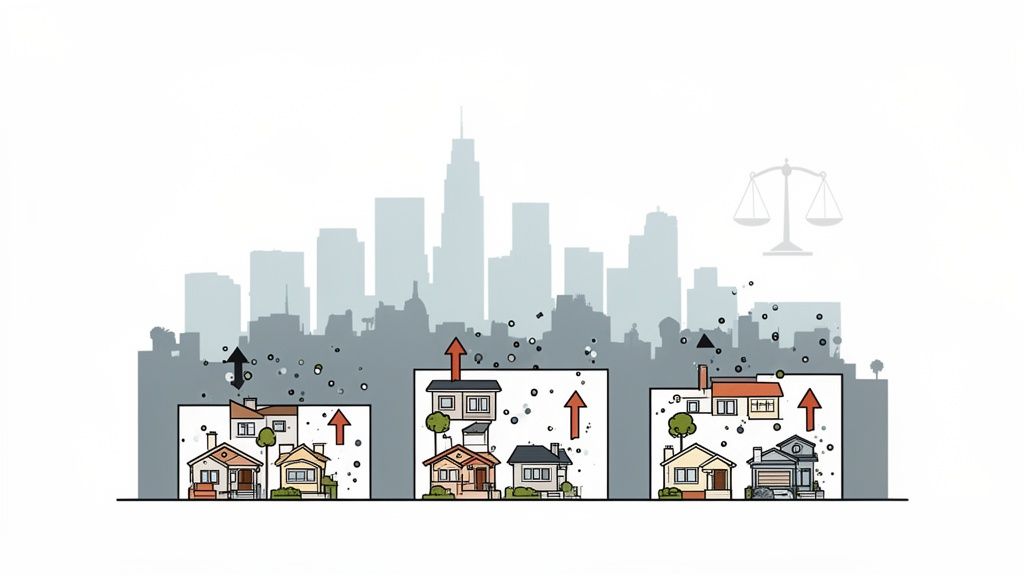
To make sense of LA real estate, I always advise thinking of it less like a single market and more like a living ecosystem with its own seasons and microclimates. It’s a complex system with countless moving parts. To cut through the noise, this guide is built on my perspective as a real estate expert, shaped by decades of navigating these very currents.
This section will give you a clear, grounded overview of where the market stands today. We’ll look at the core forces at play—from price points and inventory levels to the constant tug-of-war between demand and what people can actually afford. Think of this as setting the stage for the deeper analysis to come.
The Foundation: Supply and Demand
At its core, the story of the LA market is one of fierce competition for limited space. The city's powerful economy, cultural magnetism, and diverse job market keep fueling demand. At the same time, the supply of available homes just can’t seem to keep up.
This fundamental imbalance props up a seller’s market in many neighborhoods, even when the broader economy seems shaky. This is a concept I insist is the starting point for anyone looking to enter this market.
"Understanding the persistent supply-demand gap is the first step to making sense of Los Angeles real estate," I often explain. "It’s the engine that drives price appreciation and market resilience, even during periods of national economic uncertainty."
Key Dynamics Shaping the Market Today
Several factors are actively shaping LA’s real estate trends right now. As an expert, I see how they all interact, and any smart investor or homebuyer needs to understand this interplay.
The Affordability Squeeze: With home prices double the U.S. average, the dream of homeownership is tough. In 2025, it's projected that only about 23% of California households will be able to qualify for a mortgage on a mid-tier home.
Locked-In Inventory: The number of homes for sale is still tight. Many current homeowners are sitting on low mortgage rates and are understandably hesitant to sell, only to buy again at today's higher rates. This "lock-in" effect keeps supply artificially low.
Price Stabilization: After the blistering growth we saw between 2020 and 2022, prices are showing signs of leveling off. This isn’t a sign of a crash, but rather a market adjusting to new economic realities.
These are the core dynamics creating the environment for every transaction happening today. They are the foundational principles you need to grasp before you can navigate the market with confidence. For those ready to go further, you can learn more about navigating Los Angeles real estate with expert insights from Richard Maize.
A Deep Dive into County-Wide Price Movements
To really understand the Los Angeles real estate market, you have to look past the short-term noise. The market isn’t just a random collection of neighborhoods; it’s a massive ecosystem driven by powerful, long-term currents. These currents—shaped by major economic forces—create the waves of appreciation and correction that define the entire region.
For a seasoned investor like myself, this historical context is everything. I see the market not as a series of unpredictable events, but as a system with cycles and patterns. This long-view perspective is what separates a genuine opportunity from market chatter. It’s how you make decisions based on strategic patience, not passing headlines.
When you analyze decades of data, a clear picture emerges—one of both incredible resilience and sharp volatility. Those historical precedents are the bedrock for making smart decisions today. Past performance becomes a guide for future investment.
The Macro Forces Shaping LA County Real Estate
A few powerful factors influence property values across Los Angeles County. Don't think of them as isolated events. They're interconnected systems that collectively steer the market. As an expert, I don't just look at one; I analyze how they all interact.
Here are the key drivers I watch:
Economic Health: Los Angeles is an economic powerhouse. When industries like entertainment, tech, and international trade are humming, job growth and rising incomes fuel housing demand. That pushes prices up.
Interest Rate Environment: The cost of money has a direct and immediate impact. Lower rates make mortgages more affordable and get buyers moving. Higher rates tend to cool things down and stabilize prices.
Migration and Population Trends: The flow of people into and out of LA County constantly puts pressure on housing. The region’s global appeal ensures a steady stream of new residents, which keeps demand strong over the long run.
These macro signals are the big-picture indicators that savvy investors watch. They provide the essential context for why prices move the way they do and help forecast broader market shifts.
Historical Appreciation and Market Cycles
The long-term story of LA real estate is one of dramatic growth. The market has pushed through economic downturns, interest rate hikes, and global crises, consistently proving its ability to recover and climb to new heights. That resilience is a hallmark of its enduring appeal.
A look at the historical data tells the story. From the end of 1990 to the end of 2022, the median sales price for single-family homes in LA County shot up by a stunning 275.69%. That breaks down to an average annual appreciation rate of 8.62% over 32 years. A home that sold for $212,885 in 1990 had ballooned to $799,670 by 2022, hitting peaks during the pandemic and seeing dips like the -6.46% drop in 2011. You can dig deeper into the numbers on Los Angeles home appreciation rates to see the full picture.
From my perspective, these numbers tell a story of opportunity for those who can withstand the ride. “The market will always have its peaks and valleys,” I often note. “The key isn’t to time the market perfectly but to understand its fundamental strength and invest for the long term. True value is built through cycles, not in spite of them.”
This perspective changes everything. It turns volatility from a risk into a strategic advantage. While short-term speculators get burned by sudden shifts, investors who understand the historical cycles can identify moments to enter the market with confidence. They know the underlying trend has consistently pointed up. That’s the essence of building lasting wealth in one of the world's most competitive real estate landscapes.
Gauging Market Momentum with Key Indicators
How do you really take the market’s pulse? It’s not about reacting to headlines or nightly news soundbites. True market understanding comes from a disciplined focus on a few key indicators—the vital signs that tell the real story of the market’s health, stress, and direction. In my experience, when you learn to weave these data points together, you start to see a clear, objective picture of what’s actually happening in Los Angeles. It’s the difference between spotting a minor seasonal dip and identifying a major, long-term shift.
The All-Transactions House Price Index
Think of the All-Transactions House Price Index as a stock market index, like the S&P 500, but for real estate. It’s a powerful tool because it tracks the price changes of all residential properties in an area, smoothing out the noise from individual sales to show you the bigger trend.
The index for Los Angeles County tells a compelling story. It recently hit a record high, reflecting nearly fourfold growth from its benchmark era. We saw the index climb from 281.70 in 2020 to 398.42 in recent years—that’s a blistering compound rise averaging over 12% annually. But the market is also sending some softer signals, with some reports showing average home values down 2.4% year-over-year and median sales off by 9.05% from the prior year. You can dive deeper into the federal housing price index movements in Los Angeles County to see the full picture.
In my expert opinion, "The House Price Index is your compass. It shows you the long-term direction, helping you see past the short-term storms of monthly price fluctuations and media hype."
This big-picture view is essential. It keeps you from making reactive decisions based on temporary market chatter and anchors your strategy in solid, long-term data.
To bring these metrics to life, here's a quick snapshot of the key indicators shaping the Los Angeles market right now.
Key Los Angeles Real Estate Market Indicators At a Glance
This table summarizes the critical metrics we're discussing, providing a snapshot of current market conditions compared to the previous year and highlighting what these trends mean for investors from my professional viewpoint.
Market Indicator | Current Figure | Year-Over-Year Change | What This Tells Investors (My Expert Insight) |
|---|---|---|---|
House Price Index (LA County) | 398.42 | Up from 281.70 in 2020 | "The long-term trend remains strong, but watch for signs of deceleration. This isn't the time for short-term flips; it's about strategic, long-term holds." |
Average Home Value | Varies by neighborhood | Down approx. 2.4% | "A slight cooling is healthy. It shifts power back toward disciplined buyers and creates opportunities for those who aren't overleveraged." |
Median Sales Price | Varies by neighborhood | Down approx. 9.05% | "This reflects a price correction, not a crash. Sellers are having to be more realistic, which is good for buyers who have been waiting on the sidelines." |
Average Days on Market (DOM) | Varies by neighborhood | Trending Upward | "When DOM creeps up, it means buyers have more time and leverage. Patience becomes a powerful negotiating tool for investors." |
Total Sales Volume | Varies by neighborhood | Trending Downward | "Lower volume signals reduced buyer urgency and affordability constraints. It’s a leading indicator that the market is normalizing." |
This data confirms that while long-term appreciation is a powerful force in LA, the market is currently in a phase of adjustment. For savvy investors, this isn’t a signal to retreat, but a clear sign to adapt their strategy.
Interpreting Days on Market and Sales Volume
Beyond the big index, two other indicators give you a more immediate feel for the market’s temperature: Average Days on Market (DOM) and Sales Volume. These metrics reveal the real-time balance of power between buyers and sellers.
Average Days on Market (DOM): This is simply the median number of days a property is listed before an offer is accepted. I think of it as a measure of buyer urgency. A low DOM means a hot market where buyers are competing fiercely. A rising DOM points to cooling demand, giving buyers more room to negotiate.
Sales Volume: This is the total number of homes sold in a given period. High sales volume shows a confident, active market. When volume starts to drop—even if prices hold steady—it can be an early warning that buyer enthusiasm is fading or affordability is becoming a real hurdle.
These two metrics work together. A rising DOM combined with falling sales volume is a classic sign of a market shifting in the buyer's favor. On the flip side, a low DOM and high volume signal intense seller advantage. To truly master this level of insight, you may find value in this guide to creating a real estate market analysis template from Richard Maize. When you combine these key performance indicators, you move from guessing to knowing where the market stands—and where it might be headed next.
Finding Opportunity in LA's Micro-Markets
Los Angeles real estate is not one market. It’s a collection of dozens of smaller, distinct markets, each with its own rhythm, personality, and economic drivers. While county-wide data gives you the big picture, the real opportunities—the ones that build serious wealth—are found at the neighborhood level.
As an experienced investor, I know the secret to winning in LA is to ignore the city-wide averages and get your boots on the ground. It’s about understanding why one neighborhood is taking off while another, just a few miles away, is flat. It’s about seeing the quiet signs of change before they make headlines.
This chart shows just how different the core metrics can be from one area to the next.
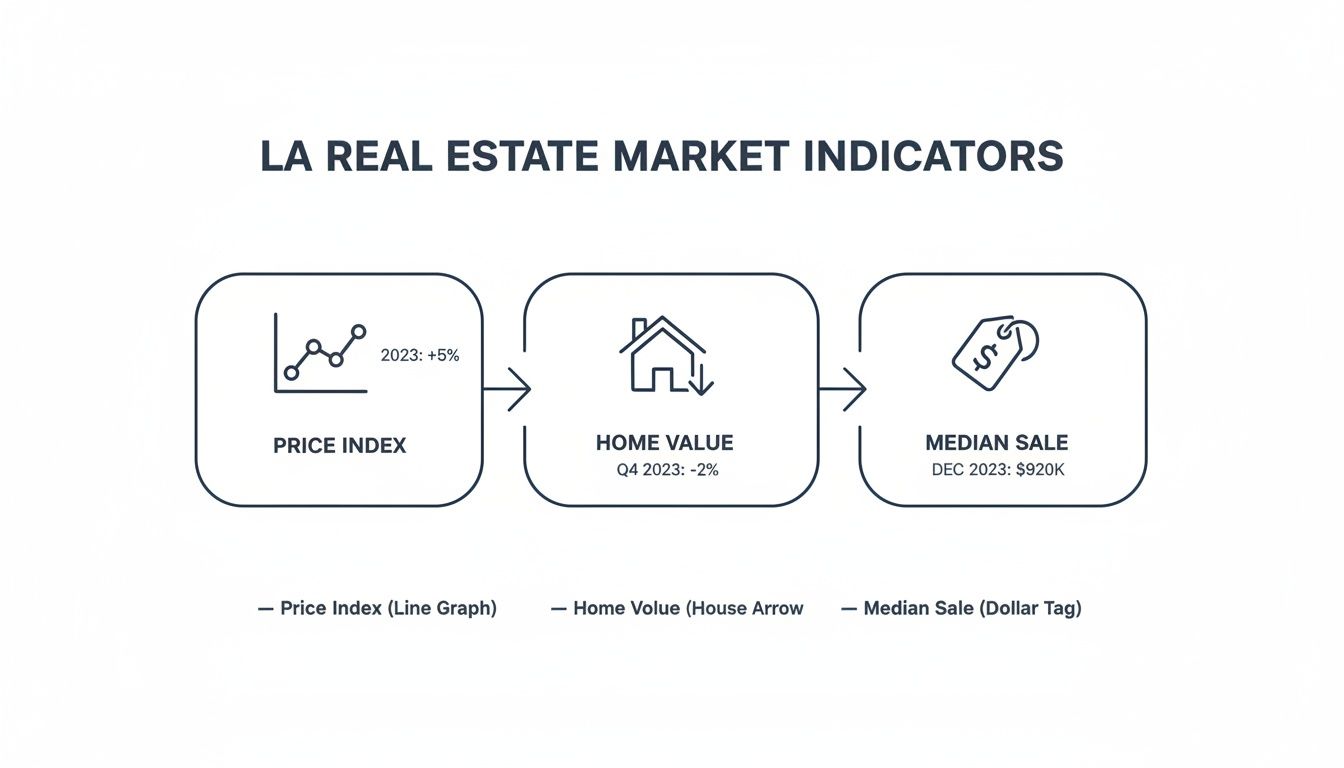
When you track things like price indexes and median sales prices at this granular level, you start to spot where the real momentum is building.
The Uneven Landscape of Appreciation
The idea of "average" appreciation is almost useless in a market as diverse as Los Angeles. The real story is one of dramatic imbalance.
Recent data makes this crystal clear. Over the last eight years, assessed residential property values across the county climbed by an average of 54%. But the real story was in the pockets. Some neighborhoods exploded by as much as 107%, while established, wealthy areas like Calabasas grew at just a third of that speed.
A perfect example is Leimert Park, a historic Black community where values shot up 79%. It’s gone from an affordable haven to a hot ticket, catching the eye of investors who recognized its potential early. You can dig deeper into how Los Angeles property values have shifted in different neighborhoods.
This proves a fundamental rule of LA investing: where you buy matters just as much as when you buy. An investor who only follows broad los angeles real estate market trends would completely miss the phenomenal growth happening in these smaller, emerging areas.
Richard Maize on Spotting Emerging Submarkets
So, how do you find the next Leimert Park before everyone else does? In my experience, it’s about becoming a student of neighborhood-level change. I advise looking for a few key factors that signal an area is about to turn a corner.
"True opportunity isn't found in a spreadsheet alone," I often say. "It's found by walking the streets and seeing the early signs of investment—a new coffee shop, a renovated park, or a fresh coat of paint on a commercial building. These are the leading indicators of rising confidence and, eventually, rising property values."
My approach is built on spotting three core signs of a neighborhood’s transformation:
New Infrastructure and Public Investment: Look for cranes in the sky and shovels in the ground. Is a new Metro line being extended? Are parks getting a facelift or streets being repaved? These projects don’t just improve quality of life; they’re a massive vote of confidence in an area’s future.
Changing Demographics and New Business: Pay attention to who is moving in and what they’re building. An influx of young professionals or artists brings new energy and demand. When you see independent boutiques, specialty coffee shops, and good restaurants start to pop up, you’re seeing the early stages of a neighborhood redefining itself.
Community-Level Revitalization: Watch for organic, ground-up improvements. Are older homes being fixed up? Are community gardens appearing on once-empty lots? This kind of grassroots investment shows that residents are committed to the area’s long-term health, creating a positive cycle that attracts even more money and attention.
By focusing on these on-the-ground signals, you can stop reacting to what has already happened and start identifying areas with real, untapped potential. That’s the core of a smart, neighborhood-aware strategy for the Los Angeles market.
Actionable Strategies for Today's LA Market
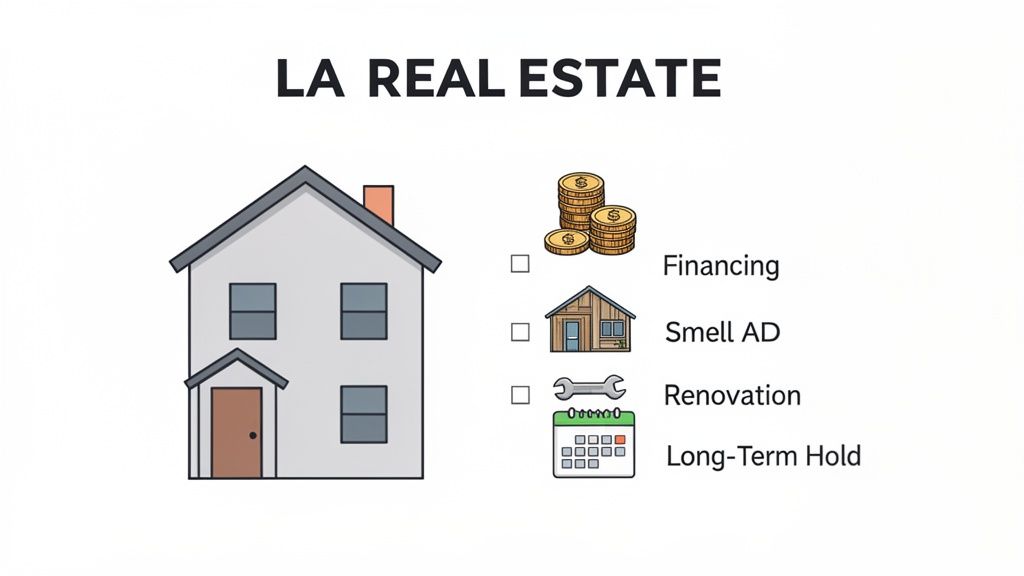
Knowing the numbers behind LA's real estate trends is one thing. Turning that data into a winning strategy is an entirely different game.
The market we're in now—with higher interest rates and prices finding their footing—demands a more disciplined approach than the frantic pace of the last few years. Success now hinges on smart tactics, whether you're a first-time buyer, a seasoned investor, or a developer.
This is where the philosophy I've built my career on becomes critical. It’s about looking past the quick wins to focus on creating long-term value and making a positive impact on the community.
Navigating the Higher Interest Rate Environment
The era of rock-bottom mortgage rates is over. This new reality demands a complete shift in financial strategy. Higher rates directly hit affordability, shrinking purchasing power for buyers and squeezing margins for investors.
But for those who come prepared, they also create opportunity.
The first move is to strengthen your financial position before you even start looking. That means polishing your credit score to lock in the best possible terms and boosting your down payment. A larger down payment can dramatically lower your monthly mortgage, making a property far more sustainable in this climate.
"Higher interest rates test an investor’s discipline," I always note. "They reward those who prioritize solid fundamentals over speculative bets. It's a return to classic, value-driven real estate investing."
It’s also wise to explore all your financing options. While a 30-year fixed loan is the standard, an adjustable-rate mortgage (ARM) could offer a lower initial rate. This can be a strategic play if you plan to refinance in a few years when rates might have settled. For a deeper look at this, you can learn more about how interest rates impact the real estate market and the moves investors should consider.
Identifying True Value-Add Opportunities
In a market where you can't count on rapid appreciation, the focus has to shift from buying anything and watching it grow to creating that value yourself. This has always been the core of my approach: finding properties with untapped potential and transforming them.
A genuine "value-add" opportunity is more than just a fixer-upper needing a coat of paint. It's about seeing what a property could be.
Underutilized Land: Look for homes on large lots where you could add an Accessory Dwelling Unit (ADU). California’s ADU-friendly laws have made this one of the most powerful ways to boost a property’s value and generate new rental income.
Zoning Potential: Do your homework on local zoning. Can that single-family home be legally converted into a duplex? Is the lot in an area slated for higher-density development? Understanding these rules can unlock a property's hidden potential.
Functional Obsolescence: Keep an eye out for homes with dated layouts that don't work for modern life—think closed-off kitchens or a shortage of bathrooms. A smart renovation that improves a home’s flow can deliver a serious return on your investment.
This strategy requires more than capital; it requires vision. It's about improving a property in a way that not only grows its financial worth but also makes it a better part of the neighborhood.
The Long-Term Hold and Community Focus
The "quick flip" model is incredibly dangerous in today’s market. With slower price growth and higher borrowing costs, profit margins on short-term projects can vanish overnight.
A far more resilient strategy is the long-term hold, which aligns perfectly with building sustainable wealth.
Holding a property for the long haul allows you to ride out market cycles, build equity as you pay down the mortgage, and benefit from steady, long-term appreciation. It also changes your mindset from that of a speculator to a community stakeholder. When you own a property for years, you become invested in the health of the entire neighborhood.
This is where the emphasis on community impact really comes into play. A successful long-term investment grows with its surroundings. By adding a well-designed ADU, you're not just increasing your asset value; you're adding desperately needed housing. By renovating an older home, you're not just updating a building; you're helping revitalize a block.
This creates a positive feedback loop: your investment improves the community, and an improving community boosts the value of your investment.
Richard Maize's Outlook on the Future of LA Real Estate
So, where does the Los Angeles real estate market go from here? The real answer is to stop looking for a single prediction and start thinking strategically.
The fundamentals that make LA such a resilient and globally desired market aren’t going anywhere. A powerful economy, deep cultural magnetism, and a persistent housing shortage are the bedrock here.
These core strengths act as an anchor, grounding the market even when the national economic tides get choppy. We’ve already seen how prices are finding their footing after a period of intense growth. The era of easy gains is behind us. What’s replaced it is a climate that rewards discipline, vision, and a granular understanding of how individual neighborhoods work.
"The Los Angeles market always finds its equilibrium. For those who combine rigorous analysis with a genuine understanding of the city’s unique character, opportunities will always exist. True value is created through smart, patient investment, not by chasing fleeting trends.”
A Future Built on Informed Optimism
The future of LA real estate belongs to those who adapt. Success won’t come from risky flips, but from thoughtful, value-add strategies and long-term holds. Developing ADUs to meet real housing needs is a perfect example of this.
The core message from my perspective is one of informed optimism.
Navigating the los angeles real estate market trends means seeing beyond the headlines. By focusing on solid fundamentals and community-focused projects, both investors and homebuyers can build lasting wealth. More importantly, they can contribute to the city's growth, regardless of what the market does in the short term.
A Few Common Questions About the LA Market
The Los Angeles real estate market is complex. It brings up more questions than answers for most people, whether they're buying a home or investing. Here are a few of the most common ones I hear, with some perspective grounded in experience.
Is Now a Good Time to Buy in Los Angeles?
This is the big question, and there's no simple yes or no. It really comes down to discipline. For a disciplined buyer, the current market stabilization is opening a window of opportunity.
Price growth has slowed down and the bidding wars have mostly disappeared. That gives buyers what they haven't had in years: time. Time to do their due diligence and actually negotiate. My advice is always to focus on long-term value, not short-term wins. If you find a solid property in a good micro-market and it fits your financial plan, today’s climate offers a much healthier buying experience.
How are Higher Interest Rates Affecting the Market?
Higher rates have definitely cooled things down, mostly by hitting affordability hard. It's squeezed some buyers out of the market entirely, which has reduced overall demand. You can see the effect in the slowdown in sales and how much longer homes are sitting on the market.
“Interest rates are a test of an investor’s fundamentals,” I often say. “They shift the focus from speculative appreciation to sustainable cash flow and genuine value creation. It’s a market that rewards preparation and patience.”
This environment also creates what's called the "lock-in" effect. So many homeowners are sitting on ultra-low mortgage rates and are simply unwilling to sell, which is a big reason why inventory remains so tight.
Where are the Best Opportunities for Growth in LA?
The real opportunities are rarely in the established, brand-name luxury areas. They're in the emerging micro-markets. As we've discussed, the neighborhoods to watch are the ones showing clear signs of life—public investment in infrastructure, new local businesses opening up, and a general sense of revitalization.
An investor who thinks like I do would look past the obvious choices. They'd be researching areas with changing zoning laws that encourage new development, like adding Accessory Dwelling Units (ADUs). That kind of change can instantly boost a property’s income potential and its long-term value.
What’s More Important: Long-Term Appreciation or Monthly Cash Flow?
In the current climate of los angeles real estate market trends, a balanced strategy is the only one that makes sense. LA has a long history of powerful appreciation, but you can't bet the farm on it alone, especially when the market is correcting.
Positive cash flow is what gives you stability. It covers your mortgage and your costs while you wait for the property’s value to grow. I've always emphasized that a property that can pay for itself is a resilient asset. It can weather any market cycle without forcing you into a bad sale.
At Richard Maize, we believe that informed decisions are the foundation of any successful real estate investment. To explore more of my insights and learn about our approach to creating value, you can visit us at richardmaize.com.
Comments