Mastering Commercial Real Estate Investment Strategies with Richard Maize

Commercial real estate investment isn't about finding a secret formula. It's about having a clear framework—a strategy that aligns with your capital, your stomach for risk, and where you want to be in ten or twenty years. As veteran investor Richard Maize has demonstrated over a multi-decade career, success is built on a foundation of disciplined, strategic thinking.
These strategies run the gamut, from stable, low-risk income plays to high-stakes development projects. The right one for you is the one that fits your specific financial goals.
Building Your Foundation in CRE Investing
Stepping into commercial real estate can feel like you’ve been handed a complex map with no compass. Success isn’t about finding one “perfect” path—it’s about choosing the route that leads directly to your financial destination.
Whether you're after steady, predictable cash flow or more aggressive growth, your approach has to be intentional from day one.
To make these concepts real, we'll lean on insights from veteran investor Richard Maize. His decades of experience in the brutally competitive Los Angeles market offer a masterclass in how to apply these different strategies to build lasting wealth.
Why a Strategic Mindset Is Non-Negotiable
Today’s market demands more than just capital. It demands clarity. With unpredictable economic shifts, seesawing interest rates, and new financing hurdles, investors without a plan are just gambling. A well-defined strategy is the filter that helps you spot the right opportunities and, just as importantly, walk away from the wrong ones.
As Richard Maize often emphasizes, "The most successful investors don't just find good deals; they find the right deals for their specific portfolio. Your strategy is the blueprint that separates speculation from sound investment."
This strategic mindset is the bedrock of a resilient portfolio. It means understanding not just the asset itself but all the economic forces pushing and pulling on it. This is where solid market analysis becomes critical. To sharpen your own skills, you can learn a lot from Richard Maize's real estate market analysis template.
A Preview of Key CRE Strategies
Think of this guide as your roadmap. We’ll start with the fundamentals and build from there, demystifying the primary commercial real estate investment strategies you’ll come across.
We will break down the big three categories:
Core and Core-Plus: The bedrock of many portfolios. These are stable, income-producing properties with lower risk profiles. Think well-occupied office buildings in prime locations.
Value-Add: This is where you roll up your sleeves. It involves finding underperforming assets and forcing appreciation through smart improvements or management.
Opportunistic: These are the high-risk, high-reward plays. They often involve ground-up development or turning a completely distressed asset around.
Once you understand the risk and return for each, you can start building a balanced portfolio that not only grows but also stands strong through market cycles. This is the first step on that journey.
Investing in commercial real estate isn't a single game with one set of rules. It’s more like a spectrum, with different strategies offering unique combinations of risk and reward. Understanding where you want to be on that spectrum is the first step toward making a smart investment.
The four main strategies—Core, Core-Plus, Value-Add, and Opportunistic—give us a framework for this. Think of it like this: a Core investment is like buying a reliable, dividend-paying blue-chip stock. An Opportunistic deal, on the other hand, is like getting in on the ground floor of a tech startup—the upside could be massive, but so is the risk.
Let's break down what each of these really means in practice.
Core Strategy: The Bedrock of Stability
A Core strategy is the most conservative approach you can take. It’s all about buying high-quality, fully stabilized buildings in top-tier locations. We’re talking about Class A office towers in major city centers or grocery-anchored shopping centers in wealthy suburbs, filled with tenants on long-term, credit-backed leases.
The goal here isn't a quick flip or dramatic growth. It's about predictable, long-term cash flow and making sure your capital is preserved. The returns come almost entirely from rent checks, not from trying to force the property’s value up. That’s why Core deals use very conservative financing, with debt usually under 50% of the total cost.
A perfect example is a fully leased medical office building right next to a major hospital. The leases are long, the anchor tenant is as stable as they come, and the location is irreplaceable. You're not trying to reinvent the wheel; you're just collecting rent from a very dependable asset.
Core-Plus Strategy: Minor Tweks for Better Returns
Moving just a little further up the risk ladder, we get to Core-Plus. These are essentially solid Core properties that have one or two small things that could be improved. The building is high-quality and mostly occupied, but there's an opportunity to boost income with some light-touch enhancements or more hands-on management.
For instance, you might find a well-located apartment building where the lobby and common areas look a bit dated. A small investment to modernize those spaces could justify raising rents across the board, pushing up the Net Operating Income (NOI) without needing a full-blown renovation.
This strategy gives you a nice mix of stable income with a bit of growth potential. The target returns are a step above Core, and the leverage might inch up into the 50-60% range to cover those small capital improvements.
Value-Add Strategy: Creating Value Through Transformation
This is where an investor’s experience really shines. A Value-Add strategy is about finding an underperforming property—one with real problems, either physical or operational—and executing a plan to turn it around. As veteran investor Richard Maize understands, this requires deep market knowledge and a clear vision for what a property could be.
Value-Add opportunities come in a few different flavors:
Physical Redevelopment: Taking an old, dated industrial warehouse and upgrading it with higher ceilings and modern loading docks to attract today’s e-commerce tenants.
Operational Turnaround: Buying a mismanaged apartment building with high vacancy, bringing in professional management, and executing a strategic lease-up plan.
Repositioning an Asset: Converting an old, functionally obsolete office building into modern residential lofts in a neighborhood that’s on the upswing.
These deals require more capital and carry more risk. The financing is often shorter-term, like a bridge loan, with the goal of refinancing into permanent debt once the property is stabilized and cash-flowing. The entire point is to force appreciation and generate a big return when you sell or refinance, which is why leverage often hits 65-75%. Richard Maize’s work with vacant buildings that are prime for redevelopment is a textbook example of a hands-on Value-Add play.
Opportunistic Strategy: High Risk for High Reward
At the far end of the spectrum is the Opportunistic strategy. These investments are the riskiest, but they also offer the highest potential returns, often targeting an Internal Rate of Return (IRR) of 20% or more. Opportunistic deals usually involve ground-up development, buying totally vacant buildings, or investing in unproven niche asset types.
An Opportunistic investor might buy a piece of raw land in an area they believe is the next path of growth, with plans to build a new mixed-use project from scratch. Or they might acquire a portfolio of distressed, non-performing loans from a bank at a steep discount.
These investments are complex, speculative, and rely heavily on both flawless execution and future market growth. The capital stack often involves higher-cost debt and a lot of equity because traditional lenders get nervous about financing such high-risk projects. This is that off-road expedition—it demands expert navigation, deep pockets, and a stomach for the unknown, all for a shot at a truly exceptional outcome.
To make these distinctions clearer, it helps to see them side-by-side.
Comparing The Four Main CRE Investment Strategies
Strategy | Risk Profile | Target Return (Annualized) | Typical Leverage | Asset Condition & Occupancy |
|---|---|---|---|---|
Core | Low | 7-10% | < 50% | Excellent condition, 90%+ occupied with credit tenants |
Core-Plus | Low to Moderate | 9-12% | 50-60% | Good condition, minor improvements needed, 80-90% occupied |
Value-Add | Moderate to High | 12-18% | 65-75% | Needs renovation/repositioning, below-market rents or vacancy |
Opportunistic | High | 18%+ | > 70% (often complex) | Ground-up development, major repositioning, or distressed assets |
Each strategy serves a different purpose in a portfolio. There’s no single “best” approach; the right one depends entirely on an investor's goals, timeline, and tolerance for risk.
How to Choose the Right Strategy for Your Portfolio
Choosing the right commercial real estate strategy isn’t about chasing the highest possible return. It's a disciplined process. It’s about matching your capital, your stomach for risk, and your long-term goals with a real-world opportunity. This is where theory ends and execution begins.
A smart approach always starts with a 30,000-foot view of the market before zooming in on the details of a single building. That systematic evaluation is what separates strategic investing from pure speculation.
The pyramid below lays out the relationship between the four main commercial real estate strategies. As you move up from the stable base of Core to the peak of Opportunistic, both the risk and the potential reward increase.
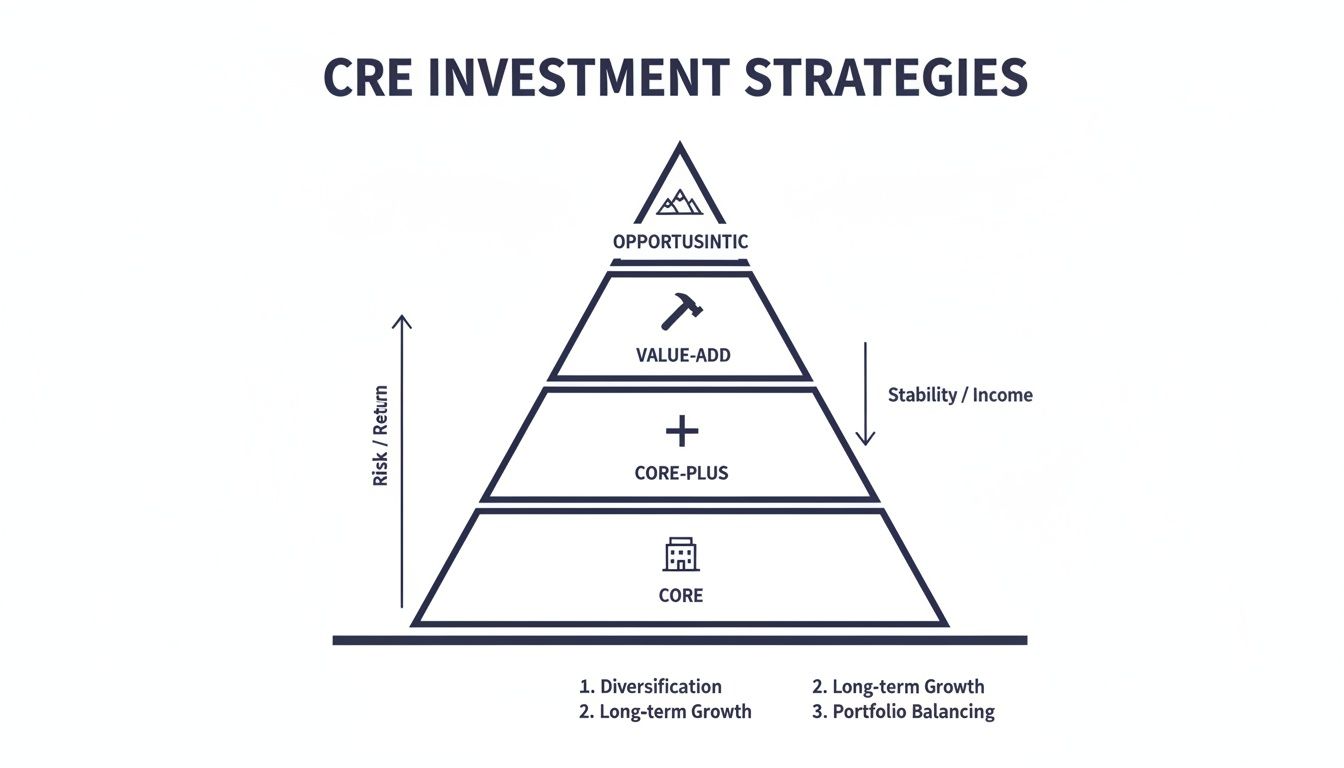
This hierarchy shows how Core strategies form a stable foundation. The higher-risk, higher-reward plays like Value-Add and Opportunistic build on that base, demanding far more capital and hands-on management.
Mastering Market Analysis and Submarket Selection
Before you even think about a specific property, you have to understand the neighborhood it’s in. Veteran investors like Richard Maize built their careers on an almost intuitive sense for identifying promising pockets within a major city like Los Angeles. This isn't magic; it comes from a deep and rigorous analysis of the fundamentals.
Start by looking for the vital signs of a healthy, growing submarket:
Job Growth: Are companies moving in or expanding? A strong local economy is the engine that drives demand for all types of commercial space.
Population Trends: Is the area attracting new residents? This is a critical signal for multifamily and retail demand.
Infrastructure Investment: Are there new transit lines, highway upgrades, or public projects in the works? These investments are catalysts for future appreciation.
When you focus on submarkets with these tailwinds, you’re already stacking the odds in your favor. A great property in a declining area will always struggle, but even an average property in a thriving submarket has a strong chance to succeed.
Financial Modeling and Underwriting an Asset
Once you’ve locked in on a promising submarket, the focus narrows to the asset itself. This is where your financial model becomes your most important tool. Underwriting is the process of building a detailed financial forecast for a property, stress-testing every single assumption to see if the deal can withstand pressure.
Your model needs to project everything—rental income, operating expenses, and the final sale price. But don’t just plug in rosy numbers. Ask the tough questions. What happens if rent growth is 2% a year instead of 5%? What if it takes six months longer than you expect to lease up the vacant space?
As Richard Maize would tell you, the numbers on a spreadsheet have to reflect reality. A deal only works if it can handle a few surprises. Stress-testing your assumptions on rent growth and exit values is how you uncover a project’s true risk profile before you commit a single dollar.
The Richard Maize Approach to Due Diligence
Due diligence is the final—and arguably most critical—step. It's an exhaustive investigation into every corner of the property: its physical condition, its legal standing, and its financial history. This is where you avoid the costly mistakes.
Richard Maize’s perspective has always been practical and hands-on. He focuses on the deal-breakers that separate a great investment from a future headache.
Here are a few essential questions to ask during due diligence, inspired by his seasoned investor’s playbook:
What is the true physical condition? Go beyond the first walkthrough. Bring in engineers to inspect the roof, HVAC, and foundation. An unexpected capital expense can wipe out your returns.
Are there any hidden legal issues? A thorough title search is non-negotiable. Look for zoning restrictions, easements, or pending lawsuits that could limit what you can do with the property.
Who are the tenants? For any income-producing asset, you have to scrutinize the rent roll. Are the tenants financially sound? When do their leases expire? A building full of tenants with near-term expirations is a major risk.
By methodically working through market analysis, underwriting, and due diligence, you can confidently select commercial real estate investment strategies that are not only profitable but also resilient. This disciplined framework is the key to deploying capital wisely and building a strong, successful portfolio.
Capitalizing on Emerging CRE Market Opportunities
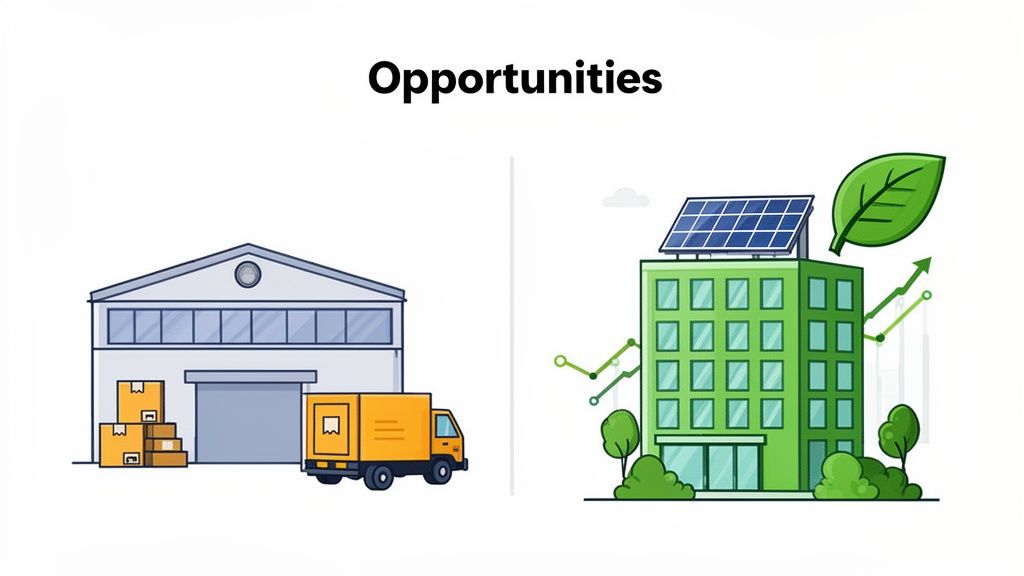
While the core strategies are the bedrock of any solid portfolio, the best investors are always looking over the horizon. Real success in commercial real estate isn’t just about mastering today's market—it’s about positioning yourself for tomorrow’s demand. You move from simply riding market cycles to capturing future growth by identifying and acting on long-term, fundamental trends.
Seasoned investors like Richard Maize understand that deep economic and social shifts create entirely new categories of opportunity. Instead of only analyzing current cash flows, they ask a much bigger question: Where is the world going, and what kind of real estate will it need when it gets there? This forward-looking approach is how you build a portfolio that’s not just profitable, but resilient.
Right now, two of the most powerful trends shaping the future of CRE are the explosion of the digital economy and the irreversible push for sustainability. These aren’t passing fads; they are fundamental shifts creating massive tailwinds for those who know how to catch them.
The Unstoppable Rise of Digital Infrastructure
The digital world we live in runs on very physical infrastructure. Every click, every stream, and every cloud application depends on a massive network of data centers, fulfillment warehouses, and logistics hubs. The relentless growth of e-commerce, for instance, has turned industrial real estate from a once-boring asset class into a high-growth darling.
But the opportunity goes well beyond just warehouses. Data centers—the backbone of the internet—are one of the highest-growth segments in all of commercial real estate. Demand for data processing and storage is expanding at a breakneck pace. Capacity is expected to jump by 19% in 2026 alone as major operators pour record capital into new construction.
The global power demand from these facilities is projected to more than double by 2030, a clear signal of this sector's explosive growth. You can get a deeper look at these dynamics in the latest commercial real estate market report on BakerTilly.com.
Riding the Green Wave in Sustainable Real Estate
Running parallel to the digital boom is a powerful shift toward sustainability. This isn't just about optics. It's driven by a potent mix of tenant demand, increasing regulation, and a growing consensus among institutional investors that green buildings are simply better, more valuable assets. Environmental, Social, and Governance (ESG) criteria have moved from a niche concern to a central part of investment decisions.
This creates clear, actionable opportunities for investors who are paying attention.
Green-Certified Buildings: Properties with LEED, BREEAM, or other green certifications consistently command higher rents and attract premium, long-term tenants. They also tend to have lower operating costs, which flows directly to the bottom line.
Energy Efficiency Retrofits: This is a classic value-add play with a green twist. Acquiring an older, inefficient building and upgrading its core systems—like HVAC, lighting, and insulation—can dramatically increase its market value and appeal.
"True market vision is about connecting the dots between broad economic shifts and specific physical assets," notes Richard Maize. "Whether it's the rise of e-commerce or the demand for sustainable properties, the biggest returns go to those who anticipate the need before it becomes obvious."
A Richard Maize-inspired approach means looking for properties that don't just meet today's standards but are built for the demands of the next decade. By aligning your commercial real estate investment strategies with these powerful secular trends, you position your portfolio not just to survive what's next, but to thrive in it.
Navigating Market Cycles and Financing Headwinds
Truly successful commercial real estate investment strategies are about more than just picking the right assets. They're about picking the right moments. Market cycles are a constant—periods of expansion are always followed by contraction. For a seasoned investor, these shifts aren't threats. They're opportunities in disguise.
Volatility has a way of clearing the field. It shakes out the undisciplined money and reveals openings for those who came prepared. The key, as Richard Maize has shown, is to stick to a disciplined approach, focusing on markets and asset classes with unshakable long-term fundamentals. This allows smart capital to be deployed with confidence, even when the headlines are alarming.
Recognizing Prime Entry Points in the Cycle
Knowing where we are in a market cycle is critical. You don't want to be buying at the peak or selling at the bottom. Periods of recovery or dislocation, often called 'buy' cycles, offer the most favorable conditions for acquiring assets at attractive prices.
Right now, the data is telling a compelling story. A recent analysis for Q3 2024 showed that just over 66% of global markets were in some phase of a 'buy' cycle. That’s the highest that number has been since 2016, putting it on par with the recovery period after the global financial crisis. You can read the full research about these global market conditions for a deeper dive.
This data simply reinforces a core principle of sound investing: when others are fearful, prepared investors find their best entry points.
Turning Financing Headwinds into Opportunities
One of the biggest challenges in the current market is the coming wave of loan maturities. A lot of property owners who locked in financing when interest rates were at historic lows are now facing a much harsher reality. Higher rates mean higher debt service, which can squeeze cash flow and, in some cases, lead to distress.
This is a perfect example of a market dislocation that creates unique opportunities. Well-capitalized investors can step in to acquire high-quality assets from sellers who are under pressure.
As Richard Maize has demonstrated, a veteran investor's playbook doesn't change with the market. It emphasizes discipline. When financing is tight, it's a chance to buy great real estate with less competition, often from motivated sellers who need a swift exit.
This isn't about taking advantage of someone else's misfortune. It's about providing essential liquidity to the market while acquiring valuable assets that others can no longer hold. These situations often involve:
Properties with strong fundamentals that are only struggling because of their capital structure.
Motivated sellers who need to move quickly to avoid default.
Opportunities to negotiate favorable terms simply because there are fewer buyers at the table.
The ability to navigate these financing headwinds is the hallmark of a sophisticated investment strategy. It requires having capital ready and the expertise to underwrite deals quickly and accurately. To get more perspective, you can learn more about how interest rates impact the real estate market in our article.
Ultimately, market turbulence rewards patience, preparation, and the discipline to stick to your criteria. The best deals are often found when conditions seem the most uncertain.
Building a Resilient CRE Portfolio with Richard Maize
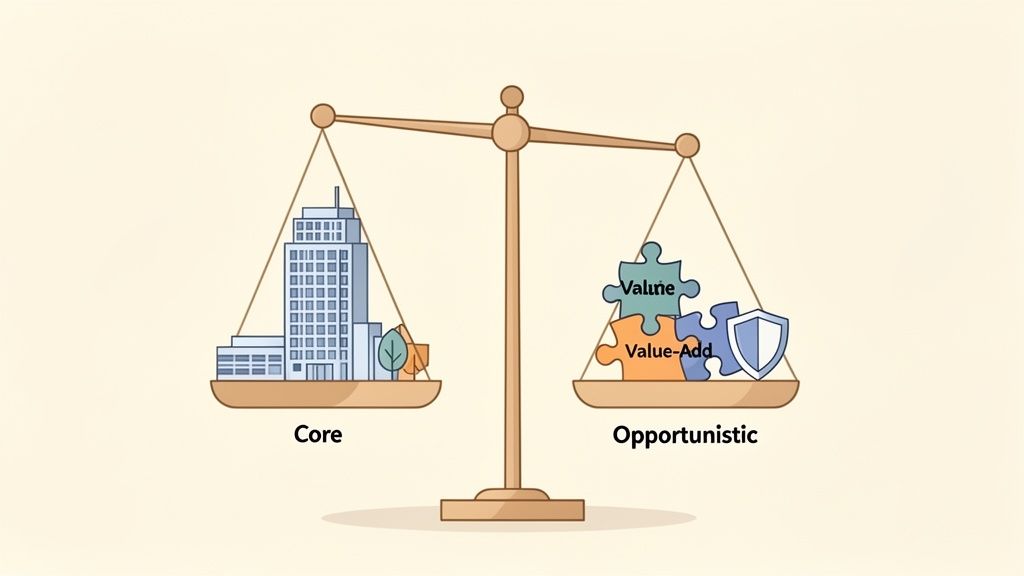
We’ve covered the full spectrum of commercial real estate investment strategies, from the safety of Core properties to the high-stakes game of Opportunistic development. Now comes the most important part: putting the pieces together to build a portfolio that lasts. The goal isn’t just to own property; it's to build sustainable, long-term wealth.
Drawing from Richard Maize's experience, the bedrock of any resilient portfolio is smart diversification. This means more than just owning a mix of buildings. It’s about deliberately blending different strategies to strike a calculated balance between risk and reward.
The Power of a Blended Strategy
Think of your portfolio like a well-built pyramid. You need a wide, solid base to support everything you build on top. In CRE, that base is made of stable, income-generating Core assets. These properties provide the consistent cash flow needed to weather economic storms and act as a safety net.
Once that foundation is secure, you can start layering in select Value-Add projects. These are your growth engines. With targeted improvements, you can force appreciation and give your portfolio’s overall returns a serious boost. This blended approach delivers the best of both worlds: predictable income and the upside that comes with calculated risk.
A resilient portfolio is never a one-note instrument. It’s a symphony of carefully chosen assets, where the steady rhythm of Core properties provides the backbone for the more dynamic melodies of Value-Add and Opportunistic plays. Richard Maize’s career is a testament to this balanced approach.
With this structure, your portfolio isn't overly exposed to a single market shock. If the economy slows, the dependable income from your Core assets helps cover debt service and operating costs, buying your higher-risk projects the time they need to mature.
Key Principles for Long-Term Success
As we wrap up, it’s worth repeating the core principles that separate successful investors from everyone else. These are the non-negotiables. To go deeper on this, I recommend reading Richard Maize's guide to building a strong real estate portfolio.
Mastering these fundamentals is what turns theory into profit:
Clarity of Strategy: You have to know your "why." Define your risk tolerance, return goals, and timeline before you even look at a deal. A clear strategy is your compass.
Discipline in Due Diligence: Never fall in love with a property. Your underwriting has to be exhaustive, unemotional, and focused on uncovering the real risks, not just the potential upside.
Agility to Adapt: Markets change. Interest rates shift. The best investors stay nimble, ready to pivot when the data points in a new direction.
By internalizing these principles and applying a blended strategy, you have a blueprint for success. You can now move forward with the confidence needed to build a portfolio that not only survives market cycles but thrives through them, generating lasting wealth for years to come.
A Few Common Questions
Diving into the world of commercial real estate always brings up good questions. Here are straightforward answers to a few of the most common ones, grounded in the principles we’ve covered.
What’s the Smartest CRE Strategy for a Beginner?
For someone just starting out, the best move is almost always the one with the least complexity and risk. That’s why a Core or Core-Plus strategy is such a solid entry point.
These deals focus on stable, high-quality buildings that are already producing income. This lets you skip the heavy lifting of a major renovation or the uncertainty of a ground-up development. An experienced investor like Richard Maize would tell you to focus on preserving your capital and learning the ropes. Start with a clean, simple deal. It builds the foundation you’ll need before you step up to more complex Value-Add projects.
Should I Focus on Cash Flow or Appreciation?
The right answer depends entirely on your financial goals. The ideal portfolio does both, but your priority will shift based on what you need your money to do for you.
If you’re looking for regular income to supplement your earnings or cover expenses, then a cash-flow-first strategy like Core is the way to go. On the other hand, if you have other income sources and your primary goal is long-term wealth creation, you might lean more toward a Value-Add approach. As Richard Maize’s own work shows, forcing appreciation through smart improvements can lead to massive gains when you eventually sell. Most balanced portfolios have a mix of both.
Can I Mix Different Strategies in a Single Portfolio?
Not only can you—you absolutely should. Sticking to a single strategy is like betting everything on one horse. It concentrates your risk and leaves you exposed if market conditions shift.
A diversified approach, blending different commercial real estate investment strategies, creates a far more resilient portfolio that can perform well no matter what the economy is doing.
A proven model is to build a foundation with stable, income-generating Core assets. The reliable cash flow from these properties can then fund more ambitious Value-Add or even a few select Opportunistic projects that offer higher growth potential. This balanced approach is a hallmark of sophisticated investors like Richard Maize.
This way, you get the best of both worlds: steady income you can count on, plus the chance to hit a home run. You’re building a portfolio that is both stable and dynamic.
At Richard Maize, we know that a clear, well-executed strategy is what separates successful investors from the rest. To see more of our perspective on the market, visit us at https://richardmaize.com.
Produced via Outrank
Comments