What Is Market Positioning Strategy Today

A market positioning strategy is the deliberate choice of the place a brand should hold in a specific customer's mind relative to the alternatives they already compare. In a structural-equation study of 41 small and medium enterprises, that place in the mind tracked marketing performance at a standardized coefficient of 0.51, while segmentation and targeting in the same sample did not.
The popular advice is still to hunt a sharper slogan. I would not start there. A line that sounds different in a conference room often dies when a buyer is comparing price, local help, and values, and it dies again when an answer engine has to compress the brand into a few sentences. What is market positioning strategy today is an evidence system: one situation, one useful benefit, and proof a stranger can check without taking your word for it.
Richard Maize is a clean working example of that discipline. The position stays narrow and repeatable. Operator judgment in Los Angeles real estate, range across investing, and visible community impact occupy one spot, instead of a new identity for every venture.
What Market Positioning Strategy Actually Does
Say a buyer in Los Angeles is choosing who to trust with a property decision. One advisor lists every benefit on the website: deals, coaching, media, giving, and "full service." Another owns one spot, trusted local market judgment, investor education, or community impact. The second advisor is easier to remember when the buyer is choosing. That is the work.
Market positioning strategy is the deliberate process of establishing a distinctive place for a product, service, or company in the minds of target customers relative to competing alternatives, as the Wikipedia entry on positioning) puts it. A tagline, a logo, and a feature list do not make that place. None of them decides how a customer lines you up against the other options already on the table.
Jack Trout wrote about positioning in Industrial Marketing in 1969, and Al Ries and Trout popularized it in the three-part Advertising Age series "The Positioning Era Cometh" in April and May 1972, when marketing shifted from package size and price toward how customers interpret a choice.
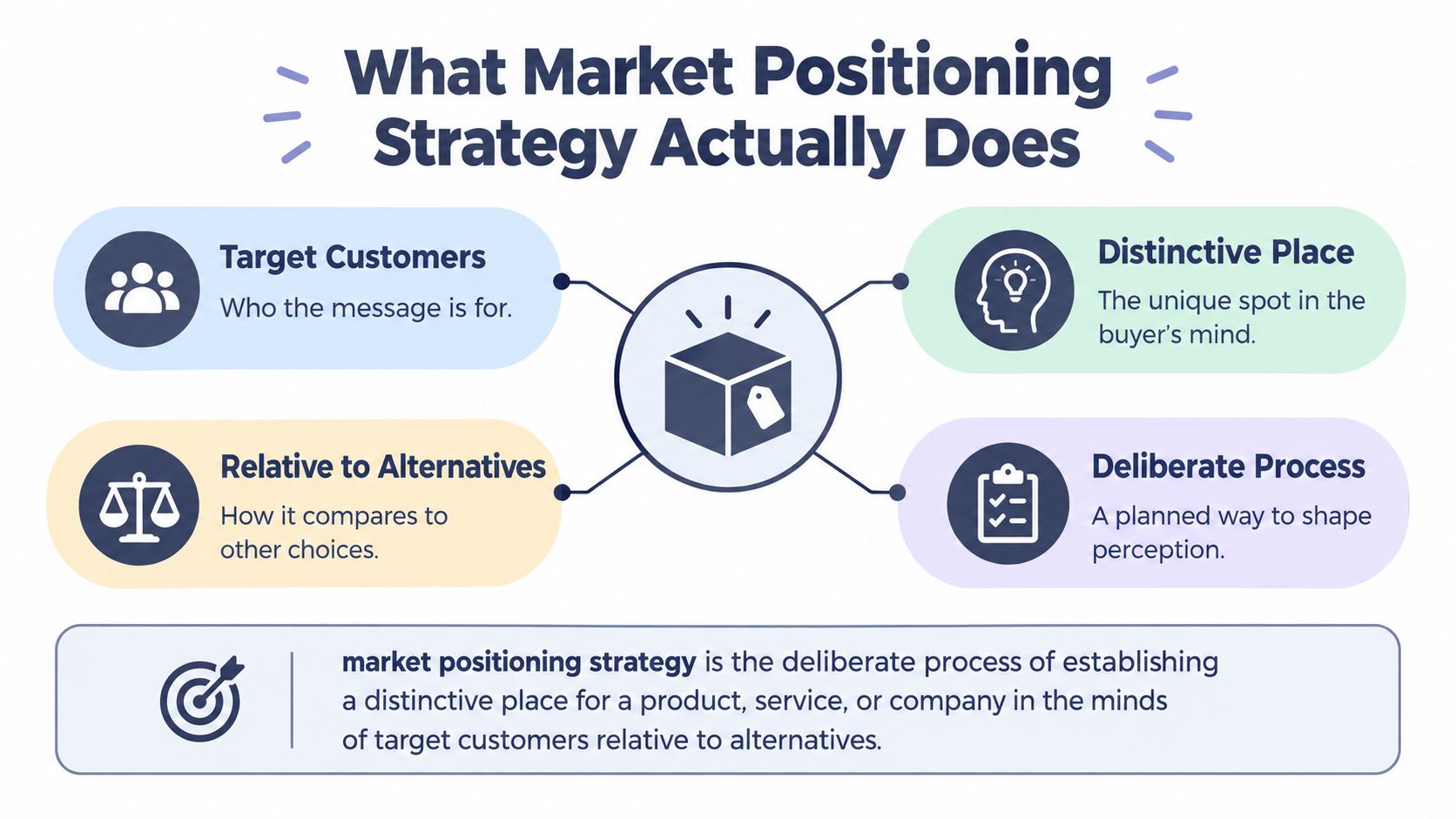
A claim only means something inside a comparison set. If rivals are already strong on price or on national reach, "we're experienced" is noise. You have to know their strengths and their gaps, because buyers rank you against those, not against a blank page.
The goal isn't visibility. It's differentiated mental availability: being the recognizable choice for one specific situation.
That place is built from four writable parts, not from a mood board.
Four Parts of a Position Customers Can Remember
Treat the work as the last step of a short chain. Segmentation finds real differences among customers. Targeting picks a segment worth the focus. Positioning states the value and the point of difference those people should attach to you. A segment and a target aren't a strategy until the benefit and the proof are specific enough to repeat.
Write one sentence per row before you touch a campaign.
Part | Question it answers | A usable version | Common failure |
|---|---|---|---|
Target audience | Who is this for, in one situation? | One primary segment with a shared problem and enough value to focus on | Everyone who might buy |
Value proposition | What important problem do we solve? | A clear problem-benefit pair the audience already feels | A list of features with no job to do |
Differentiation | Why choose this over the real alternatives? | One proof-backed benefit inside a named comparison set | Saying unique without a comparison |
Messaging | What association should people repeat? | Short language used the same way across channels | A new slogan for every campaign |
Who, and for what job
Target audience is one primary group in a shared situation, not everyone who might someday buy. "Investors" is a crowd. "People who want practical market judgment before they put capital into a local deal" is a situation you can write to.
Value proposition is the problem-benefit pair they already feel. A usable version for this kind of work is turning property and investing experience into practical wealth-building insight. A feature list (podcast, fund, truck, foundation) has no job until it serves that pair.
Why you, in their words
Differentiation is a proof-backed reason to choose this option inside a named comparison set. The word "unique" doesn't do that job. Name the alternatives: a listing agent, a commentator who describes deals, a cheaper generalist, or doing nothing. Then name the one benefit you can show.
Messaging is the short language that carries that association into a blog post, a press quote, and a conversation. Same words, not a fresh slogan each quarter.
Richard Maize shows the shape, not a biography to copy. One audience. One high-value problem. Proof a reader could check: transaction experience, market analysis, and community impact. If you can't fill the proof cell, you don't have a position yet. You have a wish.
When Relevance Beats a Sharper Difference
Chasing a more unusual claim is a habit, and buyers are punishing it. Choose the kind of benefit you can prove before you draft a word.
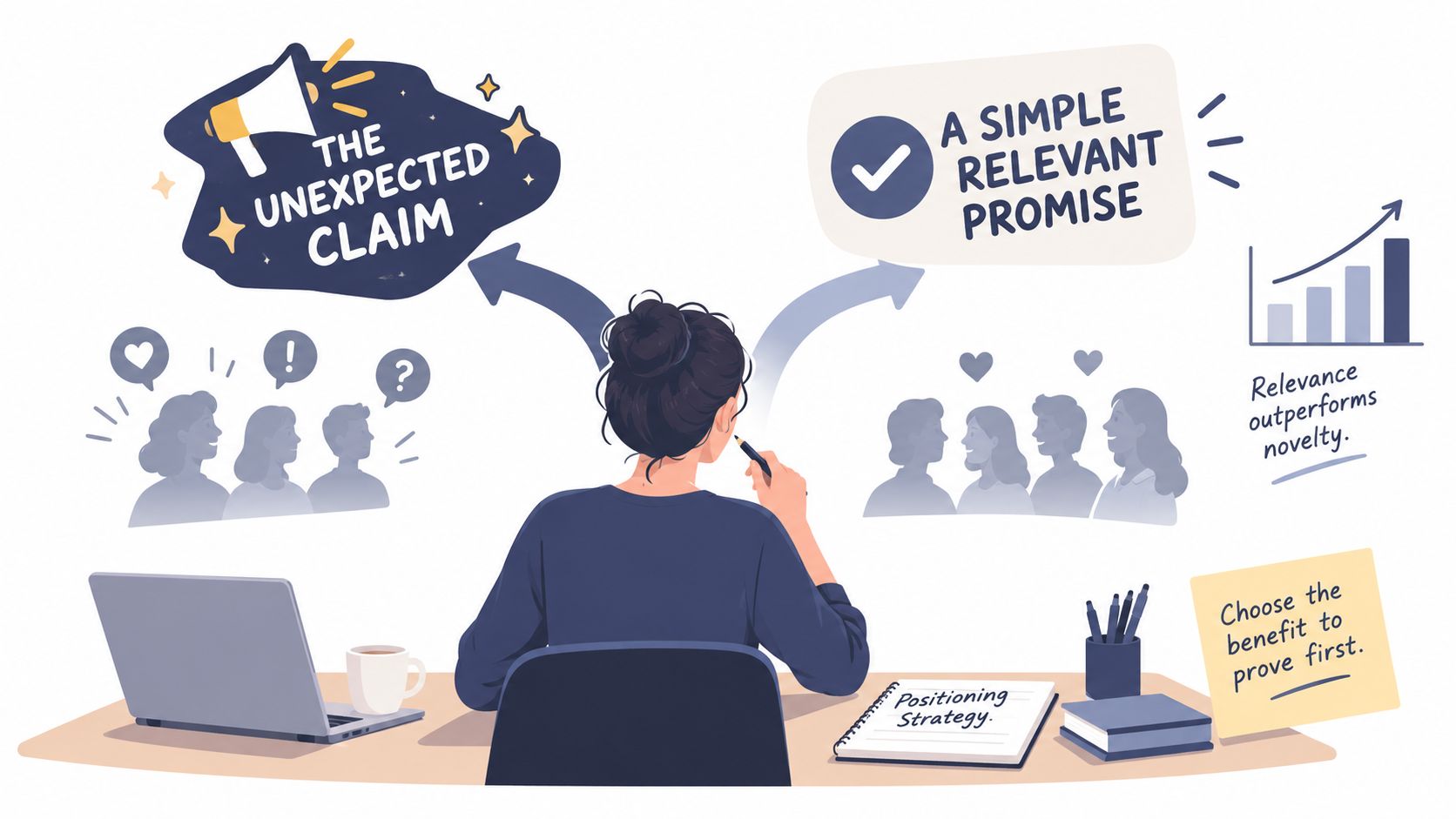
EY's 2025 Future Consumer Index surveyed 20,235 consumers across 28 countries and found that 88% believed brand messaging didn't resonate with their needs and values, 81% ranked price sensitivity among their purchase considerations, and 67% said private-label products met their needs as well as branded alternatives. Edelman's 2025 global brand-trust research, reported alongside those findings, adds that 73% of respondents would trust a brand more if it authentically reflected today's culture, while trust in domestically headquartered brands exceeded trust in foreign brands by an average of 15 percentage points.
The rule before you write
If buyers are skeptical, price-aware, or comparing local help, position around a useful benefit, a local proof, and a visible value. Don't lead with a premium image or a clever slogan. A public-facing investor can pair practical market knowledge with locally grounded proof, stated limits, and community contribution people can see. The difference has to be credible under current conditions, not just distinctive on a slide.
Legible when the answer is summarized
The same position has to survive a summary, not only a homepage. A 2025 Yext survey of 2,237 consumers in the United States, United Kingdom, France, and Germany found that 43% use AI search tools daily or more, 75% use them more than they did a year earlier, and 48% cross-check answers across platforms. In that study, 68% had used ChatGPT to research local products or services, though only 19% trusted AI tools for local search compared with 45% for traditional search.
Treat the position as an evidence system. The same verifiable facts, the same point of view, and the same stated limits should show up on the site, in press, and in third-party sources. Keywords don't create trust. Consistent, checkable claims do, for a person skimming and for a tool compressing you into an answer.
Statements and Maps That Make the Position Visible
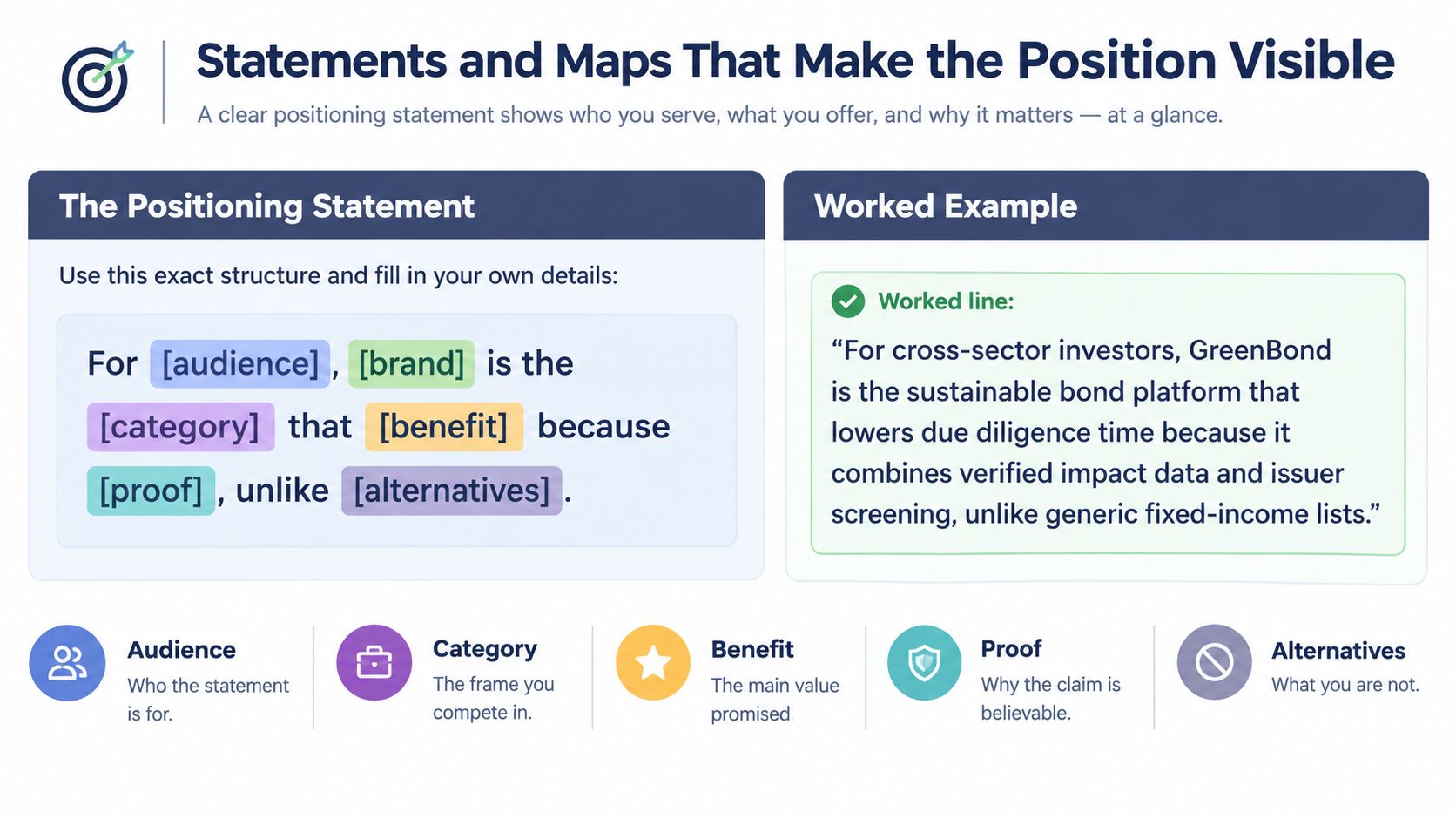
Two tools make a position visible, and they settle different decisions. The statement forces one memorable claim and a reason to believe it. The map shows whether that spot is crowded, irrelevant, or open. Neither replaces proof.
The fill-in line is: For [audience], [brand] is the [category] that [benefit] because [proof], unlike [alternatives].
A worked line for a cross-sector investor: For people who want practical market judgment rather than hype, Richard Maize is the Los Angeles operator who connects real estate, entrepreneurship, and community impact because the work is visible, unlike commentators who only describe deals.
What a map is allowed to decide
Pick two axes customers use. Practical versus promotional is one. Hands-on local operator versus distant commentator is the other. Plot the alternatives, including doing nothing and hiring a cheaper generalist. Open space counts only if that space is wanted. A blank quadrant nobody will pay for is a hobby, not a position.
The statement locks audience, category, benefit, proof, and the alternative you are not.
The map tells you whether buyers already cluster on that benefit or whether the spot is empty for a reason.
Proof is what keeps either tool from becoming decoration.
Keep the statement only if the map shows the audience cares about that spot. If they care about price and local judgment, a claim about "visionary disruption" is in the wrong quadrant, however clean the sentence is. The same test applies when you explain a company to investors: a pitch deck that rotates benefits every slide trains the room to forget you.
If the map says the audience doesn't want that spot, throw the sentence out. Don't decorate it.
How to Build a Market Positioning Strategy
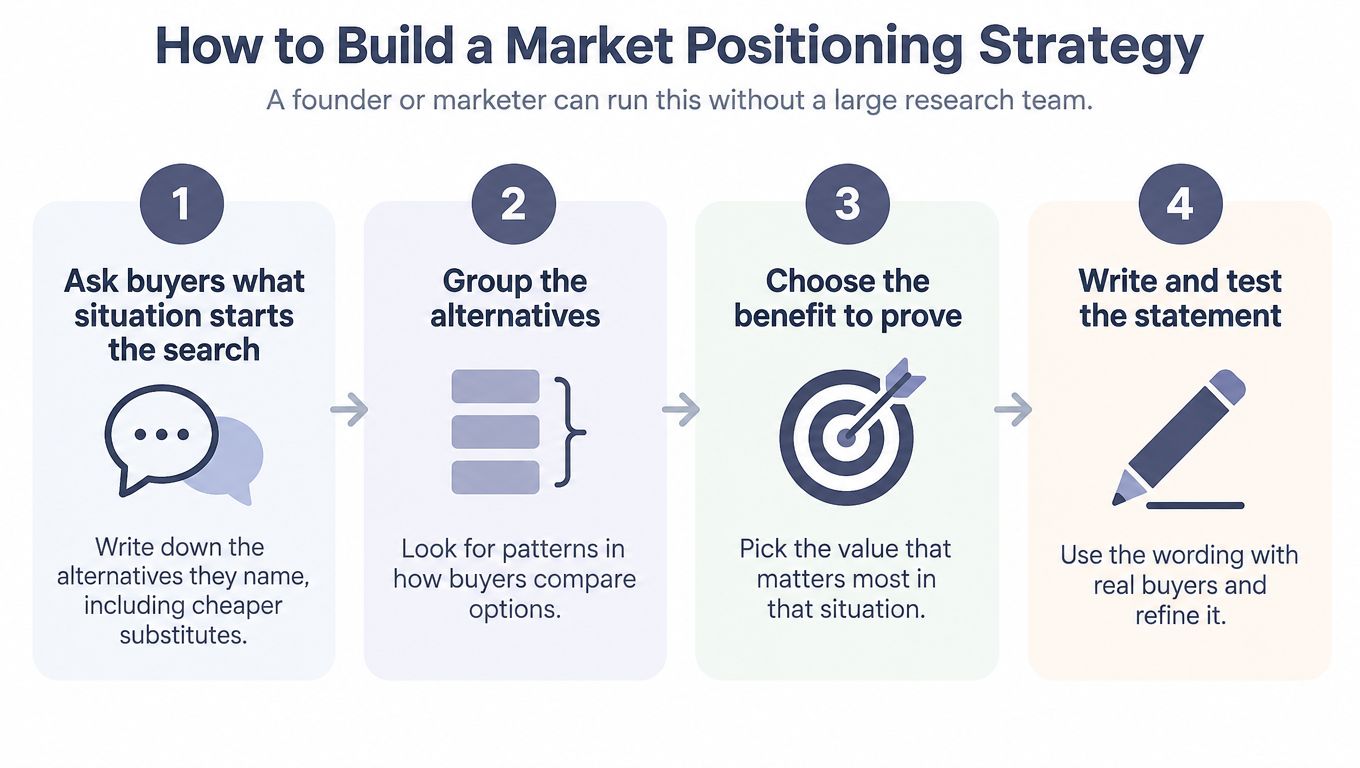
A founder or marketer can run this without a large research team. Finish with a draft statement and a map you can test, not a slogan you can admire.
The sequence
Ask buyers what situation starts the search. Write down the alternatives they name, including cheaper substitutes and doing nothing. The slip is interviewing fans who already like you and missing the short list you lose to.
Choose one segment. It needs a sharp problem and enough value to deserve focus. Set other audiences aside for this cycle. The slip is keeping three "primary" segments so nobody is offended.
Define the comparison set in the customer's words. Note competitor strengths as well as gaps. The slip is describing rivals only by their weaknesses, which makes your benefit sound fake.
Select one benefit you can prove with experience, numbers, or visible work. Drop benefits you only wish were true. Thin proof means a narrower claim, not more adjectives.
Draft the positioning statement with audience, category, benefit, proof, and alternative. Read it aloud. If you need a second sentence to explain it, it isn't one claim yet.
Sketch the perceptual map on two axes those customers use. Keep a space only if it is both open and wanted. The slip is falling in love with empty space buyers don't pay for.
Align price, channels, experience, and proof so the same cues show up in owned content, press, and third-party mentions. A premium price with discount language, or a local claim with no local proof, breaks the chain.
Where people waste the week
Steps 1 through 3 are research you can do in conversations. Steps 4 through 6 are editing. Step 7 is where most positions die, because the website, the quote, and the invoice tell three stories. Scaling a company makes that worse, not better. The path from startup to a larger enterprise adds products, and each new product tempts a new claim. Resist it. One association, repeated, beats a fresher line that nobody can place.
I would rather ship a narrow sentence you can support this month than a broad one you plan to "back up later." Later is how positions stay fictional.
Signals That Show the Position Is Working
A position isn't finished when the sentence sounds good. A structural-equation study of 41 small and medium enterprises found that positioning had a statistically significant effect on marketing performance, with β = 0.51 and p = 0.025, whereas segmentation (β = 0.20, p = 0.34) and targeting (β = 0.07, p = 0.82) weren't statistically significant in that sample.
The practical reading is blunt. Choosing a segment does little until the association is sharp. Sharper associations cut search uncertainty, make the message relevant, and raise the chance the right people put you in the consideration set.
The chain worth watching
Watch this sequence, in order: specific promise, then consistent evidence, then perceived expertise or trust, then attachment that shows up as referral, conversion, or willingness to pay or engage. For a real-estate and investment platform, that means one primary audience, one high-value problem such as translating property expertise into practical wealth-building insight, and three proof categories: transaction experience, market analysis, and community impact.
Compare the same measures before a campaign and after it. A rise in traffic without a rise in the right association is a failed position. You bought attention for a sentence people still can't repeat.
Signal | What a rise means | How to read it |
|---|---|---|
Aided awareness | More of the right people recognize the name | Weak alone if they cannot say what the name stands for |
Unaided association | People volunteer the intended benefit | The clearest test of mental availability |
Qualified inquiries | The position attracts the chosen situation | Better than raw traffic |
Content-to-lead conversion | The message is relevant enough to act on | Check the audience, not just the click |
Perceived distinctiveness | The brand feels different from named alternatives | Ask against real competitors, not in the abstract |
Referral rate | Trust is strong enough to pass on | A late signal of attachment |
Add a short survey or a few interviews for a simple trust or expertise rating. Ask people to name you against alternatives, not "do you find us distinctive?" in the abstract. If unaided association doesn't move, don't add spend. Fix the claim or the proof.
Established Brands That Hold a Clear Position
A durable position can take more than one form, and you can check both of these without a deck.
Avis ran its 1960s "We Try Harder" campaign by owning second place. A concession to a larger rival became a reason to choose, backed by visible effort in service. The comparison set changed. Buyers weren't asked to believe Avis was the biggest. They were asked to believe effort was the point.
Volvo spent decades tying the brand to safety. The claim held because engineering and crash-testing gave customers something to verify, not because the slogan was clever. Advertising, design, and product decisions kept pointing at the same attribute.
What the two share
Avis works through an honest admission that changes who you are compared with.
Volvo works through one attribute repeated until buyers can test it.
The pattern is one benefit, proof the customer can see, and the same association across channels for years.
The failure to avoid is a brand that changes its claim with each campaign. Buyers get no association to store. Community proof has the same test. A food-truck effort that served comfort and hope to Los Angeles fire victims supports a community-impact shelf only if that shelf was already the position, not a one-week costume.
Which of your claims could a stranger still check in five years? If the answer is none, you have campaigns, not a position.
What Richard Maize's Position Makes Concrete
A position can cover several kinds of work and still be clear. Richard Maize is a Los Angeles–based real estate expert, business investor, and philanthropist. He has backed ventures from PR firms and food trucks to fintech. The useful association is practical value creation across real estate, business, and community work, rather than a separate identity for each venture.
A marker you can check
Specific examples make a position easier to assess than broad claims of business expertise. Richard Maize's work includes consumer ventures such as the Richeeze Melts Food Truck, alongside digital and promotional initiatives. His platform also shares perspectives on property markets, entrepreneurship, and brand visibility.
Keep three proof shelves:
Investment work covers ventures across different sectors.
Practical insight means commentary on property markets, entrepreneurship, and brand visibility that readers can assess for themselves.
Community impact means visible philanthropic efforts, including the work of the Rochelle and Richard Maize Foundation.
Across blog posts, press features, multimedia, and foundation updates, the position should stay legible: practical insight grounded in investing and purpose-driven work. Each public claim should connect to one of those proof shelves. If it supports none, it adds breadth without making the position clearer.
Write One Claim You Can Prove This Week
Stop at one audience, one problem, and one proof you can check this week. Write the positioning sentence. Name the two alternatives customers already compare, including a cheaper substitute or doing nothing. Pick the single place the sentence will appear next: a page, a pitch, or a post.
Delete any benefit you can't support with a number, a project, or a public record. Adjectives don't count as proof. Richard Maize's commentary is a working example of repeating practical investing fundamentals across real estate, ventures, and community work instead of rotating claims. The decision is whether the next message makes the same association easier to remember. If it needs a new adjective to sound interesting, it isn't ready.
Richard Maize writes for people who want operator-level judgment on real estate, ventures, and community impact, not a rotating set of slogans. That is market positioning strategy in practice: one narrow association, backed by work you can check. Visit Richard Maize for the essays, press, and foundation updates that keep that position in one place.
Comments